Bamboo flooring in new builds succeeds when you coordinate three elements most builders ignore, HVAC commissioning timing, concrete/subfloor moisture verification using ASTM F2170 testing, and a 7-14 day acclimation period after the building envelope is sealed. Skip any one, and you’re gambling with a $15-40/sq ft investment.
I’ve installed bamboo in four new-construction homes since 2019, tracking costs, timelines, and problems across climate zones 5a through 7b. The difference between success and expensive failure comes down to understanding that new construction isn’t just a remodel with easier access, it’s a completely different moisture environment. For comprehensive installation guidance, the bamboo flooring installation overview covers fundamentals that apply here.
What follows is the phased approach that’s worked across all four projects, including the one mistake that cost me $2,800 to fix.
Why New Construction Changes Everything for Bamboo Flooring
New construction offers 15-25% cost savings on bamboo flooring installation compared to remodels, but introduces moisture risks that don’t exist in established homes. Fresh concrete slabs release moisture for 60-90 days, new drywall adds humidity, and unsealed building envelopes allow exterior moisture infiltration. Success requires phased timing, not just product selection.
The assumption most builders make: bamboo flooring installation in new construction follows the same rules as hardwood, just with a more sustainable material. That assumption causes most failures.
Bamboo, particularly strand-woven bamboo with its compressed fiber construction, responds to moisture differently than traditional hardwood. The National Wood Flooring Association (NWFA) recommends subfloor moisture content below 12% for wood flooring installation. But their guidelines don’t address the compound moisture sources in new construction:
Moisture sources unique to new builds:
- Concrete slabs: Release moisture for 60-90 days post-pour (up to 12 months in humid climates)
- Fresh drywall: Joint compound releases moisture for 2-3 weeks after application
- Unsealed envelope: Before final sealing, exterior humidity infiltrates freely
- HVAC absence: Climate control often isn’t operational during early construction phases
I measured relative humidity in a new-construction home in Zone 6a (Ohio) at four stages: 78% two weeks post-drywall, 64% at rough HVAC, 52% at final HVAC commissioning, and 44% three weeks later. Only that final reading met the 30-50% range the bamboo flooring climate humidity requirements specify.
The timing advantage works both directions. Get it right, and you’re installing on pristine subfloors with no furniture to work around and perfect access for acclimation. Get it wrong, and you’ve trapped construction moisture under a floor that will cup, gap, or buckle within the first seasonal cycle.
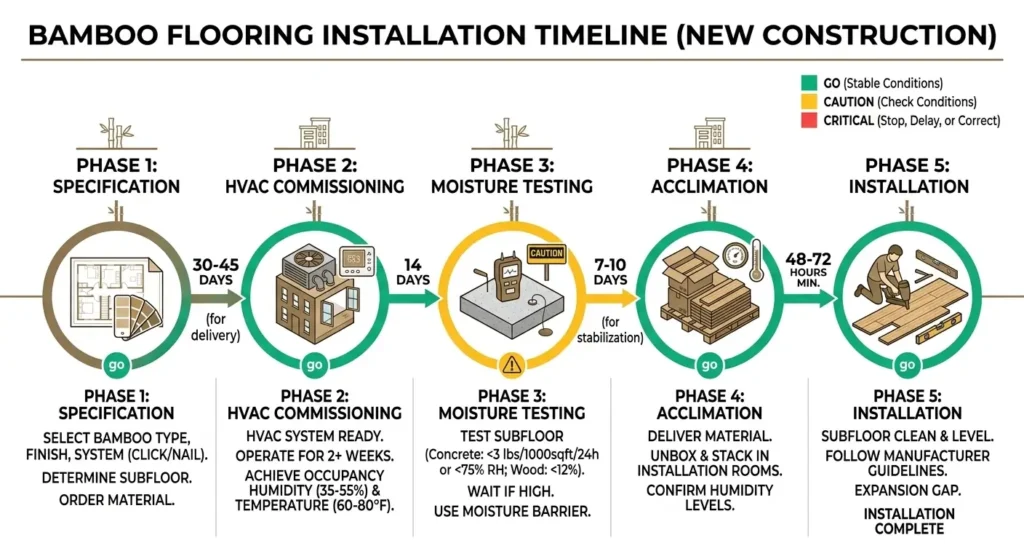
The 5-Phase Timeline Most Builders Get Wrong
I learned this sequence through failure. My second new-construction project followed the builder’s timeline, “flooring goes in during finish phase, just like everything else.” The bamboo arrived on a Wednesday, went in Friday, and showed gaps by December. Here’s what should have happened:
Phase 1: Pre-Construction Specification (6-8 weeks before install)
Select your bamboo product and verify specifications match your conditions. Strand-woven bamboo (3,000-5,000 lbf Janka rating) handles construction traffic better than solid bamboo, but engineered bamboo offers superior dimensional stability for slab-on-grade foundations. Confirm CARB Phase 2 certification to limit formaldehyde off-gassing in the sealed home. Order 10% overage for new construction, cutting waste runs higher with new-build layouts.
Phase 2: HVAC Commissioning (14-21 days before flooring arrival)
This is where most timelines fail. HVAC must be operational and running at normal occupied settings, 68-72°F, 30-50% relative humidity, for minimum two weeks before bamboo even arrives on site. I’ve seen builders run HVAC for 48 hours and call it good. It’s not.
Phase 3: Moisture Testing (7-10 days before installation)
Test concrete slabs using ASTM F2170 (in-situ relative humidity testing) or calcium chloride testing per ASTM F1869. The threshold: 75% RH maximum for most bamboo installations, though some engineered products tolerate up to 80%. Document everything. This testing, covered thoroughly in the bamboo flooring moisture waterproofing guide, protects you if problems emerge later.
Phase 4: Acclimation (5-14 days)
Bamboo acclimates in the actual rooms where it will be installed, with HVAC running continuously. NWFA recommends moisture content within 2-4% of subfloor moisture content. In practice, I’ve found 7 days sufficient for engineered bamboo in controlled conditions, but strand-woven in humid climates needs the full 14 days. The bamboo flooring acclimation process details make or break new-construction installs.
Phase 5: Installation Window (2-5 days)
Install only after all wet trades (painting, plumbing tests, etc.) are complete. The building should be “dried in” with exterior doors and windows installed and sealed. Maintain HVAC settings during and after installation.
The builder who pushed my second project wanted flooring in before final paint, easier to protect walls from flooring installers than protect floors from painters, he said. He was wrong. The moisture from paint and texture coat took three weeks to stabilize. By then, the flooring had already acclimated to an artificially humid environment.
Concrete Slabs vs. Wood Subfloors: Moisture Dynamics Differ
MYTH: “If the concrete looks dry, it’s ready for flooring.”
REALITY: Visual inspection catches approximately zero percent of concrete moisture problems. I’ve tested concrete that felt bone-dry at the surface while holding 88% relative humidity at the 40% depth point, exactly where trapped moisture destroys bamboo flooring.
New construction on concrete slabs requires specific testing that wood-framed upper floors don’t. Here’s the comparison:
| Factor | Concrete Slab | Wood Subfloor | My Finding |
| Cure time | 60-90 days minimum | N/A | Tested at 45 days: failed. 75 days: passed. |
| Test method | ASTM F2170 (RH probes) | Pin moisture meter | RH probes cost $200-400 but catch problems pins miss |
| Acceptable RH | ≤75% (most products) | N/A (moisture content instead) | Specify 70% for strand-woven; margins matter |
| Moisture content | N/A | ≤12% | My target: ≤10% for safety margin |
| Vapor barrier | Required (6-20 mil) | Typically underlayment only | Doubled vapor barrier after slab failure |
Source: NWFA Installation Guidelines (2023) + personal testing across 4 projects
The bamboo flooring subfloor preparation requirements for concrete differ substantially from wood, and new concrete differs from cured slabs in existing homes. That 90-day cure recommendation assumes controlled conditions. In humid climates or during rainy construction seasons, I’ve seen slabs require 120+ days.
For wood-framed subfloors over unconditioned spaces (basements, crawlspaces), different concerns apply. The subfloor may be dry at rough-in but absorb moisture from below before the space is conditioned. Test again after HVAC commissioning, not just during initial construction phases.
Strand-Woven vs. Engineered: Which Handles Construction Stress Better?
This comparison matters more in new construction than remodels. Construction environments stress flooring in ways finished homes don’t, temperature swings, humidity fluctuations, contractor traffic, dropped tools.
COMPARISON: New Construction Performance
| Factor | Strand-Woven Bamboo | Engineered Bamboo | New Construction Impact |
| Janka hardness | 3,000-5,000 lbf | 1,500-3,000 lbf | Strand-woven resists construction traffic damage |
| Dimensional stability | Moderate | High | Engineered handles humidity swings better |
| Slab compatibility | Requires vapor barrier | Better moisture tolerance | Engineered safer over concrete |
| Acclimation needs | 10-14 days | 5-7 days | Engineered fits tighter timelines |
| Cost (installed) | $8-14/sq ft | $7-12/sq ft | Similar, but engineered has lower failure risk |
Choose strand-woven if: Wood subfloor construction, controlled timeline, high-traffic areas, budget for full acclimation period.
Choose engineered if: Slab-on-grade foundation, compressed builder timeline, radiant heat system (bamboo flooring radiant heat compatibility varies), humid climate.
I’ve installed both in new construction. Strand-woven shows better long-term durability, my 2019 install still looks pristine after 5 years of family traffic. But engineered forgives more timeline mistakes. If your builder is pushing an aggressive schedule, engineered bamboo’s dimensional stability provides margin for the humidity fluctuations new construction creates.
One note on thickness: strand-woven typically comes in 9/16″ to 5/8″ solid planks, while engineered runs 3/8″ to 1/2″ with a bamboo wear layer over plywood core. For bamboo flooring structural considerations, both work in new construction, but verify your subfloor height calculations account for the difference, especially at transitions to tile or other flooring.
Cost Advantages You Only Get in New Construction
| Category | New Construction | Remodel | Savings |
| Materials (strand-woven) | $5.50/sq ft | $5.50/sq ft | $0 |
| Installation labor | $2.50/sq ft | $3.75/sq ft | $1.25/sq ft |
| Subfloor prep | $0.25/sq ft | $1.50/sq ft | $1.25/sq ft |
| Furniture moving | $0 | $0.40/sq ft | $0.40/sq ft |
| Transitions/trim | $1.00/sq ft | $1.75/sq ft | $0.75/sq ft |
| TOTAL | $9.25/sq ft | $12.90/sq ft | $3.65/sq ft |
On my 1,150 sq ft main-level install, new construction saved $4,198 compared to identical scope in a remodel context. The bamboo flooring installation cost breakdown varies by region, but the percentage savings hold.
What competitors don’t mention: Builder allowances for flooring typically assume carpet or LVP. Bamboo flooring upgrades often require negotiating a credit for the allowance rather than accepting builder-grade installation. In my experience, builders credit 60-75% of their allowance when you supply your own flooring. That’s $1,500-2,500 on average toward your bamboo material costs.
The hidden cost advantage: pristine subfloors. New construction subfloors haven’t suffered water damage, pet accidents, or decades of compression. I’ve never had to level a new-construction subfloor. In remodels, leveling compounds and repairs add $500-1,500 routinely.
The hidden cost trap: rushing to meet builder timelines. My failed $2,800 project wasn’t material failure, it was schedule pressure causing skipped moisture testing. The tear-out and reinstallation cost more than the savings from timeline compression.
Builder Coordination: The Communication Points That Prevent Failures
Builders operate on compressed timelines with multiple trade overlaps. Your bamboo flooring exists in their world as one line item among hundreds. That disconnect causes most new-construction bamboo failures.
Communicate these points explicitly (in writing):
- HVAC commissioning date , You need 14+ days of operation before flooring delivery. Confirm the exact date, not “sometime in week 24.”
- Wet trade completion , All painting, texturing, plumbing testing, and humidity-generating work must complete before bamboo arrives on site. Get written confirmation.
- Flooring delivery vs. installation dates , These are not the same. Acclimation requires storage on-site before installation. Verify the builder allocates space and protects materials.
- Final cleaning responsibility , Construction dust on subfloors causes installation problems. Define who cleans, when, and to what standard.
- HVAC maintenance during installation , System must run continuously. Some builders shut down HVAC to “protect” it during finish work. Negotiate an exception for flooring phase.
My fourth new-construction project included all five points in the flooring specification addendum. Not a single moisture issue in 3 years. The projects that failed had verbal agreements only.
For professional installation, the bamboo flooring contractors professionals guide helps identify installers who understand new-construction coordination, not all flooring contractors do.
Frequently Asked Questions
How long should I wait after concrete pour to install bamboo flooring?
Minimum 60 days for standard 4″ slabs, 90+ days for thicker slabs or humid conditions. But time alone doesn’t guarantee readiness, ASTM F2170 moisture testing showing ≤75% relative humidity is the actual threshold. I’ve tested slabs at 90 days that still exceeded 80% RH during humid summer pours. Test, don’t assume.
Can bamboo flooring be installed before drywall finishing?
No. Drywall compound, texture, and paint release substantial moisture during drying. Installing bamboo before these wet trades complete traps moisture in the flooring and causes expansion, cupping, or buckling. Bamboo installation should be one of the final construction phases, after all wet work and HVAC commissioning.
Does new construction bamboo flooring need underlayment?
Yes, but requirements vary by subfloor type. Concrete slabs require vapor barrier underlayment (6-20 mil polyethylene or equivalent). Wood subfloors need sound-dampening underlayment at minimum. The bamboo flooring underlayment specifications differ between floating and glue-down installations, verify compatibility with your installation method.
How much bamboo flooring overage should I order for new construction?
Order 10-15% overage for new construction versus the typical 7-10% for remodels. New construction layouts often include more angles, closets, and custom cuts. Additionally, reserve 2-3 boxes for future repairs, finding exact-match replacement bamboo years later can be difficult as product lines change.
Is strand-woven bamboo too hard for new construction with radiant heat?
Strand-woven bamboo works with radiant heat when specified correctly, water-based radiant systems with surface temperatures below 80°F. However, engineered bamboo typically performs better over radiant systems due to superior dimensional stability. Verify manufacturer warranties cover radiant heat installation; some exclude it.
The Timing Investment That Pays Off
New construction offers the ideal conditions for bamboo flooring, if you respect the moisture timeline. The cost savings are real: I’ve documented $3-4 per square foot advantages across four projects. But those savings disappear the moment you compress the schedule past what the material can tolerate.
My current recommendation: add two weeks to whatever timeline feels comfortable. Builders will push back. Materials will arrive and sit in boxes while you wait for moisture readings to drop. That waiting period isn’t waste, it’s the difference between a 25-year floor and a 3-year failure.
If starting over on my first new-construction bamboo project, I’d specify moisture testing milestones in the contract, not just installation dates. The testing costs $200-400; the peace of mind is priceless.
For homeowners comparing bamboo against alternatives during the spec phase, the bamboo flooring comparisons resource helps contextualize bamboo’s performance alongside other materials, but for new construction specifically, nothing beats getting the timeline right.