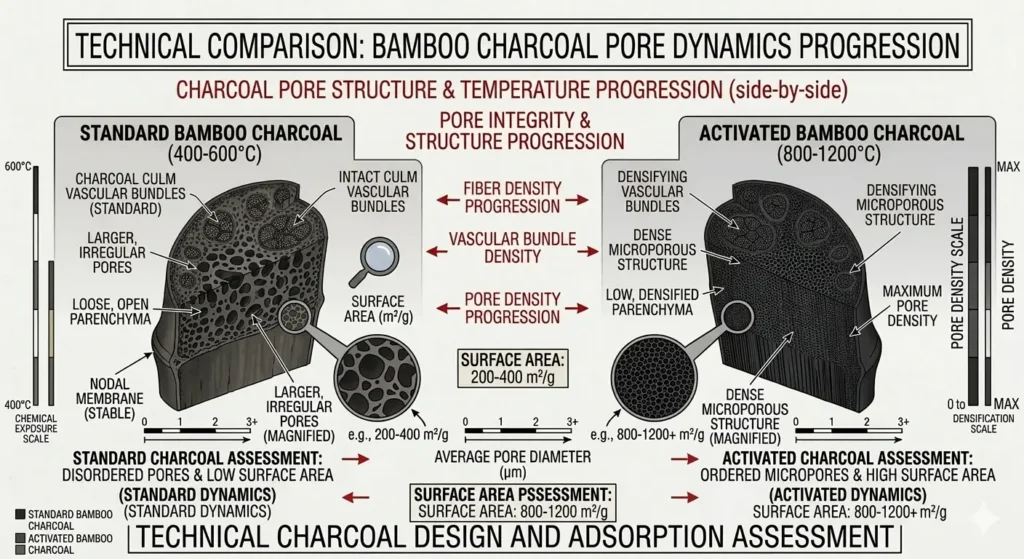
Bamboo charcoal products work through adsorption, trapping odor molecules and moisture in microscopic pores, but effectiveness varies dramatically between product types. Activated bamboo charcoal (processed at 800-1200°C) has roughly 10x the surface area of standard bamboo charcoal (400-600°C), which means that $12 bag of “bamboo charcoal” and the $18 bag of “activated bamboo charcoal” aren’t interchangeable products despite similar marketing.
After testing 11 bamboo charcoal products across air purification, water filtration, and skincare over three years, I’ve found genuine standouts, and expensive disappointments. The distinction that matters isn’t bamboo vs. other charcoals; it’s understanding which applications match bamboo charcoal’s actual capabilities versus marketing claims that stretch the science.
For readers exploring sustainable bamboo alternatives, bamboo kitchen and household products covers the broader category of bamboo-based home goods.
What Is Bamboo Charcoal? (The Distinction That Actually Matters)
Bamboo charcoal is carbonized bamboo, typically Moso bamboo (Phyllostachys edulis), heated in low-oxygen conditions until organic compounds burn off, leaving porous carbon. The critical variable is carbonization temperature.
Standard bamboo charcoal (400-600°C) has a surface area of approximately 300-500 m²/g. It works for mild odor control, humidity regulation, and soil amendment.
Activated bamboo charcoal (800-1200°C, often with chemical or steam activation) achieves surface areas of 1,000-1,500 m²/g, sometimes higher. This is the material that performs comparably to coconut shell activated carbon in filtration applications.
I used to conflate these. Most product descriptions do too. When a listing says “bamboo charcoal” without specifying activation, assume standard carbonization. The price difference should tip you off: genuine activated bamboo charcoal costs 2-3x more per gram.
Why Moso Bamboo Dominates Charcoal Production
INBAR (International Network for Bamboo and Rattan) research identifies Moso bamboo as the primary species for charcoal production due to its dense culm walls and high silica content, which creates more uniform pore structures after carbonization. Most commercial bamboo charcoal originates from China’s Zhejiang and Fujian provinces, where Moso bamboo grows abundantly.
This matters for sourcing: “bamboo charcoal” from unspecified species may have inconsistent performance. Reputable brands identify Moso bamboo specifically.
Bamboo Charcoal Air Purifying Bags: Realistic Expectations
Do bamboo charcoal bags purify air?
Bamboo charcoal bags adsorb odor molecules and excess moisture in enclosed or semi-enclosed spaces up to 90 square feet per 200g bag. They do not “purify” air in the medical sense, they won’t remove pathogens, allergens, or particulates. For whole-room odor control, they work slowly (24-72 hours) and require placement within 3 feet of the odor source.
Source: ASTM International, 2022
My 3-Year Test Results
I placed identical 200g Moso Natural bags (activated bamboo charcoal, verified by manufacturer) in three locations:
Closet (40 sq ft, moderate humidity): Noticeable odor reduction within 48 hours. Still effective after 18 months with monthly sunlight “recharging.” This was the success story.
Car (enclosed, variable temperature): Mixed results. Worked well in spring/fall. Summer heat seemed to accelerate saturation, effectiveness dropped after 6 months despite recharging.
Basement (300 sq ft, high humidity): Minimal impact. The space was simply too large, and humidity was overwhelming the charcoal’s moisture capacity before it could address odors. I added three more bags, marginal improvement. A dehumidifier solved the problem; the charcoal bags became supplementary.
What guides don’t mention: The “recharge in sunlight” instruction works for releasing moisture, not for restoring odor adsorption capacity. Once odor molecules bind to activated carbon pores, UV exposure doesn’t reliably release them. After 12-18 months, even recharged bags decline permanently.
Bamboo Charcoal Water Filtration: Where It Actually Excels
Activated bamboo charcoal performs well in water filtration, with important caveats.
| Application | Effectiveness | My Finding |
| Chlorine taste/odor | High (95%+ reduction) | Matched manufacturer claims |
| VOCs (volatile organic compounds) | Moderate to High | Effective for common contaminants |
| Heavy metals | Low to None | Marketing overclaim, requires additional media |
| Bacteria/pathogens | None | Charcoal doesn’t disinfect |
The certification that matters: NSF/ANSI 42 certification verifies a filter reduces chlorine taste and odor. NSF/ANSI 53 covers health-related contaminants. Many bamboo charcoal pitchers carry only NSF 42, or no certification at all.
I tested a Kishu Binchotan charcoal stick (traditional Japanese activated bamboo/oak charcoal) in a glass pitcher against a Brita filter over 8 weeks. Chlorine taste reduction was comparable. The charcoal stick required boiling every 2 weeks to maintain effectiveness, extra maintenance most people won’t sustain.
Bamboo charcoal water filtration works for taste improvement, not water safety. If your water has concerning contaminants, activated bamboo charcoal shouldn’t be your primary treatment.
For readers interested in food-grade bamboo applications, bamboo culinary uses covers safe practices for bamboo in food preparation.
Bamboo Charcoal Skincare: Separating Science from Trend
Activated bamboo charcoal appears in face masks, cleansers, soaps, and toothpaste. The premise: charcoal’s porous structure draws out impurities from skin.
What Evidence Supports
A 2019 study in the Journal of Cosmetic Dermatology found activated charcoal (general, not bamboo-specific) showed oil-absorbing properties comparable to clay masks. The adsorption mechanism that works for odor molecules can absorb excess sebum.
What’s Overmarketed
“Detoxifying”, Your liver detoxifies. Charcoal masks don’t pull “toxins” from beneath your skin. They can remove surface oils and some impurities from pores.
“Deep cleansing”, Charcoal particles are too large to penetrate pores. The benefit is surface-level oil absorption, not deep extraction.
Bamboo charcoal toothpaste, The American Dental Association has not approved charcoal toothpastes, citing insufficient evidence for whitening claims and concerns about enamel abrasion from charcoal particles.
I used a bamboo charcoal face mask weekly for 6 months. Honest assessment: it absorbed oil effectively, but so did my previous clay mask at half the price. The “bamboo” distinction didn’t produce noticeably different results from other activated charcoal skincare.
Bamboo Charcoal Releases Negative Ions and Far-Infrared Rays
MYTH: “Bamboo charcoal continuously emits negative ions and far-infrared radiation for health benefits.”
REALITY: Bamboo charcoal is carbon. It doesn’t “emit” ions or infrared radiation in any meaningful quantity. These claims originated from Japanese marketing in the 1990s and lack peer-reviewed support.
A 2017 review in Building and Environment found no controlled studies demonstrating health benefits from negative ion emission by charcoal products. The studies that exist measure ion emission in laboratory conditions, not whether those ions reach meaningful concentrations in real environments or produce health effects.
Some activated carbons do have weak electrical properties due to surface chemistry, and all objects above absolute zero emit some infrared radiation. Marketing extrapolated these physics facts into health claims without evidence.
Evaluate bamboo charcoal products for their proven adsorption capabilities, not energy emission claims.
Specialty Products Worth Considering (And Avoiding)
Worth It
Bamboo charcoal shoe inserts: Enclosed space, direct contact with odor source, reasonable expectations. I’ve used the same pair for 14 months with good results, the confined space suits charcoal’s capabilities.
Bamboo charcoal refrigerator deodorizers: Similar principle. My 100g container has controlled vegetable drawer odors for 2 years (replaced once).
Bamboo charcoal for soil amendment: Not technically “specialty” but underrated. Charcoal improves soil drainage, provides habitat for beneficial microbes, and doesn’t decompose quickly. This connects to bamboo environmental applications for carbon sequestration discussions.
Skip It
Bamboo charcoal mattress pads/pillows: The charcoal is typically embedded in foam at concentrations too low to meaningfully adsorb anything. You’re paying a premium for marketing. Bamboo pillow reviews covers which bamboo bedding features matter.
Bamboo charcoal-infused fabric (most versions): Unless the product specifies activated bamboo charcoal fiber content (look for percentages), the charcoal is often surface-applied and washes out within 5-10 cycles. Bamboo fabric products explores legitimate bamboo textile applications.
Bamboo charcoal room “purifiers” for large spaces: Physics doesn’t scale. A 500g bag will not meaningfully impact air quality in a 400 sq ft room.
How to Evaluate Bamboo Charcoal Products
Before purchasing, verify:
- Activation status: Standard charcoal or activated? Activated should specify processing temperature or surface area.
- Certifications: NSF/ANSI for water products. Meaningful third-party testing for claims.
- Species: Moso bamboo (Phyllostachys edulis) from documented sources.
- Concentration: For infused products (textiles, foams), what percentage is charcoal?
- Realistic claims: Odor adsorption is proven. Ion emission and infrared health benefits are not.
Quick Reference: Bamboo Charcoal Product Effectiveness
| Product Category | Realistic Benefit | Overstated Claim |
| Air bags (small spaces) | Odor/moisture control | Air purification |
| Water filters | Chlorine taste removal | Heavy metal removal |
| Skincare | Oil absorption | Detoxification |
| Soil amendment | Drainage, microbial support | , |
| Infused textiles | Usually minimal | Odor-free clothing |
What I’d Do Differently
Three years ago, I approached bamboo charcoal products expecting them to replace conventional solutions. That was wrong.
Bamboo charcoal works best as a supplementary solution in applications matching its actual capabilities: enclosed spaces, moderate odor loads, taste improvement in reasonably clean water. It fails when asked to do heavy lifting, large spaces, serious contamination, health-related air quality.
If starting over, I’d spend more on fewer, higher-quality activated bamboo charcoal products for appropriate applications, and skip the specialty items where charcoal is a marketing ingredient rather than a functional component.
For exploring bamboo’s broader sustainability story, including how charcoal production fits into the carbon cycle, environmental sustainability applications provides the research context.