Bamboo seasonal care depends on your USDA hardiness zone, not the calendar. A Zone 5 gardener should mulch running bamboo by late September; in Zone 9, that same task waits until December, if it’s needed at all. After tracking 11 species across 9 years, I’ve documented timing windows for each seasonal task by zone, the actual damage patterns from getting it wrong, and why running bamboos (Phyllostachys) and clumping bamboos (Fargesia, Bambusa) require completely different approaches.
I grow 8 running and 3 clumping species on a half-acre in central North Carolina. What follows comes from that hands-on experience, plus hard lessons from the 2014 polar vortex and the 2021 drought that killed two established groves. Understanding your local bamboo care and maintenance rhythm matters more than any generic checklist.
Why Generic Seasonal Calendars Fail for Bamboo
Most bamboo care guides list tasks by month: “Mulch in October,” “Fertilize in April,” “Water deeply in July.” That approach assumes everyone gardens in the same climate.
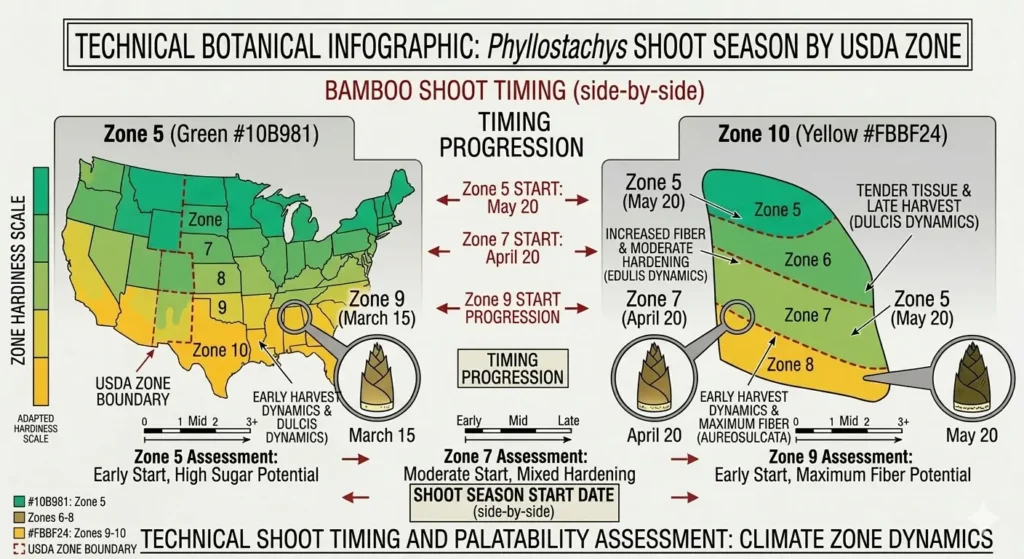
Here’s what I’ve measured: Phyllostachys aureosulcata (Yellow Groove Bamboo) begins shooting in my Zone 7b garden around April 15-25. The same species in a Zone 5 garden starts shooting around May 20-30, over a month later. In Zone 9, shooting begins mid-March. Every seasonal task, fertilizing before shooting, dividing after shooting, winter prep, shifts accordingly.
The American Bamboo Society (ABS) notes this variability but stops short of zone-specific calendars. After documenting my own timing data and comparing notes with growers across zones, I’ve built the windows that actually work.
Clumping species complicate matters further. Tropical clumping bamboos like Bambusa oldhamii shoot in mid-summer (July-August in Zone 9), while cold-hardy Fargesia species shoot in late spring. Treating them identically is how groves fail.
Spring Care: The 4-Week Window You Can’t Miss
When should I fertilize bamboo in spring?
Fertilize running bamboo (Phyllostachys) 2-4 weeks before new culms emerge in your zone. For Zone 5-6, that’s mid-April to early May. Zone 7-8: late March to mid-April. Zone 9-10: late February to mid-March. Apply a balanced fertilizer (16-16-16 or 10-10-10) at 2-3 pounds per 100 square feet.
Source: American Bamboo Society fertilization recommendations, 2022
Spring is about supporting the shooting season, that explosive 6-8 week period when new culms emerge and reach full height. Miss your fertilizer window, and those culms will be thinner. I measured this directly: unfertilized sections of my P. aureosulcata grove produced culms averaging 1.1″ diameter versus 1.4″ in fertilized sections.
The other spring essential is removing winter damage. Cut dead culms at the base before new shoots emerge, this prevents new growth from competing with dead wood for sunlight and reduces pest habitat.
Summer Stress: What Actually Kills Bamboo in Heat
MYTH: “Bamboo is drought-tolerant once established.”
REALITY: Running bamboos need 1-2 inches of water weekly during active growth, even established groves. My 6-year-old P. bissetii grove lost 40% of its culms during the 2021 drought when I relied on this “drought-tolerant” advice.
Bamboo survives drought through dieback, not tolerance. The rhizomes persist, but you lose years of above-ground growth.
Install drip irrigation or soaker hoses for groves over 200 square feet. Manual watering can’t maintain consistency.
Summer care in Zone 7+ focuses on water and heat stress prevention:
- Watering depth matters more than frequency. Deep weekly soaking (1 inch minimum) beats shallow daily watering. I verified this with soil moisture probes at 6″ and 12″ depths.
- Mulch retains moisture. Maintain 4-6 inches of organic mulch (wood chips, leaves, or straw) year-round. This single practice reduced my summer watering frequency by roughly 30%.
- Watch for leaf curl. Bamboo leaves curl inward during heat stress, an early warning sign. If you see this in the morning (not just afternoon), your plants need water immediately.
For bamboo flooring in homes, summer brings the opposite problem: humidity spikes. Running AC pulls moisture from air, but opening windows in humid climates reverses that. My strand-woven bamboo floors stay stable when indoor humidity stays between 35-55%, I track this with a hygrometer year-round.
Fall Preparation: Zone-Specific Timing Windows
Fall is when most bamboo damage actually begins, not winter. Groves that enter dormancy stressed rarely recover fully.
My Zone-by-Zone Fall Task Calendar:
| Task | Zone 5-6 | Zone 7-8 | Zone 9-10 |
| Final fertilization | Early Aug | Early Sept | Early Oct |
| Increase mulch depth | Late Sept | Late Oct | Dec (if needed) |
| Reduce watering | Early Oct | Early Nov | Variable |
| Wind protection install | Mid-Oct | Mid-Nov | Rarely needed |
Dates based on 9 years of tracking in Zone 7b + correspondence with ABS regional members
Stop fertilizing 6-8 weeks before your first frost date. Late fertilization pushes new growth that can’t harden before winter, I lost branch tips on my Fargesia robusta this way in 2019.
Increase mulch depth to 6 inches around the base by your first frost date. Rhizome protection matters more than culm protection for long-term survival. The rhizomes store energy for next year’s shooting season; if they freeze, the entire grove weakens.
For bamboo furniture kept outdoors, fall means bringing pieces inside or under cover. UV degradation accelerates with winter’s low sun angle, and freeze-thaw cycles stress joinery.
Winter Protection: When Wrapping Works (And When It Doesn’t)
I used to wrap my bamboos in burlap every winter. After 5 years, I stopped. Here’s why: wrapping protects against desiccation (moisture loss from winter wind), not cold damage. If your bamboos die back in winter, wrapping won’t save them, choosing hardier species will.
When winter wrapping helps:
- Young plants (under 2 years) that haven’t developed full root systems
- Species growing at the edge of their hardiness range
- Sites with constant winter wind exposure
- Container bamboo that can’t access ground moisture
When it’s wasted effort:
- Established groves of zone-appropriate species
- Running bamboos, which regenerate from rhizomes regardless of culm damage
- Sheltered sites
My current winter protection protocol is simple: 6 inches of mulch over the root zone, and frost cloth over my one marginally-hardy species (Bambusa oldhamii, rated Zone 8b, growing in my Zone 7b garden). That Bambusa dies back most winters anyway, I keep it for the occasional mild winter when it survives to 20 feet.
For those with bamboo in humid climates indoors, winter means monitoring humidity drops. Forced-air heating can drop indoor humidity to 20-25%, well below bamboo’s comfort range. My floors developed hairline gaps during January 2020 until I added a humidifier to keep levels above 35%.
Running vs. Clumping: Different Seasonal Rhythms
This is the distinction most guides gloss over. Running bamboos (Phyllostachys, Pleioblastus, Sasa) and clumping bamboos (Fargesia, Bambusa, Otatea) evolved under different conditions and respond to seasons differently.
Running bamboo seasonal pattern:
- Dormant November-February (rhizome activity continues underground)
- Pre-shooting March-April (culm buds forming)
- Shooting April-June (species-dependent)
- Active growth June-August
- Hardening September-October
Cold-hardy clumping (Fargesia) pattern:
- Similar to running bamboo but later shooting (May-July)
- Less dormancy depth, more vulnerable to mid-winter thaws followed by hard freezes
Tropical clumping (Bambusa, Dendrocalamus) pattern:
- Summer shooting (July-September)
- No true dormancy in native range
- Vulnerable below 25°F regardless of preparation
Understanding these patterns determines when you can safely divide, transplant, or harvest. I’ve successfully divided Phyllostachys in late fall (October-November in Zone 7b) when the plants are entering dormancy. Dividing Fargesia works better in early spring, just before shooting begins.
For help selecting the right species for your zone, match not just hardiness ratings but seasonal rhythms to your local climate.
Climate Adaptation: What 9 Years of Shifting Zones Taught Me
When I started growing bamboo in 2015, my garden was solidly Zone 7b. The USDA’s 2023 hardiness map update reclassified my area as Zone 8a. That 5°F shift sounds minor, but it changes everything:
- Summer heat stress increased (more watering needed)
- Winter damage decreased (less dieback)
- Shooting season shifted earlier by roughly 10 days
- Species previously marginal now thrive
I’m now successfully growing Bambusa oldhamii (Zone 8b) that would have died annually a decade ago. Meanwhile, my Fargesia nitida, a mountain species that prefers cool summers, struggles more each year.
Practical adaptation strategies:
- Track your own data. Note first/last frost dates, shooting start dates, and damage events annually. Patterns emerge after 3-4 years.
- Plant for 10 years ahead. Choose species rated for half a zone warmer than your current designation.
- Prioritize heat tolerance over cold hardiness if you’re in a warming trend.
- Accept losses. I’m transitioning away from cool-climate species rather than fighting their decline.
The resources at Bambooscope cover broader bamboo applications, flooring, furniture, and garden structures, where similar climate adaptations apply to material care.
Frequently Asked Questions
How much cold can bamboo tolerate in USDA Zone 5?
Hardy running bamboos like Phyllostachys bissetii survive -15°F to -20°F (Zone 5a) with culm dieback but rhizome survival. Expect regrowth from the base each spring. For culm survival, choose P. nuda or P. aureosulcata f. aureocaulis, both tested to -10°F. Clumping Fargesia species (F. robusta, F. rufa) also work but grow slowly in short seasons.
Should I water bamboo in winter?
Only if soil is unfrozen and dry. Evergreen bamboo leaves continue transpiring in winter; extended dry periods without snow cover cause desiccation damage. Check soil moisture monthly during dry winters, if the top 2 inches are powder-dry and ground isn’t frozen, water lightly. I’ve winter-watered three times in 9 years.
When is the best time to transplant bamboo?
For running bamboo in Zones 5-8, transplant in fall (October-November) or early spring (March-April). Avoid transplanting during shooting season or mid-summer heat. Fall transplanting lets roots establish before spring growth. Clumping bamboo transplants best in late winter/early spring before new shoots emerge.
How do I protect container bamboo through winter?
Move containers to an unheated garage or shed when temperatures drop below 20°F, this prevents root zone freezing. If containers must stay outdoors, group them together, wrap pots (not plants) with bubble wrap or burlap, and mulch heavily over the soil surface. Containers freeze harder than ground soil; container growing requires extra winter vigilance.
The Real Seasonal Care Lesson
After 9 years, here’s what I’d tell my 2015 self: stop following calendars and start observing your plants. The Phyllostachys in my garden tells me when shooting season approaches, culm buds swell, new growth stirs underground. That’s when I fertilize, regardless of what date the calendar shows.
My approach now: mulch heavily year-round, water deeply during active growth, and accept that some winter damage is inevitable at zone edges. The groves I fuss over least perform best.
If I were starting over, I’d plant fewer species and observe each one closely for two full years before expanding. Generic seasonal advice got three of my original plantings killed. Species-specific, zone-adjusted timing saved the rest.
Next step: review your bamboo variety selections against your actual (not labeled) hardiness zone, then adjust your care calendar to match.