I spec’d bamboo flooring across a 47-unit townhome development in 2023. Total materials bill: $127,400. The flooring performed well. The process nearly derailed the project.
For building development, bamboo flooring works, but the specification, scheduling, and contractor coordination requirements differ significantly from residential installations.
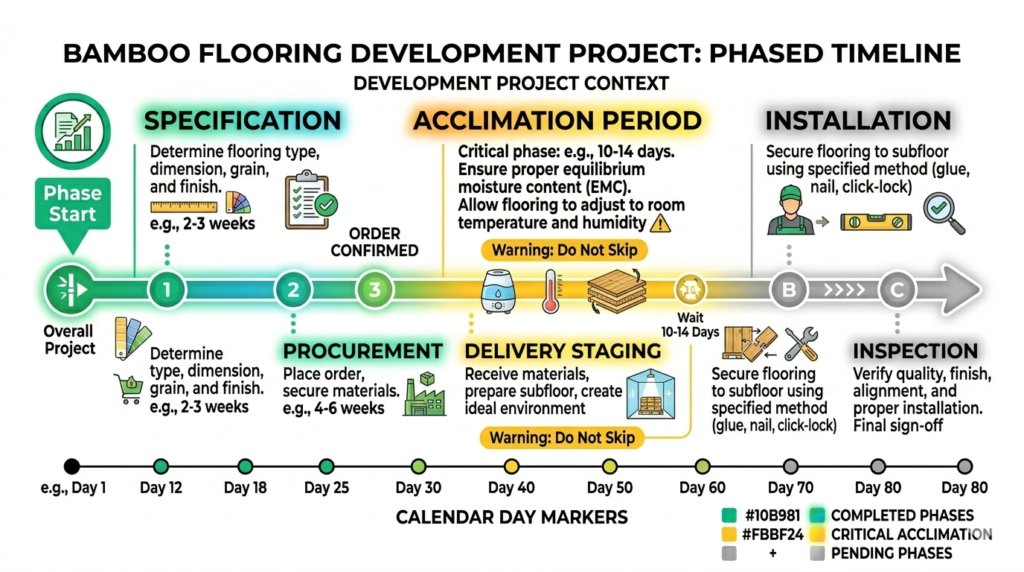
Developers need to account for 10-14 day acclimation periods per phase, require CARB Phase 2 and FloorScore certifications for code compliance, and should budget 15-20% above residential per-square-foot rates for proper commercial-grade installation. The ROI exists, but only if you understand how bamboo behaves in construction timelines.
I’ve tracked bamboo performance across three development projects over six years. What follows is what I wish the manufacturer reps had told me before that first bulk order.
Why Developers Are Specifying Bamboo (And Why Some Regret It)
Bamboo shows up in development specs for three reasons: sustainability marketing, cost positioning against hardwood, and durability claims. Two of those hold up.
The sustainability angle is legitimate. INBAR’s 2022 lifecycle analysis shows Moso bamboo (Phyllostachys edulis) reaches harvest maturity in 5-7 years versus 50-80 years for oak. For LEED certification or green building marketing, bamboo earns points that oak doesn’t.
The durability claim checks out, partially. Strand-woven bamboo hits 3,000-5,000 lbf on the Janka hardness scale, outperforming red oak (1,290 lbf) and even Brazilian cherry (2,350 lbf). For high-traffic rental units or commercial spaces, that hardness translates to fewer refinishing cycles. My 2018 development still has original bamboo floors in 31 of 36 units after six years of tenant turnover.
Here’s where developers get burned: the cost positioning. Bamboo materials run $3-6 per square foot for builder-grade product. Hardwood runs $4-8. That looks like savings. But bamboo’s acclimation requirements, moisture sensitivity, and installation complexity mean your installed cost often matches or exceeds hardwood, especially when you factor schedule delays into carrying costs.
I learned this the expensive way on a 2021 condo project. More on that shortly.
Specifying Bamboo for Development Projects
The spec sheet you hand your GC matters more with bamboo than almost any other flooring material. Get these elements wrong, and you’ll own the consequences.
Material Specifications
For development projects, I now exclusively specify strand-woven bamboo over solid or horizontal-grain options. The compressed fiber construction handles the temperature and humidity swings of unoccupied units better than traditional bamboo formats.
Critical spec requirements:
| Specification | Minimum | Recommended | Why It Matters |
| Janka Hardness | 3,000 lbf | 4,000+ lbf | Tenant durability |
| Thickness | 9/16″ | 5/8″ | Sound transmission |
| Wear Layer | 2mm | 3mm+ | Refinish potential |
| Moisture Content | 6-9% | 7-8% | Installation stability |
| CARB Phase 2 | Required | Required | Code compliance |
| FloorScore | Required | Required | Indoor air quality |
The certification requirements aren’t optional. CARB Phase 2 limits formaldehyde emissions to 0.05 ppm, California requires this, but most institutional buyers and commercial tenants expect it regardless of jurisdiction. FloorScore certification from SCS Global Services addresses VOC emissions and is increasingly required by commercial lease agreements.
Skip these certifications, and you’ll face remediation demands from commercial tenants’ environmental consultants. I’ve seen it happen.
Installation Method Specification
For multi-unit development, specify glue-down installation over floating or nail-down methods. Yes, it costs more. Here’s why it’s worth it:
Floating installations in development projects fail at connection points between units, hallways, shared corridors, anywhere the floor crosses a threshold. The 30-foot expansion limit for floating bamboo means you’re engineering transition strips every 900 square feet. In a 47-unit project, that’s 80+ transition points that tenants trip over and maintenance replaces.
The National Wood Flooring Association (NWFA) installation guidelines specify full-spread adhesive for commercial bamboo applications. Follow them. My glue-down units from 2018 have zero transition failures. My one floating-install building from 2019 has replaced 23 transition strips at $180 each.
The Acclimation Problem (And My $38,000 Mistake)
Every bamboo flooring guide mentions acclimation. Few explain what it actually means for development schedules.
Bamboo flooring must reach equilibrium moisture content (EMC) with its installation environment before installation. The NWFA requires 5-14 days of on-site acclimation at 60-80°F with 30-50% relative humidity. The flooring must be removed from packaging and stacked with spacers in the actual space it will occupy.
That seems manageable until you’re phasing a 47-unit project.
In 2021, I pushed a GC to compress the acclimation timeline on a 24-unit condo development. We needed units completed for a lending milestone. The GC agreed to 3-day acclimation instead of the specified 10 days. The flooring installed beautifully.
Six weeks later, winter heating dropped indoor humidity to 25%. Gaps opened across 19 units. Not hairline gaps, 3/16″ gaps you could drop a pencil into. Bamboo flooring gaps in rental properties trigger maintenance calls and tenant complaints at alarming rates.
Remediation cost: $38,400 in floor replacement, tenant credits, and schedule delays on unit turns.
For development scheduling:
- Build 14-day acclimation into each phase schedule, non-negotiable
- Require HVAC operational before flooring delivery, not “substantially complete,” operational
- Include acclimation verification in your GC contract with photo documentation
- Consider climate and humidity factors for your specific region
If your schedule can’t accommodate proper acclimation, specify a different flooring material. The math doesn’t work otherwise.
Real Development Costs: What I Actually Paid
The manufacturer quotes and contractor estimates you’ll receive understate true development costs by 20-35%. Here’s actual spend from my 2023 47-unit townhome project:
Materials + Installation Breakdown
| Cost Category | Budget Estimate | Actual Cost | Variance |
| Strand-woven bamboo (4,800 sf/unit) | $4.25/sf | $4.85/sf | +14% |
| Bulk discount (47+ units) | -15% | -11% | , |
| Adhesive (full-spread) | $0.45/sf | $0.62/sf | +38% |
| Installation labor | $2.50/sf | $3.10/sf | +24% |
| Transitions/trim | $1,200/unit | $1,680/unit | +40% |
| Materials subtotal | $108,000 | $127,400 | +18% |
| Schedule impact (acclimation) | Not budgeted | $34,000 | , |
| True total | $108,000 | $161,400 | +49% |
The schedule impact cost reflects carrying costs, contractor standby time, and delayed lease-up on 9 units. You can’t eliminate this cost, you can only plan for it.
What competitors don’t tell you: that bulk discount looks great on the quote, but bamboo suppliers have tighter margins than hardwood distributors. The 15% discount I was quoted became 11% after “grade adjustments” on delivery. Get physical samples from the actual production lot before signing off.
Contractor Selection: The Bamboo-Specific Requirements
Most flooring contractors install bamboo. Far fewer install it correctly at development scale.
Qualification Requirements
Before awarding a bamboo flooring subcontract, verify:
- NWFA certification , Not just “familiarity with guidelines,” actual installer certification
- Moisture testing equipment , They should own, not rent, pin and pinless moisture meters plus calcium chloride test kits
- Strand-woven experience , Solid bamboo experience doesn’t transfer; the material behaves differently
- Development-scale references , 20+ unit projects, contactable within the last 24 months
I now include moisture testing documentation in my payment milestones. Before final payment, the installer must provide moisture readings from subfloor preparation through installation, with readings within NWFA-specified ranges. This protects both parties when warranty claims arise.
Contract Language That Protects Developers
Include these provisions in your flooring subcontract:
- Acclimation certification: Installer certifies in writing that materials acclimated for [X] days at documented temperature and humidity ranges before installation
- Moisture documentation: Pre-installation moisture testing results for subfloor and flooring materials, submitted before installation begins
- Warranty assignment: Manufacturer warranty registered to property owner/developer, not installer
- Defect timeline: 90-day callback period for installation-related defects, separate from manufacturer warranty
That callback provision matters. Gapping from improper acclimation typically appears 4-8 weeks post-installation, after your standard 30-day punch list period.
Building Code and Certification Considerations
Bamboo flooring triggers specific code review requirements that hardwood doesn’t always require.
Emissions Compliance
Beyond CARB Phase 2, multi-family and commercial projects in many jurisdictions require:
- CalGreen compliance (California mandatory, adopted elsewhere voluntarily)
- LEED credit documentation (if pursuing certification)
- Tenant disclosure requirements for formaldehyde-containing materials (varies by state)
Request emissions testing documentation from your supplier, not just the certification logo, the actual test reports. I’ve had suppliers provide CARB Phase 2 claims on marketing materials that couldn’t produce test documentation for the specific product batch being delivered.
Fire Rating Considerations
Bamboo flooring carries similar fire ratings to hardwood (Class C flame spread per ASTM E84), but some jurisdictions require additional documentation for high-rise or commercial corridor applications. Verify with your building official before specifying bamboo in exit corridors or high-rise residential above 75 feet.
When Bamboo Makes Sense for Development (And When It Doesn’t)
After six years and three development projects, here’s my decision framework:
Specify bamboo when:
- Marketing sustainability/green building credentials creates measurable rent premium or sales velocity
- Project timeline accommodates 14-day acclimation per phase without carrying cost impact
- Budget supports proper installation ($7.50-9.00/sf installed, not $5.50/sf)
- Long-term hold strategy, bamboo’s durability advantage compounds over 10+ year ownership
- Commercial tenants with environmental standards (healthcare, tech) require low-VOC materials
Specify hardwood or LVP instead when:
- Schedule compression is non-negotiable
- Budget drives decisions, builder-grade hardwood installs at comparable cost with more contractor options
- Flip or short-term hold strategy, bamboo’s durability premium doesn’t justify higher install cost
- High-humidity environments without reliable HVAC control (moisture considerations become critical)
- Contractor market lacks qualified bamboo installers
I stopped recommending bamboo to developers who lead with “what’s the cheapest option?” The material works, but it punishes shortcuts more severely than alternatives. If your GC’s default is “we’ll figure it out,” you’ll pay for the education.
What I’d Do Differently
If I were starting that 47-unit project again:
I’d build 21 days of acclimation buffer into the schedule, not 14. Delivery delays happen. HVAC commissioning runs late. Weather events spike humidity. The buffer pays for itself in avoided remediation.
I’d require radiant heat compatibility documentation even for non-radiant units. Buyers increasingly expect flooring compatible with future radiant retrofits. That specification limits your product options but expands future marketability.
I’d negotiate a fixed-price bulk contract with delivery staging written into the agreement. My 2023 supplier delivered 68% of materials on the first truck and “backordered” the balance, at a higher price. Development-scale bamboo purchasing requires development-scale contract language.
For builders and developers considering bamboo: the material performs. The process requires more planning than hardwood. Budget the planning, or budget the remediation.