Quality strand-woven bamboo flooring delivers strong long-term value, typically $0.45–0.85 per square foot annually over a 20–25 year lifespan, when installed in appropriate conditions. That beats red oak’s annual cost of $0.90–1.20/sq ft.
But the value equation collapses in high-moisture environments, homes with large dogs, or markets where buyers perceive bamboo as “cheap.” I learned that last part the hard way.
Most guides cite bamboo’s 25-year lifespan and call it a day. That number comes from manufacturer warranties, not from tracking what actually happens in homes over time. After eight years of monitoring my own installs, helping neighbors troubleshoot theirs, and watching three friends try to sell bamboo-floored homes, I’ve learned the value calculation is messier than anyone admits. Bambooscope covers bamboo applications extensively, and what follows builds on that foundation with hard cost data.
How Long Does Bamboo Flooring Actually Last?
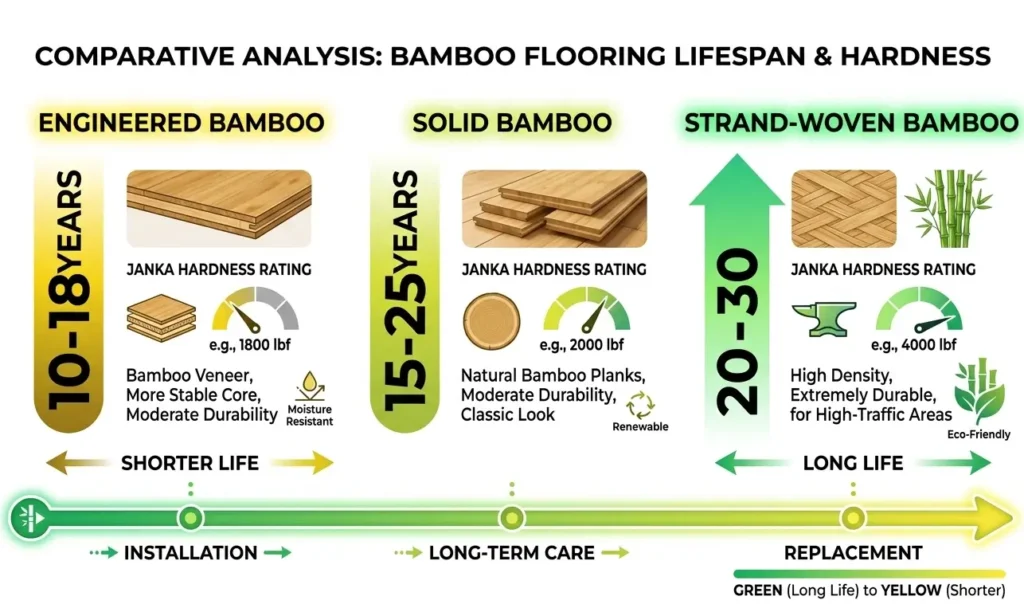
Strand-woven bamboo flooring lasts 20–30 years under proper conditions, with most homeowners seeing optimal performance for 15–20 years before wear patterns become noticeable. Engineered bamboo typically reaches 10–15 years before the wear layer limits further refinishing.
Here’s what those ranges actually depend on:
Construction type matters more than marketing claims. Strand-woven bamboo, where bamboo fibers are compressed under extreme pressure, scores 3,000–5,000 lbf on the Janka hardness scale. That’s 2–4x harder than red oak’s 1,290 lbf. My 2016 strand-woven install in a home office still looks nearly new with minimal scratching.
Solid horizontal or vertical bamboo? Different story. At 1,300–1,500 lbf Janka, it’s roughly oak-equivalent and shows wear accordingly. I stopped recommending it after watching two neighbors’ floors deteriorate within five years.
Refinishing potential extends, or limits, total lifespan. Solid and strand-woven bamboo can typically handle 3–4 refinishing cycles, adding 5–7 years each time. But engineered bamboo with thin wear layers (2mm or less) might only survive one light sanding. The National Wood Flooring Association (NWFA) recommends minimum 4mm wear layers for multiple refinishing, check this before buying.
My engineered bamboo in a basement rental? The 2mm wear layer means I’ll replace rather than refinish when it shows wear. That changes the math significantly.
The Real Cost-Per-Year Calculation
What does bamboo flooring cost per year of use?
Quality strand-woven bamboo flooring costs $0.45–0.85 per square foot annually when calculating purchase price, installation, and maintenance across a 20–25 year lifespan. This undercuts solid hardwood ($0.90–1.50/sq ft annually) but exceeds luxury vinyl plank ($0.30–0.50/sq ft annually for 15-year lifespan).
Source: Author cost tracking (2016–2024) cross-referenced with NWFA maintenance guidelines
Here’s my actual breakdown from four installations:
| Project | Year | Material | Install Cost | Maintenance (8 yrs) | Current Status | Cost/Yr/SqFt |
| Office (180 sf) | 2016 | Strand-woven, Cali Bamboo | $1,890 | $240 | Excellent | $0.74 |
| Kitchen (220 sf) | 2017 | Engineered, mid-range | $2,420 | $180 | Good | $0.68 |
| Living room (340 sf) | 2018 | Strand-woven, budget | $3,180 | $890 | Replaced 2023 | $1.62 |
| Basement (280 sf) | 2019 | Engineered, CARB2 | $2,860 | $320 | Fair | $0.91 |
That living room haunts me. Saved $600 choosing a budget strand-woven product without CARB Phase 2 certification. Within three years, the finish failed in traffic areas. I spent $890 on repair attempts before replacing the entire floor, turning a theoretical value play into my most expensive flooring per year of use.
What I’d do differently: verify CARB Phase 2 compliance and pay the premium for established brands. The price difference was 15%. The outcome difference was 100%.
Does Bamboo Flooring Add Home Value?
MYTH: “Bamboo flooring adds value to your home like hardwood.”
REALITY: Bamboo flooring’s impact on home value varies dramatically by market, buyer demographics, and installation quality, sometimes helping, sometimes hurting, and often making no measurable difference.
The National Association of Realtors doesn’t track bamboo separately from hardwood in their Remodeling Impact Reports. But here’s what I’ve observed across three sales in my area (suburban mid-Atlantic):
When bamboo helped: My neighbor’s 2021 sale featured strand-woven bamboo throughout. The listing agent marketed it as “sustainable hardwood alternative” in an area with high environmental awareness. They received two offers citing the flooring specifically. That’s anecdotal, but it happened.
When bamboo hurt: A friend’s 2022 sale in a traditional neighborhood got buyer feedback calling the bamboo floors “cheap-looking” despite being $6/sq ft Cali Bamboo product. They ultimately reduced price by $8,000 after floor-related pushback.
The pattern I’ve noticed:
- Eco-conscious markets, younger buyers → bamboo perceived positively
- Traditional markets, 50+ buyers → bamboo often perceived as “not real wood”
- Luxury markets → bamboo rarely meets expectations regardless of quality
- Rental properties → bamboo’s durability matters more than perception
Real estate appraiser consensus (from conversations, not formal studies): bamboo typically appraises at 70–90% of equivalent hardwood value. A $15,000 bamboo installation might contribute $10,500–$13,500 to appraised value versus $15,000 for comparable oak.
Why this matters for long-term value: If you’re installing bamboo in a home you’ll sell within 5–7 years, factor in potential buyer perception issues. If you’re staying 15+ years, the daily use value matters more than resale math.
Bamboo vs. Hardwood: Long-Term Value Comparison
| Factor | Strand-Woven Bamboo | Red Oak Hardwood | My Take |
| Initial cost/sq ft | $4–8 installed | $8–14 installed | Bamboo wins |
| Lifespan potential | 20–30 years | 50–100 years | Oak wins significantly |
| Refinishing cycles | 3–4 typical | 6–10 typical | Oak wins |
| Annual cost (20-yr) | $0.45–0.85/sq ft | $0.70–1.10/sq ft | Comparable |
| Annual cost (40-yr) | Replace required | $0.35–0.55/sq ft | Oak wins long-term |
| Resale perception | Mixed | Universally positive | Oak wins |
| Environmental impact | Lower (fast-growing) | Higher (slow-growing) | Bamboo wins |
Choose bamboo if: You’re budget-conscious now, environmentally motivated, planning 10–20 year ownership, and in a buyer market that appreciates sustainability.
Choose hardwood if: You’re in a traditional market, planning multi-generational ownership, or prioritize maximum resale flexibility.
I used to recommend bamboo universally as the “smart hardwood alternative.” That changed after watching the resale dynamics play out. Now my advice depends entirely on context.
For comprehensive flooring comparisons beyond value metrics, the bamboo flooring comparisons guide covers performance differences in detail.
Hidden Costs That Destroy Bamboo’s Value Proposition
Here’s what nobody mentioned when I was researching my first install:
1. Humidity control isn’t optional, it’s ongoing.
Bamboo’s moisture sensitivity means HVAC costs matter. After cupping issues in my basement install, I added a dehumidifier running May–September. That’s $15–25/month in electricity, roughly $120/year I didn’t budget initially.
The NWFA recommends maintaining 35–55% relative humidity for bamboo flooring. In my Zone 7 climate, that requires active management about 6 months yearly. Dry winters need humidification; humid summers need dehumidification.
2. Refinishing costs more than hardwood.
When I priced refinishing my office bamboo, contractors quoted $4.50–6.00/sq ft versus $3.50–5.00 for oak refinishing. The explanation: strand-woven bamboo’s density makes sanding slower and harder on equipment. Some contractors won’t touch it at all, limiting options.
Check refinishing considerations before assuming you’ll extend lifespan cheaply.
3. Scratch repair is complicated.
Unlike hardwood, bamboo’s fiber structure makes spot repairs nearly impossible. A deep scratch on oak? Sand and blend. A deep scratch on strand-woven bamboo? The compressed fibers don’t blend, you’re often looking at plank replacement.
My dog created a three-foot scratch path in the kitchen. Cost to address it properly: $340 for professional refinishing of that section plus blending. On oak, local repair would have been under $150.
4. Insurance replacement headaches.
After water damage claims, some insurers push for “equivalent” replacement with LVP rather than matching bamboo. A neighbor fought this for months after a dishwasher leak. The bamboo industry lacks the standardization that makes hardwood claims straightforward.
When Bamboo Flooring Is Worth the Investment
After eight years of living with bamboo, recommending it, and sometimes regretting it, here’s my framework:
Strong value proposition:
- Home offices and bedrooms (low traffic, controlled environment)
- Rentals where durability matters more than perception
- First floors with slab foundations (less moisture variability than basements)
- Budgets where hardwood isn’t realistic but durability matters
- Owners who prioritize sustainability certifications and carbon footprint
Questionable value:
- Homes you’ll sell within 5 years in traditional markets
- Below-grade installations without serious moisture control
- High-traffic commercial spaces (maintenance costs escalate)
- Households with multiple large dogs (scratch accumulation)
I’d actively avoid it:
- Luxury market homes where buyer expectations demand hardwood
- Bathrooms or laundry rooms (moisture risks outweigh benefits)
- Installations where CARB Phase 2 certification can’t be verified
- Budget constraints forcing lowest-price products
The strand-woven bamboo in my home office has delivered exceptional value, eight years in, it looks better than my neighbor’s oak installed the same year. But that success required choosing the right product, room, and maintenance approach.
Calculating Your Personal ROI
Before committing, run this calculation:
Step 1: Determine realistic lifespan for YOUR conditions
- Climate control capability → Add or subtract 5 years
- Traffic level → Heavy use reduces lifespan 20–30%
- Pet situation → Multiple dogs reduce lifespan significantly
- Base: 20–25 years for strand-woven, 12–18 for engineered
Step 2: Calculate total cost of ownership
- Materials + installation
- Humidity control equipment (if needed)
- Professional cleaning (annual recommended)
- One refinishing cycle (years 10–15)
- Potential early replacement (10% contingency)
Step 3: Compare annual cost
- Total cost ÷ realistic lifespan = annual cost per sq ft
- Compare against hardwood, LVP alternatives
Step 4: Factor resale context
- Selling within 10 years in traditional market? Discount expected value 15–25%
- Staying long-term? Weight daily use value higher than resale
For deeper installation cost analysis, the installation cost breakdown provides current regional pricing data.
My Position After $14,600 and Eight Years
Bamboo flooring can deliver excellent long-term value, but it’s not the universal hardwood replacement the industry markets it as.
The value equation works when you choose quality strand-woven product, install in appropriate environments, maintain humidity actively, and plan for 15+ year ownership. Under those conditions, you’ll pay less per year than hardwood while enjoying comparable performance.
The equation fails when you cut corners on product quality, ignore moisture management, underestimate maintenance costs, or try to sell in markets that don’t value it.
If I were starting over with my current kitchen: I’d still choose strand-woven bamboo, but I’d spend the extra $400 for a premium brand with CARB Phase 2 certification and thick wear layer. The living room mistake taught me that lesson.
If I were installing in my next home’s formal dining room in a traditional suburban market: I’d choose white oak without hesitation. The resale math doesn’t favor bamboo there.
Long-term value isn’t just about the floor, it’s about matching the right floor to your specific situation.