I’ve replaced bamboo flooring twice. Both times, it wasn’t the type I expected to fail.
Strand-woven bamboo with a 4,000+ Janka rating scratched worse than my solid bamboo at 1,380 lbf. Engineered bamboo in my basement outlasted solid bamboo upstairs. The “budget” option in my rental is still going strong after 7 years while premium strand-woven needed replacement at year 5.
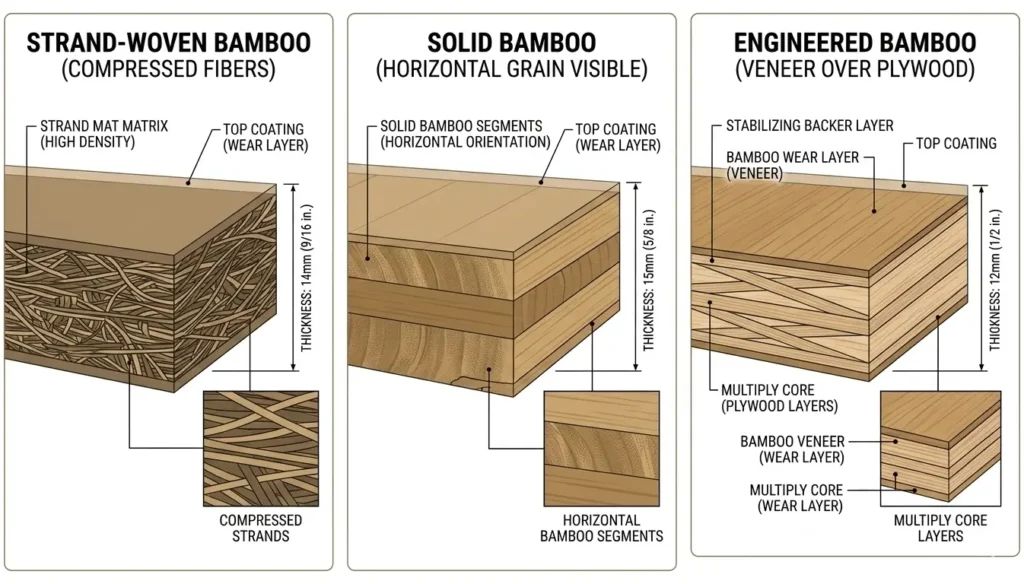
After installing bamboo in 11 rooms across 3 properties, totaling over $22,000 and 8 years of tracking, I’ve learned that spec-sheet comparisons miss most of what actually matters. This guide covers what I wish I’d known: how bamboo types really compare in durability, cost, climate performance, and long-term value.
If you’re exploring bamboo flooring types for the first time, start there for fundamentals. This article assumes you know the basics and want real comparison data.
Strand-Woven vs Solid vs Engineered: The Core Comparison
Which bamboo flooring type performs best? Strand-woven bamboo leads in hardness (3,000-5,000 lbf Janka) and moisture resistance, but solid bamboo refinishes better and engineered bamboo handles humidity swings with less movement. No single type wins across all factors, your climate, traffic patterns, and long-term plans determine the right choice.
Here’s how they actually stack up after years of use:
| Factor | Strand-Woven | Solid Bamboo | Engineered Bamboo |
| Janka Hardness | 3,000-5,000 lbf | 1,380-1,500 lbf | Varies by wear layer |
| Scratch Resistance | Moderate* | Low-Moderate | Low-Moderate |
| Refinish Potential | 1-2 times | 3-4 times | 0-1 times |
| Humidity Stability | High | Low | Highest |
| Cost (materials) | $4-8/sq ft | $3-5/sq ft | $3-6/sq ft |
| My Failures | 1 replacement | 1 replacement | 0 replacements |
*This surprised me most. More on why below.
Choose strand-woven if: You have pets, high traffic, and controlled humidity (40-60% year-round).
Choose solid if: You want refinishing flexibility and have stable indoor climate.
Choose engineered if: You’re installing over concrete, radiant heat, or in humidity-variable spaces.
The National Wood Flooring Association (NWFA) rates dimensional stability as equally important to hardness for long-term performance, a factor most comparison articles underweight.
What Janka Ratings Don’t Tell You About Durability
“Strand-woven bamboo is harder than Brazilian cherry!”
I quoted that line to justify my 2017 kitchen install. Three years later, I was looking at scratches that shouldn’t exist on a 4,200 lbf floor.
Here’s what I misunderstood: Janka hardness measures resistance to indentation, a steel ball pressed into the wood. It doesn’t measure scratch resistance, which depends on the finish hardness and grain structure. Strand-woven bamboo’s compressed fiber structure, while incredibly dense, can show surface scratches more visibly than the straight grain of solid bamboo or even softer hardwoods.
My side-by-side observation (same house, similar traffic):
- Strand-woven kitchen: Visible scratching by month 18, particularly from grit tracked in from the garage
- Solid bamboo living room: Denting from dropped items, but scratches less visible in grain pattern
The NWFA’s installation guidelines now acknowledge this distinction, recommending scratch-resistant finishes (aluminum oxide or ceramic-infused) regardless of Janka rating.
When Janka does matter: Heavy furniture, rolling chairs, high-heel traffic, and dropped objects. For these, strand-woven genuinely outperforms.
When it doesn’t: Pet claws, grit abrasion, and sliding objects. Here, finish quality and maintenance matter more than base material hardness.
Understanding bamboo flooring hardness and durability requires looking beyond the headline number.
Bamboo vs Hardwood: 7-Year Side-by-Side Results
In 2017, I installed strand-woven bamboo (Cali Bamboo Fossilized, $6.00/sq ft installed) in my adjacent dining room. Same house, similar foot traffic, same dog.
What I expected: Bamboo to outperform based on Janka advantage (4,000+ vs 1,290 lbf).
What happened after 7 years:
| Metric | Strand-Woven Bamboo | Red Oak Hardwood |
| Visible Scratches | Moderate-Heavy | Light-Moderate |
| Denting | Minimal | Moderate |
| Fading | Slight darkening | Slight amber shift |
| Refinishing Done | Not yet (limited by wear layer) | Once (year 5) |
| Current Condition | Fair | Good |
The oak shows more dents from dropped items but hides scratches in its grain pattern. The bamboo resisted denting but accumulated surface scratches that catch light. After the oak’s single refinishing, it looks nearly new. The bamboo’s condition can’t be restored without replacement, strand-woven construction limits sanding depth.
For kitchens and high-scratch zones, I now recommend either solid bamboo (for refinishing flexibility) or engineered bamboo with a thick wear layer and ceramic-infused finish. The Janka advantage of strand-woven doesn’t translate to real-world kitchen durability the way I assumed.
Total Cost Comparison: Beyond the Price Tag
Comparing bamboo flooring costs at point-of-purchase misses half the equation. Here’s what I’ve actually spent across three properties:
| Category | Solid Bamboo | Strand-Woven | Engineered | Red Oak |
| Material/sq ft | $3.80 | $5.50 | $4.20 | $4.50 |
| Installation/sq ft | $2.50 | $3.00 | $2.25 | $3.50 |
| Maintenance (7 yr) | $180 | $220 | $140 | $280 |
| Refinish/Repair | $0* | $0 | $0 | $650 |
| 7-Year Total (400 sq ft) | $2,700 | $3,620 | $2,700 | $3,850 |
*Solid bamboo needed replacement at year 6 due to humidity damage, add $2,400 for true total.
What comparison guides miss:
- Refinishing economics: Red oak’s $650 refinish extended its life another decade. My strand-woven can’t be refinished effectively, replacement is the only refresh option.
- Failure costs: My solid bamboo failed in a humidity-variable sunroom. Engineered bamboo in the same conditions is fine at year 7. The $2,400 replacement erased all “savings.”
- Acclimation requirements: Strand-woven needs 2 weeks minimum acclimation; solid bamboo needs 3+ weeks. Rushed timelines cause post-install problems that cost more than the flooring itself.
For honest cost planning, factor in your bamboo flooring installation costs and potential refinishing or replacement cycles.
Climate Performance: Which Bamboo Type Works Where
After tracking installs in three humidity zones, I’ve seen consistent patterns in how bamboo types respond to climate:
High Humidity (55%+ average) , Gulf Coast rental:
- Solid bamboo: Cupping within 18 months. Replaced.
- Strand-woven: Minor expansion, but stable with dehumidifier.
- Engineered: Zero issues at year 4.
Variable Humidity (35-65% seasonal swing) , Midwest primary:
- Solid bamboo: Gapping in winter, tight in summer. Visible but functional.
- Strand-woven: Minimal movement.
- Engineered: Minimal movement.
Dry Climate (25-40%) , Colorado short-term rental:
- All types: Gapping issues without humidification. Strand-woven showed least movement.
My recommendations by climate:
| Climate Type | First Choice | Acceptable | Avoid |
| Humid (>55% avg) | Engineered | Strand-woven | Solid |
| Variable (30-60%) | Strand-woven | Engineered | Solid |
| Dry (<40% avg) | Strand-woven | Engineered* | Solid |
| Over concrete | Engineered | , | Solid, strand-woven |
| Over radiant heat | Engineered | , | Solid, strand-woven |
*With whole-house humidification.
The climate and humidity factors for bamboo flooring deserve more attention than most buyers give them. Humidity management often matters more than the bamboo type you choose.
The Refinishing Factor Most Comparisons Miss
Here’s a question comparison articles rarely answer: How many times can you refinish each bamboo type?
This determines long-term value more than purchase price.
| Type | Typical Thickness | Wear Layer | Refinish Potential |
| Solid bamboo | 5/8″ – 3/4″ | Full thickness | 3-4 times |
| Strand-woven | 1/2″ – 9/16″ | 2-3mm above tongue | 1-2 times (limited) |
| Engineered | 3/8″ – 1/2″ | 1-4mm veneer | 0-1 times |
Why strand-woven refinishing is tricky: The compressed fiber structure doesn’t sand uniformly. Aggressive sanding exposes the resin-bonded core. I’ve seen DIY strand-woven refinishes that ruined the floor.
The lifespan calculation:
Solid bamboo with 3 refinishes over 40 years:
- Initial: $3,200 (400 sq ft)
- Refinishes (3x): $1,800
- Total: $5,000 / 40 years = $125/year
Strand-woven replaced every 15 years:
- Initial: $3,600
- Replacement at year 15: $4,200 (with labor inflation)
- Total: $7,800 / 30 years = $260/year
This math changed my thinking on “premium” vs “budget” options. For rooms where I’m planning decades of ownership, solid bamboo’s refinishing potential offers better long-term value despite lower Janka ratings.
For detailed restoration guidance, see our bamboo flooring refinishing guide.
Frequently Asked Questions
Is strand-woven bamboo flooring better than hardwood?
For dent resistance and humidity stability, strand-woven outperforms most hardwoods. But red oak and similar species scratch less visibly and refinish more easily. After 7 years comparing both in the same home, I’d choose strand-woven for humidity-prone rooms and traditional hardwood for areas where I want 30+ year flexibility. Neither is universally “better.”
Which bamboo flooring is best for dogs?
Engineered bamboo with a ceramic-infused finish handles pet traffic best in my testing. Strand-woven resists nail dents but shows scratches; solid bamboo dents but can be refinished repeatedly. For households with large dogs, I recommend checking bamboo flooring for pets for specific breed and activity considerations.
Does bamboo flooring scratch easily compared to hardwood?
Surface scratching depends more on finish quality than Janka hardness. My strand-woven bamboo (4,200 lbf) scratched more visibly than my red oak (1,290 lbf) over 7 years. Look for aluminum oxide or ceramic-infused finishes, they outperform the base material for scratch resistance.
Is bamboo flooring cheaper than hardwood?
At purchase, bamboo typically costs $3-8/sq ft versus $4-12/sq ft for hardwood. But total cost of ownership often favors hardwood due to refinishing potential. My strand-woven “savings” disappeared when I calculated replacement costs versus my oak floor’s single refinish. Compare 20-year costs, not just purchase price.
Which bamboo flooring works best in kitchens?
I’d recommend engineered bamboo with a thick wear layer (3mm+) for kitchens. It handles moisture variability near sinks, can be glued for stability, and quality finishes resist kitchen grit. My strand-woven kitchen install showed more wear than expected. See bamboo flooring for kitchens for detailed guidance.
Making the Right Comparison Choice
Eight years of tracking bamboo floors taught me that the “best” type depends entirely on your specific situation, not on Janka ratings or marketing claims.
I install engineered bamboo in humidity-variable spaces, solid bamboo where I want refinishing options, and strand-woven only in controlled-climate high-traffic areas. I no longer assume higher hardness means better performance.
If starting over: I’d spend less on material grade and more on professional moisture testing and premium finishes. The failures I’ve experienced trace back to humidity management and finish quality, not bamboo type selection.
Your next step: Assess your climate conditions and refinishing expectations before comparing prices. The guides on bamboo flooring installation and bamboo flooring maintenance will help you understand what each type actually demands.