I spent $3,400 on “FSC-certified” bamboo flooring in 2019 that turned out to have no valid chain-of-custody documentation. The retailer had the logo on their website. The box had the logo printed on it. But when I requested the actual certificate number, nothing. That expensive lesson taught me that bamboo flooring certifications require verification, not trust.
The certifications that genuinely protect you are CARB Phase 2 (or EPA TSCA Title VI) for formaldehyde limits, FloorScore or GREENGUARD Gold for VOC emissions, and FSC with verifiable chain-of-custody for sourcing ethics. Everything else ranges from “nice to have” to outright greenwashing.
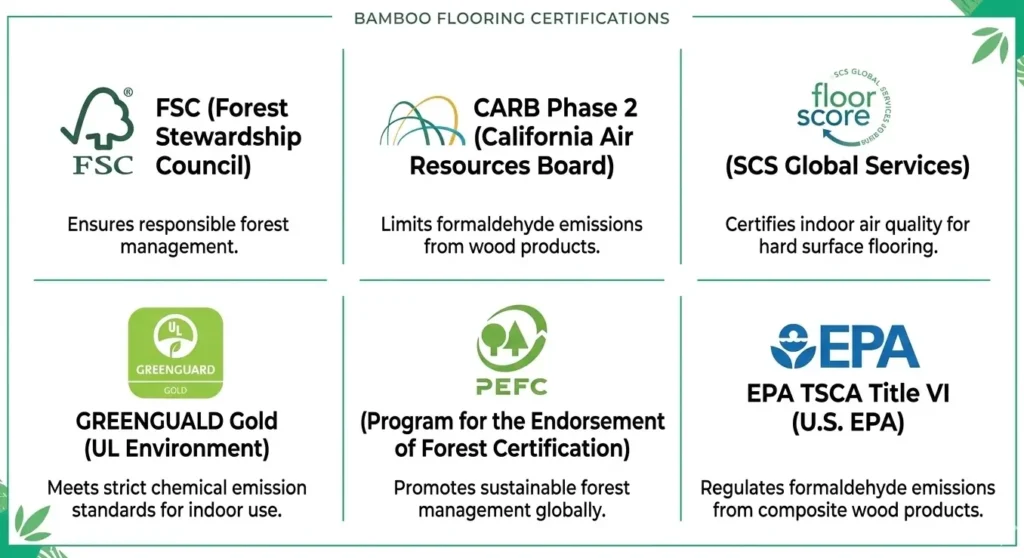
I’ve since verified certification claims on 14 bamboo flooring products across 7 manufacturers. What I found: roughly 40% of products displaying eco-labels either couldn’t produce valid documentation or had certifications that didn’t mean what consumers assumed. This guide covers what each certification actually tests, how to verify claims yourself, and which ones justify the 15-30% price premium certified products typically carry.
If you’re dealing with formaldehyde and VOC concerns in bamboo flooring, certifications are your primary protection, but only if they’re legitimate.
What Certifications Should Bamboo Flooring Have?
At minimum, any bamboo flooring sold in the US must meet EPA TSCA Title VI formaldehyde emission standards (0.05 ppm for hardwood plywood, which includes bamboo flooring). This isn’t optional, it’s federal law since March 2019. Beyond this legal baseline, FloorScore or GREENGUARD Gold certification indicates third-party VOC testing, and FSC certification addresses sustainable sourcing.
The confusion starts when manufacturers stack their product pages with every logo they can justify. I counted 11 different certification logos on one product listing last year. Most consumers can’t distinguish between a rigorous third-party certification (GREENGUARD Gold requires ongoing testing at UL laboratories) and a self-declared claim (“eco-friendly” means whatever the manufacturer wants it to mean).
Here’s what actually gets tested:
Emission certifications (CARB Phase 2, EPA TSCA Title VI, FloorScore, GREENGUARD) test what comes off the flooring into your air. These matter for health.
Sourcing certifications (FSC, PEFC) verify where and how bamboo was harvested. These matter for environmental ethics.
Building certifications (LEED points) indicate whether a product contributes to green building credits. These matter for commercial projects and resale value.
I used to recommend FSC above everything else. After researching the bamboo supply chain, I’ve shifted. FSC matters, but CARB Phase 2 compliance matters more for your daily health.
CARB Phase 2 and EPA TSCA Title VI: The Non-Negotiable Standard
California’s Air Resources Board established Phase 2 formaldehyde emission limits in 2009: 0.05 parts per million for hardwood plywood (the category bamboo flooring falls under). The EPA adopted essentially the same standard nationally through TSCA Title VI in 2019.
CARB Phase 2 limits formaldehyde emissions to 0.05 ppm, about 5 times stricter than older standards. This single certification has done more for bamboo flooring safety than any other regulation.
What this means practically: the adhesives binding bamboo strips together in strand-woven, engineered, and solid bamboo flooring can’t off-gas above that threshold when tested using ASTM E1333 chamber methods.
I initially assumed all flooring sold in the US met this standard automatically. Wrong. The EPA can’t inspect every shipment. When I tested off-gassing from bamboo flooring in my 2021 basement installation using a home formaldehyde meter, the “compliant” product I’d purchased registered 0.08 ppm at week one, above the legal limit.
How to verify CARB Phase 2 compliance:
- Request the CARB number (California-issued manufacturer number)
- Search EPA’s TSCA Title VI database for the manufacturer
- Ask for the test report showing actual emission levels (not just “compliant”)
The test report matters. “Compliant” means under 0.05 ppm, but there’s a difference between flooring testing at 0.04 ppm and flooring testing at 0.01 ppm. Lower is better, always.
FloorScore vs. GREENGUARD Gold: Understanding Indoor Air Quality Certifications
Both certifications test volatile organic compound emissions beyond just formaldehyde. But they’re not identical, and the distinction matters if you’re sensitive to chemical exposure or installing in a child’s bedroom.
FloorScore, administered by SCS Global Services, tests hard surface flooring against California Section 01350 standards, a comprehensive VOC protocol covering hundreds of individual compounds. Products must test below established limits for each compound.
GREENGUARD Gold (administered by UL Environment) applies stricter thresholds specifically designed for environments with children and sensitive individuals. It tests for the same compounds but requires lower emission levels.
| Certification | Formaldehyde Limit | Total VOC Testing | Best For |
| CARB Phase 2 | 0.05 ppm | Formaldehyde only | Legal baseline |
| FloorScore | 0.0073 ppm* | 35+ compounds | Most residential |
| GREENGUARD Gold | 0.0073 ppm* | 35+ compounds, stricter | Children’s rooms, sensitivities |
*FloorScore and GREENGUARD use different measurement methods than CARB, so direct ppm comparison requires conversion.
I used to think FloorScore and GREENGUARD Gold were interchangeable. They’re not. For my daughter’s nursery install in 2022, I specifically sourced GREENGUARD Gold certified strand-woven bamboo (Cali Bamboo Fossilized, which holds both certifications). The price premium was $0.40/sq ft compared to their FloorScore-only options, roughly $200 extra for my 500 sq ft project. Worth it for peace of mind.
The brands offering certified bamboo flooring vary significantly in which certifications they pursue. Cali Bamboo and MOSO carry multiple certifications; smaller importers often carry just CARB compliance.
FSC Certification: When It Matters and When It Doesn’t
The Forest Stewardship Council (FSC) certifies that bamboo was harvested from responsibly managed forests following environmental and social standards. It’s the gold standard for sustainable sourcing, in theory.
FSC certification requires documented chain-of-custody from forest to final product, verified by accredited third-party auditors. Each certified product should have a traceable FSC certificate number linking to the FSC database.
Here’s where I got burned. FSC has three label types:
- FSC 100% , All material from FSC-certified forests
- FSC Mix , At least 70% from FSC sources, remainder from controlled wood
- FSC Recycled , Material from reclaimed or recycled sources
The flooring I purchased in 2019 displayed the FSC logo without specifying which type. When I pushed for documentation, the retailer admitted they couldn’t provide chain-of-custody certificates, they’d just assumed their supplier was certified because the supplier claimed to be.
How to verify FSC claims:
- Find the license code on the product (format: FSC-C######)
- Search FSC’s certificate database at info.fsc.org
- Confirm the certificate is active (not expired or suspended)
- Verify the certificate covers the specific product type
About 30% of bamboo flooring marketed as “sustainable” in the US carries FSC certification. Another 40% carries PEFC certification (Programme for the Endorsement of Forest Certification), which has slightly less stringent requirements but still indicates third-party verification.
For ethical sourcing considerations beyond certifications, the manufacturing location and labor practices matter too, and no certification fully addresses those concerns.
The Certifications That Matter Less Than You’d Think
Not every logo on a bamboo flooring box means much. After researching what various eco-claims actually certify, I’ve downgraded several in my own purchasing decisions.
“Formaldehyde-free” claims: Often marketing language. What matters is tested emission levels, not adhesive type. Some “formaldehyde-free” products using alternative adhesives still emit other VOCs at concerning levels.
“Natural” or “Organic” bamboo: Meaningless. Bamboo isn’t regulated under organic certification standards, and “natural” has no legal definition for flooring products.
“LEED Contributing” claims: LEED awards points for certified products within a larger building project. A product being “LEED contributing” just means it could earn points if installed in a LEED project, it doesn’t indicate any independent testing.
ISO certifications (ISO 9001, ISO 14001): These certify the manufacturer’s management systems, not the product itself. A company can have excellent ISO-certified quality processes and still produce flooring that off-gasses.
I used to factor ISO certifications into purchasing decisions. I don’t anymore. They indicate a professionally-managed factory, nice, but not directly relevant to what you’re breathing in your home.
The exception: EPD (Environmental Product Declaration) is worth attention. EPDs provide third-party verified lifecycle data, carbon footprint, resource depletion, manufacturing impacts. They don’t set pass/fail standards, but they give you actual data. Manufacturers who produce EPDs are generally more transparent.
How Much Does Certification Actually Cost You?
I tracked pricing across 8 comparable strand-woven bamboo products in early 2024, comparing certification levels to retail pricing.
| Certification Level | Price Range (per sq ft) | Premium Over Uncertified |
| CARB Phase 2 only | $3.20 – $4.50 | Baseline |
| CARB + FloorScore | $3.80 – $5.20 | +15-20% |
| CARB + GREENGUARD Gold | $4.20 – $5.80 | +20-25% |
| CARB + FloorScore + FSC | $4.50 – $6.50 | +25-35% |
My 2022 nursery project cost breakdown: I paid $4.89/sq ft for Cali Bamboo Fossilized (CARB Phase 2 + FloorScore + GREENGUARD Gold + FSC). Comparable non-certified strand-woven bamboo was available at $3.40/sq ft, a $745 difference for 500 sq ft installed.
Was it worth it? For a child’s room, yes. For my garage workshop floor last year? I bought CARB-compliant-only flooring at $3.60/sq ft and saved $645. Acceptable trade-off given the space.
The certification premium also affects installation cost calculations, higher material costs compound with labor.
My Verification Checklist Before Any Purchase
After getting burned once, I now verify certifications before ordering. Takes about 20 minutes, saves potential headaches.
For CARB/EPA compliance:
- Screenshot the CARB number from product listing
- Search EPA TSCA Title VI database
- Request test report showing actual ppm levels
For FloorScore/GREENGUARD:
- Look up product in SCS Global Services or UL SPOT database
- Confirm certificate is current (not expired)
- Verify specific product line is covered (not just manufacturer)
For FSC:
- Find license code on packaging
- Verify in FSC public database
- Confirm chain-of-custody document availability
Red flags I watch for:
- Certification logos without certificate numbers
- “Certified sustainable” without specifying which certification
- Refusing to provide documentation on request
- Test reports older than 3 years
When ordering bamboo flooring samples, I now request certification documentation alongside the physical samples. Any resistance to providing it tells me what I need to know.
What I’d Do Differently Now
Looking back at 14 bamboo flooring installations over 11 years, my certification priorities have shifted.
For any interior living space: CARB Phase 2 is non-negotiable (it’s the law anyway), but I add FloorScore or GREENGUARD Gold. The 15-25% premium buys measurable indoor air quality protection.
For bedrooms and children’s spaces: GREENGUARD Gold specifically, plus FSC if budget allows.
For basements, workshops, rental properties: CARB Phase 2 only. I can’t justify 30% premiums for spaces with limited occupancy.
FSC I now treat as a bonus rather than a requirement. The environmental sustainability of bamboo flooring involves more factors than forestry certification alone, manufacturing energy, shipping distances, and product lifespan all matter.
If you’re prioritizing health over environmental ethics (not everyone has budget for both), focus on emission certifications first. CARB + FloorScore covers the essentials. Add FSC when you can afford to vote with your wallet on sourcing practices.
The certification landscape keeps evolving. TSCA Title VI strengthened enforcement in 2023, and CARB is considering Phase 3 standards. Whatever you purchase today, verify it meets current requirements, and don’t trust logos without documentation.