Healthy bamboo rarely suffers significant pest damage. The most common bamboo pests, mites, aphids, and scale, primarily attack stressed plants, making diagnosis more important than treatment selection. Before reaching for any pesticide, identify whether you’re seeing true pest damage or environmental stress symptoms that pests exploit secondarily.
I’ve watched neighbors spray insecticides monthly for “mite damage” that was actually iron chlorosis from alkaline soil. I’ve done it myself, spent $180 on treatments in 2016 for a “scale infestation” that was actually sooty mold growing on honeydew from aphids I never addressed. Expensive lessons, but useful ones.
This guide covers identification of actual bamboo pests, diseases that genuinely require intervention, and, perhaps more importantly, the environmental issues that mimic pest damage and waste your treatment budget. For foundational bamboo care and maintenance practices that prevent most problems, start there if you’re new to bamboo cultivation.
What Are the Most Common Bamboo Pests?
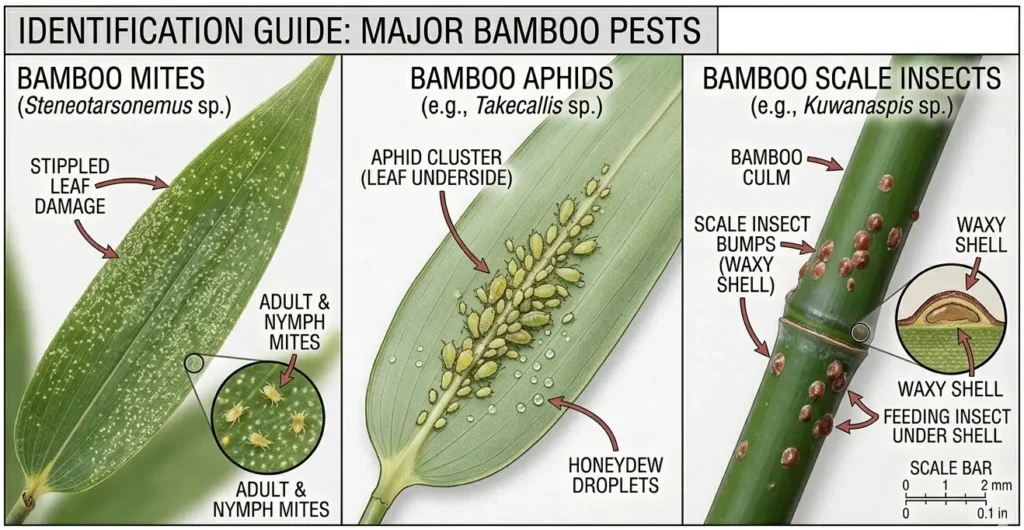
The three most common bamboo pests in North America are bamboo mites (Schizotetranychus celarius), bamboo aphids (Takecallis species), and scale insects (both armored and soft varieties). Mites cause stippled, bronzed leaves; aphids produce sticky honeydew and attract sooty mold; scale appears as small bumps on culms and leaves.
Bamboo Mites (Schizotetranychus celarius)
These aren’t spider mites, though they’re related. Bamboo mites are host-specific, they’ve evolved alongside bamboo and target it exclusively. Look for:
- Stippling on leaf undersides (tiny pale dots)
- Bronzing or russeting of foliage (advanced infestations)
- Webbing visible in severe cases (rare with bamboo mites)
I first noticed mites on my Phyllostachys aureosulcata in August 2019, a drought year. The stippling appeared within three weeks of missed irrigation. After restoring consistent watering, the mite population crashed without intervention. That pattern repeated in 2022.
Bamboo Aphids (Takecallis species)
Two species dominate: Takecallis arundinariae and Takecallis taiwanus. Both cluster on leaf undersides and produce honeydew, that sticky residue that coats everything beneath infested culms.
Signs include:
- Honeydew on lower leaves and surrounding surfaces
- Sooty mold (black fungal coating) growing on honeydew
- Ant activity (ants farm aphids for honeydew)
- Curled new growth in heavy infestations
The sooty mold looks alarming but isn’t pathogenic to bamboo, it’s just unsightly. Controlling the aphids eliminates the mold’s food source.
Scale Insects
Both armored scale and soft scale attack bamboo. They appear as small (1-3mm) bumps on culms and leaves, armored scale looks like tiny oyster shells; soft scale is dome-shaped and often waxy.
Heavy scale infestations weaken plants over multiple seasons rather than causing rapid decline. They’re the slowest-developing pest problem and the easiest to overlook until populations explode.
Understanding bamboo growth characteristics helps you spot abnormalities early, knowing what healthy growth looks like is half the diagnostic battle.
The Problem That Looks Like Pests But Isn’t
Here’s where I’ve watched the most money get wasted, mine included.
Common belief: “My bamboo leaves have yellow streaks and brown tips, so I have a pest problem.”
What I’ve learned: Yellow streaking and tip burn indicate nutrient deficiency or water stress in roughly 8 out of 10 cases I’ve diagnosed for neighbors. True pest damage has specific patterns that environmental stress doesn’t replicate.
The Diagnostic Distinction
| Symptom | Pest Cause | Environmental Cause |
| Yellow leaves | Mite stippling (check undersides for tiny dots) | Nitrogen deficiency, overwatering, cold damage |
| Brown leaf tips | Rare from pests | Salt buildup, underwatering, wind burn |
| Sticky residue | Aphid honeydew | None, this is always insects |
| Black coating | Sooty mold (secondary to aphids) | Occasionally pollution deposits |
| Culm discoloration | Scale insects (look for bumps) | Sunscald, physical damage, age |
The sticky residue test is definitive. If leaves feel tacky, you have aphids or scale producing honeydew. If leaves are dry, your “pest damage” is almost certainly environmental.
In 2018, I treated my Phyllostachys nigra for mites based on bronzed foliage. Three applications of horticultural oil. No improvement. A soil test revealed pH of 7.8, too alkaline for bamboo, causing iron chlorosis. A sulfur application fixed the “mite damage” within six weeks.
Real Bamboo Diseases vs. Cultural Problems
True bamboo diseases exist but are uncommon in properly sited plants. Root rot and bamboo mosaic virus cause the most concern.
Root Rot (Phytophthora and Pythium species)
Root rot kills bamboo. It’s caused by waterlogged soil, not pathogens alone, these fungi are present in most soils but only attack roots deprived of oxygen.
Symptoms:
- Culms yellowing and collapsing without pest presence
- New shoots emerging weak or rotting at soil level
- Rhizomes soft, dark, and foul-smelling when dug
Prevention beats treatment. Once root rot establishes, you’re removing affected plants and amending drainage, not applying fungicides. This connects to why bamboo irrigation and water management matters so much, overwatering is the primary cause.
I lost a 40-culm Bambusa oldhamii grove in 2017 to root rot. A neighbor’s drainage project redirected water toward my property. The bamboo looked stressed for two months before rapid collapse. Excavation revealed rhizomes that disintegrated when handled. Replacement cost: $650 plus drainage correction.
Bamboo Mosaic Virus
Viral infection shows as yellow mosaic patterns on leaves, irregular patches rather than the uniform chlorosis of nutrient deficiency. There’s no treatment. Affected plants should be removed to prevent spread.
The good news: I’ve never seen bamboo mosaic virus in person, and I’ve examined hundreds of bamboo plants. It’s documented but rare in landscape settings.
Sooty Mold
Not technically a disease, it’s a fungus growing on honeydew, not attacking plant tissue. It blocks light and looks terrible but doesn’t directly harm bamboo. Eliminate the aphids, rinse the mold off with water, problem solved.
My $180 Mistake: When Treatment Makes Things Worse
In September 2016, I noticed black coating on my Phyllostachys bissetii and panicked. Searched “black mold on bamboo,” found generic advice about fungicides, and spent $180 on products and applications over two months.
What I got wrong: I treated the mold without identifying its cause. Sooty mold grows on honeydew. Honeydew comes from aphids. I never looked at leaf undersides.
What I should have done: Flip a leaf. I would have found aphid colonies immediately.
The actual fix: A single application of insecticidal soap ($12) to address aphids, followed by a hose rinse to remove sooty mold. Total time: 30 minutes.
The fungicides I applied did nothing because sooty mold isn’t pathogenic, it doesn’t penetrate tissue, just sits on surfaces. I was treating a symptom of a symptom.
This experience restructured my approach. Now I follow a diagnostic sequence:
- Check for sticky residue (honeydew = aphids/scale)
- Examine leaf undersides with magnification
- Rule out environmental factors before assuming pests
- Treat only when I’ve confirmed what I’m treating
Species selection also affects susceptibility. Some bamboo varieties show natural pest resistance that others lack, my Fargesia species have never needed treatment while Phyllostachys occasionally does.
Organic vs. Chemical Treatment: What Actually Works
Should you use organic or chemical pesticides on bamboo?
Organic treatments (neem oil, insecticidal soap, horticultural oil) handle 90% of bamboo pest situations effectively. Chemical pesticides are rarely necessary and risk killing beneficial insects that provide natural pest control. Reserve synthetics for severe infestations unresponsive to organic
Source: Integrated Pest Management guidelines, UC Davis IPM Program
Organic Options That Work
Neem oil (azadirachtin-based): Effective against mites, aphids, and scale crawlers. Apply at 2-3 tablespoons per gallon, spray leaf undersides thoroughly. Repeat every 7-14 days for three applications.
Insecticidal soap: Kills soft-bodied insects on contact. Works well on aphids. Ineffective on armored scale (their shell protects them).
Horticultural oil: Smothers insects, including scale. Apply during dormant season for scale, or as summer-weight oil during growing season. Don’t apply when temperatures exceed 90°F.
When Chemicals Make Sense
I’ve used synthetic pesticides once in 11 years, a systemic insecticide (imidacloprid) for a scale infestation that spread across three groves before I caught it. The scale population had exceeded what contact treatments could manage.
Systemics work but create problems:
- They kill beneficial insects feeding on treated plants
- Pollinators accessing bamboo flowers are affected
- Effects persist for months
If going chemical, avoid broad-spectrum contact killers. Systemics target only insects feeding on plant tissue.
Prevention Protocol: 15 Minutes Weekly
Most pest problems are preventable through regular monitoring and cultural practices.
Weekly Inspection Routine
Time required: 15 minutes per 100 square feet of bamboo
- Flip three leaves per grove , check undersides for insects
- Touch leaf surfaces , sticky = honeydew = problem developing
- Examine new culm sheaths , scale often establishes here first
- Note stressed plants , they’re pest targets
Cultural Prevention
- Water consistently , drought stress invites mites
- Avoid overwatering , root rot kills faster than any pest
- Maintain mulch , 3-4 inches reduces stress, supports beneficial insects
- Quarantine new plants , inspect for 4 weeks before planting near established groves
Growing bamboo in containers creates different pest pressure, root-bound stress increases susceptibility, but isolation prevents spread to other plants.
Beneficial Insects
Ladybugs and lacewings consume massive aphid quantities. Parasitic wasps control scale. I haven’t purchased beneficial insects, maintaining diverse plantings around my bamboo groves keeps natural predator populations healthy.
Broad-spectrum pesticides destroy these allies. After one imidacloprid application in 2020, my aphid problems increased the following year because I’d eliminated predators.
Frequently Asked Questions
Why are my bamboo leaves turning yellow with brown spots?
Brown spots with yellow halos typically indicate bacterial or fungal leaf spot, usually triggered by overhead irrigation keeping foliage wet. Switch to drip irrigation and remove affected leaves. If spots appear on new growth despite dry foliage, send a sample to your extension office for diagnosis. This pattern rarely indicates insects.
Is neem oil safe to use on all bamboo species?
I’ve used neem on Phyllostachys, Fargesia, Bambusa, and Otatea without damage. Apply in evening to avoid leaf burn (neem + hot sun can scorch). Avoid application when temperatures exceed 85°F. Test on a few leaves first if concerned about a specific cultivar.
How do I know if my bamboo has root rot versus pest damage?
Root rot affects entire culms, they yellow uniformly, then collapse. Pest damage creates localized symptoms: stippling, honeydew, visible insects. Dig near a declining culm; healthy rhizomes are firm and white/cream colored. Rotted rhizomes are dark, soft, and smell sour. Root rot requires drainage correction, not pesticides.
Should I remove a bamboo plant that has pests to prevent spread?
Rarely necessary for insect pests, treatment typically succeeds. Removal is appropriate for bamboo mosaic virus (no treatment exists) and severe root rot where drainage cannot be corrected. For insect infestations, isolate the affected area, treat, and monitor before removing otherwise healthy plants.
Starting Over: What I’d Do Differently
Eleven years of bamboo pest management taught me one thing above all: diagnosis matters more than treatment. The hours I spent researching pesticides would have been better spent learning plant stress symptoms.
If I were starting fresh with bamboo, I’d establish these habits immediately:
- Weekly leaf inspections with a hand lens
- Soil testing before planting (pH and drainage)
- A “quarantine corner” for new acquisitions
- Relationships with local extension agents who actually know bamboo
My current approach involves zero scheduled pesticide applications. I treat when I confirm a problem, which averages once every three years. The bamboo groves are healthier for it, and so is my wallet.
For comprehensive guidance on maintaining thriving bamboo through proper cultural practices rather than reactive treatment, explore Bambooscope’s bamboo care resources.