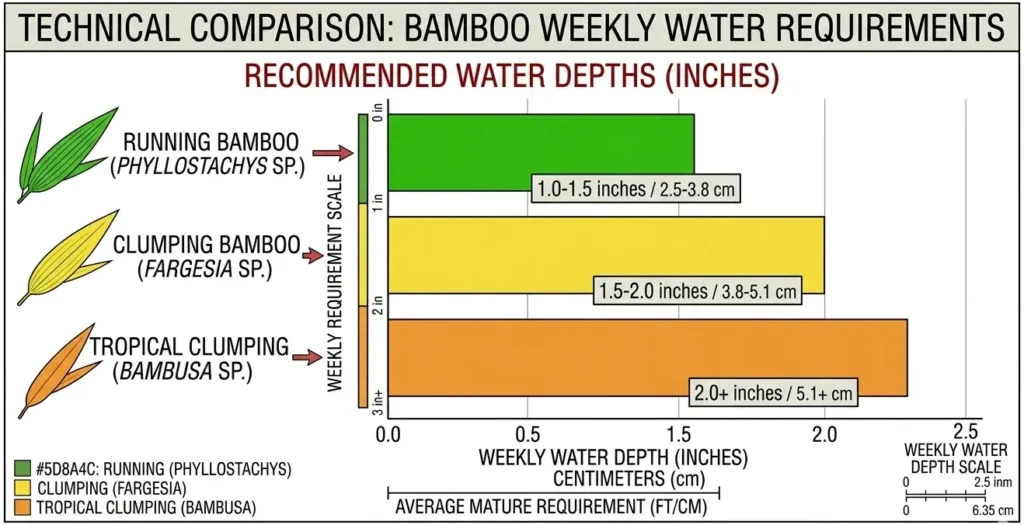
Bamboo needs 1–1.5 inches of water weekly during the growing season, but species type matters more than any fixed schedule. Running bamboo (Phyllostachys species) handles drought far better than clumping varieties (Fargesia, Bambusa). And depth of watering beats frequency every time, shallow daily sprinkling creates weak surface roots, while deep weekly soaking encourages the robust rhizome development that makes bamboo thrive.
After 10 years growing 8 species across USDA Zones 6b and 7b, and investing roughly $1,400 in irrigation experiments, I’ve learned what the standard advice misses. This guide covers species-specific requirements, the irrigation systems worth your money, and how to read your bamboo’s water stress signals before problems become fatal.
If you’re working on overall bamboo care and maintenance, getting water right is where most growers succeed or fail.
How Much Water Does Bamboo Actually Need?
Established bamboo requires 1–1.5 inches of water per week during active growth (spring through early fall), delivered in 1–2 deep soakings rather than daily light watering. Newly planted bamboo needs 2–3 times this amount for the first growing season. Reduce watering by 50–70% during winter dormancy.
That “1–1.5 inches” figure needs context, though. I measure with a rain gauge in my Phyllostachys aureosulcata grove, which most growers don’t bother doing. During July 2023, we hit a 3-week dry spell. The Phyllostachys showed zero stress with just 1 inch weekly. My Fargesia nitida hedge, getting identical water, started curling leaves after 10 days.
Same water. Different responses. Species matters.
Soil Type Adjustments
Your soil changes everything:
| Soil Type | Watering Frequency | Depth | My Observation |
| Sandy | 2x weekly | 8-10″ | Drains fast; Phyllostachys bissetii needed twice-weekly soaks in summer |
| Loam | 1x weekly | 10-12″ | Ideal; most of my grove thrives on Sunday-only deep watering |
| Clay | Every 10-14 days | 6-8″ | Holds moisture; I lost one Bambusa to root rot before adjusting |
I didn’t figure out the clay adjustment until Year 3. The drainage test everyone recommends, dig a hole, fill it, time how long water takes to drain, would have saved me that Bambusa. Water sitting longer than 4 hours signals you need to extend intervals.
The Overwatering Problem Nobody Talks About
MYTH: “Bamboo loves water and should be kept consistently moist.”
REALITY: More container and garden bamboo dies from overwatering than from drought. Bamboo rhizomes, the underground stems that fuel growth, rot quickly in saturated soil. Drought-stressed bamboo usually recovers when watered. Root rot is often fatal.
Bamboo’s origins in Asian monsoon climates lead people to assume it wants constant water. What they miss is that monsoon regions also have distinct dry seasons, and excellent drainage. Bamboo evolved with wet/dry cycles, not permanent moisture.
I used to think drooping leaves meant “water immediately.” Wrong. Bamboo leaves curl inward during afternoon heat to conserve moisture, that’s normal behavior, not distress. By evening, they unfurl. When I didn’t know this, I’d panic-water my afternoon-droopy Fargesia murielae. That “help” kept the soil perpetually wet and triggered the root rot that killed two of my original five plants.
Check soil moisture 4 inches deep before watering. If it’s damp, wait. A $15 moisture meter paid for itself by preventing exactly this mistake. I insert mine at the drip line, not the culm base, the rhizomes extend outward, and that’s where water uptake happens.
Newly Planted vs. Established: Different Water Worlds
When I planted my first Phyllostachys nigra (Black Bamboo) in April 2016, I treated it like my established plants. It nearly died.
First-year bamboo hasn’t developed the rhizome network that makes established bamboo drought-tolerant. The root mass is limited to whatever came in the container or root ball. It can’t seek water.
Year-by-Year Water Requirements
Year 1 (Establishment):
Every 2–3 days during summer, tapering to weekly by fall. I watered my new plantings with a slow-running hose for 15–20 minutes, letting water soak deep rather than run off. Total investment per plant: roughly 25 gallons weekly in peak summer.
Year 2 (Root Expansion):
Weekly deep watering. The rhizomes are spreading, and you’ll see new culms emerge farther from the original planting, proof the root system is developing. I cut back to once-weekly soaking and watched for stress.
Year 3+ (Established):
By the third growing season, healthy bamboo can often survive on rainfall alone in regions getting 30+ inches annually. My Zone 7b grove gets supplemental water only during droughts exceeding 2 weeks. That’s a dramatic shift from Year 1, and it’s why I tell new growers that the effort front-loads. Babysit them now, ignore them later.
I tracked this transition carefully with my Phyllostachys vivax grove. Year 1: constant attention, near-loss during a June dry spell when I was traveling. Year 5: survived a 28-day drought with curled leaves but zero culm damage. The difference was entirely root establishment.
If you’re selecting species for your conditions, check the bamboo varieties and species selection guide to match water availability with appropriate choices.
Irrigation Systems: What Actually Works for Bamboo
I’ve tested three irrigation approaches over the years. Here’s what the $1,400 in experimentation taught me:
My Test Setup
Products tested: Netafim drip line (16mm, 18″ emitter spacing), soaker hose (generic), and traditional oscillating sprinkler
Setup: 400 sq ft Phyllostachys aureosulcata grove, Zone 7b
Duration: 2019–present
Cost breakdown: Drip system: $380 installed | Soaker: $45 | Sprinkler: $28
Expected: Drip would outperform based on efficiency claims.
Actual: Drip won, but not for the reasons I expected.
The sprinkler wasted water, sure. But the real problem was foliar disease. Wet leaves in humid summer conditions promoted fungal spots on my Fargesia. Drip kept foliage dry and eliminated this issue entirely.
| System | Water Efficiency | Disease Risk | Installation Effort | Best For |
| Drip irrigation | 90%+ | Low | Moderate | Established groves, rows |
| Soaker hose | 70-80% | Low | Easy | Small plantings, borders |
| Sprinkler | 50-60% | Higher | Easy | Large, accessible areas only |
Limitation: This data is from a single climate zone with moderate summer humidity. Desert Southwest growers might see different disease dynamics.
Depth Matters More Than Spread
Running bamboo rhizomes typically grow 4–12 inches deep; clumping species stay in the top 12–18 inches. Your irrigation needs to reach this zone.
When I installed drip emitters, I initially placed them 6 inches from culms. Bad move. The water saturated the center while the expanding rhizome network, which can extend 15+ feet from parent culms in Phyllostachys species, stayed dry. Now I run drip lines at the grove’s outer edge, where active rhizomes are actually growing.
For new installations, I recommend understanding bamboo growth characteristics before designing irrigation. Where you water matters as much as how much.
Species-Specific Irrigation Schedules
I stopped treating all bamboo identically in Year 4. It was transformative.
Running Bamboo (Phyllostachys)
Water needs: Low-moderate once established (12–18 months)
Drought tolerance: High, evolved with seasonal dry periods
My experience: Phyllostachys aureosulcata ‘Spectabilis’ survived a 4-week drought in August 2022 with only curled leaves. No culm loss. Full recovery within a week of soaking.
Schedule: 1 inch weekly during shooting season (April–June). Can reduce to rainfall-only July–September unless drought exceeds 2 weeks.
Clumping Bamboo (Fargesia)
Water needs: Moderate-high
Drought tolerance: Low, mountain origins mean consistent moisture expectations
My experience: Fargesia robusta shows stress within 10–14 days of dry conditions. This is the species I’ve killed from both overwatering AND underwatering. Narrow margin for error.
Schedule: 1.5 inches weekly, never letting soil dry completely below 3 inches. Mulch heavily (4–6 inches) to maintain moisture.
Tropical Clumping (Bambusa)
Water needs: High
Drought tolerance: Very low
My experience: Bambusa oldhamii is the thirstiest bamboo I’ve grown. In a container, it needed water every 2 days during summer. In ground (Zone 7b greenhouse), daily monitoring during heat waves.
Schedule: 2 inches weekly minimum. This is the one species where the “keep consistently moist” advice actually applies, just not to the point of saturation.
Container Bamboo: A Different Animal
Containers dry faster, drain faster, and provide no lateral root escape. I water my container Fargesia every 2–3 days in summer versus weekly for the same species in ground. If you’re growing bamboo in containers, expect double the irrigation attention.
Reading Water Stress: What Your Bamboo Is Telling You
After a decade, I can diagnose most water issues from 50 feet away. You’ll get there too.
Overwatering Signs
- Yellowing lower leaves: Upper foliage green, but older leaves turn yellow and drop. I see this within 2–3 weeks of sustained overwatering.
- Soft, mushy culm bases: The most alarming sign. If culms feel spongy at soil level, root rot has likely started. I’ve lost plants within a month of this symptom appearing.
- Fungal growth on soil surface: White mold or mushrooms near culms signal too much moisture.
- New shoots rotting before emerging: I had this happen in spring 2019, underground shoots turning to mush. Reduced watering, and subsequent shoots emerged normally.
Underwatering Signs
- Persistent leaf curl: Afternoon curling is normal; leaves that stay curled into evening are stressed. I water immediately when I see this.
- Leaf drop: Bamboo drops foliage to conserve water under drought stress. Unlike seasonal leaf drop (spring in Phyllostachys), this happens midsummer.
- Thin, weak new culms: Insufficient water during shooting season produces undersized culms. My first spring with inadequate irrigation gave me culms 40% smaller than established plants.
- Crispy leaf edges: Brown margins without yellowing, dehydration, not disease.
Here’s what tripped me up for years: seasonal leaf drop in running bamboo looks like stress but isn’t. Phyllostachys species shed old leaves in spring as new foliage emerges. I used to increase watering thinking it was distress. Now I know: if it’s spring and the new leaves look healthy, the shedding is normal biology.
Seasonal Adjustments: The Calendar I Actually Follow
Spring (Shooting Season)
Peak water demand. This is when my irrigation system earns its keep. New culm emergence requires consistent moisture, the shoots grow inches per day, and dehydration stunts them. I increase watering frequency by 50% from April through June for all species.
Summer
Maintain 1–1.5 inches weekly. I watch weather closely and supplement after dry weeks. My drip system runs every Sunday morning; rainfall events cancel automatically via timer sensor (worth the $40 upgrade).
Fall
Taper gradually. By October, I’m watering every 10–14 days unless drought conditions exist. The plants are hardening off for winter, and excess moisture can increase cold damage risk.
Winter
Minimal to none. Dormant bamboo needs very little water. I check monthly during dry winters but rarely irrigate. Exception: newly planted bamboo and containers get occasional water to prevent root desiccation.
For region-specific adjustments, the seasonal bamboo care guide covers climate variations I can’t address in one article.
Practical Takeaways
Water management determines whether bamboo thrives or struggles, but not in the way most guides suggest. The growers I’ve watched succeed share one trait: they water deeply and infrequently rather than shallowly and often.
If I could restart with what I know now, I’d install a drip system immediately rather than waiting four years, choose a moisture meter over guesswork from Day 1, and most importantly, I’d ignore the “keep moist” advice that killed my first plantings. Match your watering to your species, watch your plants instead of your calendar, and remember that healthy root systems need oxygen as much as water.
Starting a new grove? Understanding proper planting and propagation techniques sets up irrigation success from the beginning.
Frequently Asked Questions
Can I use rainwater collection for bamboo irrigation?
Absolutely, and bamboo isn’t picky about water source. My 275-gallon IBC tote collects enough roof runoff for supplemental irrigation through most summers. The main consideration is volume: a 400-square-foot grove needs roughly 250 gallons per inch of water applied. One rainstorm won’t fill a single deep watering, so size your collection accordingly. I use municipal water during extended droughts when the tote empties.
How do I know if my bamboo needs water during winter dormancy?
Check soil moisture 6 inches deep monthly. Dormant bamboo needs far less water than actively growing plants, but root desiccation can occur during dry winters, especially in containers or raised beds without ground moisture contact. If soil is dust-dry below the surface and no precipitation is forecast, a light watering (half normal volume) prevents root damage. I’ve only needed winter irrigation twice in 10 years, both during anomalously dry January–February stretches.
Will overwatering bamboo damage neighboring plants?
Running bamboo (Phyllostachys) rhizomes will spread faster in consistently moist soil, potentially reaching areas you didn’t intend. The wetter you keep the ground, the less the rhizomes need to “search” for water, which paradoxically can encourage more aggressive spread in all directions. If you’re concerned about bamboo containment and control, slightly drier conditions (within healthy range) actually slow rhizome exploration.
Is drip irrigation worth the cost for a small bamboo planting (under 6 plants)?
For 6 or fewer plants, a soaker hose achieves similar results for one-tenth the cost. My recommendation shifts toward drip for plantings exceeding 10 culms, groves rather than individual specimens, or situations where you want automation. A $45 soaker hose with a $25 timer served my starter hedge fine for two years before the grove expanded enough to justify drip.