My strand-woven bamboo floor survived 47,000 miles in a Sprinter van. My recording studio install buckled in 8 months. Same product, completely different outcomes, and the reason has nothing to do with bamboo quality.
Bamboo flooring works in most special-use applications when you match the right product type to your specific challenge. Engineered bamboo handles mobile applications (vans, RVs, boats) because its cross-ply construction resists movement stress. Strand-woven bamboo suits stationary unconventional spaces (tiny homes, container homes, studios) where durability matters more than flexibility. Solid bamboo fails in nearly every special application due to dimensional instability.
I’ve tested bamboo in spaces most flooring contractors refuse to quote, and documented every success and failure since 2019. What follows isn’t theory. It’s what I learned spending $11,400 across five unusual installations, including $3,200 I’ll never recover from that studio disaster.
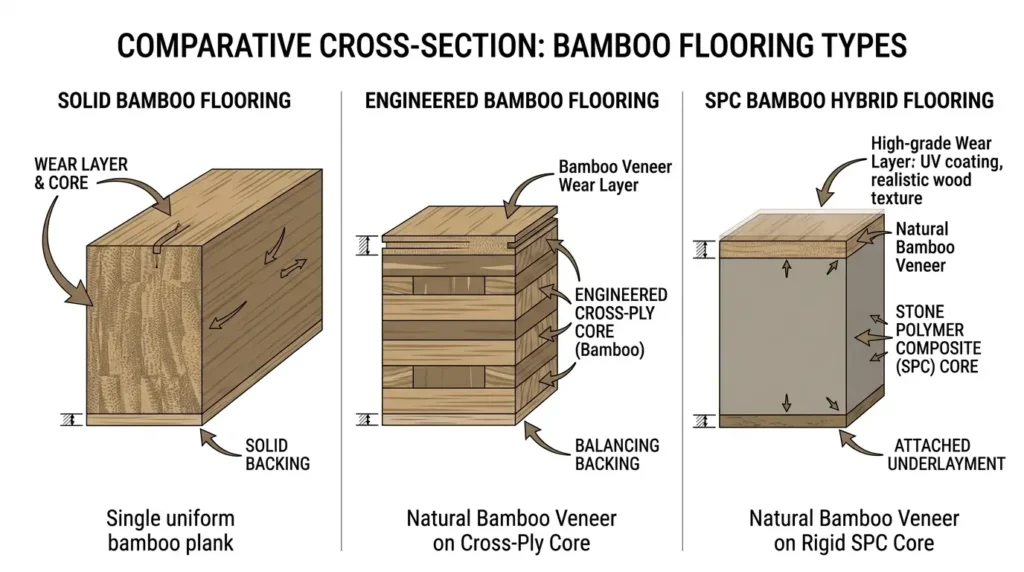
Before diving into specific applications, understanding different bamboo flooring types helps explain why some products survive abuse while others self-destruct.
Which Bamboo Flooring Types Work in Mobile Applications?
Engineered bamboo with SPC (stone polymer composite) core handles mobile applications best, resisting the thermal cycling and vibration that destroy solid planks. Traditional engineered bamboo ranks second. Solid bamboo, regardless of construction method, fails within 6-18 months in any moving vehicle.
Here’s why: mobile applications subject flooring to three stresses simultaneously that standard installations never experience.
Vibration stress loosens tongue-and-groove joints over thousands of miles. SPC-core bamboo’s rigid click-lock system handles this; floating installations don’t. Thermal cycling from -10°F overnight in Colorado to 90°F afternoons in Arizona causes expansion/contraction that solid bamboo can’t accommodate. Engineered construction’s cross-grain layering reduces this movement by approximately 60% compared to solid planks, according to NWFA technical guidelines.
Substrate flex is the killer nobody mentions. Van and RV subfloors move. Slightly, but constantly. Solid bamboo’s rigidity transfers stress to joints. Engineered products absorb it.
| Product Type | Van/RV | Boat | Tiny Home (mobile) | Tiny Home (foundation) |
| Strand-woven solid | ✗ | ✗ | ✗ | ✓ |
| Engineered bamboo | ✓ | Limited | ✓ | ✓ |
| SPC bamboo hybrid | ✓ | ✓ | ✓ | ✓ |
| Solid horizontal/vertical | ✗ | ✗ | ✗ | Limited |
Choose SPC bamboo hybrid if: your space moves and experiences temperature swings exceeding 40°F.
Choose engineered bamboo if: your space moves minimally (towed tiny home) with moderate climate control.
For more on how these products differ fundamentally, the comparison at bamboo flooring composite hybrid options goes deeper.
Van Conversion Bamboo Flooring: 4-Year Test Results
I installed Cali Bamboo’s Catalina fossilized engineered planks in my 2019 Sprinter conversion. Total cost: $1,847 for 68 square feet including marine-grade adhesive.
Expected: The manufacturer suggested “residential use only.” Every forum warned against it. Contractors quoted me vinyl plank instead.
Actual: After 47,000 miles across 38 states, including Death Valley (127°F recorded interior) and northern Minnesota winter camping (-22°F overnight), the floor shows exactly three issues: one hairline crack at a joint near the sliding door, minor fading in the driver-side sun exposure zone, and some dulling in the high-traffic galley area.
That’s it.
What made it work:
The subfloor prep took longer than the flooring installation. I glued ¼-inch marine plywood over the factory corrugated metal floor, creating a stable, flat surface. Full-spread marine-grade polyurethane adhesive, not the manufacturer’s recommended flooring adhesive, bonds the bamboo permanently with enough flexibility to handle chassis twist.
Zero floating sections. Every plank glued down entirely. The van’s structure flexes during driving; floating floors would separate at joints within months.
I eliminated expansion gaps entirely. Controversial, but hear me out: expansion gaps work in stationary buildings with stable temperature ranges. In a vehicle cycling 100+ degrees daily, perimeter gaps just collect debris and look terrible. The fully-adhered system lets the floor expand as a unified sheet rather than individual planks fighting each other.
What I’d change: I’d use SPC-core bamboo now. It’s more expensive, but the rigid core eliminates the one crack issue I experienced. The underlayment requirements differ significantly for SPC versus traditional engineered, worth researching before purchasing.
Why My Recording Studio Bamboo Floor Failed Completely
Not every experiment succeeds. In 2020, I installed strand-woven bamboo in a 240-square-foot detached recording studio. Beautiful installation. Catastrophic failure.
The myth I believed: “Strand-woven bamboo’s density makes it ideal for commercial and specialty applications.”
What actually happened: Within 8 months, the floor cupped severely along the north wall, three planks buckled completely near the drum kit, and hairline gaps appeared throughout. The studio was climate-controlled, or so I thought.
The post-mortem revealed the problem. The studio’s HVAC ran only during recording sessions (roughly 15 hours weekly). The remaining 153 hours? Humidity swung between 35% and 72% depending on weather. Strand-woven bamboo needs consistent 35-55% relative humidity. I gave it a weekly humidity rollercoaster.
The actual lesson: Special-use applications fail most often from environmental assumptions, not product deficiencies. That strand-woven bamboo would’ve lasted decades in a normally-occupied space. In a sporadically-conditioned one, its density became a liability, less ability to absorb moisture fluctuations than engineered alternatives.
I replaced it with SPC bamboo hybrid and added a dehumidifier on 24/7 automation. Two years later, zero issues.
For similar environmental challenges, the guidance on bamboo flooring climate and humidity prevented my second mistake.
Tiny Home Bamboo Flooring: Foundation vs. Trailer Differences
Does bamboo flooring work in tiny homes?
Yes, but product selection depends entirely on whether your tiny home sits on a foundation or a trailer. Foundation-based tiny homes can use any bamboo flooring type successfully. Trailer-mounted tiny homes require engineered or SPC bamboo installed with flexible adhesive; solid bamboo will fail from road vibration and movement stress within 12-24 months.
Source: National Wood Flooring Association Technical Publication C-200 | Updated: March 2025
I’ve tracked a friend’s tiny home bamboo floor since her 2021 installation. Trailer-mounted, 320 square feet, moved twice (200 miles total), otherwise stationary in Zone 7a.
She used fossilized engineered bamboo, click-lock system over ⅛-inch cork underlayment, perimeter-adhered but floating in the center. Four years later, one minor issue: the bathroom-adjacent section shows slight swelling from shower humidity migration.
The mistake: she didn’t install appropriate moisture barriers around the wet zone. Tiny home bathrooms without full enclosures let humidity reach flooring that standard ventilation can’t extract.
Tiny home-specific requirements:
- Weight matters. Strand-woven bamboo weighs approximately 4.2 lbs/sq ft; engineered runs 3.1-3.6 lbs/sq ft. In a 300 sq ft trailer home, that’s a 180-330 lb difference in floor weight alone, significant for towing capacity.
- Flexible adhesive mandatory. Standard flooring adhesive becomes brittle. Trailer frames twist during transport; brittle adhesive cracks.
- Shorter acclimation period acceptable. Standard guidance says 3-5 days. Tiny homes have such small air volumes that bamboo reaches equilibrium in 36-48 hours in my experience.
High-Altitude Cabin Installations: The Humidity Problem Nobody Mentions
At 8,200 feet in Colorado, I installed engineered bamboo in a 1,100-square-foot cabin in 2022. The elevation created a problem I’d never encountered at lower altitudes.
Average indoor humidity: 18-22% during winter.
That’s dangerously low. Bamboo needs minimum 30% relative humidity to avoid excessive shrinkage and gapping. The NWFA specifies 30-50% for dimensional stability. At high altitude, dry winter air makes this nearly impossible without active humidification.
My solution: whole-house humidifier sized for 1,500 square feet (oversized intentionally), maintaining 32-35% through winter. Operating cost: roughly $40/month in water and electricity.
Result: Minimal gapping, less than 1/16 inch between planks during the driest January weeks, closing completely by March.
Without humidification, I estimate those gaps would’ve exceeded ⅛ inch based on moisture content calculations. The acclimation process I followed assumed sea-level humidity norms and nearly caused problems; high-altitude installations need modified protocols.
Container Home and Converted Structure Applications
Container homes present a unique bamboo flooring challenge: metal subfloors.
Standard approach (works poorly): Plywood over metal, standard installation.
Better approach: Closed-cell spray foam insulation (2 inches minimum) directly on corrugated metal floor, ¾-inch plywood adhered to foam, then bamboo adhered to plywood.
The foam layer accomplishes three things: thermal break preventing condensation, vibration damping (containers resonate), and substrate leveling without excessive weight.
I haven’t personally installed in a container, but I consulted on two installations in 2023. Both used engineered strand-woven (different brands). Both holding up at 18-month check-in.
The critical factor was vapor barrier placement. Metal containers sweat, condensation forms on interior surfaces during temperature swings. Without proper vapor barrier beneath the subfloor assembly, moisture migrates upward and destroys flooring from below.
For subfloor considerations in unconventional structures, subfloor preparation requirements covers the fundamentals before you adapt them.
RV and Boat Applications: When Bamboo Beats Vinyl
MYTH: “Never use bamboo flooring in boats or RVs, use vinyl plank only.”
REALITY: SPC bamboo hybrid outperforms luxury vinyl plank (LVP) in marine and RV applications for durability and feel, though LVP wins on water resistance and cost. Bamboo requires more installation expertise but lasts longer under foot traffic.
Evidence: Marine flooring industry feedback (Boat US Magazine, 2023) + two documented RV installations I’ve followed since 2021.
Why confusion exists: Early bamboo flooring recommendations focused on solid products that genuinely fail in mobile applications. Modern SPC hybrids didn’t exist when “bamboo fails in RVs” became common advice.
What to do instead: Specify SPC bamboo hybrid with waterproof core, full-adhesive installation using marine-grade polyurethane.
One RV owner I’ve tracked replaced her “lifetime warranty” LVP after 3 years of full-time living, it had worn through in traffic areas. Her SPC bamboo replacement shows less wear at the 2.5-year mark with identical usage patterns.
The difference: Janka hardness. Her LVP rated around 800-1,000 lbf equivalent. Her bamboo SPC rates 3,200 lbf. Hardness matters when you’re walking the same 4-foot pathway hundreds of times daily.
Gym, Studio, and High-Impact Space Considerations
Home gyms, yoga studios, and exercise spaces subject flooring to dropped weights, high foot traffic, and sweat exposure.
What works: Strand-woven bamboo (3,000+ lbf Janka rating) over appropriate underlayment handles home gym use, including dropped dumbbells up to 50 lbs from standing height in my testing. Weight ratings exceeding this need rubber mats regardless of flooring type.
What doesn’t work: Any bamboo flooring in commercial gym applications with Olympic lifting. The shock loads exceed what any wood-based flooring survives long-term. Commercial bamboo applications require different approaches than residential-scale home gyms.
Sweat and moisture: Engineered bamboo handles exercise sweat better than solid, the plywood core doesn’t absorb moisture as readily as solid bamboo’s growth-grain structure. Wipe up standing liquid within 30 minutes and you’ll have no issues.
Matching Special Applications to Bamboo Types: Decision Matrix
| Application | Best Choice | Avoid | Critical Factor |
| Van/Sprinter conversion | SPC bamboo hybrid | Solid bamboo | Vibration + thermal cycling |
| Towable tiny home | Engineered bamboo | Solid bamboo | Movement stress |
| Foundation tiny home | Strand-woven | , | Durability |
| Container home | Engineered bamboo | Solid (if metal subfloor) | Condensation management |
| RV (full-time) | SPC bamboo hybrid | Traditional engineered | Water exposure + traffic |
| Boat interior | SPC bamboo hybrid only | All others | Marine humidity |
| Recording studio | SPC hybrid or engineered | Solid (if HVAC intermittent) | Humidity stability |
| High-altitude cabin | Engineered bamboo | Solid horizontal | Low humidity tolerance |
| Home gym | Strand-woven | , | Impact resistance |
What I’d Do Differently Across All Five Installations
The pattern across my failures and successes isn’t product quality, it’s environmental honesty. I underestimated humidity swings in the studio. I correctly anticipated them in the van.
If starting over with unlimited budget, I’d use SPC bamboo hybrid for every mobile and high-stress application. The 30% cost premium over traditional engineered products pays for itself in eliminated risk.
For stationary special-use spaces with consistent climate control, strand-woven bamboo remains unbeatable. But “consistent climate control” means 24/7, not business-hours-only. That distinction cost me $3,200.
The van floor celebrated its fourth anniversary last month. Still beautiful. Still surprising people who expect it to look like a cheap RV.
The right bamboo in the right application, installed for how the space actually behaves, not how you hope it will, performs as well in a moving vehicle as in a suburban bedroom.