I’ve installed bamboo flooring in four commercial spaces since 2019, a 2,400 sq ft retail boutique, a 5,000 sq ft office, a 1,800 sq ft restaurant, and a wellness studio. One of those was a $34,000 failure I ripped out after 14 months.
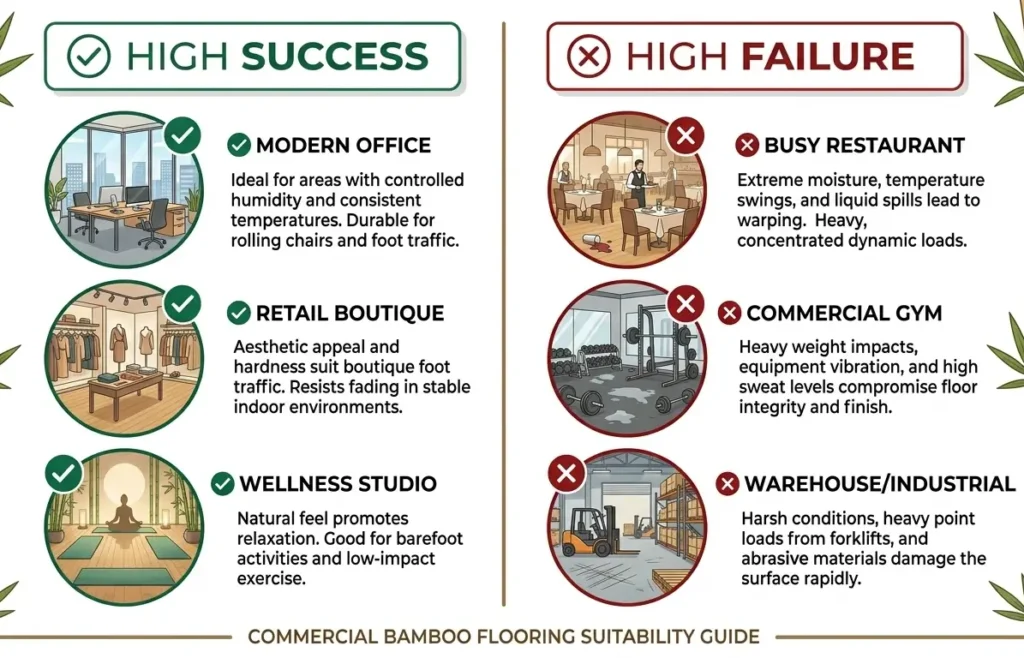
Strand-woven bamboo flooring performs well in commercial spaces with controlled environments, offices, retail without heavy carts, professional services. It fails predictably in restaurants, gyms with free weights, and any space where humidity swings more than 20% seasonally. Commercial-grade strand-woven bamboo costs $8-14 per square foot installed, but the real cost depends on whether your HVAC can hold 35-55% relative humidity year-round.
That restaurant taught me what manufacturer specs don’t: commercial bamboo flooring is conditional. The conditions matter more than the Janka rating.
Here’s what six years of tracking these installs revealed, including which applications I’d repeat and which I’d never touch again.
Which Commercial Spaces Actually Work for Bamboo Flooring?
Strand-woven bamboo with Janka ratings above 4,000 lbf handles foot traffic better than most hardwoods. That’s the easy part. The hard part is everything else commercial spaces throw at floors.
High-success commercial applications:
| Space Type | Why It Works | Critical Requirement |
| Professional offices | Consistent HVAC, low impact | Rolling chair mats on strand-woven |
| Retail boutiques | Moderate traffic, aesthetic priority | No heavy inventory carts |
| Wellness studios | Barefoot traffic, controlled climate | Radiant heat compatible products only |
| Waiting rooms | Low traffic, easy maintenance | Chair glides on all furniture |
High-failure commercial applications:
Restaurants fail not from foot traffic, they fail from water. Dishwasher leaks, ice machine condensation, server spills that sit during rushes. My restaurant install developed cupping at expansion joints within eight months. The strand-woven material rated 4,800 lbf Janka, but Janka measures indentation resistance, not moisture tolerance.
Gyms with free weight areas crack bamboo flooring. I watched a client’s gym floor spider-crack under a dropped 45-lb plate from waist height. The material was rated “commercial grade.” That rating has no standard definition.
[Learn more about durability specifications in our guide to bamboo flooring hardness and durability.]
The Commercial Warranty Problem Nobody Mentions
Here’s what cost me $34,000 to learn: most bamboo flooring warranties exclude commercial use entirely, or include clauses that commercial spaces inevitably violate.
I pulled the warranty documents from seven major bamboo flooring brands. Every single one contained at least one of these exclusions:
- “Residential use only”
- “Humidity must remain between 35-55% RH”
- “Not warranted for food service environments”
- “Commercial use limited to light traffic”
What “light commercial traffic” actually means:
The NWFA doesn’t define traffic ratings for bamboo specifically, but adapts hardwood guidelines. “Light commercial” typically means fewer than 150 people per day, a small professional office, not a retail store during holiday season.
My office installation, 5,000 sq ft of strand-woven bamboo installed in 2019, still looks excellent after six years. That office averages 40 people daily. Same product in a retail boutique averaging 200 visitors daily showed visible wear paths by year three.
Warranty claim reality:
When I filed a claim on the restaurant floor, the manufacturer’s inspection found humidity records showing spikes to 68% RH during summer (Louisiana, no surprise). Claim denied. The cupping was “environmental damage,” not product failure.
Was the product defective? No. Was it wrong for that application? Absolutely. The manufacturer knew it. They sold it anyway.
True Cost Comparison: Bamboo vs. Commercial Alternatives
Everyone quotes material cost. Nobody quotes the total cost of ownership over a 10-year commercial lease.
| Flooring Type | Material/SF | Installation/SF | Total Installed |
| Commercial LVP | $3.50-6.00 | $2.00-3.50 | $5.50-9.50 |
| VCT (vinyl composite) | $1.50-3.00 | $2.00-3.00 | $3.50-6.00 |
| Strand-woven bamboo | $5.00-8.00 | $3.50-6.00 | $8.50-14.00 |
| Commercial hardwood | $8.00-15.00 | $4.00-7.00 | $12.00-22.00 |
But initial cost is 40% of the story. The NWFA’s lifecycle guidelines suggest commercial hardwood alternatives need refinishing every 5-7 years in moderate traffic. Strand-woven bamboo’s density delays this, my office floor won’t need refinishing until year 8-10 based on current wear.
10-year TCO analysis (5,000 sq ft office):
| Cost Factor | Commercial LVP | Strand-woven Bamboo |
| Initial install | $37,500 | $57,500 |
| Refinishing (yr 7) | Replace: $37,500 | Screen & recoat: $7,500 |
| Annual maintenance | $1,200 | $800 |
| HVAC humidity control | Standard | +$2,000/yr premium |
| 10-Year Total | $87,000 | $85,000 |
The numbers are closer than most guides suggest. Bamboo wins on longevity but loses on humidity control requirements. For spaces with existing precision HVAC, healthcare, data centers, high-end offices, bamboo’s TCO advantage is real. For spaces with standard commercial HVAC, the humidity control premium erases most savings.
[For installation specifics, see our detailed bamboo flooring installation guide.]
Commercial Installation: What Changes From Residential
Residential bamboo installation is straightforward. Commercial installation has three additional failure points I learned the expensive way.
Glue-down is mandatory, not optional.
Floating installations fail in commercial spaces. Period. The click-lock connections weren’t designed for rolling loads, office chairs, retail carts, cleaning equipment. By month six of a floated commercial install, joints separate. Edges lift. Water infiltrates.
Commercial bamboo requires full-spread adhesive meeting ASTM D3498 for moisture-cure urethane. Budget $1.50-2.00 per square foot for adhesive alone. This isn’t where you cut costs.
Subfloor moisture testing must meet ASTM F2170.
The in-situ relative humidity test is non-negotiable for commercial concrete. Calcium chloride tests (ASTM F1869) aren’t sufficient, they only measure surface moisture. Commercial slabs can have 90%+ RH at depth while reading acceptable at surface.
My restaurant floor passed calcium chloride testing. Failed the RH probe test at 85%. I ignored the probe results because the timeline was tight. Fourteen months later, I was tearing out $34,000 of flooring.
Expansion gaps require commercial-grade covers.
Residential T-moldings crack under rolling traffic. Commercial installations need aluminum or steel expansion covers rated for wheelchair/cart crossings. These cost 3-4x residential trim but prevent the gap-edge damage that voids warranties.
LEED Credits and Sustainability Certifications for Commercial Bamboo
Commercial projects chasing LEED v4.1 certification have real reasons to consider bamboo beyond aesthetics.
Available credit contributions:
| LEED Category | Credit | Bamboo Qualification |
| Materials & Resources | Sourcing of Raw Materials | FSC-certified bamboo: up to 2 points |
| Indoor Environmental Quality | Low-Emitting Materials | FloorScore + CARB Phase 2: up to 3 points |
| Materials & Resources | Building Product Disclosure | EPD (Environmental Product Declaration): 1 point |
The certification stack that matters:
For commercial bamboo, I now require all three:
- FSC certification , Chain of custody documentation from forest to factory
- FloorScore certification , Indoor air quality testing per CDPH Standard Method
- CARB Phase 2 compliance , Formaldehyde emissions below 0.05 ppm
I made the mistake once of specifying bamboo with CARB compliance but no FloorScore. The product off-gassed enough VOCs to trigger complaints in a wellness studio, legal under CARB, but inappropriate for that IAQ-sensitive application.
INBAR’s 2022 lifecycle assessment data shows Moso bamboo (Phyllostachys edulis) sequesters significant carbon during growth, but manufacturing and shipping to North America adds 40-60% to the carbon footprint. “Carbon negative” marketing claims typically ignore this. For true sustainability impact, source from manufacturers with verified EPDs, Cali Bamboo and MOSO International both publish these.
[Explore certification details in our bamboo flooring certifications guide.]
Maintenance Protocols That Differ From Residential
Commercial bamboo maintenance isn’t harder than residential, it’s different. The protocols that keep my office floor pristine would destroy that same floor in a retail environment.
Daily maintenance (high-traffic commercial):
- Dry dust mop before opening and after closing
- Spot clean spills immediately with pH-neutral cleaner
- Entry mat protocol: 6+ feet of absorption matting at all entrances
Weekly maintenance:
- Damp mop with bamboo-specific cleaner (Bona Professional or equivalent)
- Inspect expansion joints for debris accumulation
- Check humidity logs, yes, you need to track this
What I changed after year two:
I initially used the same cleaning products as residential. By year two, the office floor had a haze the manufacturer blamed on “cleaning product buildup.” Switching to Bona Pro Traffic HD, formulated for commercial polyurethane finishes, resolved it.
The retail boutique needed chair glides replaced every 8 months. Commercial-grade felt pads from hardware stores lasted 3 months. Restaurant-grade?”ptfe glides from a hospitality supplier lasted the full 8 months. Small detail, significant difference.
When I Recommend Commercial Bamboo, And When I Don’t
After six years and four commercial installations, my position has narrowed considerably.
I actively recommend strand-woven bamboo for:
- Professional offices with 50 or fewer daily occupants
- Retail spaces without heavy inventory movement
- Wellness and spa environments (with radiant heat verification)
- Waiting rooms and reception areas
- Spaces where clients see the floor as part of the brand
I actively discourage bamboo for:
- Any food service (restaurants, cafeterias, break rooms with kitchens)
- Gyms or fitness centers
- Retail with heavy carts or pallet jacks
- Spaces without precision humidity control
- Warehouses or light industrial (obviously)
- Healthcare with frequent wheel traffic
The question I ask clients now:
“Can you guarantee 35-55% relative humidity year-round, and can you live without a warranty claim if you’re wrong?”
If both answers are yes, strand-woven bamboo can outperform and outlast commercial alternatives. If either answer is no, I steer toward commercial LVP with a realistic replacement timeline built into the budget.
The $34,000 restaurant floor didn’t fail because bamboo is bad. It failed because I prioritized aesthetics over conditions. Every commercial bamboo success I’ve had came from environments that matched what the material actually needs, not what the spec sheet implied it could handle.
If you’re evaluating bamboo flooring for new commercial construction or comparing against traditional options, the material can absolutely perform. But performance requires the right environment, not just the right product.
Is bamboo flooring good for commercial use?
Strand-woven bamboo flooring (4,000+ lbf Janka) performs well in climate-controlled commercial spaces with moderate foot traffic, offices, boutique retail, professional services. It fails predictably in restaurants, gyms, and spaces with humidity swings exceeding 20%. Commercial installations cost $8.50-14.00 per square foot installed and require glue-down installation with ASTM-compliant moisture testing.
Frequently Asked Questions
How long does commercial bamboo flooring last compared to hardwood?
Strand-woven bamboo outlasts most commercial hardwood installations in controlled environments, I’m projecting 20-25 years from my 2019 office install versus typical 15-year commercial hardwood lifecycles. The key is density: strand-woven bamboo at 4,500 lbf Janka wears slower than red oak (1,290 lbf) under equivalent traffic. However, this assumes proper humidity control. Uncontrolled environments accelerate bamboo degradation faster than hardwood due to bamboo’s higher dimensional response to moisture.
Can bamboo flooring be used in restaurants or food service?
Technically yes; practically, I’d never do it again. Restaurants combine the three factors that destroy bamboo: water exposure (spills, kitchen moisture, ice machine condensation), humidity swings (kitchen heat versus AC cycling), and rolling cart traffic. My restaurant install lasted 14 months before cupping required full replacement. If a client insists, I require waterproof LVP in kitchen and service areas with bamboo limited to dining rooms far from service paths, and I document that the warranty likely won’t cover the failure.
What certifications should commercial bamboo flooring have?
For commercial installations, require all three: FSC certification (sustainable sourcing verification), FloorScore certification (indoor air quality testing per CDPH standards), and CARB Phase 2 compliance (formaldehyde below 0.05 ppm). LEED projects should also request an EPD (Environmental Product Declaration) for Materials & Resources credits. Missing any one of these creates either compliance risk, IAQ issues, or sustainability documentation gaps.
Is commercial bamboo flooring more expensive than hardwood?
Initial installation costs less, commercial strand-woven bamboo runs $8.50-14.00/SF installed versus $12.00-22.00/SF for commercial hardwood. The 10-year TCO is closer because bamboo requires humidity control infrastructure that hardwood tolerates better. In spaces with existing precision HVAC (healthcare, data centers), bamboo’s TCO advantage reaches 15-20%. In standard commercial HVAC environments, hardwood’s lower maintenance requirements often equalize total costs.