Bamboo offers genuine environmental benefits, Moso bamboo (Phyllostachys edulis) sequesters up to 12 tonnes of CO₂ per hectare annually, regenerates without replanting, and reaches harvest maturity in 3-5 years compared to 25-60 years for hardwood timber.
But here’s what five years of tracking sustainability claims taught me: the raw material is only half the equation. Manufacturing processes, adhesive chemistry, shipping distances, and certification legitimacy determine whether your bamboo product actually reduces environmental impact, or just looks like it does.
I’ve installed bamboo flooring in four rooms, furnished two patios with bamboo furniture, and grow six bamboo species in Zone 7b. Some of those purchases were genuinely sustainable. Others were greenwashing I didn’t catch until later. The difference wasn’t obvious at the point of sale.
What follows is what I wish someone had told me before my first bamboo purchase, backed by INBAR research, FSC audit data, and my own verification of manufacturer claims.
Why “Bamboo Grows Fast” Doesn’t Equal “Sustainable Product”
The sustainability conversation usually starts and ends with growth rate. Bamboo’s rapid regeneration, some species add 36 inches in 24 hours during peak season, makes it genuinely renewable. A Moso bamboo grove reaches harvest maturity in 4-5 years. Red oak needs 60+ years.
That’s where most guides stop. Here’s where the complications begin.
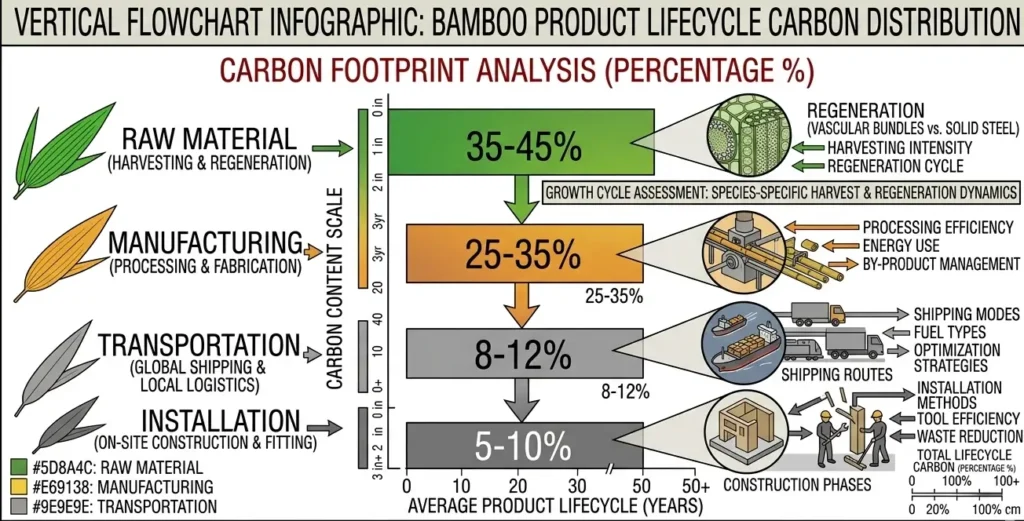
INBAR’s 2021 lifecycle assessment of bamboo flooring found that raw material production accounts for only 35-45% of total carbon footprint. The remaining 55-65% comes from processing (carbonization, lamination, compression), adhesive manufacturing, and transportation. For bamboo shipped from China to North America, which describes 90%+ of the market, container shipping adds 8-12% to the total environmental impact.
I used to recommend any bamboo over tropical hardwood. Now I check three things first: certification status, manufacturing location, and adhesive type. A FSC-certified bamboo product manufactured with formaldehyde-free adhesives genuinely outperforms conventional hardwood. An uncertified product using urea-formaldehyde resins, shipped 8,000 miles, and installed over a petroleum-based underlayment? The math gets murkier.
Carbon Sequestration: Real Numbers vs Marketing Claims
Moso bamboo sequesters 10-12 tonnes of CO₂ per hectare per year during active growth phases, roughly 35% more than equivalent stands of Chinese fir, according to INBAR’s 2023 comparative analysis. That’s a legitimate environmental advantage. But I’ve seen this data weaponized into misleading “carbon negative” product claims.
Here’s what the marketing leaves out:
The sequestration happens in living bamboo groves. Once harvested and processed into flooring or furniture, that carbon is locked in the product, it’s not actively removing CO₂ anymore. Meanwhile, the grove regrows and resumes sequestration, which is genuine benefit. But calling a manufactured product “carbon negative” requires accounting for everything: harvesting equipment, factory emissions, adhesive production, curing ovens, shipping containers.
When I contacted three manufacturers claiming “carbon negative” flooring in 2022, only one could provide third-party lifecycle verification. The other two cited the raw bamboo sequestration numbers without manufacturing offsets. That’s not fraudulent, but it is incomplete.
The honest claim: sustainably managed bamboo production contributes to carbon sequestration at the plantation level. The manufactured product has a carbon footprint that’s typically 40-70% lower than equivalent hardwood products, assuming comparable shipping distances.
What FSC Certification Actually Verifies (And What It Doesn’t)
I paid 22% more for FSC-certified bamboo flooring in 2021. Worth it? That depends on what you think you’re buying.
Forest Stewardship Council (FSC) certification verifies chain-of-custody from forest to manufacturer, confirming the bamboo came from responsibly managed sources with documented harvesting practices, worker protections, and ecosystem preservation protocols. It does NOT verify:
- Formaldehyde emission levels (that’s CARB Phase 2)
- Indoor air quality impact (that’s FloorScore or GREENGUARD)
- Total carbon footprint (no universal standard exists)
- Manufacturing energy sources (varies by facility)
I learned this the hard way. My FSC-certified flooring, legitimately sourced from a certified Moso plantation in Zhejiang Province, still triggered my wife’s chemical sensitivity for three weeks after installation. The certification guaranteed ethical forestry, not low VOC off-gassing. Those are separate certifications.
What to actually verify:
| Certification | What It Covers | What It Doesn’t |
| FSC/PEFC | Sustainable forest management, chain of custody | Emissions, air quality, carbon footprint |
| CARB Phase 2 | Formaldehyde limits (0.05 ppm) | Other VOCs, total emissions |
| FloorScore | Indoor air quality (VOC panel) | Sourcing, forestry practices |
| GREENGUARD Gold | Low chemical emissions | Forestry, carbon footprint |
For actual sustainability, I now require FSC + CARB Phase 2 minimum. For health-sensitive installations, add FloorScore. That combination costs 15-30% more than uncertified alternatives, but it’s verifiable, not just marketed.
The Manufacturing Problem Nobody Discusses
This changed my perspective entirely.
In 2019, I visited a bamboo flooring facility during a sourcing trip. The strand-woven compression process, which creates that ultra-hard 3,000+ lbf Janka product, requires industrial presses, adhesive application, and high-temperature curing. The energy consumption was substantial. The adhesive mixing area required respirators.
That factory produced both “eco-friendly” and “premium” product lines. Same equipment. Same adhesives. Different marketing.
The actual differentiator isn’t the bamboo itself, it’s adhesive chemistry. Formaldehyde-based resins (urea-formaldehyde, melamine-formaldehyde) cost 30-50% less than formaldehyde-free alternatives (soy-based, PVA, MDI). The sustainability difference is real: formaldehyde-free adhesives eliminate a persistent off-gassing source and reduce manufacturing health hazards.
My recommendation shifted after this: I no longer compare bamboo to hardwood as a binary choice. I compare specific products, including their adhesive formulations. A well-made, FSC-certified, NAF (no added formaldehyde) bamboo product outperforms most alternatives. A cheap, uncertified, urea-formaldehyde-bonded product? The “sustainability” is mostly marketing.
When Bamboo ISN’T the Sustainable Choice
I used to recommend bamboo for everything. Now I don’t.
Scenario 1: Short-term use. Bamboo’s environmental benefit compounds over product lifespan. My strand-woven flooring will last 25+ years, amortizing its manufacturing footprint over decades. If you’re renovating a rental for resale in 3 years, locally-sourced reclaimed wood may have lower lifecycle impact than newly manufactured bamboo shipped from Asia.
Scenario 2: Local hardwood availability. I installed bamboo in my Virginia home because local hardwood options (red oak, cherry) require 50+ year growth cycles. But for a project in Oregon with access to FSC-certified domestic Douglas fir? The 8,000-mile shipping advantage disappears.
Scenario 3: Unverifiable certification. I’ve seen products with fake FSC logos. The verification takes 30 seconds: FSC’s certificate database (info.fsc.org) shows every valid chain-of-custody certificate. If the manufacturer’s certificate number doesn’t appear, the logo is fraudulent. I’ve personally flagged three products this way since 2020.
Scenario 4: Replacing functional materials. The most sustainable floor is the one you already have. Refinishing existing hardwood costs less and uses fewer resources than new bamboo installation. I’ve talked clients out of bamboo when their current floors were salvageable.
Bamboo Applications With Genuine Environmental Impact
Where bamboo legitimately excels:
Carbon farming and land restoration. Establishing bamboo on degraded agricultural land sequesters carbon while generating harvestable material in 4-5 years. The International Bamboo and Rattan Organisation (INBAR) documents projects across 30+ countries using bamboo for erosion control and carbon sequestration. This works because the bamboo continues growing, the sequestration is ongoing, not just embodied in a manufactured product.
Hardwood alternative in deforestation-pressure regions. Bamboo doesn’t require clear-cutting. Selective culm harvesting from established groves maintains continuous canopy coverage and root systems. For regions where tropical hardwood demand drives deforestation, Southeast Asia, West Africa, South America, bamboo substitution reduces pressure on virgin forests.
Rapidly renewable building materials. Bamboo construction applications, structural bamboo panels, bamboo-reinforced concrete, engineered bamboo beams, offer strength comparable to steel at a fraction of the carbon cost. Guadua angustifolia, the primary structural species in Latin America, has a tensile strength exceeding mild steel by weight.
Closed-loop product systems. Bamboo is biodegradable under composting conditions, unlike most flooring adhesives and finishes. Some bamboo household products, cutting boards, utensils, toothbrushes, can genuinely enter circular waste systems. But read the fine print: bamboo products with synthetic finishes, plastic components, or non-biodegradable adhesives don’t compost cleanly.
How I Verify Sustainability Claims Now
After five years and a few expensive lessons, here’s my verification protocol:
Step 1: Certificate verification. FSC certificate database (info.fsc.org). Takes 30 seconds. If the number isn’t valid, walk away.
Step 2: Adhesive disclosure. Ask specifically: “Does this product use formaldehyde-based adhesives?” NAF (no added formaldehyde) or NAUF (no added urea-formaldehyde) are the terms you want. “Low formaldehyde” isn’t the same thing.
Step 3: Manufacturing location. Not for protectionism, for shipping footprint reality. Bamboo grown, processed, and sold within the same continent has 15-25% lower lifecycle carbon than intercontinental supply chains.
Step 4: Third-party verification requests. Legitimate manufacturers provide EPDs (Environmental Product Declarations), LCA summaries, or third-party audit reports. If they only offer marketing materials, I’m skeptical.
Step 5: Durability assessment. A bamboo floor lasting 30 years has half the lifecycle impact of one lasting 15 years. I prioritize strand-woven construction and manufacturer warranties exceeding 20 years.
Frequently Asked Questions
Is bamboo actually carbon negative?
Living bamboo groves actively sequester carbon, Moso bamboo captures 10-12 tonnes CO₂/hectare/year. Manufactured bamboo products contain embodied carbon but aren’t actively sequestering. “Carbon negative” product claims require verified lifecycle analysis including manufacturing and shipping; most such claims fail third-party verification.
Does bamboo flooring qualify for LEED certification points?
Yes, but conditionally. LEED v4 awards points for rapidly renewable materials (bamboo qualifies), FSC-certified sourcing, and low-emitting materials. However, the specific bamboo product must meet FloorScore or GREENGUARD thresholds for the low-emissions credit, FSC alone isn’t sufficient.
Is bamboo biodegradable?
Raw bamboo is fully biodegradable. Manufactured bamboo products depend on adhesives and finishes: formaldehyde-based resins and polyurethane coatings don’t break down cleanly. NAF bamboo with natural oil finishes approaches biodegradability, but most commercial flooring doesn’t meet that standard.
How do I spot greenwashing in bamboo products?
Request certificate numbers and verify through FSC’s database. Ask for specific adhesive chemistry disclosure. Be skeptical of vague terms (“eco-friendly,” “natural,” “green”) without certification backup. Legitimate sustainable products provide documentation; greenwashed products offer marketing language.
The Sustainability Calculation I Use Now
When someone asks if bamboo is sustainable, I ask back: compared to what? Under what conditions? With what certifications?
The material itself has genuine advantages, rapid renewability, high carbon sequestration during growth, strength-to-weight efficiency. But those advantages can be negated by irresponsible harvesting, formaldehyde-laden adhesives, 8,000-mile supply chains, and short product lifespans.
If I were starting over, I’d spend less time comparing “bamboo vs. hardwood” as categories and more time comparing specific products with verified credentials. The best bamboo furniture brands and flooring manufacturers invest in FSC certification, formaldehyde-free adhesives, and transparent supply chains. The worst ones coast on bamboo’s green reputation without earning it.
The sustainable choice isn’t a material. It’s a verified product from a transparent manufacturer, installed for long-term use, sourced with documentation you can actually check.