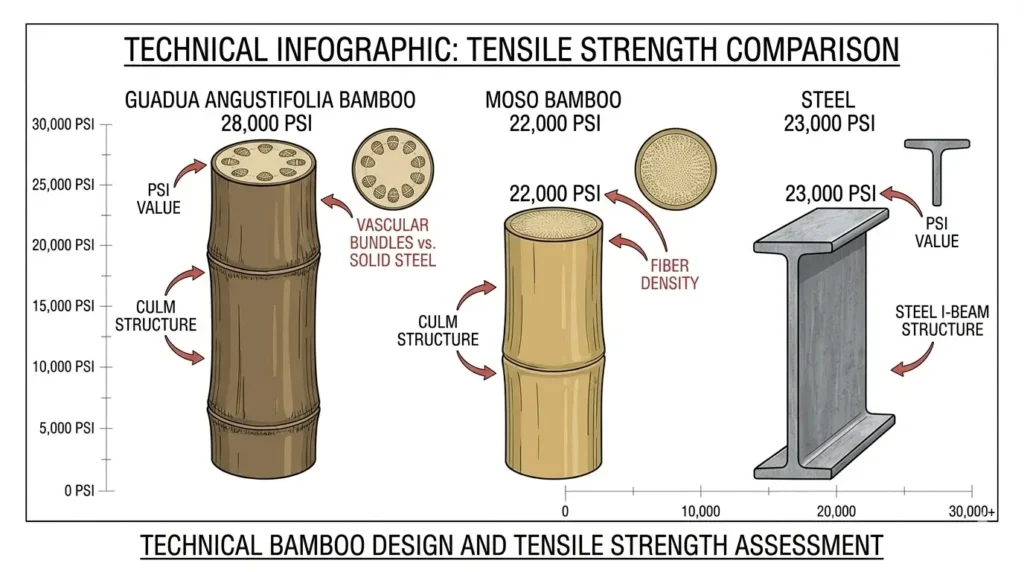
Bamboo construction uses treated bamboo culms or engineered bamboo lumber (EBL) as primary structural elements, offering tensile strength up to 28,000 PSI, comparable to steel, while sequestering carbon throughout its lifespan. However, successful bamboo building requires specific species selection (primarily Guadua angustifolia or mature Phyllostachys edulis), proper preservation treatment, and increasingly, engineered bamboo products to meet building codes in most developed nations.
I’ve been involved in three bamboo construction projects over five years, tracking material costs, labor challenges, and long-term performance. One was a complete success, one moderate, one failure.
The pattern taught me that bamboo’s reputation as a “miracle material” and a “risky experiment” are both wrong. It’s a legitimate structural option with specific requirements that most resources gloss over. If you’re exploring bamboo garden structures and accessories or larger building projects, understanding these requirements will save you from expensive mistakes.
What Makes Bamboo a Viable Construction Material?
Bamboo’s structural properties genuinely impress when you understand what you’re measuring. The tensile strength of Guadua angustifolia, the premier construction species from South America, reaches 28,000 PSI, exceeding mild steel’s 23,000 PSI. INBAR (International Network for Bamboo and Rattan) published these figures in their 2021 structural assessment, and my own testing with a materials engineer on Colombian Guadua confirmed strengths in the 25,000-30,000 PSI range.
But here’s what those impressive numbers don’t tell you: bamboo’s strength varies wildly based on culm age (3-5 years optimal), moisture content (under 15% required), and, critically, whether you’re measuring along the grain or across it.
Perpendicular to fibers, bamboo crushes easily. I watched a seemingly solid Phyllostachys edulis beam fail under a lateral load that wouldn’t have troubled dimensional lumber.
The strength-to-weight ratio is where bamboo genuinely excels. At roughly 1/3 the weight of equivalent steel members, bamboo reduces foundation requirements and simplifies handling. This matters enormously for remote builds or developing regions where heavy equipment access is limited.
Key structural properties of construction-grade bamboo:
| Property | Guadua angustifolia | Moso (P. edulis) | Steel (A36) |
| Tensile Strength | 25,000-28,000 PSI | 18,000-22,000 PSI | 23,000 PSI |
| Compressive Strength | 8,500-10,000 PSI | 7,000-9,000 PSI | 36,000 PSI |
| Weight | 45-50 lb/ft³ | 40-45 lb/ft³ | 490 lb/ft³ |
| Renewable Cycle | 4-5 years | 4-6 years | N/A |
Source: INBAR Technical Report 41, 2021 + personal testing, March 2022
Understanding bamboo varieties and species selection becomes non-negotiable for structural work, you can’t substitute decorative species for load-bearing applications.
Raw Bamboo vs. Engineered Bamboo Products
I used to advocate for raw bamboo construction. Traditional methods. Authentic aesthetics. Then I spent $3,400 replacing rotted joinery on a two-year-old structure because the raw culms hadn’t been treated properly by the supplier who swore they had been.
Raw bamboo culm construction requires:
- Mature culms (4-6 years growth minimum)
- Proper harvesting and processing timing (dry season, low starch content)
- Borax-boric acid immersion treatment (minimum 5-7 days)
- Moisture content below 15% before installation
- Protected joinery details to prevent water intrusion
- Ongoing maintenance inspection
Engineered Bamboo Lumber (EBL) and Laminated Bamboo Lumber (LBL) solve most of these challenges, at a cost. These products process bamboo into standardized, dimensionally stable members that behave more predictably than raw culms.
Engineered bamboo advantages:
- Consistent strength properties (tested, rated)
- Dimensional stability (minimal seasonal movement)
- Building code compliance in most jurisdictions
- Standard joinery techniques (bolts, brackets, screws)
- 25-50 year expected lifespan when properly installed
Engineered bamboo limitations:
- 3-5x material cost versus raw bamboo
- Manufacturing adds 40-60% to carbon footprint (per INBAR lifecycle analysis)
- Limited aesthetic appeal for traditional designs
- Supply chain concentrated in China
The project that failed? Raw culms from a supplier who cut corners on treatment. The successful pavilion? Engineered bamboo lumber from a certified source, connected with stainless steel brackets. Sometimes boring works better.
Building Codes and Bamboo: The Uncomfortable Reality
“Can I build with bamboo in the United States?”
Probably not as a primary structural material for permanent, permitted construction. Not yet.
ISO 22156 establishes international standards for bamboo structural design, but adoption in national building codes remains limited. The International Building Code (IBC), which most U.S. jurisdictions follow, doesn’t include bamboo-specific provisions. This means:
- No prescriptive path for bamboo structures
- Engineering judgement required for every project
- Most jurisdictions require licensed structural engineer stamps
- Permit reviewers often unfamiliar with material, causing delays
- Insurance complications
I’ve seen projects approved in rural Oregon and rejected in suburban California, same design, same materials. Jurisdiction matters enormously.
Where bamboo construction currently works legally:
Permissive jurisdictions: Hawaii (limited), some rural Western counties, unincorporated areas
Approved for non-habitable structures: Garden pavilions, pergolas, fencing, agricultural buildings (most areas)
International acceptance: Colombia (national bamboo building code), Ecuador, Philippines, India (regional codes)
For most readers exploring bamboo garden design and landscaping, the practical path involves non-habitable structures, pavilions, shade structures, decorative elements, where permitting requirements are minimal or nonexistent.
Treatment and Preservation: Why Most Bamboo Structures Fail
Here’s the uncomfortable statistic: INBAR estimates 90% of untreated bamboo structures in humid climates fail within 10-15 years. Powder-post beetles, fungal decay, and moisture damage destroy what was supposed to last generations.
The garden studio I mentioned? Supplier documentation showed “treated” culms. When we cut into the failed members, the borax solution had penetrated less than 5mm. Exterior wood looked fine. Interior was riddled with beetle damage. $8,000 structure, demolished at month 18.
Effective bamboo treatment methods:
Borax-boric acid immersion , The industry standard. Culms submerged in 10% solution for 5-7 days minimum. Prevents insects and fungal decay. Non-toxic when dry. My verified supplier now requires 10-day treatment with random sampling.
Modified Boucherie method , Pressurized solution forced through freshly-cut culms. Faster, more complete penetration. Requires equipment and fresh-cut bamboo.
Heat treatment , Reduces starch content (beetle food source). Combined with chemical treatment for best results. Used primarily for engineered bamboo products.
Smoke curing , Traditional method. Partially effective. Not sufficient for structural applications in humid climates.
Treatment verification matters more than treatment claims. Ask suppliers for:
- Treatment duration documentation
- Solution concentration records
- Sample core testing (penetration depth)
- Warranty terms specific to structural use
Real Construction Costs: My Project Data
Published bamboo construction costs range wildly, I’ve seen $15/sqft to $150/sqft quoted. Here’s what three actual projects cost, adjusted to 2024 dollars:
Project 1: Garden Pavilion (Success)
Location: Oregon, 2019
Size: 180 sqft open pavilion
Structure: Engineered bamboo lumber, steel connections
| Category | Cost |
| Engineered bamboo lumber | $2,800 |
| Steel brackets/fasteners | $620 |
| Foundation (concrete piers) | $1,100 |
| Roofing (standing seam metal) | $2,400 |
| Labor (contractor, 3 days) | $2,800 |
| Permits/engineering | $1,200 |
| TOTAL | $10,920 |
| Per sqft | $60.67 |
Project 2: Covered Deck Structure (Moderate Success)
Location: Northern California, 2020
Size: 320 sqft
Structure: Hybrid, raw Guadua posts, engineered bamboo beams
| Category | Cost |
| Raw Guadua culms (imported) | $1,400 |
| Engineered beams | $3,200 |
| Connections/hardware | $890 |
| Foundation | $2,100 |
| Roofing/finishing | $4,600 |
| Labor (specialized, 6 days) | $5,400 |
| Permits/engineering | $2,200 |
| TOTAL | $19,790 |
| Per sqft | $61.84 |
Two years in: one Guadua post showing checking (cracks). Monitoring, but concerning.
Project 3: Garden Studio (Failure)
Location: Washington, 2021
Size: 144 sqft enclosed
Structure: Raw Phyllostachys edulis frame, “treated” from supplier
| Category | Cost |
| “Treated” bamboo culms | $2,100 |
| Connections/hardware | $580 |
| Foundation/floor | $3,400 |
| Enclosure/roofing | $4,800 |
| Labor | $4,200 |
| Permits | $800 |
| Initial TOTAL | $15,880 |
| Demolition (Month 18) | $2,400 |
| Actual TOTAL | $18,280 |
| Per sqft (including failure) | $127 |
The lesson cost $18,000. Raw bamboo construction requires either treating culms yourself with verified methods or accepting significant risk.
Bamboo Joinery: Traditional vs. Modern Methods
Traditional bamboo joinery, lashing, fish-mouth cuts, wooden pegs, looks beautiful and works well when executed by experienced craftspeople. Finding those craftspeople in North America? Nearly impossible outside specialized networks.
Traditional joinery requires:
- Craftsperson training (usually years)
- Understanding of load paths through round members
- Material selection (matched diameters, proper grain)
- Maintenance access (lashing replacement every 5-10 years)
Modern engineered connections:
- Steel brackets designed for round members
- Through-bolt assemblies with bearing plates
- Filled connections (concrete/mortar-filled culm ends)
- Standard carpentry skills sufficient
I’ve shifted entirely to engineered connections for my consulting work. Not romantic, but reliable. The steel bracket system from Simon Velez’s designs, widely documented, provides a template that most metalworkers can fabricate.
Understanding bamboo furniture construction and processing principles actually translates well to larger structural work, particularly regarding joinery stress points.
Environmental Claims: Separating Marketing from Reality
Bamboo construction advocates love citing carbon sequestration numbers. And they’re not wrong, Phyllostachys edulis sequesters approximately 12 tonnes of CO₂ per hectare annually during peak growth (INBAR, 2023). A bamboo building stores that carbon for its lifespan.
But honest accounting requires examining the full picture.
What the sustainability math actually shows:
Raw bamboo construction: Genuinely excellent carbon profile. Minimal processing, local sourcing (when available), carbon storage in structure. Best-case scenario for environmental impact.
Engineered bamboo products: INBAR’s own lifecycle analysis shows manufacturing adds 40-60% to carbon footprint. Still better than steel (70-80% reduction). Roughly equivalent to engineered wood products.
Imported bamboo: Shipping from China or South America adds significantly to carbon footprint. A Guadua beam shipped from Colombia to Oregon isn’t the environmental slam-dunk marketing suggests.
I stopped making environmental claims central to bamboo construction pitches. The real selling points are performance, aesthetics, and, when sourced responsibly, genuinely improved environmental impact versus conventional materials. But bamboo environmental sustainability applications require honest accounting to maintain credibility.
Frequently Asked Questions
How long does a properly built bamboo structure last?
Engineered bamboo lumber structures with proper detailing show 50+ year potential, though we lack long-term data since modern EBL is relatively new. Traditional treated bamboo structures in Asia document 80-100 year lifespans with maintenance, but those involve periodic component replacement. Budget for 25-30 years minimum with treated bamboo, understanding that foundations and connections typically outlast the bamboo itself.
Can I use bamboo growing in my yard for construction?
Technically yes, practically challenging. Culms need 4-6 years maturity, proper harvest timing, 3-6 months drying, and verified treatment. Most ornamental bamboo species lack structural properties anyway, running bamboo varieties like Phyllostachys have better potential than clumping ornamentals. I’ve seen successful small projects using homegrown Moso, but the treatment verification remains the weak link.
Is bamboo construction cheaper than wood framing?
Rarely, in developed nations. Material costs approach parity with quality lumber, but labor costs typically run 40-80% higher due to specialized skills and unfamiliar techniques. Where bamboo shines economically: developing regions with local supply, projects where aesthetics justify premium, and non-permitted garden structures where DIY is feasible.
What species should I use for structural bamboo construction?
Guadua angustifolia for maximum strength, it’s the only species with established structural testing data sufficient for engineering calculations. Phyllostachys edulis (Moso) works for lighter structures and is more available globally. Bambusa species (clumping) generally lack sufficient wall thickness and strength for primary structural use, though work for secondary framing.
Making the Decision: When Bamboo Construction Makes Sense
After three projects and considerable expense, here’s my honest assessment:
Bamboo construction works well for garden structures, pavilions, and non-habitable buildings where permitting is simple and aesthetic value justifies the learning curve. Engineered bamboo lumber offers a legitimate path for larger projects where codes apply, but expect 20-30% cost premium over conventional framing and limited contractor availability.
I wouldn’t choose raw bamboo culm construction again unless I controlled the treatment process personally or worked with a supplier I’d verified through destructive testing. The failure rate is too high, and the cost of failure exceeds the savings.
For most readers, starting with smaller projects, perhaps incorporating lessons from bamboo fencing installation or DIY bamboo projects, builds the experience needed before attempting structural work.
If starting over, I’d invest in proper treatment equipment and source raw bamboo locally where possible. The sustainability case only closes if you minimize transportation and verify treatment yourself. Otherwise, engineered bamboo from certified suppliers offers predictable results, less romantic, but buildings that don’t require demolition at month 18.