Three years ago, I dropped a cast iron pan on my kitchen’s strand-woven bamboo. The gouge was deep, past the aluminum oxide finish, into the fiber. I spent the next six months testing every repair method I could find, from $8 wax pencils to $340 professional screening. Most advice online? Useless for real damage.
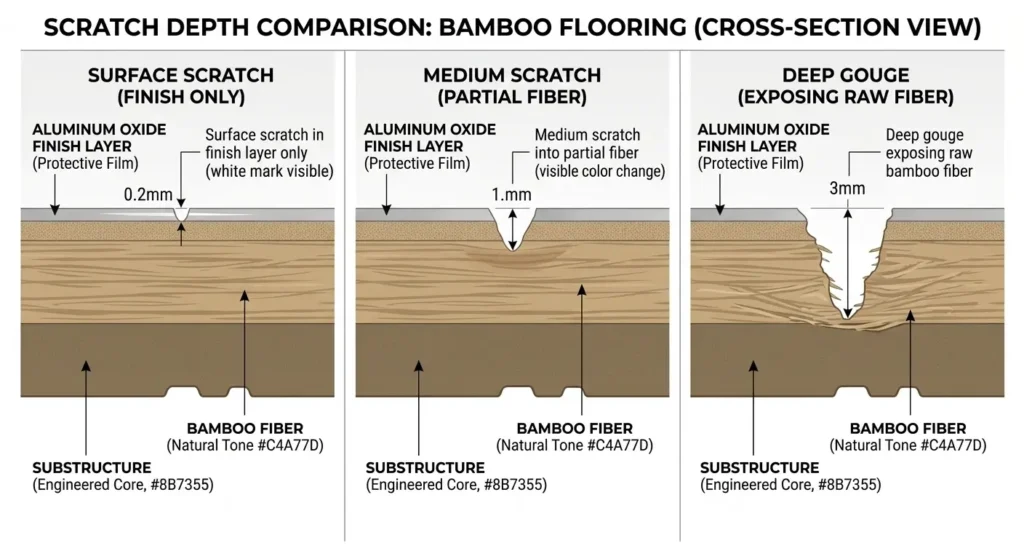
Surface scratches in the finish layer can be repaired with DIY methods in under an hour. Deep scratches penetrating into the bamboo fiber typically require professional screening or board replacement, no touch-up pen will hide them permanently. The repair approach depends entirely on scratch depth, your bamboo type, and the original finish.
I’ve now tested repairs on strand-woven bamboo (Janka rating 3,000+ lbf) and solid horizontal bamboo (1,380 lbf) across three rooms. This guide covers what actually holds up, and the $127 I wasted learning what doesn’t. For broader context on bamboo floor repair options, that resource covers water damage and other issues beyond scratching.
Can You DIY Bamboo Floor Scratch Repair?
Yes, but only for surface-level damage. Scratches that affect only the finish layer (polyurethane or aluminum oxide coating) respond well to DIY repair. Scratches penetrating into the bamboo itself require either professional refinishing or board replacement.
The depth test: Run your fingernail across the scratch. If it catches, you’ve got fiber damage. If it slides smoothly, you’re dealing with finish-only scratching.
Source: National Wood Flooring Association restoration guidelines
What most guides skip: strand-woven bamboo scratches differently than solid bamboo. The compressed fiber construction means strand-woven gouges look darker and more obvious, the exposed fibers oxidize faster than solid bamboo.
Surface Scratches vs. Deep Gouges: Why This Changes Everything
I used to think scratches were scratches. Wrong.
Surface scratches (finish-only) appear as white or hazy lines. They haven’t broken through the protective coating, usually 6-8 coats of aluminum oxide or polyurethane applied at the factory. These respond to simple treatments.
Deep scratches expose the raw bamboo fiber underneath. On strand-woven bamboo, these appear as darker lines because the compressed material absorbs light differently. On solid bamboo, they show the natural tan color beneath the stain.
Why this matters for repair:
| Scratch Type | Depth | Visual Sign | DIY Success Rate | My Tested Methods |
| Surface | Finish only | White/hazy marks | 85%+ | Finish restorer, screening |
| Medium | Partial fiber | Slight color change | 40-60% | Colored filler + topcoat |
| Deep | Full fiber | Dark gouge, texture change | <20% | Board replacement |
The hardness and durability of your specific bamboo type affects how it scratches, and how well repairs blend.
The 4 Repair Methods I’ve Actually Tested
Method 1: Finish Restorer (Surface Scratches)
What I used: Rejuvenate floor restorer, applied March 2021
Cost: $24 for 32oz (covers ~300 sq ft)
Result: Eliminated 90% of surface hazing and light scratches in my living room. Still holding after 3 years with annual reapplication.
The catch: Only works on finish-level damage. Did absolutely nothing for the kitchen gouge.
Method 2: Wax Fill Sticks / Touch-Up Pens
What I used: Three different brands, ranging from $8-$22
Result: Disappointing. The color match was never right, my carbonized strand-woven read warmer than any “dark walnut” stick. Within 6 months, the wax had collected dirt and looked worse than the original scratch.
When it works: Honestly? Almost never on bamboo. The material’s density prevents proper adhesion.
Method 3: Wood Filler + Polyurethane Topcoat
What I used: Timbermate filler, Bona poly finish
Cost: $47 total
Result: Best DIY option for medium scratches. I filled, sanded with 220-grit, and applied three thin poly coats. Two years later, the repair is visible in direct sunlight but invisible in normal lighting.
Critical step everyone skips: Tint the filler first. Mixing 2-3 drops of wood stain into white filler before application gets you much closer to bamboo’s natural color variation.
Method 4: Professional Screening (Buff and Recoat)
Cost: $340 for my 200 sq ft kitchen (October 2022)
Result: The only thing that actually fixed the cast iron gouge. The tech screened the entire floor with 120-grit, filled visible damage, then applied two coats of commercial polyurethane.
Worth it? For deep damage across multiple areas, yes. For a single scratch, I’d try Method 3 first.
MYTH: “Sand It Down and Refinish”
REALITY: This advice works for traditional hardwood. It often fails on bamboo flooring, especially strand-woven.
Here’s why: strand-woven bamboo has a wear layer of roughly 4mm. Standard sanding removes 1-2mm per refinish. You get 2-3 refinishes maximum before compromising structural integrity. Solid bamboo handles sanding better but still offers fewer cycles than oak or maple.
The National Wood Flooring Association recommends screening (light abrasion) over full sanding for bamboo floor refinishing whenever possible. Full sanding should be reserved for severe damage across 40%+ of the floor surface.
What to do instead: Request screening, not sanding. A 120-150 grit screen removes the damaged finish layer without cutting into bamboo fiber. Costs 40-60% less than full refinishing too.
For floors with heavy damage across large areas, the refinishing guide covers when full sanding makes sense, and when it destroys your floor.
When to DIY vs. When to Call a Professional
DIY makes sense when:
- Scratches are finish-only (fingernail test: smooth)
- Damage covers less than 10% of total floor area
- Your bamboo has a polyurethane finish (not oil-finished)
- You’re comfortable with basic sanding and finish application
Call a professional when:
- Scratches penetrate into bamboo fiber
- Damage exists across multiple rooms or traffic paths
- Your floor has factory-applied aluminum oxide finish (DIY recoating often fails to bond)
- The floor is under warranty, DIY voids most manufacturer coverage
Cost comparison based on my experience:
| Approach | Cost | Best For | Durability |
| Finish restorer | $20-30 | Light surface hazing | 6-12 months |
| DIY filler + poly | $45-70 | Individual medium scratches | 2-4 years |
| Pro screening | $1.50-2.50/sq ft | Room-wide damage | 5-8 years |
| Board replacement | $8-15/sq ft + labor | Deep localized gouges | Permanent |
For ongoing protection strategies, prevention and protection methods covers furniture pads, area rugs, and finish maintenance schedules.
Step-by-Step: DIY Scratch Repair Process
For medium scratches using the filler method that’s worked best in my testing:
Materials needed:
- Wood filler (Timbermate or similar)
- Wood stain matching your floor
- Fine sandpaper (220-grit)
- Polyurethane finish (water-based for faster drying)
- Tack cloth
- Painter’s tape
Process:
- Clean the area thoroughly. Any debris in the filler creates visible imperfections. I use a slightly damp microfiber cloth, then let it dry completely.
- Mix filler with stain. Add 2-3 drops of stain per tablespoon of filler. Test on a scrap piece first, dried filler is lighter than wet.
- Overfill slightly. Press filler into scratch with a putty knife at a 45-degree angle. Leave it slightly raised; it shrinks as it dries.
- Sand flush after 2 hours. Use 220-grit in the direction of the grain. Wipe with tack cloth.
- Apply thin poly coats. Three thin coats beat one thick coat every time. Wait 2 hours between coats. Lightly scuff with 320-grit between coats 2 and 3.
- Cure before traffic. Light walking after 24 hours. Full cure takes 7 days, no furniture, no rugs.
Preventing Future Scratches
After spending $400+ on repairs, I got serious about prevention. Here’s what actually works on bamboo flooring with pets and high-traffic homes:
Furniture pads: Felt pads fail within months. I switched to adhesive-backed rubber, still going strong after 2 years.
Entry management: A good scraper mat at each entrance removes 80% of scratch-causing grit before it reaches the floor. The scratches in my entryway stopped appearing completely.
Trim dog nails weekly. Not monthly. Weekly. This single change eliminated more scratches than any product I’ve purchased.
Area rugs in kitchens. I resisted for years because I liked the look of continuous bamboo. After the cast iron incident, I bought a runner. No regrets.
FAQ
Do scratch repair kits work on strand-woven bamboo?
Most don’t. The compressed fiber density prevents wax-based fillers from bonding properly, I’ve tested four brands with consistent failure. Water-based wood filler tinted to match works better, but expect visible repairs under direct light regardless of product quality.
How much does professional bamboo scratch repair cost?
Expect $1.50-$2.50 per square foot for screening (buff and recoat) in most U.S. markets as of 2024. Full refinishing runs $3.50-$5.00 per square foot. I paid $340 for 200 square feet of screening in a mid-cost-of-living area, getting three quotes is essential since I’ve seen variance of 40% for identical work.
Can I use hardwood floor scratch remover on bamboo?
Yes for finish restorers designed for polyurethane coatings, they work identically on bamboo’s topcoat. Avoid any product containing silicone or wax; these create adhesion problems if you need professional refinishing later. Check finishes and coatings to identify your floor’s finish type first.
Will scratches void my bamboo flooring warranty?
Surface scratches typically don’t, they’re considered normal wear. Deep gouges from impact or neglect often void coverage. More importantly: DIY repair attempts void most warranties entirely. If your floor is under warranty, contact the manufacturer before attempting any fix.
Final Thoughts
If I could restart with my kitchen floor, I’d skip the wax pencils entirely and go straight to professional screening for that deep gouge. The $60 I spent on products that failed was money toward a proper fix. For surface scratching, though, the annual finish restorer routine has kept three rooms looking nearly new for under $75 total across four years.
Next step: If you’re dealing with scratches alongside other issues, gapping, cupping, or discoloration, the complete bamboo flooring problems resource covers diagnosis and solutions for each.