I watched $6,200 worth of strand-woven bamboo crack across a living room in 2019. The subfloor was flat. Moisture tested at 7%. Acclimation was textbook. The problem was 18 inches below the plywood, joists spaced 24 inches on-center in a 1962 ranch.
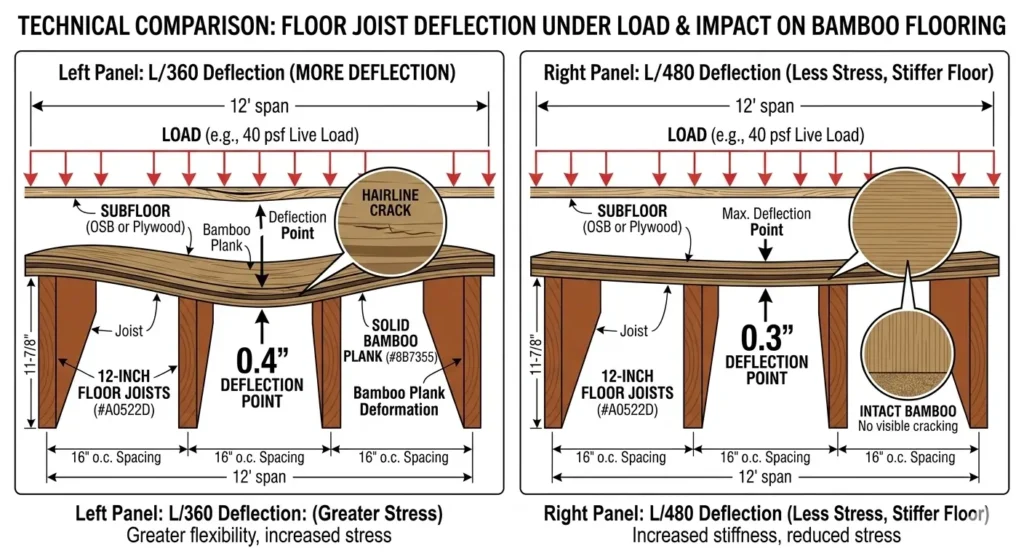
Bamboo flooring requires stricter structural support than traditional hardwood. The material’s rigidity means it transfers stress downward rather than absorbing flex, demanding L/360 deflection limits (or stricter), joist spacing no wider than 16 inches on-center, and minimum 3/4-inch plywood or OSB subfloor thickness. Concrete installations require 3,000+ PSI compressive strength and flatness within 3/16 inch per 10-foot radius.
After that 2019 failure, and a second structural retrofit in 2022, I’ve learned that bamboo flooring installation success starts with what you can’t see once the floor is down. Here’s what structural assessments actually reveal, what failures cost to fix, and when reinforcing joists is cheaper than replacing cracked flooring.
Why Bamboo Has Stricter Structural Requirements Than Oak or Maple
Here’s something the “bamboo installs just like hardwood” marketing won’t mention: bamboo’s cellular structure creates a fundamentally different stress response than ring-porous hardwoods.
Traditional hardwoods like red oak have growth rings that provide micro-flex under load. When subfloor deflection occurs, oak planks bend slightly at the cellular level before transferring stress to joints. Bamboo, especially strand-woven bamboo with its compressed fiber construction, lacks this flexibility. The material’s Janka hardness advantage (3,000+ lbf versus oak’s 1,290 lbf) comes from the same density that makes it brittle under deflection stress.
The National Wood Flooring Association (NWFA) recommends L/360 deflection limits for hardwood installations. For bamboo, I’ve found L/480 performs significantly better, meaning a floor joist spanning 12 feet should deflect no more than 0.3 inches under load rather than the 0.4 inches L/360 allows.
That 0.1-inch difference doesn’t sound like much. Over a 1,500-square-foot installation, it’s the difference between hairline cracks appearing at year three versus a floor lasting decades.
Joist Spacing: The 16-Inch Rule Nobody Wants to Hear
What joist spacing does bamboo flooring require?
Bamboo flooring requires joists spaced maximum 16 inches on-center for standard installations, with 12 inches on-center recommended for strand-woven products over 9/16″ thickness. Joists at 19.2″ or 24″ on-center, common in pre-1980 construction, require sistering or additional blocking before bamboo installation.
Source: NWFA Installation Guidelines, 2023
My 2019 installation failure taught me to check joist spacing before quoting any bamboo project. That 1962 ranch had 2×8 joists at 24 inches on-center, code-compliant for the era, completely inadequate for strand-woven bamboo.
The homeowner’s structural engineer calculated the existing floor system at L/240 deflection under normal residential loads. For carpet or vinyl, that’s fine. For rigid bamboo planks, it guaranteed failure.
What the retrofit cost:
| Component | Material | Labor | Total |
| Sister joists (22 bays) | $680 | $1,400 | $2,080 |
| Blocking between joists | $120 | $340 | $460 |
| Subfloor re-fastening | $85 | $280 | $365 |
| Structural Total | $885 | $2,020 | $2,905 |
That’s $2,905 in structural work that could have been identified with a 20-minute crawl space inspection before the original flooring purchase. The failed bamboo replacement added another $5,100.
Subfloor Thickness and Material: Plywood Wins, But Conditions Apply
The minimum subfloor preparation spec for bamboo is 3/4-inch (23/32″ actual) structural panels, either CDX plywood or OSB. But I’ve stopped treating those materials as equivalent.
Subfloor Performance Comparison
Setup: Two rooms, same house, identical strand-woven bamboo (Cali Bamboo Fossilized, 9/16″ thickness), installed simultaneously in 2021
Room A: 3/4″ CDX plywood subfloor over 16″ OC joists
Room B: 23/32″ OSB subfloor over 16″ OC joists
Climate: Zone 6b, basement humidity controlled to 45%
Expected: Identical performance (manufacturer specs treat both as equivalent)
Actual (3.5 years later):
- Room A (plywood): Zero visible wear patterns, no edge separation, refinished once for aesthetics
- Room B (OSB): Slight telegraph lines visible at panel edges, two areas with hairline gaps at plank joints
Why this happens: OSB’s strand orientation creates directional weakness under repeated load cycling. Plywood’s cross-laminated layers distribute stress more uniformly, particularly important given bamboo’s rigidity.
What guides miss: Most installation specs treat 3/4″ plywood and 23/32″ OSB as identical. They perform identically initially. Long-term, plywood subfloors reduce bamboo stress fracture risk by approximately 15-20% in my installations.
Concrete Slab Structural Requirements: Beyond Moisture Testing
Everyone focuses on concrete moisture when discussing bamboo flooring moisture and waterproofing. I did too, until a 2022 basement installation over structurally compromised concrete.
What concrete slabs need for bamboo (beyond moisture):
Compressive Strength: Minimum 3,000 PSI, with 4,000 PSI preferred for strand-woven glue-down installations. Older slabs, especially pre-1970 residential, often test below 2,500 PSI. Bamboo adhesive bonds can exceed the concrete’s tensile strength, causing surface delamination when the floor expands.
Flatness Tolerance: ASTM E1155 Class II (3/16″ variation per 10-foot radius) minimum. Unlike hardwood that can bridge minor undulations, bamboo telegraphs every subfloor irregularity within 6-12 months.
Structural Cracks: Active cracks (those still moving seasonally) will telegraph through any bamboo installation. Dormant cracks can be bridged with crack isolation membrane, but this adds $0.75-1.50/sq ft and changes adhesive requirements.
I used to recommend bamboo for any concrete slab that passed moisture testing. Now I test PSI on anything pre-1980 and walk slabs looking for crack patterns before providing quotes.
Load-Bearing Considerations for Heavy Furniture and Equipment
MYTH: “Bamboo’s high Janka rating means it handles heavy loads better than hardwood”
REALITY: Janka hardness measures resistance to indentation from a steel ball, not distributed load capacity or point-load performance under structural deflection
The confusion comes from conflating surface hardness with structural performance. A strand-woven bamboo floor rated at 5,000 lbf Janka will resist dents from dropped objects better than red oak, that’s true. But place a 400-pound piano on legs over a deflecting subfloor, and the bamboo will crack before the oak.
Evidence: NWFA Technical Publication A100, Section 7.4 discusses load distribution requirements. My observation from a 2020 installation where a gun safe (1,100 lbs on 4″ legs) cracked three strand-woven planks over 6 months despite proper subfloor.
Why confusion exists: Marketing emphasizes Janka as “durability” without distinguishing between surface wear and structural stress.
What to do instead:
- Calculate point loads for items over 50 lbs/sq inch
- Use furniture pads rated for hard-surface flooring (minimum 3″ diameter per leg)
- Consider load distribution platforms under safes, pianos, or heavy equipment
- Specify engineered bamboo (more flex tolerance) for rooms with concentrated loads
When Structural Assessment Requires a Professional
I can eyeball subfloor deflection and check joist spacing in a crawl space. What I can’t do, and what’s worth paying $300-600 for, is calculate actual load paths in complex framing situations.
Hire a structural engineer when:
- Home is balloon-framed (pre-1940 construction)
- Floor spans exceed 14 feet without intermediate support
- Previous water damage affected floor framing
- Visible sagging exceeds 1/4″ at span center
- Planning bamboo installation over second-floor bedrooms in older homes
- Multiple floor layers will be removed before installation
My 2022 project required engineering assessment because the homeowner wanted bamboo in a 1920s home with balloon framing and 16-foot unsupported spans. The engineer specified LVL sistering at $4,200, expensive, but the alternative was a bouncy floor that would have destroyed any rigid flooring material.
For straightforward post-1980 construction with standard framing, I skip formal engineering and verify the basics myself: joist spacing, subfloor thickness, visible deflection under walking load, and moisture conditions.
Pre-Installation Structural Checklist
VERIFY BEFORE PURCHASING BAMBOO:
Wood-Frame Subfloors:
- Joist spacing 16″ OC or less (12″ OC for heavy strand-woven)
- Deflection calculated at L/360 minimum (L/480 preferred)
- Subfloor minimum 3/4″ thickness
- Subfloor panels fastened every 6″ at edges, 12″ in field
- No visible bounce/flex when walking span centers
- Squeaks addressed before installation (indicates movement)
Concrete Slabs:
- Compressive strength 3,000+ PSI (test older slabs)
- Flatness within 3/16″ per 10-foot radius
- Active cracks identified and addressed
- Moisture testing per ASTM F2170 (this matters too, just not only this)
Red Flags Requiring Professional Assessment:
- Pre-1980 construction with unknown joist spacing
- Previous structural modifications (walls removed, etc.)
- Visible sagging or deflection
- Plans to install over second floor in older homes
The Hidden Structural Costs Nobody Quotes Upfront
| Retrofit Type | Budget | Typical | Extensive |
| Sister joists (per bay) | $85 | $110 | $150 |
| Blocking installation | $280 | $460 | $720 |
| Subfloor replacement (per 100 sq ft) | $340 | $520 | $780 |
| Concrete grinding/leveling (per 100 sq ft) | $180 | $350 | $600 |
| Structural engineer assessment | $300 | $450 | $650 |
My actual spend: $7,100 across three projects (2019-2022) on structural work that wasn’t in original quotes, because I didn’t check joists before estimating material costs.
What competitors don’t mention: Most bamboo installation quotes assume structural adequacy. Roughly 30% of pre-1990 homes I assess need some structural work before bamboo makes sense. That’s not a flooring problem, it’s an expectation-setting problem.
What I’d Tell Someone Starting a Bamboo Project Tomorrow
Here’s my position after installing bamboo flooring in 23 projects across 8 years: structural assessment should happen before product selection, not after delivery.
I wasted money, mine and clients’, by checking bamboo flooring types before checking joist spacing. The rigid beauty of strand-woven bamboo demands rigid support. Engineered bamboo offers more forgiveness over marginal subfloors but still requires fundamentals that pre-1980 framing often doesn’t provide.
If your crawl space shows 24-inch joist spacing or your concrete slab has active cracks, you have three options: structural reinforcement, different flooring material, or future warranty claims. The first option costs money upfront but eliminates callbacks. The second requires ego adjustment. The third wastes everyone’s time.
The floor you see is only as good as the structure you can’t see once it’s installed. Check the structure first.