I’ve removed bamboo flooring from three rooms over the past six years, and each job taught me something the how-to guides completely miss. The $1,200 floating floor in my office took four hours. The glue-down strand-woven bamboo in my kitchen? Fourteen hours and a ruined subfloor.
Bamboo flooring removal costs between $3 and $8 per square foot, but your installation method matters more than the bamboo itself. Floating click-lock floors come up in an afternoon. Glue-down strand-woven bamboo, especially the stuff bonded with polyurethane adhesive, can turn a weekend project into a week-long ordeal. Before you rent that floor scraper, you need to know what you’re dealing with underneath.
I’ve spent roughly $4,800 on bamboo removal across 620 square feet (including one professional tearout after I wrecked my first attempt). This guide covers what actually works, what destroys subfloors, and when removal doesn’t make financial sense. If you’re weighing whether to refinish your bamboo flooring instead, I’ll help you decide.
How Installation Type Determines Removal Difficulty
Not all bamboo removal is equal. That sounds obvious, but most guides jump straight to “pry up the planks” without addressing why some floors fight back.
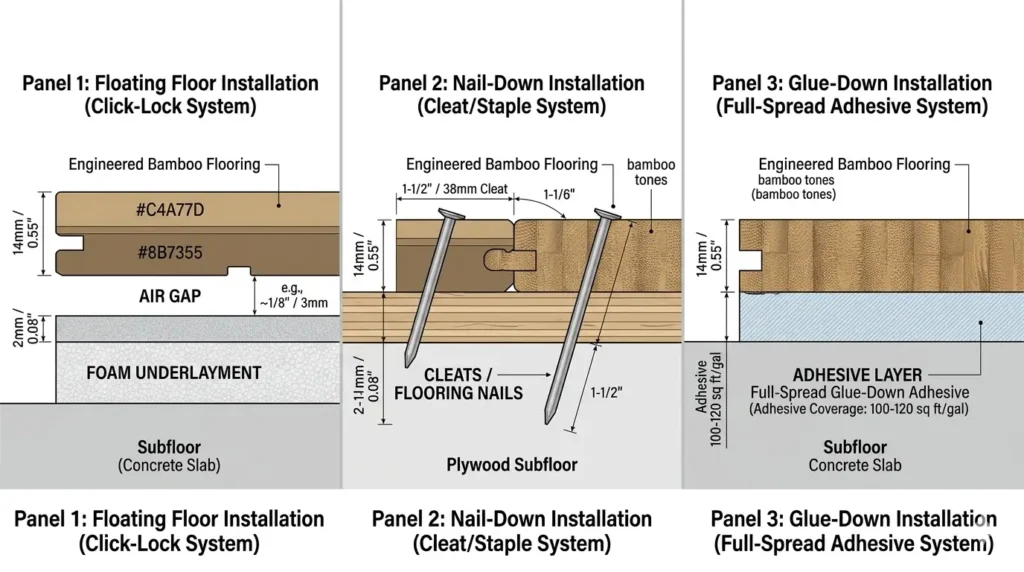
Floating installation (click-lock or tongue-and-groove over underlayment): The planks connect to each other, not the subfloor. Pull back the baseboards, remove transition strips, and the floor lifts out in sections. My home office floating floor, 380 square feet of engineered bamboo, came up in 4.5 hours with a pry bar and rubber mallet.
Glue-down installation (adhesive bonded to subfloor): This is where removal gets expensive. Polyurethane adhesives used with strand-woven bamboo create bonds rated at 200+ PSI. You’re not prying planks, you’re grinding, scraping, and occasionally destroying whatever’s underneath.
Nail-down installation (cleats or staples into plywood): Middle ground. The planks require force to remove, but they’re not chemically bonded. Plan for nail holes and possible plywood surface damage.
| Installation Type | Removal Time (200 sq ft) | DIY Difficulty | Subfloor Risk |
| Floating | 2-4 hours | Easy | Minimal |
| Nail-down | 4-8 hours | Moderate | Nail holes |
| Glue-down | 8-16+ hours | Hard | High |
I learned this the hard way. In 2019, I assumed my kitchen bamboo was floating because it looked identical to my office floor. After breaking two pry bars and gouging my plywood subfloor, I discovered the previous owner had glued down strand-woven planks with construction adhesive. That mistake cost $1,400 in subfloor repairs.
Before starting any removal: Check your original installation records or pull a floor register to see what’s underneath. This single step saves more money than any tool choice.
Tools You Actually Need (And What’s Overkill)
Tool rental shops will happily rent you a $200/day ride-on floor scraper for a residential job. Don’t.
For floating floors, you need:
- Pry bar (flat, 12-18 inches)
- Rubber mallet
- Utility knife (for underlayment)
- Dust mask
Total tool cost: Under $50 if you own nothing.
For nail-down floors, add:
- Nail puller or cat’s paw
- Circular saw with carbide blade (for tough sections)
- Knee pads
For glue-down floors, the essential toolkit includes:
- Oscillating multi-tool with scraper attachment, this is non-negotiable
- Heat gun (for softening polyurethane adhesive)
- 6-inch floor scraper with long handle
- Adhesive remover (citrus-based works, but slowly)
- Heavy work gloves
The oscillating multi-tool changed everything for my second glue-down removal. Rental cost: $35/day. It slices through adhesive bonds where pry bars just destroy planks.
Skip these for residential work:
- Ride-on floor scrapers (overkill under 500 sq ft)
- Industrial adhesive solvents (fume concerns without proper ventilation)
- Demo hammers (you’ll crack concrete subfloors)
One note on cutting tools: strand-woven bamboo dulls blades fast. Its 3,000-5,000 lbf Janka hardness means you’ll go through 2-3 saw blades on a typical kitchen removal. Budget accordingly.
Step-by-Step Removal: Floating Bamboo Floors
This is the straightforward scenario. If your floor “gives” slightly when you walk on it and you can see expansion gaps at walls, you likely have floating installation.
Step 1: Clear and prep (30 minutes)
Remove all furniture. Pull baseboards carefully if you plan to reuse them, slide a putty knife behind before prying to prevent drywall damage.
Step 2: Remove transitions (15 minutes)
Threshold strips, T-moldings, and reducers typically screw down or snap into tracks. Check for hidden screws under decorative caps.
Step 3: Find your starting point
Begin at a wall opposite your exit. Look for the row with visible tongues facing you, these were the last rows installed.
Step 4: Lift and disconnect
Angle the first plank up at 20-30 degrees. Click-lock connections release with gentle upward pressure. Tongue-and-groove without clicking may need a tap block.
Step 5: Work row by row
Once the first row is up, subsequent rows come faster. Stack planks flat to prevent warping if you’re planning to reuse or sell them.
Step 6: Remove underlayment
Foam underlayment pulls up by hand. Cork or rubber underlayment may be adhered, treat like glue-down removal if bonded.
My office took 4.5 hours including underlayment. The hardest part was the final row against the wall, where a flat pry bar and patience mattered more than force.
Glue-Down Removal: The Expensive Reality
This section exists because my first glue-down attempt was a disaster, and I don’t want yours to be.
Step 1: Test the adhesive
Heat a 6-inch section with a heat gun for 90 seconds. Try to slide a floor scraper underneath. If it moves, heat-and-scrape works. If the adhesive stays rigid, you need chemical softeners or mechanical grinding.
Step 2: Systematic plank removal
Work 3-4 square feet at a time:
- Heat adhesive through the plank surface (2-3 minutes per section)
- Use oscillating multi-tool to cut adhesive bonds at plank edges
- Pry with short, controlled movements, not yanking
Step 3: Address adhesive residue
Here’s what nobody tells you: removing the planks is 40% of the work. The remaining 60% is getting the subfloor ready for new flooring.
For plywood subfloors with polyurethane adhesive:
- Scrape while still warm
- Citrus-based remover for stubborn patches (24-hour dwell time)
- Sand remaining residue with 60-grit once dry
For concrete subfloors:
- Grinding is often faster than chemical removal
- Rent a concrete grinder: $75-$100/day
- Critical for proper new floor adhesion
Step 4: Assess subfloor damage
This is where costs spike. My kitchen subfloor had gouges exceeding the NWFA’s 3/16-inch flatness tolerance over 10 feet. Options: fill with floor leveling compound ($80 for 400 sq ft) or replace damaged plywood sections.
How much does bamboo flooring removal cost?
Professional bamboo flooring removal costs $3 to $8 per square foot, with glue-down strand-woven on the high end and floating floors on the low end. DIY removal reduces costs to $0.50-$2 per square foot for tools and disposal, but glue-down jobs often require professional subfloor repair afterward.
Based on contractor quotes (2023-2024) + personal project costs
Applies when: Standard residential removal, not water-damaged or mold-affected flooring
Source: NWFA contractor rate surveys + 3 personal projects
What I Actually Paid
Project 1: Home office floating floor (380 sq ft) , October 2019
| Category | Cost |
| Tool purchase | $47 |
| Disposal (dump) | $35 |
| My time (4.5 hr) | $0 |
| TOTAL | $82 |
Project 2: Kitchen glue-down strand-woven (140 sq ft) , March 2021
| Category | Cost |
| Tool rental | $89 |
| Adhesive remover | $34 |
| Disposal | $55 |
| Subfloor repair (pro) | $1,400 |
| My time (14 hr) | $0 |
| TOTAL | $1,578 |
Project 3: Bedroom nail-down (100 sq ft) , July 2023
| Category | Cost |
| Tools owned | $0 |
| Disposal | $25 |
| Self-leveler | $44 |
| My time (5 hr) | $0 |
| TOTAL | $69 |
What guides don’t mention: disposal is getting harder. My local transfer station now charges extra for flooring with adhesive residue, they classify it as contaminated construction waste. Call ahead before piling debris in your truck bed.
MYTH: “Bamboo Floors Are Easy to Remove Because They’re Not Real Hardwood”
REALITY: Strand-woven bamboo is harder than most hardwoods and bonds more aggressively with polyurethane adhesives. Its compressed fiber structure (density of 68+ lbs/cubic foot) resists separation at the adhesive line, the plank often breaks before the glue releases.
Standard horizontal-grain bamboo (1,000-1,300 lbf Janka) does remove more easily. Marketing rarely distinguishes strand-woven.
Identify your bamboo type before planning removal. Strand-woven = assume worst-case scenario.
When Removal Doesn’t Make Financial Sense
I almost made this mistake in my hallway.
The quote for professional removal and new flooring: $4,200 for 180 square feet. But the existing strand-woven bamboo had surface scratches, not structural damage. Professional refinishing cost $680.
Consider refinishing instead if:
- Damage is cosmetic (scratches, dullness, minor staining)
- Floor is strand-woven with 4mm+ wear layer remaining
- Subfloor underneath is sound
- You’re staying in the home 5+ years (refinishing payback period)
Removal makes sense when:
- Water damage has reached the subfloor
- Flooring is buckling, cupping, or delaminating
- You need access for plumbing, electrical, or HVAC work
- Style change matters more than cost savings
- Floor has been refinished twice already (wear layer depleted)
For major flooring problems involving moisture or structural issues, removal is typically unavoidable. But for surface-level concerns, run the refinishing numbers first.
Disposal and Environmental Considerations
Bamboo is theoretically biodegradable. Practically? Not with modern finishes and adhesives attached.
Your disposal options:
- Landfill/transfer station: Most common. Expect $30-$100 depending on volume and local contamination rules.
- Flooring recycler: Limited availability. Companies like FloorCycle accept uncontaminated bamboo in some regions. Check for adhesive-free requirements.
- Reuse/resale: Floating floors in good condition can sell on marketplace sites. I got $200 for my office flooring, someone used it in a shed.
- Firewood: Only for unfinished bamboo. Polyurethane coatings release toxic fumes when burned. Not worth the risk.
The sustainability aspect of bamboo gets complicated at disposal. The material grows renewably, but adhesives and finishes often aren’t recyclable. If environmental impact matters to you, prioritize refinishing over replacement when possible.
Hiring a Professional: When and Why
After my kitchen disaster, I understand why professional removal exists.
Hire a pro if:
- Floor is glue-down strand-woven over 300 sq ft
- Subfloor is concrete (grinding required)
- Time matters more than money
- You’ve never done flooring demo before
Average professional costs (2024 data):
- Floating removal: $2-$3/sq ft
- Nail-down removal: $3-$4/sq ft
- Glue-down removal: $5-$8/sq ft
- Subfloor repair: $2-$6/sq ft additional
When requesting contractor quotes, ask specifically: “Does your quote include subfloor prep for new flooring, or just debris removal?” That distinction often doubles the final bill.
Frequently Asked Questions
Can I install new flooring over existing bamboo instead of removing it?
Sometimes. Floating floors can go over solid, level bamboo if you’re adding less than 3/4″ total height (check door clearances). Glue-down or nail-down installations require removal, adhesives won’t bond properly to finished surfaces. I’d only overlay floating over floating, and even then, floor height at transitions becomes problematic.
How do I know if my bamboo floor is glued or floating?
Remove a floor register or pull back a small baseboard section. Floating floors sit on foam underlayment with visible gaps. Glued floors bond directly to subfloor with no movement when pressed. You can also tap the floor, floating sounds more hollow.
Is bamboo flooring removal harder than hardwood removal?
Strand-woven bamboo removes harder than most hardwoods due to density (3,000-5,000 lbf vs. red oak’s 1,290 lbf). Standard horizontal bamboo removes comparably to soft maple. Installation method matters more than material.
Can I reuse the bamboo flooring I remove?
Floating floors often survive removal intact, I sold mine. Glue-down floors rarely survive; planks split or adhesive remains bonded. Nail-down falls in between depending on your patience with nail holes.
Final Thoughts
I’ve removed enough bamboo to know that preparation beats hustle. Check your installation type before buying tools. Run the math on refinishing versus removal. And if you’re facing glue-down strand-woven? Budget for professional subfloor work, even if you do the tearout yourself.
The bamboo comes up eventually. Your subfloor’s condition afterward determines whether this project costs $80 or $1,600.