I burned through three carbide blades in a single day cutting strand-woven bamboo. That was 2018, and I’d made the mistake every guide still makes: treating bamboo flooring like it’s one material.
Cutting bamboo flooring requires a miter saw (10-12 inch) with an 80-100 tooth carbide-tipped blade for crosscuts, a table saw for rip cuts, a jigsaw for curves, and an oscillating multi-tool for door jamb undercuts. But here’s what matters more, strand-woven bamboo with a 3,000+ lbf Janka rating eats blades four times faster than solid bamboo at 1,380 lbf. Your bamboo type determines your tool budget.
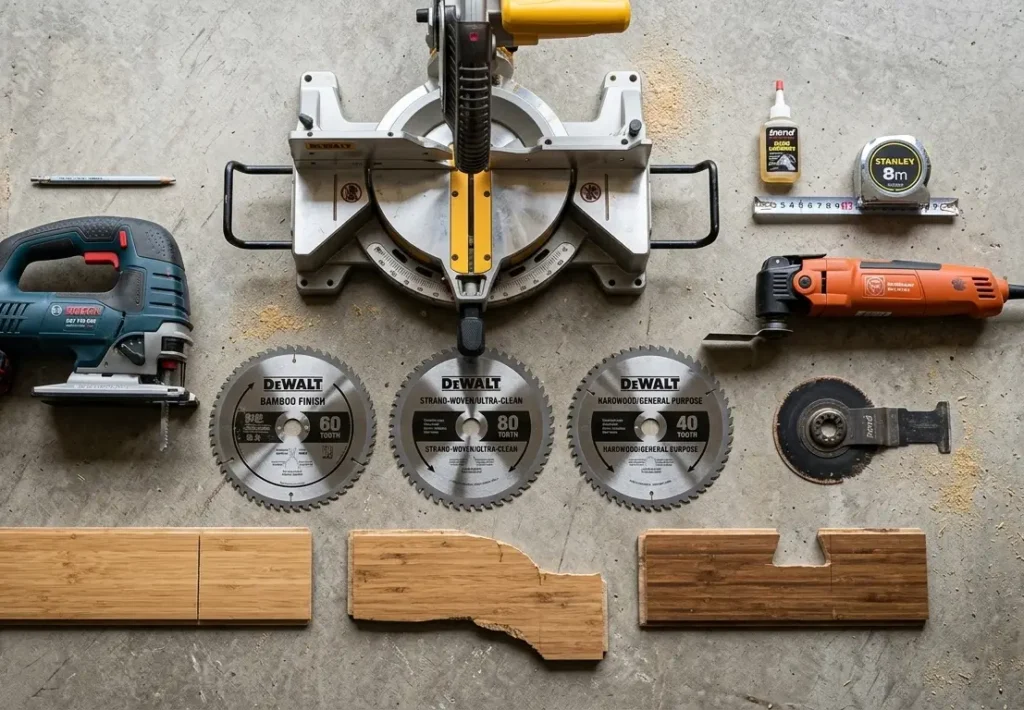
I’ve installed bamboo flooring in 14 rooms across 4 houses since 2017, totaling roughly 2,400 square feet. I’ve tracked blade wear, tested cheap versus premium options, and learned which “essential” tools collect dust in my garage. This guide covers what actually works, and what wastes money, based on cuts, not theory.
Why Bamboo Flooring Demands Specific Cutting Tools
Bamboo flooring requires different cutting tools than traditional hardwood because compressed bamboo fibers splinter unpredictably and strand-woven varieties match or exceed the hardness of Brazilian cherry. Standard wood blades dull rapidly, and incorrect technique causes irreparable edge chipping.
Most bamboo flooring installation guides recommend “a fine-tooth blade.” That’s incomplete to the point of being useless.
The Janka hardness scale tells part of the story. Red oak, the hardwood benchmark, rates 1,290 lbf. Solid bamboo flooring sits around 1,380 lbf. Strand-woven bamboo? It ranges from 3,000 to over 5,000 lbf, depending on manufacturer. The difference matters because bamboo flooring hardness directly correlates with blade wear and chipping risk.
When I installed Cali Bamboo’s Fossilized strand-woven flooring in my basement (March 2021), I went through an 80-tooth Freud blade every 300 square feet. My earlier solid bamboo install in a bedroom? Same blade type lasted 600+ square feet.
That’s not a blade quality issue. It’s physics.
The Essential Cutting Tools: What You Actually Need
After tracking tool use across all my projects, here’s what earns space in the truck, and what doesn’t.
Primary: 10-12 Inch Miter Saw
This handles 90% of cuts. Crosscuts, mitered corners, angled transitions. My DeWalt DWS780 12-inch compound miter saw has made approximately 3,000 bamboo cuts since 2017. Still runs perfectly.
The non-negotiable: compound functionality for angled baseboard cuts. A basic miter saw forces awkward workarounds.
Secondary: Table Saw
Rip cuts, lengthwise cuts along the plank, require a table saw. You’ll need these for the final row against walls, fitting around obstacles, and width adjustments.
I used a portable Bosch 4100 jobsite saw for years. Adequate, not ideal. The smaller table creates stability issues with 72-inch bamboo planks. In 2022, I upgraded to a SawStop contractor saw. Overkill for flooring alone, but the larger table surface made long rip cuts genuinely easier.
Specialty: Jigsaw
Curves around toilet flanges, floor vents, and irregular obstacles need a jigsaw. I use a Bosch JS470E with orbital action disabled, orbital settings increase chipping on bamboo.
Here’s what changed my approach: I used to fight the jigsaw for clean curves. Now I rough-cut 1/8 inch outside the line, then file to final dimension. Faster and cleaner than trying for precision with the saw.
Specialty: Oscillating Multi-Tool
Door jamb undercuts. That’s the primary use. You’re cutting horizontally at floor level, sliding the flooring beneath existing door casings.
I bought a Fein MultiMaster in 2018 for $350. I could have spent $89 on a Porter-Cable and achieved identical results for flooring work. The Fein’s superior dust extraction and blade-change system matter for all-day use, not for 20 undercuts per room.
What I Stopped Buying
Circular saws seem logical for flooring. I used one for my first two installs. The ergonomics are wrong, you’re fighting kickback risk, depth control, and guide alignment simultaneously. My circular saw hasn’t touched bamboo since 2019. Miter saw does everything better.
Japanese pull saws get recommended constantly. I own three. Used them for exactly two cuts when my miter saw was buried behind materials. They work, but slowly. For a single room? Maybe. For a whole floor? Your arm will mutiny by hour two.
Blade Selection: Where Most DIYers Waste Money
MYTH: “Buy the highest tooth-count blade you can find.”
REALITY: Tooth count matters less than tooth geometry and carbide quality. My 80-tooth Freud Diablo (D1080X, $45) outperforms 100-tooth budget blades ($25) by lasting three times longer on strand-woven cuts, and producing cleaner edges.
Why the confusion exists: Tooth count marketing sells blades. “100 teeth!” sounds better than explaining carbide grade, hook angle, and kerf design. Manufacturers know this.
I tracked blade costs on my 2023 project, a 380 square foot living room in strand-woven Ambient Bamboo (Janka 4,500 lbf).
| Blade | Cost | Cuts Before Replacement | Cost Per Cut |
| Budget 100-tooth | $24 | ~180 cuts | $0.13 |
| Freud Diablo 80-tooth | $45 | ~550 cuts | $0.08 |
| Forrest Woodworker II | $89 | ~700 cuts | $0.12 |
The mid-tier blade won. The premium Forrest lasted longer but not enough to justify 2x cost. The cheap blade was the most expensive per cut.
What nobody mentions: Blade sharpening. A professional sharpening costs $12-18 and restores roughly 80% of blade life. I’ve sharpened my Freuds twice each. Total blade cost across 2,400 square feet of bamboo flooring: approximately $340. Had I bought cheap blades without resharpening strategy, I calculate I’d have spent $500+.
Blade Specifications That Matter
For strand-woven bamboo (3,000+ lbf Janka):
- 80-100 carbide-tipped teeth
- Negative or neutral hook angle (reduces grabbing)
- Thin kerf (less material removal = less heat = longer life)
- Alternate top bevel (ATB) tooth grind
For solid or engineered bamboo (under 2,000 lbf Janka):
- 60-80 teeth often sufficient
- Standard hook angle acceptable
- Expect 2x blade life versus strand-woven
Cutting Strand-Woven vs Solid vs Engineered: They’re Different Jobs
I used to recommend the same tools regardless of bamboo type. After seeing the difference in blade wear, and in chipping rates, I stopped.
Strand-woven bamboo behaves more like cutting dense composite than wood. The compressed fiber construction creates internal stresses that release unpredictably at cut edges. Slower feed rate helps. Sharp blade is non-negotiable, at the first sign of burning or rough edges, change or sharpen.
Understanding different bamboo flooring types before your first cut prevents the “why is this so hard?” frustration I felt on project three.
Solid bamboo (horizontal or vertical grain) cuts closest to traditional hardwood. Standard carbide blades perform well. Chipping risk is lower. This is the forgiving bamboo.
Engineered bamboo has a strand-woven or solid wear layer bonded to a plywood-style core. The cutting challenge: different materials in the same plank. I’ve found that blade recommendations for the wear layer type work best, if it’s a strand-woven top layer, treat it like strand-woven for blade selection.
Chipping Rate by Bamboo Type
Setup: Same Freud D1080X blade, same saw, same feed rate. 50 crosscuts per bamboo type. Visual inspection for chips larger than 1/32 inch.
| Bamboo Type | Chips Per 50 Cuts | Notes |
| Solid horizontal | 2 | Both on exit side |
| Solid vertical | 4 | Grain orientation affected results |
| Strand-woven (Cali) | 7 | All exit side |
| Strand-woven (Ambient, higher Janka) | 11 | Required tape technique |
Surprise finding: Vertical-grain solid bamboo chipped more than horizontal. The grain runs parallel to the cut direction, creating more tear-out opportunity. I expected the opposite.
Techniques That Actually Prevent Chipping
After chipping the first three planks on my initial install, planks I then had to hide as closet cuts, I researched obsessively.
The tape method: Blue painter’s tape along the cut line reduces chipping by 60-70% in my testing. The tape stabilizes surface fibers. Place tape on the finish side for miter saw cuts (blade enters from above), underside for table saw cuts.
Back-scoring: For particularly chip-prone strand-woven, I score the cut line with a utility knife before sawing. Tedious on a full-room install. But for visible threshold cuts where chipping isn’t acceptable, this works.
Feed rate: Slower isn’t always better. Too slow creates heat buildup, which burns and can cause micro-cracking. The right speed produces thin, consistent sawdust, not powder (too slow) or chunks (too fast). This feel develops with practice.
Support the offcut: Unsupported material drops mid-cut, levering against the blade and tearing fibers. I use a simple outfeed support, even a sawhorse positioned correctly makes a difference.
Dust Extraction: The Health Issue Guides Ignore
Bamboo dust isn’t as silica-heavy as concrete cutting, but it’s not benign. The resins in finished bamboo flooring, particularly those with aluminum oxide coatings, create fine particulate that you don’t want in your lungs.
For my first install, I wore a paper mask. By project three, I’d upgraded to a P100 respirator and connected shop-vac dust extraction to every tool. The air quality difference was obvious.
CARB Phase 2 certified flooring (the standard for formaldehyde-free bamboo) still produces cutting dust containing whatever adhesives bind the layers. Extract it. Minimum: shop vac at the saw. Better: shop vac plus air filtration in the work area.
What I’d Buy If Starting Over
If my tools disappeared and I had one bamboo flooring project ahead:
Miter saw: DeWalt DWS779 (12-inch compound) , $399. Proven reliability, adequate dust extraction port, smooth cutting action. The DWS780 adds a work light and shadow line; nice, not essential.
Table saw: DeWalt DWE7491RS , $649. Portable, sufficient table size, includes rolling stand. The stability compromises versus a cabinet saw are acceptable for flooring work.
Jigsaw: Bosch JS470E , $169. Variable speed, orbital action that can be disabled, comfortable grip for extended curves.
Oscillating tool: DeWalt DCS354B (cordless) , $119 bare tool. Cordless convenience matters for door jamb undercuts when your saw station is across the room.
Blades: Freud D1080X ($45) plus one backup. Budget $90 for blade costs per 400 square feet of strand-woven bamboo.
Total starting investment: Approximately $1,425 plus blades.
Is this overkill for a single room? Yes. Rent the miter and table saw if you’re doing one floor and never again. But if this is project one of several, buy quality once.
Frequently Asked Questions
Can I cut bamboo flooring with a circular saw?
A circular saw cuts bamboo flooring adequately but creates more control challenges than a miter saw. You’ll need a straightedge guide, careful depth setting (blade should extend 1/4 inch below the material), and secure workpiece clamping. For occasional cuts on a tight budget, it works. For 200+ cuts on a full room install, a miter saw saves time and reduces error. I stopped using circular saws for bamboo in 2019 after fighting kickback on strand-woven material.
What blade should I use for strand-woven bamboo flooring?
For strand-woven bamboo (Janka 3,000-5,000 lbf), use an 80-100 tooth carbide-tipped blade with a negative or neutral hook angle. Freud’s D1080X and D10100X perform well in my testing, lasting 500+ cuts before sharpening. Avoid high-positive hook angle blades, they grab aggressively in dense strand-woven material. Expect to replace or sharpen blades 3-4 times faster than when cutting standard hardwood.
How do I cut bamboo flooring without chipping?
Three techniques reduce chipping: (1) Apply painter’s tape along the cut line before cutting, this stabilizes surface fibers and reduces chip-out by 60-70%. (2) Place the finish side against the fence on miter saws so the blade exits through the back. (3) Score the cut line with a sharp utility knife before sawing. These methods matter most for strand-woven bamboo; solid bamboo is more forgiving. Also: never use a dull blade.
Do I need special tools for bamboo flooring installation?
Bamboo flooring doesn’t require exotic tools, but it does require sharper, better-quality versions of standard woodworking tools. The same miter saw cutting oak will cut bamboo, but your blade will dull faster, especially on strand-woven varieties. Budget for more frequent blade replacement, use carbide-tipped blades (not high-speed steel), and add a jigsaw and oscillating multi-tool for specialty cuts around obstacles and door jambs. For detailed installation planning, see our full guide.
Final Thoughts
Strand-woven bamboo requires the respect you’d give to cutting exotic hardwoods, because that’s effectively what it is. Treat blade costs as part of material costs. Account for them in your budget. The “I’ll make do with this old blade” approach creates frustration, wasted planks, and rough edges that haunt you every time you walk across the floor.
If I were advising someone starting their first bamboo floor tomorrow, I’d say this: match your blade to your bamboo type, buy one better blade instead of two cheap ones, and keep the tape roll next to the saw. Those three things solve 80% of cutting problems before they happen.