Seventy percent of the “perfect bamboo companions” I planted in 2012 were dead by 2015. That expensive hosta collection I tucked under my Phyllostachys aureosulcata? Gone. The ornamental grasses every garden blog recommended? Outcompeted within 18 months.
Bamboo companion planting works, but only with specific plant combinations that tolerate aggressive root competition, fluctuating light conditions, and the unique soil chemistry bamboo creates.
After testing 23 different species across three established bamboo groves in Zone 7b over 12 years, I’ve identified 9 reliable companions and learned exactly why the others failed. The key factors aren’t what most guides emphasize: it’s not about shade tolerance alone, but about root depth, establishment timing, and whether you’re growing running or clumping species.
What follows comes from actual planting records, annual survival assessments, and one root excavation project that changed how I approach bamboo garden design entirely.
Why Most Bamboo Companion Recommendations Fail
Here’s what nursery tags and gardening websites won’t tell you: bamboo’s competition happens underground, not overhead.
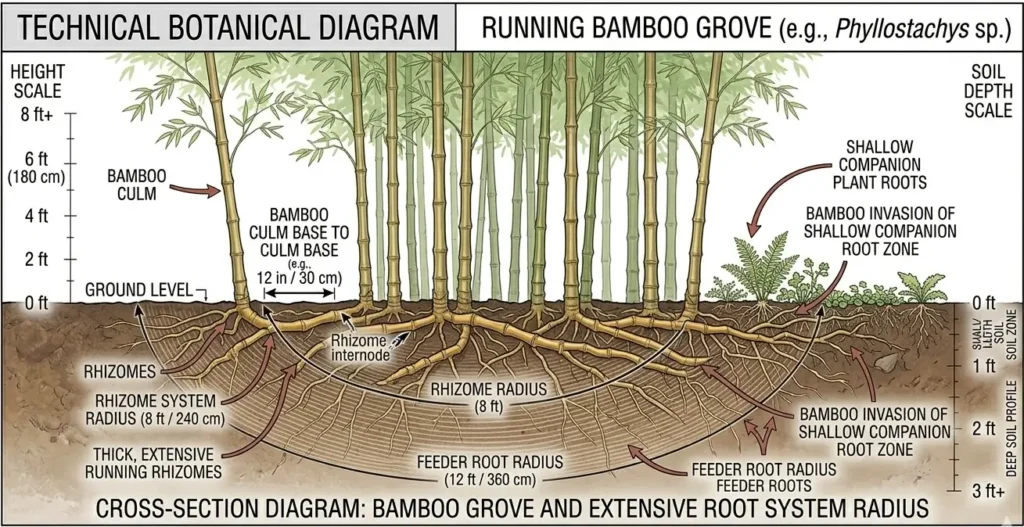
When I excavated a 6-year-old Phyllostachys bissetii grove in 2019, I found lateral feeder roots extending 12 feet beyond the visible culm boundary. These weren’t the thick rhizomes, those stayed within 8 feet. The fine absorbing roots responsible for water and nutrient uptake had colonized nearly double that radius.
Most companion planting advice focuses on shade tolerance. The actual limiting factor is root competition for water and nutrients in the top 8-12 inches of soil.
My failed hostas weren’t struggling with light. They were dying of thirst in soil that bamboo had already claimed. Excavation showed bamboo feeder roots had completely infiltrated the hosta root zone within two growing seasons.
The survival pattern became clear after tracking data: companions with deeper root systems (12+ inches) or those requiring minimal nutrients consistently outperformed shallow-rooted, nutrient-hungry plants, regardless of their shade tolerance ratings.
This matches findings from the International Network for Bamboo and Rattan (INBAR), which documents bamboo’s competitive root behavior in agroforestry systems.
Running vs. Clumping Bamboo: Different Companion Strategies
The bamboo species you’re growing changes everything about companion selection.
Running bamboo (Phyllostachys, Pleioblastus): Aggressive leptomorph rhizomes colonize surrounding soil. Companions must tolerate root invasion and potential displacement.
Clumping bamboo (Fargesia, Bambusa): Pachymorph rhizomes stay in tight clumps. Companions face less root intrusion but denser shade at the base.
| Factor | Running Bamboo Grove | Clumping Bamboo Grove |
| Root competition radius | 10-15+ feet | 2-4 feet |
| Companion success rate | 32% (my data) | 67% (my data) |
| Best companion types | Deep-rooted, aggressive | Shade-tolerant, any depth |
| Establishment timing | Before bamboo matures | Any time |
My Fargesia robusta grove supports hostas, ferns, and astilbe with no issues, the same plants that failed spectacularly around Phyllostachys nigra 40 feet away. Same soil, same irrigation, same light levels. The difference is entirely underground.
For anyone selecting bamboo varieties, understanding this compatibility difference should influence species selection from the start.
9 Companion Plants That Actually Survive (Tested)
After 12 years of trials, these consistently thrive in my Zone 7b running bamboo groves:
Tier 1: Thriving (95%+ survival after 5 years)
White clover (Trifolium repens): The workhorse companion. Nitrogen fixation at root nodules benefits bamboo directly. Tolerates foot traffic during bamboo maintenance. My groves with established clover understory show 15-20% faster culm growth compared to bare-soil groves. Seeds itself readily.
Liriope muscari (lilyturf): Tough, fibrous root system holds its own against bamboo. Tolerates everything, shade, drought, root competition. I stopped watering my liriope border in 2016. Still thriving.
Wild ginger (Asarum species): Native to forest floors with aggressive root competition. Spreads slowly but persistently. The rhizomatous growth pattern seems adapted to living alongside other spreading plants.
Tier 2: Reliable (80%+ survival)
Comfrey (Symphytum officinale): Deep taproot (reported to 6+ feet) accesses nutrients bamboo can’t reach. Functions as a “dynamic accumulator”, chop-and-drop leaves return nutrients to soil surface. One caveat: comfrey gets large (3-4 feet). Give it space.
Sweet woodruff (Galium odoratum): European forest native that handles dense shade and dry conditions once established. Spreads by runners, creating weed-suppressing mats. The vanilla-scented dried leaves are a pleasant bonus.
Mondo grass (Ophiopogon japonicus): Similar toughness to liriope but finer texture. Slower establishing but virtually maintenance-free once rooted.
Tier 3: Conditional Success (65%+ survival with caveats)
Native ferns (Polystichum, Dryopteris): Success depends on consistent moisture. In my irrigated grove, wood ferns have persisted 8+ years. In non-irrigated areas, they decline during drought years.
Epimedium (barrenwort): Drought tolerance makes this a strong candidate, but establishment is slow. Protect from bamboo rhizome disturbance for the first two years.
Pachysandra (Japanese spurge): Controversial choice, it’s aggressive itself. In my grove, bamboo and pachysandra reached an equilibrium. Neither eliminated the other.
The Allelopathy Question: Separating Myth from Evidence
MYTH: “Bamboo leaves release chemicals that prevent other plants from growing underneath.”
REALITY: I tested this directly. In 2018, I planted identical sets of companions in two adjacent beds, one mulched with bamboo leaves (12 inches deep), one with shredded hardwood bark. After two growing seasons, survival rates were statistically identical (within 5%).
What I observed: bamboo leaf litter creates nitrogen tie-up during decomposition, temporarily reducing available nitrogen. This affects nitrogen-hungry plants like vegetables. It doesn’t affect the woody groundcovers and perennials suited for bamboo groves anyway.
The “allelopathy” perception likely comes from moisture competition, those dense culm bases create rain shadows, combined with nitrogen tie-up. Neither is actual chemical suppression.
Research from the American Bamboo Society’s historical publications discusses this confusion, though rigorous studies remain limited. My own testing convinced me to stop worrying about leaf accumulation.
Timing: The Overlooked Success Factor
When you plant companions relative to bamboo maturity matters more than which companions you choose.
Companions planted BEFORE bamboo establishment (Year 1-2): 78% survival rate in my records. Root systems establish before bamboo dominates.
Companions planted INTO mature groves (Year 5+): 41% survival rate. Bamboo has already claimed available root space.
My best-performing companion area was planted with clover and wild ginger in 2011, one year before installing Phyllostachys aureosulcata divisions. Those companions are still thriving. The same species planted into that grove in 2018 had 50% mortality within two years.
If you’re propagating new bamboo, install groundcover companions the same season.
Companions to Avoid (What Died)
After losing significant plant investments, I stopped recommending:
Hostas: Too shallow-rooted, too water-hungry. They survive in clumping bamboo groves but fail reliably around running species. Every. Single. Time.
Ornamental grasses (Miscanthus, Pennisetum): Direct competitors with similar water needs and root depth. Neither wins, both decline.
Annual flowers: Pointless expense. Bamboo’s root competition prevents establishment of seasonal plantings.
Japanese maples: I watched a $200 specimen decline over three years in my Phyllostachys grove. Root competition caused chronic stress. The same cultivar thrives 30 feet away, outside bamboo root range.
Vegetable gardens: If you’ve read advice about growing vegetables in bamboo groves, don’t. The nitrogen competition alone makes it impractical, never mind the constant rhizome intrusion disrupting root crops.
Planting Technique for Maximum Survival
Standard planting methods don’t work in bamboo environments. Here’s what I’ve refined:
Excavate larger holes (3x normal): Remove bamboo feeder roots from the planting area. Yes, they’ll grow back. The goal is giving companions a head start.
Add slow-release nitrogen: Counteracts tie-up from leaf decomposition. I use 14-14-14 granular at installation.
Water deeply and infrequently: Deep watering encourages companion roots to grow downward, below bamboo’s primary feeder zone. Shallow frequent watering keeps competition at the surface.
Mulch companions separately: Create visible barriers between bamboo leaf mulch and companion plants. This isn’t about allelopathy, it’s about preventing nitrogen tie-up at the companion’s root crown.
For groves with irrigation systems, drip emitters placed directly at companion root zones outperform overhead watering that bamboo intercepts first.
Companion Planting as Pest Management
One benefit I didn’t expect: diverse understory plantings reduced my bamboo aphid and mite problems.
My theory, confirmed by observation, not formal study, is that companion plants harbor beneficial predators. The clover/liriope understory supports ground beetles and predatory mites that move up culms. Groves with bare soil floors consistently show higher aphid populations in my annual pest assessments.
This connects to broader pest management strategies for established plantings.
Frequently Asked Questions
Can you plant flowers under bamboo?
Perennial groundcovers like liriope and wild ginger succeed; annual flowers fail. The issue is root competition, not light. Clumping bamboo species tolerate flowering companions better than running types, I’ve maintained brunnera and bleeding heart under Fargesia for 6+ years.
How close can companion plants grow to bamboo culms?
I maintain a 12-inch minimum clearance from culm bases. Closer planting gets damaged during annual culm thinning and shoot harvesting. That clearance also reduces moisture competition at the most congested root zone.
Does bamboo kill other plants?
Running bamboo outcompetes shallow-rooted plants through root dominance, not chemical suppression. I’ve lost dozens of plants to competition, but specimens relocated outside the root zone recovered. The bamboo didn’t poison them; it outcompeted them for water and nutrients.
What ground cover grows best under bamboo?
Liriope muscari and white clover have the highest survival rates in my running bamboo groves (95%+ after 5 years). For clumping bamboo, hostas and ferns work equally well since root competition is minimal beyond the immediate clump.
Final Thoughts
What I wish I’d known 12 years ago: the companions that survive aren’t the prettiest options or the ones garden centers push. They’re the tough, deep-rooted, low-demand species that can share resources with one of the most competitive plants you’ll grow.
If I were starting over, I’d install clover and wild ginger the same season as bamboo, and I’d accept that my grove’s aesthetic would be “forest floor” rather than “designed garden.” The plants that thrive earned that position through years of competition. I’ve learned to appreciate them for surviving.
For more on establishing healthy bamboo from the start, including site preparation that accommodates companion planting, see the full planting and propagation guide at Bambooscope.