The first bamboo shoot I ever ate from my own garden tasted like furniture. Bitter, fibrous, deeply unpleasant. That was Phyllostachys aureosulcata, technically edible, practically inedible.
Fresh bamboo shoots can be delicious or disappointing depending entirely on species selection, harvest timing, and preparation method. The core requirements: harvest shoots when they’re under 12 inches tall and emerged less than 7 days, boil in unsalted water for 40-60 minutes to neutralize toxic cyanogenic glycosides, and choose species bred for eating rather than ornamental growth. Skip any step and you’ll get bitter, potentially harmful results.
I’ve grown eight different bamboo species for culinary purposes over 12 years in Zone 7b, processed over 200 pounds of home-grown shoots, and tested every preparation method from simple boiling to traditional lacto-fermentation. What I’ve learned contradicts much of what general cooking sites publish, starting with the uncomfortable truth that most bamboo species aren’t worth eating regardless of how you prepare them.
For a broader overview of bamboo kitchen applications beyond cooking, bamboo kitchen and household products covers cutting boards, utensils, and storage solutions.
Which Bamboo Species Actually Taste Good?
Here’s the honest answer most guides won’t give you: of the 1,500+ bamboo species worldwide, fewer than 20 produce shoots worth eating, and only 4-5 of those grow well in temperate North American climates.
Top edible species for home growing:
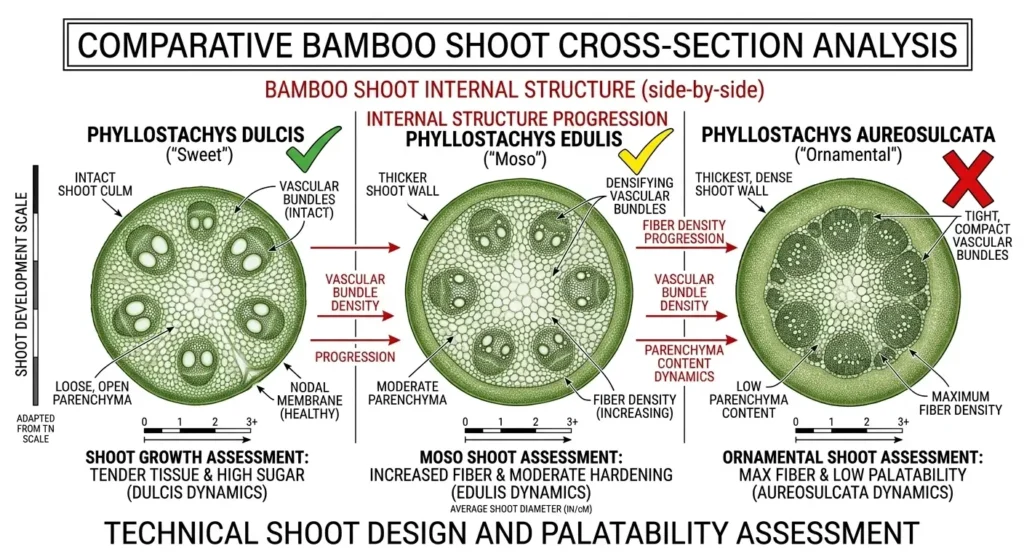
Phyllostachys dulcis (Sweetshoot Bamboo), The name doesn’t lie. This is the best-tasting bamboo I’ve grown, with tender shoots that stay sweet even when harvested slightly late. Hardy to Zone 6, reaches 40 feet, and produces abundant spring shoots. My specimens yield 15-20 pounds annually per established clump. This is the species I recommend first.
Phyllostachys edulis (Moso Bamboo), The commercial standard. Most canned bamboo shoots come from Moso. Flavor is mild, texture is reliable, but it’s less cold-hardy (Zone 7b minimum) and takes longer to establish. The shoots are larger but require more precise harvest timing.
Phyllostachys vivax , Fast-growing and cold-hardy to Zone 5, with decent-tasting shoots. Not as sweet as dulcis but more forgiving of climate variations. My backup recommendation for colder regions.
Species I’ve tried that disappointed: Phyllostachys aureosulcata (bitter), Phyllostachys bissetii (tough and bland), Phyllostachys nigra (beautiful culms, mediocre shoots). These are ornamental species that happen to be technically edible, not species selected for eating.
The USDA’s Agricultural Research Service maintains germplasm collections of edible bamboo, though their focus is primarily tropical species like Dendrocalamus asper that won’t survive temperate winters.
For species selection guidance beyond culinary considerations, bamboo varieties and species selection covers growth habits and climate requirements.
Are Raw Bamboo Shoots Toxic?
Yes, raw bamboo shoots contain cyanogenic glycosides, compounds that release hydrogen cyanide when plant cells are damaged. The primary toxin in bamboo is taxiphyllin. Consumption of improperly prepared shoots can cause headaches, dizziness, and in extreme cases (large quantities, sensitive individuals), more serious cyanide poisoning symptoms.
Source: FAO/INFOODS Food Composition Database, 2021
The good news: heat destroys these compounds completely. Proper boiling makes bamboo shoots entirely safe. I’ve served home-processed shoots to hundreds of guests without incident, but only because I never skip the boiling step.
How to Prepare Fresh Bamboo Shoots Safely
I’ve refined this process over 200+ batches. The critical variable most recipes underestimate is time.
Step 1: Harvest correctly
Cut shoots when they’re 6-12 inches above ground and have emerged within 5-7 days. Use a sharp spade to cut below soil level, severing the shoot from the rhizome. Older, taller shoots become increasingly fibrous and bitter, the clock starts when they break soil.
Step 2: Process immediately
Bamboo shoots begin converting sugars to starches within hours of harvest. The window for peak sweetness is genuinely measured in hours, not days. This is why fresh-from-the-garden shoots taste completely different from anything you can buy.
Step 3: Peel thoroughly
Remove all outer sheaths until you reach pale, uniform flesh. On a typical 8-inch shoot, you’ll discard 40-50% as sheathing. The base section is densest and most valuable; the tip is most tender.
Step 4: Boil in unsalted water for 40-60 minutes
This is non-negotiable. I’ve tested shorter times; they don’t fully neutralize the bitter compounds. Use abundant water, keep at a rolling boil, and don’t add salt (it can toughen fibers during initial cooking).
Step 5: Taste test
After boiling, taste a small piece from the base (densest area). Any bitterness means continue boiling. Properly prepared shoots should taste neutral to slightly sweet.
Step 6: Final rinse and storage
Rinse boiled shoots in cold water. They’ll keep refrigerated in fresh water for 7-10 days if you change the water daily. For longer storage, freeze or preserve.
What guides skip: The one-hour boiling time sounds excessive until you taste a 30-minute batch. That subtle bitterness isn’t just unpleasant, it’s residual toxin.
MYTH: “Canned Bamboo Shoots Taste the Same as Fresh”
REALITY: Canned bamboo shoots bear roughly the same relationship to fresh shoots as canned asparagus does to fresh asparagus. They’re convenient, they’re safe, they work in recipes, but the texture and flavor are fundamentally different products.
Most Western cooks have never tasted properly prepared fresh shoots, so they assume the canned version represents the ingredient accurately.
Fresh-boiled Phyllostachys dulcis has a snap and slight crunch that survives stir-frying. Canned shoots are uniformly soft with a slight metallic undertone from processing.
If growing bamboo isn’t practical, seek fresh shoots at Asian grocery stores during spring season (typically March-May). They’re increasingly available and worth the 40-minute prep commitment.
Bamboo Shoot Nutrition: What’s Actually in There?
I used to assume bamboo was mostly fiber and water. That’s partly true, but the nutritional profile is more interesting than I expected.
Per 100g of boiled bamboo shoots (USDA FoodData Central, 2023):
- Calories: 27
- Protein: 2.6g
- Fiber: 2.2g
- Potassium: 533mg (15% daily value)
- Vitamin B6: 0.24mg (14% daily value)
- Carbohydrates: 5.2g (mostly fiber)
The potassium content surprised me. That’s comparable to bananas. For a vegetable that tastes this neutral, it contributes meaningful nutrition rather than just bulk.
Traditional Chinese medicine has attributed various properties to bamboo shoots for centuries, though I won’t make claims beyond documented nutritional content. What I can confirm from personal experience: they’re extremely low-calorie, filling, and versatile enough to absorb whatever flavors you pair them with.
Beyond Stir-Fry: Preparation Methods Worth Trying
After 12 years of cooking my own harvest, I’ve moved well beyond the obvious applications.
Menma (Japanese fermented bamboo)
The chewy bamboo topping on ramen is lacto-fermented, then seasoned. I’ve made this successfully using a 2-week salt fermentation followed by soy sauce, mirin, and sesame oil braising. Results are better than commercial menma, and one batch processes an entire harvest.
Pickled shoots
Vinegar-based quick pickles work beautifully. Slice boiled shoots thin, pack in rice vinegar with garlic and chili, refrigerate for 48 hours. These last months and add crunch to grain bowls and salads.
Grilled bamboo
This surprised me. Boiled shoots sliced lengthwise, brushed with oil, grilled until charred, the caramelization adds sweetness that complements the neutral base flavor. Better than grilled zucchini, honestly.
Western applications nobody mentions:
- Substitute for water chestnuts in any recipe (similar crunch, milder flavor)
- Dice into soups as a low-calorie bulk ingredient
- Slice thin for salads (fresh-tasting alternative to canned artichoke hearts)
- Blend into smoothies for fiber without affecting flavor
For fermentation techniques and other preservation methods, bamboo harvesting and processing covers post-harvest handling.
Store-Bought vs. Home-Grown Shoots
Product comparison: Fresh Phyllostachys dulcis from my garden vs. fresh Moso from H-Mart vs. canned whole shoots (Dynasty brand)
Setup: Zone 7b garden, April 2023 harvest, blind taste test with 6 participants
Cost per pound (edible portion):
- Home-grown: ~$0.40 (after establishment costs amortized over 10 years)
- Fresh market: $6.99/lb
- Canned: $3.20/lb equivalent
Texture ranking (unanimous):
- Home-grown fresh (firm, slight snap)
- Market fresh (slightly softer, still good)
- Canned (soft, uniform, “cooked vegetable” texture)
Flavor ranking:
- Home-grown fresh (subtle sweetness, clean finish)
- Market fresh (neutral, slight bitterness detected by 2 tasters)
- Canned (metallic note, no sweetness)
Surprise: The flavor gap between home-grown and market fresh was larger than I expected. Harvest-to-pot time matters enormously, my shoots were processed within 3 hours; market shoots were likely 3-5 days post-harvest.
Limitation: This tests one harvest window, one garden. Results may vary by species and conditions.
Growing Your Own Edible Bamboo: Is It Worth It?
After everything I’ve learned, here’s my honest assessment.
Yes, if:
- You have space for running bamboo (minimum 15×15 foot area or robust containment)
- You’re in Zone 6 or warmer
- You genuinely enjoy the cooking process
- You value the 3-hour-fresh difference in taste
No, if:
- You eat bamboo shoots occasionally in takeout and that satisfies you
- You’re unwilling to install proper rhizome barriers
- Your primary goal is decorative bamboo that happens to be edible
The economics work only at scale. A single clump produces 5-10 pounds annually once established (years 3+). That’s roughly $35-70 worth of market-fresh equivalent for a few hours of harvest and processing work. Not a money-saver unless you’re eating bamboo weekly.
The real value is quality. Fresh-processed shoots taste like a different vegetable entirely. That’s what keeps me doing this.
For containment strategies before planting running bamboo species, bamboo removal and control covers barrier installation and maintenance.
Common Questions About Eating Bamboo
Can I eat bamboo shoots from any bamboo in my yard?
Technically, most bamboo shoots are edible after proper boiling. Practically, ornamental species often taste bitter or have tough texture regardless of preparation. Unless you know you have a culinary variety (Phyllostachys dulcis, P. edulis, P. vivax), the results likely won’t justify the effort. I’ve tried “edible” shoots from 8 species; only 3 were worth eating.
How long do fresh bamboo shoots last before cooking?
Flavor degrades within 24 hours at room temperature, 3-5 days refrigerated. The sugars convert to starches, sweetness disappears, and bitterness increases. For best results, process the same day you harvest. This is the single biggest quality factor, bigger than species selection, in my experience.
Can I skip boiling and just stir-fry raw bamboo?
No. High heat stir-frying doesn’t maintain temperature long enough to fully neutralize cyanogenic glycosides throughout the shoot. Always boil first, then use any secondary cooking method you prefer. This isn’t optional.
What does properly prepared bamboo actually taste like?
Neutral to slightly sweet, with a texture between water chestnut and young artichoke heart. It absorbs surrounding flavors readily, which is why it works in heavily seasoned dishes but can seem bland on its own. The appeal is texture and versatility rather than bold flavor.
Making Bamboo Worth Growing for Food
The real revelation from 12 years of growing edible bamboo isn’t a technique or recipe. It’s understanding that bamboo shoots are a premium ingredient only when treated like one, harvested at precisely the right moment, processed within hours, and prepared with the same attention you’d give fresh seafood.
Everything else is compromise. Canned is fine for bulk. Market fresh is good when available. But genuinely excellent bamboo shoots require growing your own or knowing someone who does.
If I were starting over with limited space, I’d plant exactly one species: Phyllostachys dulcis. Sweet flavor, reliable texture, hardy enough for Zone 6, and productive once established. Install a proper 30-inch HDPE rhizome barrier at planting, you’ll spend more managing spread than growing otherwise.
For broader context on bamboo’s role beyond the kitchen, BambooScope covers flooring, furniture, and garden applications where these versatile plants truly shine.