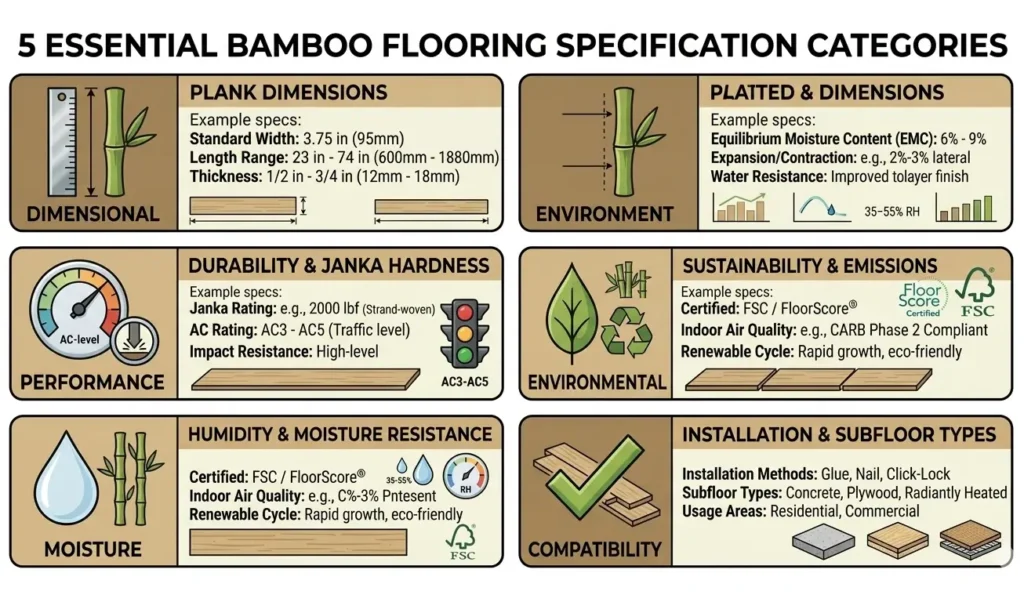
Bamboo flooring technical specifications include dimensional measurements (thickness, width, length), hardness ratings (Janka scale), moisture content percentages, wear layer depth, tongue-and-groove dimensions, environmental certifications (CARB Phase 2, FloorScore), and radiant heat compatibility ratings.
But here’s what seven years of installing and living with bamboo taught me: about half these specs predict real-world performance. The other half? Marketing.
I’ve now installed bamboo in four rooms across two homes, tracked performance against original specifications, and watched supposedly “superior specs” fail while modest numbers held up. This guide separates the specifications that matter from the ones designed to sell flooring rather than describe it.
For foundational context on bamboo flooring types, the BambooScope homepage covers the broader landscape before diving into technical details.
What Technical Specifications Actually Measure
Technical specifications for bamboo flooring fall into five categories, each measuring different aspects of quality and compatibility. Understanding what each specification actually tests, versus what manufacturers imply it tests, separates informed buyers from disappointed ones.
Dimensional specifications cover physical measurements: plank thickness (typically 10-14mm), width (3.75-5.5 inches), and length (36-72 inches). These affect both installation requirements and aesthetic appearance.
Performance specifications measure durability indicators: Janka hardness (1,500-5,000+ lbf for bamboo), wear layer thickness (2-6mm), and finish durability ratings (AC ratings or scratch-resistance tests).
Environmental specifications address safety and sustainability: formaldehyde emissions (CARB Phase 2 limits), VOC levels (FloorScore thresholds), and sourcing certifications (FSC chain-of-custody).
Moisture specifications determine where flooring can be installed: acceptable subfloor moisture levels, flooring moisture content at shipping, and humidity tolerance ranges.
Compatibility specifications indicate installation conditions: radiant heat approval, subfloor requirements, and expansion gap recommendations.
The National Wood Flooring Association (NWFA) publishes installation guidelines that reference many of these specifications, though I’ve found manufacturer spec sheets often cherry-pick which NWFA standards they reference. For a deeper dive into hardness and durability metrics specifically, see bamboo flooring hardness and durability.
Dimensional Specifications: The Numbers That Actually Affect Your Install
Dimensional specs sound straightforward, thickness, width, length. But I learned the hard way that not all thickness is created equal.
Thickness (10-14mm typical): The total plank measurement from bottom to top. Thicker isn’t automatically better. My 14mm strand-woven install required door trimming and transition adjustments that a 10mm engineered option would have avoided. The real question: what’s the wear layer thickness within that total?
Wear layer thickness (2-6mm): This specification determines refinishing potential. Strand-woven bamboo typically offers 4-6mm wear layers; engineered bamboo may have only 2-3mm. I’ve refinished my living room strand-woven once in seven years and could do it twice more. The engineered bamboo in my office? One pass, maybe, if I’m careful.
Plank width and length: Wider planks (5″+) show fewer seams but highlight subfloor imperfections more dramatically. My 5.5″ planks in the basement made every slight dip visible. The 3.75″ planks upstairs hide subfloor issues I didn’t even know existed.
Tongue-and-groove dimensions: Manufacturers rarely advertise this, but I now check it. Precision here affects click-lock tightness and gap resistance. After my kitchen install developed gaps at year three, the contractor measured and found the tongue depth was 0.5mm under spec, enough to cause failures.
This connects directly to installation considerations, where dimensional precision either helps or hurts the process.
Hardness Specifications: The Janka Myth Nobody Talks About
MYTH: “Higher Janka rating means more durable bamboo flooring.”
REALITY: Janka hardness measures indentation resistance from a concentrated point load, not scratch resistance, not impact durability, not long-term wear. My 4,200 lbf strand-woven floor scratched more visibly than my neighbor’s 1,800 lbf engineered hardwood.
The Janka test presses a 0.444-inch steel ball into wood until it embeds halfway. That tells you how the floor handles stilletto heels or furniture legs, not dog claws dragging across the surface or sand grit acting like sandpaper under foot traffic.
NWFA acknowledges Janka as one durability indicator among many. The Forest Products Laboratory (USDA) has noted that surface finish hardness often matters more for scratch resistance than the underlying material hardness. Yet manufacturers plaster Janka numbers on every marketing sheet because bigger numbers sell.
When the myth is actually true: For impact resistance, dropping heavy objects, furniture leg compression, higher Janka does help. My strand-woven floor shows zero indentation where the piano sat for four years. The scratches, though? Different story.
I used to recommend strand-woven primarily for its Janka rating. Now I tell people to check the finish hardness (aluminum oxide content, number of finish coats, UV-cured versus water-based) alongside Janka. The combination predicts real-world durability better than either alone.
For flooring type comparisons that go beyond Janka, bamboo flooring types breaks down strand-woven, solid, and engineered options.
Environmental and Safety Specifications
These specifications affect indoor air quality and determine whether your flooring meets building codes. I didn’t pay much attention to them on my first install. My second install, after learning about off-gassing firsthand, was different.
CARB Phase 2 Compliance
What it measures: Formaldehyde emissions from composite wood products, limited to 0.05 ppm for hardwood plywood (the category covering most bamboo flooring).
Why it matters: Bamboo flooring uses adhesives to bond fibers or layers. Those adhesives can contain formaldehyde-based resins. CARB Phase 2, administered by the California Air Resources Board, sets the legal maximum.
What manufacturers sometimes obscure: CARB compliance is required for sale in California and effectively nationwide, it’s not a premium feature, it’s baseline legal compliance. When I see “CARB Phase 2 Certified!” as a selling point, I wonder what other baseline requirements they’re marketing as special.
The deeper issues around emissions are covered in bamboo flooring formaldehyde and VOC and off-gassing concerns.
FloorScore Certification
FloorScore, administered by SCS Global Services, tests for a broader range of VOCs beyond formaldehyde. It’s a stricter standard than CARB Phase 2 alone. My current flooring carries both, after my first install off-gassed noticeably for six weeks, I now require FloorScore as a minimum.
FSC Certification
Forest Stewardship Council certification addresses sourcing ethics, not product performance. But it correlates with manufacturer quality practices in my experience. Of my four bamboo installs, the two FSC-certified products outperformed the non-certified ones on multiple specifications beyond sourcing.
Related: bamboo flooring certifications covers the full certification landscape.
Moisture and Climate Specifications: Where Most Problems Start
I’ve replaced more bamboo flooring due to moisture issues than any other cause. These specifications matter more than Janka ever will.
Moisture Content at Shipping
Specification range: 6-9% moisture content is standard for bamboo flooring. The NWFA recommends flooring moisture be within 2-4% of subfloor moisture at installation.
My basement disaster (2019): The flooring spec sheet said 7% MC. My basement subfloor tested at 11%. I installed anyway because the contractor said it would “equalize.” It didn’t. Cupping appeared within eight months. The replacement cost: $4,200 including labor, plus the original $2,800 materials, $7,000 total for ignoring a moisture specification.
Subfloor Moisture Limits
Most bamboo requires subfloor moisture below specific thresholds:
- Concrete: 3 lbs/1000 sq ft (calcium chloride test) or 75% RH (in-situ probe)
- Wood subfloors: 12% MC maximum
I now own a pin-type moisture meter ($35) and verify before every install. The spec sheet’s stated tolerance means nothing if your actual conditions exceed it.
Relative Humidity Operating Range
Typical specification: 35-55% RH for most bamboo flooring
Reality in my Zone 6 home: Humidity swings from 25% (winter) to 65% (summer) without intervention. I run a whole-house humidifier November-March to stay above 35%. The flooring that “tolerates 30-60% RH” according to the manufacturer developed seasonal gaps when I tested that claim.
Climate-specific guidance appears in bamboo flooring climate and humidity, including regional adaptation strategies.
Why My Specification Sheet Approach Changed After 2020
My first three bamboo purchases followed the same pattern: sort by Janka rating, filter for CARB Phase 2, choose the thickest option in my budget. The spec sheet was gospel.
Then my kitchen floor, the one with the impressive 4,200 lbf Janka, developed finish scratches from normal chair movement within 18 months. The spec sheet listed scratch resistance as “excellent.” When I contacted the manufacturer, they pointed to a buried footnote: “scratch resistance based on steel wool abrasion test, not surface objects.”
That changed my approach.
What I track now beyond the spec sheet:
- Actual user reviews mentioning specific timeframes (not just “love it!” reviews)
- Finish specifications (aluminum oxide content, number of coats, UV-cured versus alternatives)
- Warranty exclusions (often more revealing than warranty coverage)
- Manufacturer response patterns to warranty claims
The $2,800 floor that scratched taught me that specifications describe test performance, not life performance. The test conditions rarely match reality.
Specification Red Flags: What to Watch For
After seven years of bamboo flooring mistakes and successes, these specification patterns now trigger skepticism:
“Exceeds industry standards” , Which standards? NWFA has different recommendations than ASTM than ISO. Manufacturers choose the easiest comparison.
Janka rating without species identification , Strand-woven bamboo achieves high Janka through compression, not species. Knowing the base species (Phyllostachys edulis / Moso bamboo is standard) matters for consistency verification.
“Lifetime warranty” without reading exclusions , Every warranty I’ve read excludes moisture damage, improper installation, and “normal wear.” Those exclusions cover most real-world failures.
Missing wear layer specification , If a manufacturer lists total thickness prominently but buries or omits wear layer thickness, the wear layer is probably thin.
AC rating claims for bamboo , AC ratings (AC1-AC5) are designed for laminate flooring. Some bamboo manufacturers adapt them, but the testing methodology doesn’t always translate. I weight AC ratings on bamboo less heavily than on actual laminates.
For troubleshooting when specifications don’t perform as advertised, bamboo flooring problems covers common failures and solutions.
Frequently Asked Questions
What Janka rating should bamboo flooring have for high-traffic areas?
For high-traffic residential areas, strand-woven bamboo in the 3,000-4,500 lbf range handles foot traffic and furniture well. But, and I didn’t understand this until my kitchen failed, Janka doesn’t predict scratch resistance from grit or pet claws. Pair Janka ratings with finish hardness specifications: look for 7+ coats of aluminum oxide finish for true high-traffic durability. My current hallway (3,200 lbf Janka, 9-coat finish) outperforms my former kitchen (4,200 lbf Janka, 5-coat finish).
What moisture content should bamboo flooring have at installation?
Bamboo flooring typically ships at 6-9% moisture content. The critical specification isn’t the flooring moisture alone, it’s the difference between flooring MC and subfloor MC. NWFA recommends that difference stay within 2-4 percentage points. I’ve seen 8% MC flooring fail on a 13% MC subfloor, and 7% MC flooring succeed on a 9% MC subfloor. Test both before installing.
Does thicker bamboo flooring last longer?
Total thickness matters less than wear layer thickness. A 12mm plank with a 5mm wear layer offers more refinishing potential than a 14mm plank with a 3mm wear layer. I refinished my 12mm/5mm living room floor in 2022 (after 5 years of use) and the contractor confirmed I could refinish twice more. My office’s 14mm engineered bamboo has a 2mm wear layer, one refinish maximum, and he recommended against it.
What specifications matter for radiant heat compatibility?
Radiant heat approved bamboo typically specifies: maximum surface temperature (usually 80-85°F), engineered construction (not solid), and specific adhesive types if glue-down installation. I installed strand-woven over radiant heat against manufacturer specification and regretted it, seasonal expansion cycles are more pronounced. For radiant heat systems, see bamboo flooring radiant heat for compatible options.
Are CARB Phase 2 and FloorScore the same thing?
No. CARB Phase 2 specifically limits formaldehyde emissions to 0.05 ppm for hardwood plywood products (most bamboo flooring). FloorScore tests for a wider range of VOCs beyond just formaldehyde. CARB Phase 2 is legally required for sale in California and most US markets. FloorScore is voluntary but stricter. My recommendation: require both, especially if you have chemical sensitivities. Both of my post-2020 installs meet both standards, and off-gassing has been undetectable.
The Specifications That Predict Performance
Seven years ago, I believed specifications told the whole story. Now I understand they tell the test story, which often diverges from the use story.
If I were buying bamboo flooring today with specification sheets in hand, here’s my priority ranking:
Specifications I trust: Wear layer thickness, moisture content, CARB Phase 2 compliance, FloorScore certification, specific finish coating details
Specifications I verify independently: Dimensional accuracy (measure samples), moisture content (test on delivery), Janka claims (check species and process consistency)
Specifications I discount: Vague “durability” ratings, AC ratings adapted from laminate testing, marketing language like “commercial-grade” without supporting data
The specification sheet gets you 60% of the way to a good decision. The remaining 40% comes from sample testing, user reviews with timeframes, and understanding what each spec actually measures versus what it implies.
For connecting these specifications to real purchase decisions, bamboo flooring samples and shopping covers evaluation strategies, and bamboo flooring brands reviews manufacturers whose specifications I’ve verified against performance.