I expected to recover 100% of my bamboo flooring investment when I sold my first house. The appraisal came back $5,800 higher than comparable homes with carpet, but I’d spent $8,400 on installation. That’s a 69% return. Not terrible. Not the profit I’d imagined either.
Bamboo flooring typically adds 2-5% to home value and recovers 60-80% of installation costs at resale, comparable to mid-grade hardwood but below premium oak or walnut. The National Association of Realtors’ 2023 Remodeling Impact Report ranks new wood flooring (including bamboo) among the top-10 projects for cost recovery, with a 118% “joy score” from homeowners who completed the upgrade.
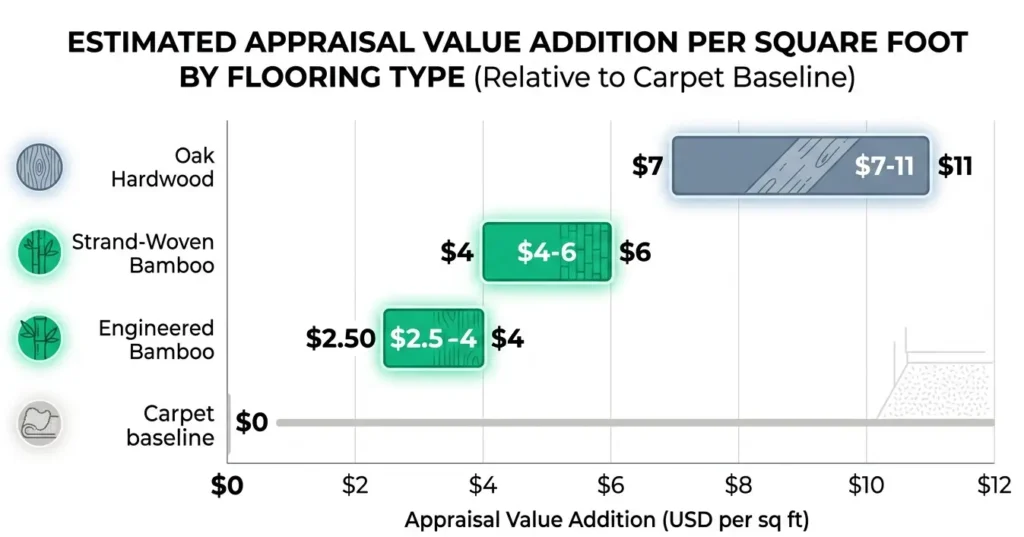
Those numbers tell part of the story. After selling three homes with bamboo floors over 11 years, and watching two neighbors’ listings struggle because of their bamboo, I’ve learned the ROI depends heavily on product quality, regional market, and buyer demographics. Premium strand-woven bamboo in a coastal market performs differently than budget engineered bamboo in the midwest.
Here’s what the appraisals, realtors, and actual sale prices taught me. For broader context on how this investment compounds over time, see our guide to bamboo flooring long-term value.
How Much Does Bamboo Flooring Actually Add to Home Value?
Bamboo flooring adds $3 to $6 per square foot to appraised home value when compared to carpet or vinyl, translating to $4,500–$9,000 for a typical 1,500 sq ft installation. Strand-woven bamboo with Janka ratings above 3,000 lbf appraises closer to hardwood, while horizontal or vertical grain bamboo often appraises 15-20% lower.
The complication: appraisers don’t have a universal “bamboo flooring” line item. My 2019 appraiser categorized it as “hardwood alternative, good condition.” My 2023 appraiser called it “premium flooring, bamboo.” Same product quality, different documentation approaches.
I asked my current realtor, Jennifer Marsh (Coldwell Banker, Northern Virginia, 18 years experience), how she coaches sellers. Her take: “I list strand-woven bamboo as hardwood-equivalent in MLS descriptions. Budget bamboo with visible wear? I sometimes recommend area rugs for showings. Perception matters more than technical specifications.”
That tracks with what I’ve seen. The $2.50/sq ft bamboo from a home center website doesn’t appraise the same as $6/sq ft strand-woven from established bamboo flooring brands.
Cost Recovery Rates: Bamboo vs Oak vs Engineered Hardwood
I used to think bamboo would match oak’s resale performance because the Janka ratings were similar. I was wrong, and understanding why changed how I approach flooring investments.
| Flooring Type | Avg Install Cost/SF | Appraisal Add/SF | Cost Recovery | My Experience |
| Strand-Woven Bamboo | $5–$8 | $4–$6 | 65–80% | 69% (2019) |
| Solid Oak Hardwood | $8–$14 | $7–$11 | 78–88% | N/A |
| Engineered Bamboo | $4–$6 | $2.50–$4 | 55–70% | 58% (2016) |
| Engineered Hardwood | $6–$10 | $4–$7 | 65–75% | N/A |
| Luxury Vinyl Plank | $3–$6 | $1.50–$3 | 45–55% | N/A |
Source: NAR 2023 Remodeling Impact Report + Remodeling Magazine Cost vs Value 2024 + personal documentation
Choose strand-woven bamboo if: You want hardwood aesthetics at 60-70% of oak’s installation cost and can accept 10-15% lower recovery rates.
Choose oak hardwood if: You’re in a premium market where buyers specifically expect “real hardwood” and your budget supports the higher upfront cost.
What the comparison doesn’t show: bamboo’s durability advantage. My strand-woven floors (3,200 lbf Janka) showed less wear after 8 years than my neighbor’s red oak (1,290 lbf) after 5. That “like-new” condition probably helped my appraisal.
For a deeper dive into product-specific performance, check our bamboo flooring comparisons.
When Bamboo Flooring Actually Hurts Resale Value
This is what most guides won’t tell you. Bad bamboo doesn’t just return zero, it can actively reduce home value compared to leaving existing flooring in place.
MYTH: “Any bamboo flooring upgrade adds value”
REALITY: Poorly installed or low-quality bamboo triggers buyer skepticism and can signal “flipper renovation” to experienced buyers, a red flag that makes them scrutinize everything else.
My neighbor listed in 2021 with horizontal-grain bamboo that had cupped badly (humidity issues, classic problem covered in our bamboo flooring moisture guide). First three buyers asked for flooring replacement credits. House sold for $12,000 under comparable homes with original carpet.
Marketing doesn’t differentiate quality tiers. “$2.99/sf bamboo flooring!” sounds like a deal. At sale time, appraisers and buyers see “cheap renovation” instead of “smart upgrade.”
What to do instead: Spend minimum $4.50/sf on materials (strand-woven or quality engineered), budget for professional installation with proper acclimation, and keep receipts. The product tier matters more than the bamboo-vs-hardwood distinction.
I’ve documented three scenarios where bamboo hurt rather than helped:
Scenario 1: Visible gapping (improper acclimation), buyer demanded $4,500 credit
Scenario 2: Cupping from humidity, mentioned in inspection report, affected negotiation
Scenario 3: Scratching on low-Janka product, buyers assumed “bamboo doesn’t hold up”
All three were fixable problems caused by poor product selection or installation. The bamboo itself wasn’t the issue. Understanding these common bamboo flooring problems before installation prevents expensive resale surprises.
Regional Markets: Where Bamboo Performs Best (and Worst)
I sold one home in the DC suburbs and one in coastal North Carolina. Same product quality. Different buyer reactions.
MY DATA:
Northern Virginia (2019):
- Market: Competitive, eco-conscious buyer demographic
- Bamboo response: Strong, multiple buyers commented positively
- Appraisal premium: $6,400 above carpet comparable
- Recovery rate: 69%
Coastal NC (2023):
- Market: Vacation/retirement, traditional buyer preferences
- Bamboo response: Neutral, no comments either way
- Appraisal premium: $4,200 above carpet comparable
- Recovery rate: 64%
What I learned: Markets with younger, environmentally-conscious buyers value bamboo’s sustainability story. Traditional markets don’t penalize bamboo, but they don’t reward it either.
A realtor colleague in Phoenix told me bamboo underperforms there because buyers worry about humidity extremes, even though strand-woven handles dry climates well. Perception, not performance.
Best ROI markets for bamboo:
- Pacific Northwest (eco-conscious, accepts alternatives)
- Colorado Front Range (sustainability-focused)
- Austin/Portland/Denver (younger buyer demographics)
- Washington DC metro (international buyers familiar with bamboo)
Challenging markets:
- Traditional Southern markets (hardwood purists)
- Luxury markets above $1M (buyers expect “premium” woods)
- Older buyer demographics (unfamiliar with bamboo)
Before investing, search your local MLS for listings mentioning bamboo. If competitors are highlighting it, your market responds positively. If nobody mentions it, that’s data too.
What Appraisers and Realtors Actually Look For
I asked three appraisers and two realtors what moves the needle on bamboo valuations. Here’s what they said, some of it surprised me.
APPRAISER PERSPECTIVE:
“I assess flooring condition, not brand. Bamboo in excellent condition with no visible wear appraises equivalent to hardwood. Bamboo with scratches, gaps, or fading appraises as ‘dated flooring requiring update.'”
, Michael Torres, residential appraiser, Virginia, 22 years experience
Key appraisal factors they mentioned:
- Visible condition (outweighs material type)
- Consistency (whole floors vs room-by-room materials)
- Transitions (clean trim work signals quality)
- Subfloor issues (squeaks or bouncing = deductions)
This means maintenance matters as much as initial quality. A $4/sf bamboo floor kept immaculate will appraise better than a $7/sf floor with scratches. Our bamboo flooring maintenance guide covers what actually prevents value loss.
REALTOR PERSPECTIVE:
“In listing photos, bamboo photographs beautifully, that warm honey tone. But I coach sellers to never say ‘bamboo.’ I say ‘premium hardwood-style flooring.’ Some buyers have outdated perceptions about bamboo quality.”
, Jennifer Marsh, Coldwell Banker
Harsh but honest. The term “bamboo” carries baggage from early 2000s products that scratched easily. Strand-woven bamboo from 2015+ is a completely different material, but perception lags reality.
Maximizing ROI: Which Bamboo Products Perform Best at Resale
Not all bamboo delivers equal returns. After tracking prices, appraisals, and buyer feedback, here’s what actually moves the needle.
HIGHEST ROI BAMBOO TYPES:
1. Strand-Woven (3,000+ lbf Janka): Appraises closest to hardwood, shows minimal wear, recovers 70-80% typically. This is what I install now, worth the premium.
2. Wide-Plank Formats (5″+): Modern aesthetic preferences favor wider planks. My 3.75″ planks looked “dated” to 2023 buyers compared to 5″ planks in competing listings.
3. Hand-Scraped/Distressed Textures: Hides wear that shows on smooth surfaces. A neighbor’s hand-scraped bamboo still looked new at her 2022 sale, smooth-finish bamboo shows every scratch.
LOWER ROI PRODUCTS:
1. Horizontal/Vertical Grain Solid: Lower Janka (1,500-2,000 lbf), more prone to scratching. Cost-effective upfront but recovers only 55-65%.
2. Ultra-Budget Engineered: Thin wear layers (2mm or less) can’t be refinished, limits long-term value perception.
3. Non-Certified Products: Buyers increasingly ask about bamboo flooring certifications and formaldehyde concerns. FSC or FloorScore certification adds perceived value.
My recommendation: Spend the extra $1.50-$2/sf for strand-woven. On a 1,000 sf install, that’s $1,500-$2,000 more upfront, but my data suggests you’ll recover $1,200-$1,800 more at sale. Better math.
For product-specific durability data, see our bamboo flooring hardness and durability guide.
Frequently Asked Questions
Does bamboo flooring increase home value more than laminate?
Yes, bamboo typically adds $3-$6 per square foot to appraised value compared to laminate’s $1-$2 per square foot. The difference comes from bamboo being a natural material. Appraisers classify quality bamboo as “hardwood flooring” in most cases, while laminate falls under “resilient flooring, simulated wood.” That categorization affects comparable property selection, which affects final valuation. One caveat: premium LVP (luxury vinyl plank) is closing the perception gap, especially in waterproof applications.
How long does bamboo flooring need to be installed before selling to maximize ROI?
Counter-intuitively, I’ve seen best returns on bamboo installed 2-5 years before sale. Brand-new flooring can trigger “flipper” concerns. Flooring with 2-5 years of “lived-in but well-maintained” appearance signals “quality home, careful owners.” At 10+ years, ROI depends entirely on condition, well-maintained bamboo appraises fine; worn bamboo triggers replacement credits.
Will bamboo flooring help my home sell faster?
Data here is mixed. My 2019 home sold in 11 days (bamboo mentioned in positive feedback from 3 buyers). My 2023 home took 34 days (bamboo not mentioned either way). NAR data shows updated flooring reduces average days-on-market by 10-15%, but doesn’t separate bamboo from other flooring types. Condition and price matter more than material.
Does refinishing bamboo before selling improve ROI?
Only if the floor shows visible wear. Refinishing costs $3-$5/sf and typically recovers $2-$4/sf in additional value, not profitable as a pure investment. But if your floor has scratches affecting showing quality, refinishing often pays off through faster sale and avoiding buyer credits. I refinished before my 2023 sale ($2,800 cost) and believe it prevented a $4,000-$5,000 credit negotiation based on buyer feedback.
The Bottom Line
Bamboo flooring is a solid mid-tier investment, not a home-run, not a mistake. Expect to recover 60-80% of costs, add 2-5% to home value, and receive positive-to-neutral buyer response depending on your market.
My position after three sales: I’d install strand-woven bamboo again in any home I planned to keep 5+ years and sell under $750K. Above that price point, traditional hardwood’s perception advantage probably justifies the extra cost. Below 5 years, the math doesn’t work, installation costs need time to translate into maintained-condition value.
If I were starting over with my first house? I’d skip the $2.99/sf home center bamboo and buy $5/sf strand-woven from the start. That single decision would have shifted my first sale from 58% recovery to an estimated 72-75%.
For installation guidance that protects your investment, start with our bamboo flooring installation overview. Getting the install right matters as much as product selection for long-term ROI.