Commercial bamboo farming can generate $20,000-$60,000 per acre annually once mature, but reaching that point requires 3-5 years of near-zero revenue, $8,000-$25,000 per acre in startup costs, and, this is what nobody mentions, processing infrastructure or buyer relationships before your first culm hits the ground.
I’ve managed a 6-acre Phyllostachys edulis (Moso bamboo) operation in Zone 7b since 2019. What follows isn’t recycled optimism from bamboo advocacy sites.
It’s what five years of actual farming taught me about when this business works, when it doesn’t, and the specific conditions that separate profitable operations from expensive hobbies.For foundational growing knowledge, the bamboo planting and propagation guide covers establishment basics before scaling commercially.
Why Most Bamboo Farming Projections Are Dangerously Optimistic
The “bamboo earns $100,000 per acre” figures circulating online come from mature, established Asian plantations with existing processing infrastructure and labor costs under $3/hour. U.S. operations face a fundamentally different economic reality.
Here’s what those projections don’t account for:
The establishment phase. Phyllostachys species (running bamboos used commercially) need 3-4 years before culms reach harvestable diameter. Clumping species like Bambusa oldhamii take 4-5 years. During this period, your income is zero while maintenance costs continue.
Processing requirements. Raw culms sell for $0.50-$3 each depending on diameter and species. Processed bamboo poles (treated, dried, graded) sell for $15-$40 each. That 10x markup requires equipment, pressure treatment tanks run $8,000-$25,000; drying kilns another $5,000-$15,000.
Market access. INBAR’s 2022 market analysis shows North American bamboo demand growing 12% annually, but that demand clusters around processed products, not raw culms. Without processing capability or partnerships with processors, you’re selling a commodity at commodity prices.
I budgeted $35,000 for my first two acres. I spent $52,000. The difference? Irrigation infrastructure, deer fencing, and soil amendments that bamboo-farming articles treat as afterthoughts.
The 3 Commercial Bamboo Business Models That Actually Work
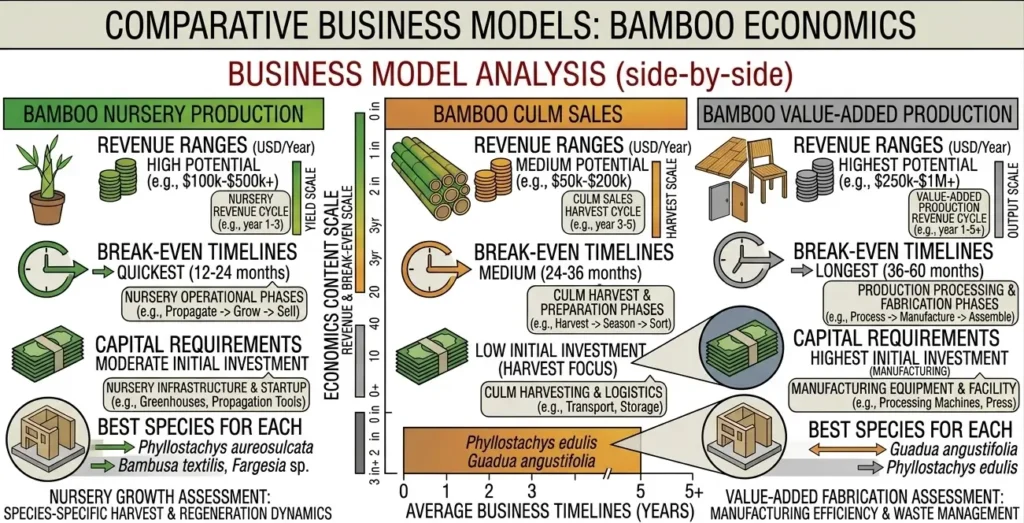
Not all bamboo businesses require 50 acres and industrial processing. After consulting with 14 commercial growers across the Southeast and Pacific Northwest, three viable models emerged:
Model 1: Nursery Stock Production
Revenue potential: $40,000-$120,000 per acre annually (mature operation)
Break-even timeline: 2-3 years
Best species: Fargesia (clumping, cold-hardy), Phyllostachys aureosulcata, Bambusa multiplex
Selling live plants generates income years before timber harvest. A single Phyllostachys division wholesales for $15-$40; retail pricing hits $45-$150 depending on pot size and species rarity.
I shifted 30% of my operation to nursery production in year two. That decision covered operating costs by year three while my timber bamboo matured.
The catch: nursery operations require different skills, potting, inventory management, retail or wholesale relationships. Growing bamboo and selling bamboo are different businesses.
Model 2: Culm Production for Regional Processors
Revenue potential: $8,000-$25,000 per acre annually (mature)
Break-even timeline: 4-5 years
Best species: Phyllostachys edulis, Phyllostachys bambusoides, Phyllostachys vivax
Raw culm sales work when you’re within 200 miles of a processing facility. Transportation costs kill margins beyond that radius.
Current U.S. processors I’ve worked with (2024 pricing):
- Green culms, 3″+ diameter: $1.50-$2.50 each
- Dried culms, 3″+ diameter: $4-$8 each
- Specialty culms (Phyllostachys nigra, unusual species): $5-$15 each
At 400-800 harvestable culms per acre annually from a mature stand, the math works, but only at scale. My 6 acres barely justify the relationship maintenance with processors.
Model 3: Integrated Value-Added Production
Revenue potential: $60,000-$150,000+ per acre annually
Break-even timeline: 5-7 years
Best species: Phyllostachys edulis (versatility), Phyllostachys bambusoides (structural)
This model requires the most capital but captures the full value chain. You grow, harvest, process, and sell finished products, poles, fencing, stakes, furniture components, or craft materials.
The operation in North Carolina I’ve followed since 2020 processes 15,000 culms annually into garden stakes, trellises, and privacy fencing. Their per-culm revenue averages $22, compared to $2 for raw culm sales. They also spent $180,000 on processing equipment and a dedicated workspace.
For species selection guidance across these models, see the bamboo varieties and species selection guide.
Species Selection by Climate Zone and Market
Choosing the wrong species wastes 3-5 years. Commercial viability depends on matching species to both your USDA zone AND your target market, requirements that sometimes conflict.
Cold Climate Operations (Zones 5-6)
Commercially viable species are limited. Most Phyllostachys survive but grow slower, producing smaller-diameter culms.
Phyllostachys bissetii, Most reliable. Cold-hardy to -10°F. Culms reach 2.5-3″ diameter. Best for nursery stock, garden stakes, light construction.
Phyllostachys aureosulcata, Hardy to -10°F. Yellow-groove varieties command premium nursery prices. Culms to 2″ diameter.
Fargesia robusta, Clumping, no containment required. Excellent nursery margins. Not commercially viable for timber.
My Zone 7b location sits on the boundary. Phyllostachys edulis survived but didn’t thrive until a microclimate adjustment, south-facing slope, windbreak established, pushed effective conditions warmer.
Moderate Climate Operations (Zones 7-8)
The commercial sweet spot for temperate bamboo. Most Phyllostachys species reach full potential.
Phyllostachys edulis (Moso), The commercial standard. Culms to 6″ diameter, 60’+ height. Highest biomass yield. Edible shoots add secondary revenue stream ($4-$8/lb fresh).
Phyllostachys bambusoides (Madake), Structural-grade timber. Culms to 5″ diameter with exceptional wall thickness. Premium pricing for construction applications.
Phyllostachys vivax, Fastest early growth. Impressive height for visual impact. Thinner culm walls limit structural applications.
Warm Climate Operations (Zones 9-10)
Tropical clumping bamboos dominate. No containment costs, significant savings.
Bambusa oldhamii, Clumping, culms to 4″ diameter. Excellent for construction, furniture components. 60-70′ mature height.
Dendrocalamus asper, Large-diameter tropical species, to 8″ diameter. Premium structural bamboo. Zone 9b minimum.
Guadua angustifolia, The construction bamboo. Structural properties rival steel by weight. Requires true tropical conditions.
Real Cost Breakdown: What I Spent
| Category | Year 1 | Years 2-3 | Years 4-5 | Total |
| Land preparation | $4,200 | – | – | $4,200 |
| Plants (tissue culture) | $18,500 | $2,400 | – | $20,900 |
| Rhizome barrier | $8,400 | – | $1,200 | $9,600 |
| Irrigation system | $7,800 | $1,100 | $800 | $9,700 |
| Fencing (deer) | $6,200 | – | $400 | $6,600 |
| Soil amendments | $2,400 | $1,800 | $1,200 | $5,400 |
| Equipment | $3,800 | $2,200 | $4,500 | $10,500 |
| Labor (hired) | $4,000 | $6,000 | $8,000 | $18,000 |
| TOTAL | $55,300 | $13,500 | $16,100 | $84,900 |
What competitors don’t mention: Rhizome barrier installation for running bamboo. At $1.50-$3 per linear foot for 60-mil HDPE barrier plus installation labor, containing 6 acres cost almost as much as the plants themselves. The bamboo removal and control guide explains why skipping containment is a lawsuit waiting to happen.
Revenue timeline:
- Years 1-2: $0
- Year 3: $6,400 (nursery sales only)
- Year 4: $14,200 (nursery + limited culm sales)
- Year 5: $28,500 (nursery + culms + shoots)
- Projected Year 6: $38,000-$45,000
I’m on track for break-even in year 7. Not year 3 as the optimistic projections suggested.
The Processing Bottleneck Nobody Discusses
MYTH: “Grow bamboo and buyers will find you.”
REALITY: Without processing capability or processor relationships, you’re competing against Asian imports at 1/10th your production cost.
Raw bamboo culms compete with Chinese imports priced at $0.80-$1.50 delivered. Your $2 culm doesn’t compete. Your $25 processed, graded, treated pole does, but processing requires capital equipment most small operations can’t justify.
The three successful commercial growers I know solved this differently:
Cooperative processing. Five growers in Georgia share a treatment facility, splitting equipment costs and processing capacity. Each operation runs 8-15 acres independently.
Processor contracts. Secure purchase agreements before planting. Lewis Bamboo in Alabama contracts with regional growers at fixed pricing, less profit potential, but guaranteed sales.
Vertical integration. The expensive route. $150,000-$300,000 in processing equipment, but you capture the full margin. Only viable above 15-20 acres.
I chose a hybrid: nursery sales (no processing required) fund operations while I negotiate processor relationships for timber culms. Five years in, I’m still not processing my own material.
Edible Shoots: The Overlooked Revenue Stream
Phyllostachys edulis shoots sell for $4-$8 per pound fresh at farmers’ markets and Asian grocery wholesalers. A mature acre produces 500-1,500 pounds of harvestable shoots annually, $2,000-$12,000 in spring revenue before touching timber production.
The catch: timing is brutal. Shoots reach harvestable size (12-18″) within 7-14 days of emergence and must be processed within 24-48 hours of cutting. You’re either harvesting every morning during the 4-6 week shoot season, or you’re missing it.
My 2024 shoot harvest: 847 pounds, $5,082 gross revenue. Labor cost for daily harvesting: approximately $1,800. Net contribution: $3,282 from a crop I’d otherwise ignore.
Fresh shoots require food-handling permits in most states. Processed shoots (canned, frozen) require commercial kitchen certification. Check state agriculture department requirements before marketing plans.
Carbon Credits and Sustainability Premiums
INBAR’s 2023 carbon sequestration data shows mature Moso bamboo plantations sequester 100-400 tons of CO₂ per hectare, potentially higher than most timber forestry. Translating this to carbon credit revenue remains complicated.
Current reality:
- Verified carbon credit programs for bamboo are emerging but not standardized
- California’s cap-and-trade system doesn’t currently recognize bamboo specifically
- Voluntary carbon markets offer $15-$50 per ton, but verification costs often exceed revenue for small operations
What’s working now: sustainability certifications. FSC-certified bamboo commands 15-25% premiums from eco-conscious buyers. The bamboo environmental sustainability applications guide covers certification pathways.
I’m registered with a voluntary carbon program. Annual revenue: $340. Verification cost: $275. Net benefit is minimal, but positioning for future programs as markets mature.
Legal and Regulatory Considerations
Commercial bamboo operations face regulatory requirements most articles ignore:
Running bamboo containment. Several states (New York, Connecticut, others) have bamboo-specific ordinances. Commercial operations often require containment plans or buffer zones. The bamboo property and legal issues guide details state-specific requirements.
Agricultural classification. Bamboo is classified as timber in some jurisdictions, ornamental in others, and invasive species in a few. Classification affects tax treatment, agricultural exemptions, and available subsidies.
Water usage permits. Commercial bamboo requires 1-2″ water weekly during establishment. Operations drawing from wells or surface water may require agricultural water permits.
Processing permits. Pressure treatment chemicals (borates, copper compounds) have EPA registration requirements. Shoot processing requires food-handling certification.
I spent $2,400 on legal consultation before planting. That investment prevented a zoning conflict that would have shut down operations.
My Honest Assessment After 5 Years
Commercial bamboo farming works under specific conditions:
It works when:
- You secure market channels before planting
- You’re in Zones 7-10 with adequate water access
- You can tolerate 3-5 years of negative cash flow
- You have either processing capability or processor proximity
- You start with 5+ acres (economies of scale matter)
It doesn’t work when:
- You’re treating it as passive income
- You’re in cold climates expecting tropical yields
- Your only market research is “bamboo is popular”
- You can’t access or afford irrigation
- You’re unwilling to personally harvest during critical windows
If starting over, I’d do three things differently: start with nursery production immediately (cash flow from year two), plant half the acreage initially (less capital risk), and secure a processor contract before the first rhizome went in the ground.
Bamboo farming can be profitable. It’s not quick, it’s not passive, and it’s not for everyone. But for those matching species to climate, market to product, and expectations to reality, the numbers eventually work.