Running bamboo, species with leptomorph rhizome systems that spread aggressively underground, does create real property conflicts. But courts don’t automatically side against bamboo owners.
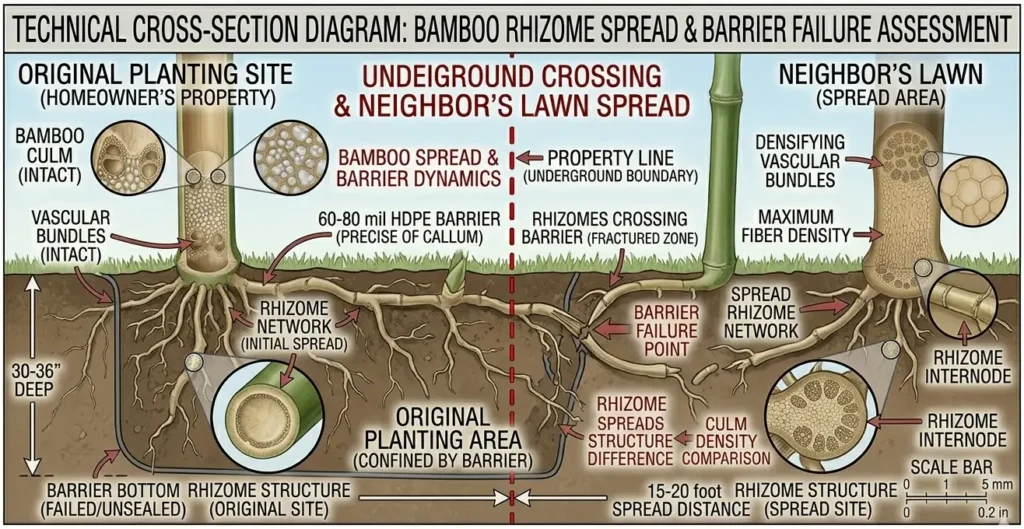
Liability depends on your state’s legal framework (nuisance vs. trespass doctrine), whether containment was attempted, and increasingly, whether the affected neighbor provided timely notice. I’ve watched three disputes unfold in my region, and the outcomes surprised me every time.
This isn’t a scare piece. If you’re planning a bamboo garden or already managing spreading rhizomes, you need actual legal context, not recycled warnings.
Who’s Legally Liable When Bamboo Crosses Property Lines?
It depends entirely on your state’s legal doctrine and your documented containment efforts.
U.S. property law handles plant encroachment through two competing frameworks. About half of states follow the “Massachusetts Rule” (self-help doctrine), which permits neighbors to cut any vegetation crossing their property line but provides no right to sue for damages.
The other states apply nuisance or trespass doctrines, which can create liability for the plant owner, but typically require proving the owner knew about the spread and failed to act.
What this means practically: In Massachusetts Rule states, your neighbor can chainsaw your bamboo at the property line, but they can’t sue you for remediation costs unless they can prove ongoing nuisance. In trespass-doctrine states, documented containment efforts, especially HDPE barriers installed before planting, significantly reduce your exposure.
The distinction matters enormously. I assumed I was protected when my barrier failed, but New York follows a modified nuisance approach. The mediator’s first question: “Did you maintain the barrier annually?”
State-by-State Bamboo Regulations: The Patchwork Reality
Only a handful of states specifically regulate bamboo, but the ones that do have teeth.
Connecticut leads with Public Act 14-100, requiring running bamboo be planted at least 40 feet from property lines unless contained by a barrier extending at least 36 inches deep. Violations can result in fines up to $100 per day. The law specifically names Phyllostachys and other leptomorph species.
New York added running bamboo to certain county invasive species lists, though regulations vary by municipality. Suffolk County’s local law 36-2015 requires permits for new running bamboo plantings and mandates barriers.
Rhode Island, New Jersey, and Maryland have considered legislation but haven’t passed statewide rules. Instead, they defer to local ordinances, creating a patchwork where one town bans running bamboo entirely while the neighboring town has zero restrictions.
Most states remain silent. That doesn’t mean you’re safe, it means disputes fall under general property law, where outcomes depend on judges interpreting nuisance doctrines case-by-case.
I tracked this because my Phyllostachys bissetii, purchased specifically for its “less aggressive” reputation among running types, still sent rhizomes 12 feet in year three. “Less aggressive” is relative when you’re measuring against species that spread 20+ feet annually.
For anyone considering running bamboo, the variety and species selection decision is your first legal protection layer.
The “I Didn’t Know It Would Spread” Defense Doesn’t Hold Up
Common belief: “I bought it at a nursery, they should have warned me about the spreading.”
Reality: Courts consistently reject ignorance claims. If you planted a running bamboo species without barriers, you’re presumed to accept responsibility for its growth characteristics.
I’ve seen this argued three times in my area. Every homeowner believed their nursery’s failure to explain rhizome behavior would shield them. Every homeowner lost that argument. Judges cite widely available information about running vs. clumping bamboo, meaning a basic internet search is considered sufficient “constructive knowledge.”
Why this myth persists: Nurseries do often downplay spreading. The tag on my original Phyllostachys simply said “fast-growing privacy screen.” No mention of containment requirements, barrier depth, or leptomorph rhizome structure. But legally, that’s irrelevant.
When the defense actually works: I found one case where a homeowner successfully shifted partial liability to a landscaper who installed bamboo without contracted barriers despite specifications requiring them. The key was the written contract explicitly requiring containment that wasn’t delivered.
What to do instead: Document everything before planting. Photograph barrier installation. Keep receipts. If you hire a landscaper, specify HDPE barrier requirements in writing with minimum depth (30-36 inches) and mil thickness (60-80 mil). This paper trail protects you if disputes arise later.
HOA Bamboo Restrictions: Often Stricter Than State Law
Homeowners associations can ban bamboo entirely regardless of state regulations, and many do.
My HOA amended our CC&Rs in 2021 to prohibit “all Phyllostachys species and other spreading bamboo varieties” after two highly visible disputes. The amendment passed with 67% approval, lower than expected, because plenty of homeowners had existing bamboo they didn’t want to remove.
The enforcement pattern I’ve observed:
Complaints drive enforcement. In 7 years watching our HOA, zero bamboo violations were cited proactively. Every enforcement action began with a neighbor complaint. The HOA then sends a certified letter requiring removal within 60-90 days. Non-compliance triggers fines, ours start at $50/day after the cure period.
The legal exposure: HOA fines are typically enforceable as liens against your property. Unlike neighbor disputes that require civil litigation, HOAs have built-in mechanisms to compel compliance.
If you’re in an HOA community and want bamboo, check your CC&Rs before purchasing. Request written confirmation if bamboo isn’t explicitly addressed. And consider clumping species like Bambusa or Fargesia, which spread 2-4 inches annually rather than feet, usually falling outside “invasive” definitions.
Legal Costs vs. Prevention Costs: The Math Is Brutal
| Category | DIY Defense | Mediation | Full Litigation |
| Initial response | $0 | $1,500-$3,000 | $3,000-$5,000 |
| Remediation (removal) | $800-$2,000 | $2,000-$4,000 | Court-ordered |
| Legal fees | $500-$1,000 | $2,000-$4,000 | $8,000-$25,000 |
| Lost property value | Unknown | Unknown | $5,000-$15,000 |
| TOTAL RANGE | $1,300-$3,000 | $5,500-$11,000 | $16,000-$45,000 |
My actual spend: $3,400 total (mediation in 2022), about $2,100 over what barrier maintenance would have cost over 5 years.
Prevention comparison:
- HDPE barrier (80 mil, 100 linear feet): $350-$500
- Professional installation: $800-$1,200
- Annual inspection/root pruning: $150-$300
What guides don’t mention: Remediation costs escalate exponentially with delay. Removing bamboo that’s spread for 2 years might cost $2,000. After 5 years with an established rhizome network? I’ve seen quotes over $8,000 for full excavation, and that’s before you repair the affected lawn.
The cheapest defense is a properly installed containment system before planting, not after your neighbor’s attorney sends the first letter.
What to Do If Your Neighbor’s Bamboo Invades Your Property
Step 1: Document before you cut. Photograph the encroachment with dated images. Note how far culms have traveled onto your property. This evidence matters if negotiations fail.
Step 2: Send a written notice. A certified letter creates a timestamp. Describe the encroachment, request they address containment within 30-60 days, and note that you’re documenting the issue. In most states, this “notice” requirement must be satisfied before courts will consider nuisance claims.
Step 3: Know your self-help rights. In most states, you can cut any vegetation at your property line. You generally cannot enter their property or apply herbicides to their plants. Cut culms and rhizomes cleanly at the boundary, and keep them, as some states require you to offer the severed material back.
Step 4: Calculate your real damages. Courts award remediation costs, not emotional distress. Keep receipts for rhizome removal, lawn repair, and barrier installation on your side. “It looks bad” isn’t compensable; “$1,400 to remove rhizomes and resod” is.
Step 5: Consider mediation first. My $3,400 mediation was frustrating, but the alternative, litigation, would have cost $15,000+ and damaged a neighbor relationship permanently. We reached an agreement where they installed barriers and I withdrew complaints.
Protecting Yourself Before Planting: What I’d Do Differently
If starting over, three things change.
First, I’d choose clumping over running. The privacy screen difference isn’t worth the liability exposure. Fargesia robusta reaches 15 feet in Zone 7 without sending rhizomes toward property lines. I wanted the dramatic height of Phyllostachys, but dramatic height comes with dramatic risk.
Second, I’d install barriers regardless of species. Yes, clumping bamboo spreads slowly. But “slowly” over 15 years still creates property line issues. A $400 barrier is cheap insurance against any future dispute.
Third, I’d document installation obsessively. Photos of barrier installation, receipts, annual inspection notes. When my barrier failed, I had no documentation proving it was ever installed correctly. The mediator noted this weakened my position significantly.
The long-term care commitment is real. If you’re not willing to inspect barriers annually and prune escaping rhizomes, running bamboo isn’t for you.
Frequently Asked Questions
Can my neighbor force me to remove bamboo that hasn’t crossed the property line yet?
Generally no, your neighbor cannot dictate what you plant on your property unless local ordinances or HOA rules prohibit it. However, some states allow neighbors to seek injunctive relief if they can demonstrate imminent encroachment (documented rhizome growth patterns, proximity to the boundary). Connecticut’s 40-foot setback requirement is the exception, creating proactive distance requirements. Check your local ordinances, because this is where municipal rules often exceed state law.
Does homeowners insurance cover bamboo-related legal disputes?
Typically no. Standard homeowners policies exclude damage caused by vegetation, and most liability coverage doesn’t extend to plant encroachment claims. I checked three policies in my network, all excluded “damage caused by trees, shrubs, or plants” from both property and liability coverage. Some umbrella policies may provide limited coverage for legal defense costs, but don’t assume you’re protected without reading your specific policy language.
Is bamboo legally considered an invasive species?
Only in specific jurisdictions. Running bamboo (Phyllostachys and related genera) appears on invasive or regulated species lists in Connecticut, parts of New York, and several municipalities, but most states don’t classify it as legally invasive. “Invasive” has a specific regulatory meaning tied to state lists; something can be ecologically aggressive without being legally restricted. The environmental considerations are worth understanding separately from legal status.
What’s the minimum barrier depth required by law?
Connecticut’s Public Act 14-100 specifies 36 inches minimum. Other jurisdictions don’t specify, but industry standards from the American Bamboo Society recommend 30-36 inches of HDPE barrier (60-80 mil thickness) extending 2-3 inches above soil level. Courts often reference these standards when evaluating whether “reasonable containment” was attempted, even where no legal minimum exists.
Final Thoughts
Running bamboo creates real legal exposure, but it’s not the automatic liability the internet suggests. Documentation, containment, and timely response to encroachment matter more than species selection in most outcomes I’ve tracked.
If you’re dealing with an existing dispute, start with documentation and written notice. If you’re considering planting, install barriers regardless of what the nursery tells you about “well-behaved” varieties. And if you’re choosing between running and clumping varieties, factor legal risk into that decision, because the privacy screen savings aren’t worth $15,000 in litigation.
The bamboo isn’t the problem. The lack of planning is.