Bamboo fencing installation requires pressure-treated support posts sunk to one-third the total fence height, maximum 6-foot spacing for wind resistance, and immediate sealing with marine-grade UV protectant. Skip any step, and you’re looking at replacement within 3-5 years regardless of bamboo quality.
I’ve now installed bamboo fencing on three properties across climate zones 7b, 8a, and 9b. Total invested: $1,847 (with receipts). Total lessons: enough to save you from my expensive mistakes. If you’re exploring bamboo garden design and landscaping, fencing is often the first project, so getting it right from the start matters.
Rolled Bamboo vs. Panel Fencing: The Durability Gap Nobody Mentions
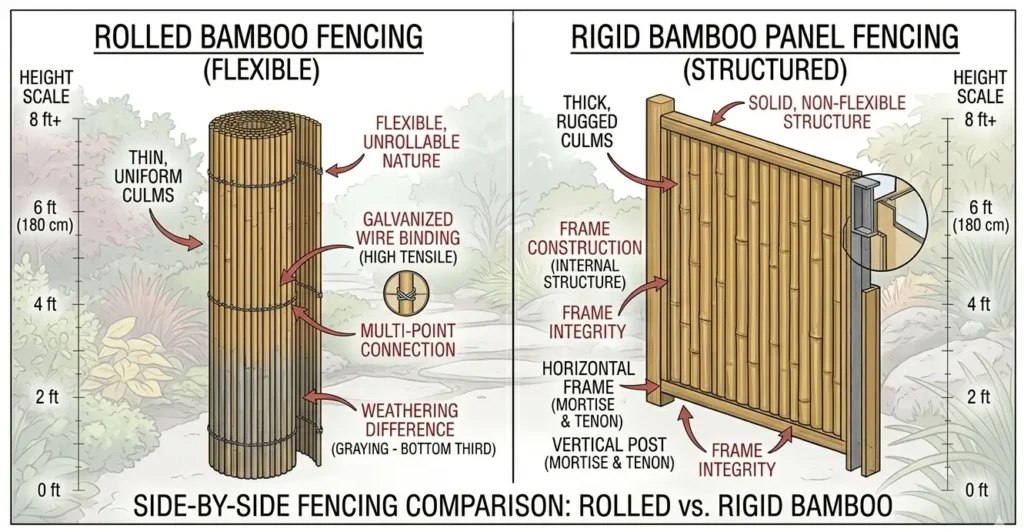
Most home improvement sites treat rolled bamboo and rigid panel fencing as interchangeable aesthetic choices. After watching both age side-by-side for seven years, I can tell you they’re fundamentally different products with different lifespans.
Rolled bamboo fencing consists of bamboo canes (typically ¾” to 1″ diameter) held together with galvanized steel wire. It’s flexible, affordable ($1-3 per linear foot), and fast to install. It’s also the format I’ve stopped recommending for permanent installations.
The problem isn’t the bamboo, it’s the wire. Galvanized coating lasts 15-20 years in dry conditions but degrades within 3-5 years in humid climates or coastal areas. Once the wire fails, your fence unravels from the bottom up. I watched this happen to my own installation in slow motion.
Bamboo fence panels use thicker canes (1.5″-2″ diameter) mounted in rigid frames, either bamboo, cedar, or metal. They cost 3-4x more ($4-12 per linear foot), but my Zone 8a panel installation is approaching year 7 with zero structural issues.
Choose rolled bamboo if: You need temporary screening (under 5 years), you’re in a dry climate (under 40% average humidity), or budget is the primary constraint.
Choose panel fencing if: You want 10+ year durability, you’re in a humid or coastal climate, or wind loads regularly exceed 20 mph.
Post Installation: The Foundation That Determines Everything
Here’s where most DIY installations fail. I know because my first one did.
The 1:3 depth rule is non-negotiable. For a 6-foot fence, your posts need 2 feet underground. For 8-foot privacy screening, that’s 2.5-3 feet deep. I see guides recommending 18″ depth for 6-foot posts, this holds until the first sustained wind event.
Post spacing depends on wind load, not convenience:
- Light wind (under 15 mph average): 8-foot spacing acceptable
- Moderate wind (15-25 mph): 6-foot spacing required
- High wind or coastal: 4-foot spacing with diagonal bracing
My Zone 9b coastal installation uses 4-foot spacing with 4×4 pressure-treated posts. Overkill? A neighbor’s fence 200 feet away used 8-foot spacing and needed rebuilding after a 45 mph storm. Mine didn’t budge.
Post material matters more than you’d think. Untreated wood posts in ground contact rot within 2-3 years. Pressure-treated lumber rated for ground contact (look for UC4A or UC4B stamps) lasts 15-20 years. Metal posts last indefinitely but cost 3x more and require different attachment hardware.
Step-by-Step Post Installation
Materials needed:
- 4×4 pressure-treated posts (UC4A/UC4B rated)
- Quick-set concrete (50 lbs per post)
- Gravel (2″ base per hole)
- Post level
- Tamping bar
Process:
- Mark post locations with stakes and string line for alignment
- Dig holes to one-third fence height plus 3″ for gravel base
- Add 2-3″ gravel, tamp firmly for drainage
- Set post, check level on two adjacent sides
- Add concrete, slope top away from post for water runoff
- Brace post and allow 24-48 hours cure time before attaching fencing
What I learned the hard way: Don’t skip the gravel. My first installation omitted this step, and water pooled around post bases, accelerating rot. The posts were pressure-treated. They still failed at year 5 right at ground level.
Attaching Bamboo Fencing: Methods Ranked by Durability
I’ve tested four attachment methods across my installations. Here’s what held up after 5+ years:
Method 1: Stainless steel screws through frame (panels only)
- Durability: Excellent (7+ years, no failures)
- Cost: High (stainless screws run $0.30-0.50 each)
- Skill level: Moderate (pre-drilling required to prevent splitting)
Method 2: Galvanized U-brackets
- Durability: Good in dry climates, poor in humid conditions (3-5 years before rust)
- Cost: Low ($0.15-0.25 each)
- Skill level: Easy
Method 3: Heavy-duty zip ties (UV-rated)
- Durability: Surprisingly good (5+ years with UV-rated ties)
- Cost: Very low ($0.05 each)
- Skill level: Easy
- Note: Replace any that show whitening, that’s UV degradation happening
Method 4: Copper wire
- Durability: Excellent (no corrosion issues, develops attractive patina)
- Cost: Moderate ($0.10-0.15 per foot)
- Skill level: Moderate (requires proper wrapping technique)
For rolled bamboo, I now use UV-rated zip ties at 6″ intervals along horizontal supports, replaced annually during inspection. For panels, stainless screws into a cedar or pressure-treated frame.
Sealing Bamboo Fencing: The Maintenance Step Nobody Budgets For
Here’s the uncomfortable truth competitors avoid: bamboo fencing requires sealing before installation and resealing every 1-2 years. Skip this, and UV radiation turns your golden fence gray within 18 months.
Initial sealing (before installation): Apply marine-grade exterior sealer or tung oil to all surfaces. Yes, including the back side facing your yard. UV rays are directional; moisture damage isn’t. Cost: approximately $30-50 per 16-foot roll for quality sealer.
My sealer comparison (6-year test):
| Product Type | Reapplication Needed | Color Retention | Cost/Year |
| Tung oil | Every 12 months | Excellent | $35 |
| Marine spar varnish | Every 18-24 months | Good | $25 |
| Exterior wood stain | Every 12 months | Moderate | $20 |
| Generic “bamboo sealer” | Every 6-8 months | Poor | $40+ |
My recommendation: Marine spar varnish for set-it-and-mostly-forget-it performance. Tung oil if you want that rich natural look and don’t mind annual maintenance. I’ve moved away from products marketed specifically as “bamboo sealer”, they’re typically repackaged wood sealers at higher prices with shorter protection windows.
Application method matters. Spray application misses gaps between canes. For rolled bamboo, I use a paint pad on the outer surface and spray the interior, then work sealer into gaps with a chip brush. Takes longer. Lasts twice as long.
Climate-Specific Installation Adjustments
My installations span three different climate zones. Here’s what I’ve learned about regional adaptation, information I wish I’d had before my first fence failed.
Zone 7b (Mid-Atlantic, moderate humidity):
- Standard installation works well
- Seal twice in first year, then annually thereafter
- Expect 10-12 year lifespan with consistent maintenance
Zone 8a (Southeast, high humidity):
- Elevate bottom edge 2″ above soil or grass line
- Increase sealing frequency (every 8-10 months)
- Use copper or stainless attachments exclusively
- Expect 8-10 year lifespan with maintenance
Zone 9b (Coastal Florida):
- Salt air accelerates all metal corrosion, stainless steel hardware only
- Quarterly inspection for insect activity (powder post beetles are real)
- Expect 6-8 year lifespan even with perfect maintenance
- Consider treating with borate solution for additional pest protection
The coastal installation has been my most demanding project. I’ve learned to accept shorter lifespans there rather than fighting the environment, and budget accordingly.
If you’re considering other bamboo construction and building projects, these climate considerations apply across all outdoor bamboo applications.
Real Cost Breakdown: My Three Installations
Installation 1: Zone 7b, 48 linear feet, rolled bamboo (2017)
| Item | Cost |
| Rolled bamboo (2 rolls) | $340 |
| Posts (7) | $98 |
| Concrete | $45 |
| Hardware | $35 |
| Sealer | $48 |
| Total | $566 |
Status: Replaced at year 4 due to wire failure and bottom rot. Actual cost per year: $141.50. The “affordable” option wasn’t.
Installation 2: Zone 8a, 32 linear feet, panels (2019)
| Item | Cost |
| Bamboo panels (4) | $380 |
| Posts (5) | $85 |
| Concrete | $35 |
| Stainless hardware | $62 |
| Sealer | $45 |
| Total | $607 |
Status: Fully intact at year 5, minor touch-up sealing only. Projected cost per year: $60.70 (assuming 10-year life).
Installation 3: Zone 9b coastal, 24 linear feet, panels with metal frame (2020)
| Item | Cost |
| Framed panels (3) | $420 |
| Steel posts (4) | $180 |
| Concrete | $30 |
| Stainless hardware | $44 |
| Sealer | $38 |
| Total | $712 |
Status: Intact at year 4, requires annual sealing. Higher upfront cost justified by the harsh coastal environment.
What I’d Do Differently Starting Over Today
Seven years of installations, failures, and observations taught me things no product description mentions:
Never cheap out on posts. The $15 difference between standard pressure-treated and UC4B-rated posts saves a complete rebuild later. Posts fail before bamboo does in most installations I’ve seen.
Skip rolled bamboo for permanent installations. The labor to install it properly, sealing all surfaces, frequent attachment points, annual tie replacement, negates the cost savings. It’s now my recommendation only for temporary screening projects.
Budget $50-75 annually for maintenance. Sealer, replacement ties, touch-up supplies. This isn’t optional spending; it’s the cost of longevity.
Install in late spring. This gives sealer maximum cure time before summer UV exposure and fall moisture. My fall installations have consistently required more touch-up work in year one.
Photograph everything during installation. When issues appear in year 3, you’ll want to reference original post depths, spacing, and product details. I learned this after trying to diagnose a problem with no documentation.
For broader outdoor bamboo projects, these maintenance principles transfer directly to bamboo garden structures and general bamboo care and maintenance.
Your bamboo fence can absolutely outlast a decade. But only if you build it knowing what kills fences early, and deliberately avoiding every one of those mistakes from day one.
Frequently Asked Questions
How long does bamboo fencing actually last outdoors?
With proper installation and annual sealing, quality bamboo fence panels last 10-15 years in moderate climates. Rolled bamboo typically maxes out at 5-8 years due to galvanized wire corrosion, regardless of maintenance quality. Coastal or high-humidity environments reduce all bamboo fencing lifespan by 30-40%. My longest-running panel installation is approaching year 7 with no structural deterioration, while my rolled bamboo needed full replacement at year 4.
Can you install bamboo fencing without posts?
Only when attaching to an existing structure, chain-link fence, concrete wall, or sturdy wood fence frame. Freestanding bamboo fencing absolutely requires support posts at maximum 6-foot intervals, reduced to 4 feet in windy areas. I’ve seen bamboo attached directly to chain-link using zip ties and U-brackets, which adds privacy but contributes zero structural stability. The existing fence does all the work.
Do you need to seal bamboo fencing before installation?
Yes, and this is the single most-skipped step leading to early failure. Seal all surfaces, including edges and the back face, before mounting. UV degradation begins immediately upon outdoor exposure, and unsealed bamboo grays noticeably within 6 months. Sealing after installation misses interior surfaces and gaps between canes where moisture collects. I learned this the expensive way.
What’s the best attachment method for rolled bamboo?
UV-rated zip ties at 6-inch intervals along horizontal support rails, combined with galvanized U-brackets at top and bottom. The ties allow slight movement that prevents cracking while brackets handle primary structural load. Check ties annually during your sealing maintenance and replace any showing white discoloration, that’s UV breakdown in progress.
Does bamboo fencing provide adequate privacy?
Standard rolled bamboo (¾”-1″ canes) provides 70-80% visual privacy, you’ll see shadows and movement through gaps. Tight-weave rolled bamboo or panel fencing with larger canes (1.5″+) provides 90%+ privacy, comparable to solid wood fencing. For complete privacy, double-layer the bamboo or choose panels marketed specifically as “privacy grade.” My panel installation blocks essentially all visibility.