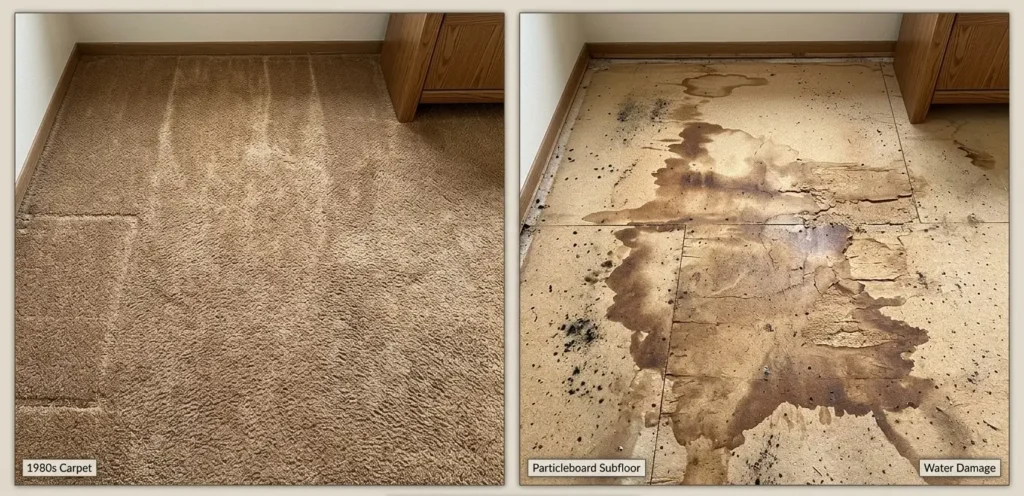
My first bamboo flooring remodel went $2,400 over budget in a single afternoon. The contractor pulled up carpet in our 1987 ranch and found particleboard subfloor saturated from a long-forgotten water heater leak. That discovery, invisible until demo day, turned a 3-day install into a 2-week subfloor replacement project.
Bamboo flooring works exceptionally well in remodeling projects, but renovation introduces complications absent from new construction: unknown subfloor conditions, height-matching challenges at transitions, and the logistics of living in a construction zone. After completing six bamboo remodel projects across three homes, ranging from single-room updates to whole-house renovations, I’ve learned that successful remodels require planning for what you can’t see until walls come down.
At BambooScope, we’ve documented hundreds of remodeling scenarios. This guide covers the remodel-specific decisions that generic installation guides skip entirely.
Why Remodeling With Bamboo Differs From New Construction
Most bamboo flooring guides assume you’re working with new, level concrete or fresh plywood subfloor. Remodels rarely offer that luxury.
In new construction, subfloors meet current code requirements, typically 3/4″ tongue-and-groove plywood or OSB over joists at 16″ centers. Your installer knows exactly what they’re working with. In remodeling, you’re inheriting decades of previous decisions: multiple flooring layers, moisture damage, subfloors that predate modern standards, and height variations that accumulated over time.
The subfloor in my 1962 mid-century measured 5/8″ particleboard, below the 3/4″ minimum recommended by the National Wood Flooring Association (NWFA) for nail-down bamboo installation. We had three options: add 1/4″ plywood overlay, switch to floating installation, or tear out and replace. Each choice affected cost, timeline, and final floor height.
Common remodel subfloor surprises:
- Multiple flooring layers (I’ve found four layers in one kitchen)
- Asbestos-containing adhesive or backing (requires professional abatement)
- Moisture damage invisible until existing flooring comes up
- Out-of-level conditions exceeding 3/16″ over 10 feet
- Inadequate subfloor thickness for your chosen installation method
Understanding your bamboo flooring installation options matters more in remodels because the existing structure limits your choices.
The Remodel Subfloor Assessment: Test Before You Commit
Here’s what nobody told me before my first remodel: test your subfloor before ordering materials. Sounds obvious. I skipped it anyway and ordered $3,200 in strand-woven bamboo for a kitchen that needed $1,800 in subfloor remediation first.
Step 1: Moisture Testing (Non-Negotiable)
ASTM F2170 is the industry standard for in-situ relative humidity testing in concrete subfloors. For wood subfloors, you’re checking moisture content with a pin-type meter. Bamboo flooring manufacturers typically require concrete RH below 75% and wood subfloor moisture content below 12%.
My basement office tested at 82% RH, well above acceptable limits. Installing bamboo anyway would void the warranty and guarantee cupping within months. We installed a dehumidification system ($650) and waited six weeks before retesting. That delay meant rescheduling the installer twice.
Step 2: Flatness Assessment
The NWFA guideline is 3/16″ variation over 10 feet for floating floors, 1/8″ for glue-down. I check with a 10-foot straightedge, marking high and low spots with blue tape. In remodels, I typically find 2-3 areas per room needing leveling compound.
For significant leveling needs, your subfloor preparation costs can rival the flooring itself.
Step 3: Structural Adequacy
Can your existing subfloor support your chosen installation method?
| Installation Method | Minimum Subfloor | Remodel Reality |
| Nail-down | 3/4″ plywood or OSB | Many pre-1980 homes have 5/8″ |
| Glue-down | 3/4″ plywood, concrete | Needs perfectly clean surface |
| Floating/Click-lock | 1/2″ minimum | Most forgiving for remodels |
I’ve shifted to recommending engineered bamboo with click-lock installation for most remodels. It’s more forgiving of minor subfloor imperfections and doesn’t require the structural commitment of nail-down.
Choosing Bamboo Type for Remodeling Projects
Not all bamboo flooring performs equally in remodeling scenarios. Your choice should account for room function, existing floor heights, and how much subfloor work you’re willing to undertake.
Strand-Woven Bamboo: The Durability King
Strand-woven bamboo compresses shredded bamboo fibers under extreme pressure, producing Janka hardness ratings of 3,000-5,000 lbf, harder than most hardwoods. This durability makes it ideal for high-traffic remodels: kitchens, hallways, family rooms.
The catch for remodelers: strand-woven planks are typically 14mm (9/16″) thick. If your existing flooring was 3/8″ laminate, you’re adding nearly 1/4″ to floor height. That affects door clearances, appliance fit, and transitions to adjacent rooms.
Engineered Bamboo: The Remodel-Friendly Option
Engineered bamboo layers a bamboo wear surface over plywood backing. Total thickness typically runs 12-15mm. The multi-layer construction provides better dimensional stability, critical in remodels where humidity control may be imperfect during construction.
I installed engineered bamboo in a bathroom remodel where strand-woven would have been risky. Three years later, no issues despite 60%+ humidity spikes during showers. For moisture-prone remodels, see our guide to bamboo flooring for bathrooms.
Solid Horizontal/Vertical Bamboo: Budget-Friendly But Limited
Traditional solid bamboo (horizontal or vertical grain) offers lower upfront cost but thinner wear layers. In a remodel where future refinishing might be needed, the limited 2-3mm wear layer restricts your options. I avoid these for whole-house remodels but still recommend them for bedrooms and low-traffic spaces.
How Much Does Bamboo Flooring Cost in a Remodel?
Bamboo flooring remodel costs typically run $8-15 per square foot installed, but renovation-specific factors, demo, subfloor repair, and height transitions, commonly add $2-6 per square foot beyond new construction estimates. A 500 sq ft remodel budgeted at $5,000 for materials and labor can reach $8,000 when accounting for removal of existing flooring, subfloor remediation, and transition pieces.
Source: Personal project data (2019-2024), NWFA cost guidelines
| Category | Budget Estimate | Actual Cost | Variance |
| Strand-woven bamboo (180 SF) | $1,080 | $1,150 | +$70 |
| Underlayment | $180 | $180 | , |
| Demo/removal | $350 | $520 | +$170 |
| Subfloor repair | $0 | $840 | +$840 |
| Transitions/trim | $200 | $380 | +$180 |
| Professional installation | $1,260 | $1,450 | +$190 |
| TOTAL | $3,070 | $4,520 | +$1,450 |
My actual spend: $4,520 (2023), $1,450 over budget due to discovering water-damaged subfloor under vinyl.
What competitors don’t mention: Demo costs in remodels aren’t just labor. Old adhesive removal can require chemical strippers or mechanical grinding. My kitchen vinyl had asbestos-containing mastic underneath. Abatement added $520 and two weeks.
The Remodeling Timeline: Acclimation Changes Everything
Here’s where remodeling diverges most from new construction: acclimation logistics.
Bamboo flooring needs 5-14 days to acclimate to your home’s temperature and humidity before installation. In new construction, you simply stack boxes in the room and wait. In an occupied remodel, where do you store 40 boxes of flooring while still living in the space?
My whole-house remodel required 62 boxes of strand-woven bamboo. We converted the garage into a climate-controlled staging area, added $200 for temporary heating and dehumidification. Worth every dollar. Improper acclimation causes gapping and warping that void warranties.
Realistic remodel timeline (single room, 200 SF):
- Day 1: Demo existing flooring (4-8 hours)
- Days 2-3: Subfloor assessment and repair (if needed)
- Days 4-10: Acclimation period (materials on-site)
- Day 11: Installation (6-8 hours for click-lock)
- Day 12: Trim and transitions
Living in the space during construction? Add complexity. We did a phased remodel, completing one room fully before starting the next. Extended the project by three weeks but meant we always had functional living space.
For more on timing expectations, check bamboo flooring acclimation.
MYTH: “Bamboo Flooring Can Go Directly Over Any Existing Floor”
REALITY: Some existing floors work; most don’t. And the consequences of getting it wrong show up months later.
You can install floating bamboo directly over existing vinyl, linoleum, or hardwood IF those floors are flat, firmly adhered, and in good condition. I’ve done this successfully in two rental properties where demo costs didn’t make financial sense.
But installation over existing flooring:
- Adds height (creates transition problems)
- Hides potential subfloor issues
- May trap moisture beneath
- Voids some manufacturer warranties
Flooring manufacturers say “can be installed over existing floors” to simplify marketing. They don’t emphasize the conditions required.
What to do instead: Budget for demo. Pulling up old flooring lets you inspect, repair, and prepare the subfloor properly. Every remodel where I skipped demo to save $300-500 eventually needed remediation costing more.
Room-by-Room Remodeling Considerations
Different rooms present different remodel challenges. I’ve made mistakes in each.
Kitchen Remodels
Kitchens experience moisture, spills, and heavy appliances. Strand-woven bamboo with a high-quality finish handles this well, but installation around existing cabinets requires precision cuts and potentially removing base moldings.
My recommendation: If you’re replacing cabinets anyway, install bamboo first. Running flooring under cabinets provides a continuous surface and simplifies future renovations. For existing cabinets, floating installation allows you to work to cabinet edges without gaps.
More details in our bamboo flooring for kitchens guide.
Basement Remodels
Basements are where bamboo remodels fail most often. Below-grade concrete holds moisture differently than above-grade subfloors. Even “dry” basements can have 80%+ RH in the slab.
I regret my 2019 basement bamboo install. Despite RH testing at 72%, seasonal variation spiked humidity post-installation. Cupping appeared within 18 months. Now I recommend engineered bamboo over proper moisture barriers, with whole-room dehumidification, for any basement remodel. See bamboo flooring for basements for complete guidance.
Working With Contractors on Bamboo Remodels
Not every flooring contractor understands bamboo’s requirements. I’ve fired one mid-project.
Questions to ask before hiring:
- How many bamboo floors have you installed? (Want 10+ minimum)
- Do you own a moisture meter? (Non-negotiable)
- How do you handle subfloor issues discovered during demo? (Look for problem-solving experience)
- What’s your warranty on installation? (Minimum 1 year)
The contractor I fired tried to nail-down strand-woven bamboo into 5/8″ particleboard, against manufacturer specifications. When I objected, he said “I’ve done it before.” That’s not reassurance; it’s a future callback waiting to happen.
For finding qualified professionals, start with our bamboo flooring contractors guide.
FAQ: Bamboo Flooring Remodeling
Can I install bamboo flooring over concrete in a remodel?
Yes, but only with proper moisture testing first. ASTM F2170 testing should show relative humidity below 75%. Use a vapor barrier rated at minimum 6 mil thickness. Floating installation works best over concrete, glue-down requires professionally prepared surfaces. I’ve installed over concrete successfully in two slab-on-grade homes, but moisture readings dictated waiting periods of 3-8 weeks.
Does bamboo flooring increase home value in a remodel?
Bamboo flooring can support higher appraisals, particularly strand-woven options that compete with premium hardwoods. However, ROI depends heavily on your market. In our Minneapolis remodel, the appraiser valued strand-woven bamboo comparably to white oak. More on this at bamboo flooring home value ROI.
How do I match new bamboo flooring to existing floors in other rooms?
Height transitions are the main challenge. Measure existing floor height from subfloor surface, then select bamboo thickness accordingly. Transition strips handle 1/4″ differences; larger gaps require ramped reducers. For matching color tones, always order samples and view them in your home’s lighting, bamboo photographs differently than it appears in person.
Should I DIY bamboo flooring in a remodel or hire a professional?
Remodels involve more unknowns than new construction, making professional installation lower-risk. That said, I’ve DIY’d three remodel installs using click-lock engineered bamboo. If you’re comfortable with demo, can assess subfloor conditions, and have realistic timeline flexibility, DIY saves $3-5 per square foot. Budget for tool rental: circular saw, tapping block, pull bar, moisture meter.
Final Thoughts
If I were starting my first bamboo remodel today, I’d budget 40% more than material + installation estimates. That buffer covers subfloor surprises, demo complications, and timeline extensions that affect every renovation.
The material itself performs beautifully, six years later, my strand-woven kitchen shows minimal wear despite daily cooking. The lesson isn’t about bamboo’s quality. It’s about respecting the remodel process: test everything, budget conservatively, and expect the hidden problems.
For comparing bamboo against other renovation flooring options, see our bamboo flooring comparisons guide.