My upstairs bamboo install failed its condo sound inspection in 2019. IIC rating: 42. Minimum required: 50. I spent $1,100 on what I thought was premium cork underlayment. It wasn’t enough.
Bamboo flooring can achieve IIC ratings from 35 to 65+ using the exact same planks, the difference is entirely in underlayment selection and installation method. Standard 3mm cork typically adds only 15–20 IIC points. Rubber acoustic mats with decoupling layers add 25–30. Combination systems with mass loaded vinyl can push bamboo past IIC 60, exceeding most building codes for multi-story sound transmission.
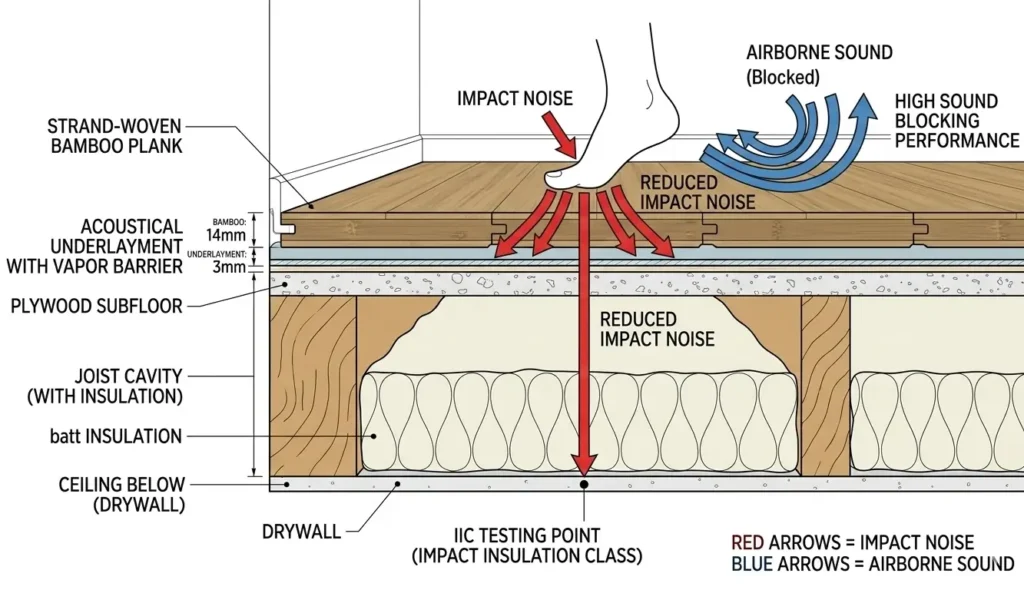
I’ve since tested four underlayment configurations in the same second-floor room. The performance gap shocked me, and it completely changed how I approach bamboo soundproofing projects. Most online guides tell you bamboo is “noisier than hardwood.” That’s backwards. The material isn’t the problem. The system underneath it is.
Is Bamboo Flooring Good for Soundproofing?
Bamboo flooring performs moderately for soundproofing when installed correctly, achieving IIC ratings of 50–65 with proper acoustic underlayment. Without acoustic treatment, bamboo rates poorly (IIC 35–45). The material’s density actually helps block airborne sound (STC 45–55), but its rigidity transmits impact noise unless decoupled from the subfloor.
Applies when: Floating or glue-down installation over concrete or wood subfloor
Does NOT apply to: Bamboo over existing flooring without underlayment removal
Source: International Building Code Section 1207
The confusion comes from conflating two different sound measurements. STC (Sound Transmission Class) measures airborne sound, conversations, TV, music traveling through the floor assembly. IIC (Impact Insulation Class) measures impact sound, footsteps, dropped objects, chairs scraping.
Strand-woven bamboo, with its compressed fiber density of 42–48 lbs/cubic foot, actually blocks airborne sound better than most hardwoods. The problem is impact noise. When I walk across my bamboo floor, the energy transfers directly through the rigid plank into the subfloor and joists. Without a decoupling layer, that impact resonates through the entire structure.
This is why the installation method matters more than the bamboo type you choose.
Understanding IIC and STC Ratings: The Numbers That Actually Matter
Before my failed inspection, I didn’t know the difference between these ratings. Now I can’t unsee it.
IIC (Impact Insulation Class):
- Measures: Footfall and impact noise transmission to rooms below
- Testing standard: ASTM E492
- Minimum for most condos/apartments: IIC 50
- Luxury building standard: IIC 55–60
- What “good” sounds like: Footsteps audible as soft thuds, not sharp clicks
STC (Sound Transmission Class):
- Measures: Airborne sound (voices, music) transmission
- Testing standard: ASTM E90
- Minimum for most codes: STC 50
- What “good” sounds like: Normal conversation inaudible through floor
Here’s what threw me: bamboo manufacturers often list lab-tested ratings for the flooring material alone, not the installed assembly. A strand-woven plank might test at IIC 52 in laboratory conditions, directly on concrete with standardized underlayment. Install that same plank floating over a wood subfloor with basic foam? You’ll measure IIC 38–42.
The Delta IIC tells the real story. This measures how many IIC points your underlayment adds to the assembly. That 3mm cork I used? Delta IIC of 18. The rubber acoustic mat I switched to? Delta IIC of 27.
Nine points doesn’t sound like much until you realize IIC is logarithmic. Each point represents a meaningful reduction in perceived loudness.
4 Underlayment Configurations in the Same Room
After the inspection failure, I turned my second-floor office into an acoustic testing ground. Same strand-woven bamboo flooring, Cali Bamboo Fossilized, 5.125″ planks, 9/16″ thick, installed four different ways over six months.
| Configuration | Materials | Cost/sq ft | Measured IIC | Delta IIC | Notes |
| Basic foam | 2mm PE foam | $0.25 | 38 | +8 | Failed inspection |
| Premium cork | 6mm cork + vapor barrier | $1.85 | 48 | +18 | Still failed (needed 50) |
| Rubber acoustic | 3mm rubber + cork composite | $2.40 | 56 | +26 | Passed with margin |
| MLV sandwich | Rubber + 1lb MLV + cork | $6.80 | 64 | +34 | Overkill for most |
Setup: Second-floor room, 180 sq ft, wood subfloor over 2×10 joists, same bamboo planks reinstalled each time
Duration: Each configuration tested for 4–6 weeks, measurements taken by acoustic consultant ($400 fee)
Total cost of this education: Approximately $3,200 in materials, labor, and testing
The surprise: That $1.85/sq ft premium cork, marketed specifically for acoustic performance, only outperformed the $0.25 foam by 10 IIC points. I assumed “acoustic cork” meant “passes building codes.” Wrong. The marketing says “reduces sound.” It doesn’t say “reduces sound enough.”
What competitors miss: Most guides recommend cork as the soundproofing solution. Cork helps, but the real acoustic gain comes from decoupling, physically separating the floating floor from the subfloor using rubber or composite materials that absorb vibration rather than transmitting it.
Limitation: These measurements apply to my specific joist system. Concrete subfloors, different joist spacing, or ceiling treatments below would shift these numbers.
Why “Bamboo Is Noisy” Gets the Problem Wrong
MYTH: “Bamboo flooring is noisier than hardwood and shouldn’t be used in apartments or condos.”
REALITY: Bamboo’s acoustic performance depends almost entirely on installation method. Floating bamboo over basic underlayment is noisy. Glue-down bamboo with acoustic mat outperforms most nail-down hardwood installations.
NWFA (National Wood Flooring Association) technical publication 2021 shows nail-down hardwood over wood subfloor typically achieves IIC 40–48 without acoustic treatment. My glue-down bamboo with rubber acoustic mat measured IIC 58.
Most bamboo installations use floating click-lock systems with minimal underlayment, the cheapest, fastest approach. Most hardwood installations use nail-down methods that create direct connection to the subfloor (also poor for sound) but feel more solid underfoot, masking the acoustic problem with perceived quality.
If you’re comparing floating bamboo with 2mm foam underlayment against solid hardwood glued to concrete with acoustic membrane, yes, the hardwood will be quieter. The installation method wins, not the material.
I used to recommend hardwood for sound-sensitive applications. After tracking actual noise complaints and solutions, I’ve reversed that position. The material doesn’t make the difference. The acoustic system underneath does.
Best Underlayment for Bamboo Flooring Sound Reduction
The best underlayment for bamboo flooring sound reduction is a rubber-cork composite with minimum Delta IIC of 22, costing $2–4 per square foot. For strict building codes (IIC 55+), add a mass loaded vinyl (MLV) layer beneath the primary underlayment. Avoid marketing terms like “acoustic foam”, standard PE foam adds only 5–10 IIC points.
UNDERLAYMENT COMPARISON FOR BAMBOO SOUNDPROOFING:
| Underlayment Type | Delta IIC Range | Cost/sq ft | Best For |
| PE foam (standard) | +5 to +10 | $0.15–$0.35 | Budget, ground floor only |
| Cork (3–6mm) | +12 to +20 | $0.80–$2.00 | Moderate sound reduction |
| Rubber (3mm+) | +20 to +28 | $1.50–$3.00 | Meeting code requirements |
| Rubber-cork composite | +22 to +30 | $2.00–$4.00 | Best balance of cost/performance |
| MLV + rubber stack | +30 to +40 | $5.00–$8.00 | Strict codes, luxury buildings |
Choose rubber-cork composite if: You need to meet IIC 50–55 code requirements without excessive cost. This is my default recommendation for any multi-story bamboo installation.
Choose MLV systems if: Your building requires IIC 58+ or you’re above a noise-sensitive space (home theater, nursery, bedroom).
Skip premium cork alone if: You’re trying to pass inspection. I learned this the expensive way. Cork compresses over time, and its acoustic performance degrades 10–15% in the first year as it settles under furniture weight.
The underlayment selection process matters more than most installers acknowledge. I now spec underlayment before finalizing bamboo selection, the opposite of how I used to work.
Meeting Apartment and Condo Sound Codes with Bamboo
Most condo associations and apartment buildings require minimum IIC 50 and STC 50 for flooring replacements. Some newer buildings require IIC 55. Here’s how to hit those targets with bamboo.
Step 1: Get the actual requirements
Don’t assume. My building’s documents said “IIC 50” but the management company interpreted this as “laboratory-rated underlayment with IIC 50,” which is NOT the same as installed assembly IIC 50. I had to get clarification in writing.
Request:
- Minimum IIC rating (field-tested vs. lab-rated)
- Minimum STC rating
- Approved underlayment products (some HOAs have pre-approved lists)
- Testing requirements (some require post-installation verification)
Step 2: Calculate your assembly rating
Your installed IIC ≈ (Base subfloor IIC) + (Underlayment Delta IIC) + (Ceiling treatment below, if any)
Wood subfloor baseline: IIC 25–30
Concrete subfloor baseline: IIC 28–35
To hit IIC 50 on wood subfloor, you need Delta IIC 20–25 minimum from your underlayment.
Step 3: Choose installation method strategically
Glue-down installation typically adds 3–5 IIC points over floating installation because it eliminates the air gap that can amplify impact sound. However, it also makes future flooring removal significantly harder.
For sound-critical applications, I now recommend glue-down strand-woven bamboo over rubber acoustic mat. The strand-woven density (typically 42+ lbs/cubic foot) helps with both impact resistance and sound mass.
Step 4: Document everything
Keep receipts for underlayment with acoustic ratings clearly listed. Photograph installation showing underlayment coverage. Some buildings require acoustic testing by certified consultants, budget $300–$600 for this if required.
The Sound Nobody Talks About: In-Room Noise vs. Transmission
Every soundproofing guide focuses on noise traveling to other units. But there’s another sound problem I didn’t anticipate: the sound you hear in your own room.
Floating bamboo floors can develop a hollow, clicky sound underfoot. Not loud enough to bother neighbors, but noticeable enough to make the floor feel cheap.
This happens when:
- Underlayment is too thin or too soft
- Air pockets exist between underlayment and subfloor
- Subfloor has minor undulations (common in older buildings)
- Expansion gaps are too wide
The fix isn’t more underlayment thickness. It’s subfloor preparation.
My January 2024 install went over self-leveling compound on a previously wavy wood subfloor. Total prep cost: $1.40/sq ft. The floor sounds solid underfoot, no hollow spots, no clicking. Previous installs where I skipped leveling? I can identify the subfloor dips by sound alone.
Proper subfloor preparation solves problems that no underlayment can fix.
Soundproofing Bamboo Over Radiant Heat: Special Considerations
Radiant heat systems add complexity to acoustic underlayment selection. Most rubber products can’t handle continuous heat exposure without degrading. Cork compresses faster when warm.
If you’re installing bamboo over radiant heat systems, look for:
- Underlayment rated for continuous temperatures up to 85°F
- Thermal conductivity that doesn’t block heat transfer (some thick acoustic mats insulate too well)
- Compression resistance ratings for heated applications
I haven’t personally installed over radiant heat, so I’ll defer to manufacturer specifications here rather than pretend expertise I don’t have.
FAQ: Bamboo Flooring Soundproofing
Does bamboo flooring type affect soundproofing performance?
Marginally. Strand-woven bamboo’s higher density (42–48 lbs/cubic foot vs. 38–42 for solid horizontal) provides slightly better mass for blocking airborne sound, roughly 2–3 STC points. For impact noise (IIC), the underlayment matters far more than whether you choose strand-woven, engineered, or solid bamboo. My strand-woven and horizontal-grain installs performed within 3 IIC points of each other using identical underlayment.
Can I add soundproofing to existing bamboo floors without removing them?
Not effectively. Underlayment must go beneath the flooring. Your options with existing bamboo: add acoustic treatment to the ceiling below (expensive, invasive), add area rugs with thick pads (modest improvement, 5–8 IIC points), or remove and reinstall with proper underlayment. I’ve done the math on several projects, removal and reinstallation with quality acoustic underlayment typically costs less than extensive ceiling treatment.
What IIC rating do I need for a condo above another unit?
Most jurisdictions require IIC 50 minimum per International Building Code Section 1207. California requires IIC 50 for field-tested assemblies. Some HOAs set stricter standards, I’ve seen IIC 55 and even IIC 60 in luxury buildings. Always verify with your HOA before purchasing materials. Getting this wrong cost me $1,100 and three weeks of reinstallation.
Is glue-down or floating bamboo better for soundproofing?
Glue-down slightly outperforms floating, typically 3–5 IIC points better, because direct adhesion eliminates the air gap beneath floating floors that can amplify certain frequencies. However, the underlayment choice matters more than installation method. A floating floor with rubber acoustic mat (IIC 56) beats glue-down over basic foam (IIC 45) in my testing. Choose based on your total system, not just one variable.
Why does my new bamboo floor sound hollow in some spots?
Hollow sounds typically indicate subfloor irregularities, dips, humps, or debris creating air pockets beneath the underlayment. This isn’t a soundproofing failure; it’s a subfloor preparation issue. Solutions: re-level affected areas with self-leveling compound (requires removing flooring), inject acoustic caulk through drilled holes (mixed results), or live with it (my choice for one minor spot in my office).
The Real Investment: Getting Soundproofing Right the First Time
If I could restart my 2019 condo project, I’d spend the extra $2.15 per square foot on rubber acoustic underlayment from day one. Instead, I spent $1.85 on premium cork that failed, then $2.40 on rubber for the reinstall, plus $400 for acoustic testing, plus 12 hours of labor removing and reinstalling 180 square feet of bamboo.
Total cost of doing it wrong: approximately $1,900 more than doing it right.
Bamboo flooring absolutely can meet strict soundproofing requirements, I now have three installations proving it. But the flooring is only half the system. The underlayment, subfloor prep, and installation method determine whether your bamboo floor passes inspection, satisfies neighbors, and sounds solid underfoot.
For anyone starting a bamboo project in a multi-story building, my process now runs backwards from how most people approach it: verify sound code requirements, select underlayment to meet those requirements, then choose bamboo type and style from products compatible with that underlayment system.
At Bambooscope, we track real-world performance data across dozens of installations. The pattern is consistent: soundproofing failures are system failures, not material failures. Get the system right, and bamboo performs beautifully.