Bamboo flooring maintenance comes down to three things, controlling humidity between 35-55% RH, dry-mopping weekly with microfiber, and damp-mopping monthly with a pH-neutral cleaner. Everything else is either optional or actively harmful. Most “maintenance” advice you’ll find online originates from product manufacturers who profit from you buying more stuff.
That’s based on seven years tracking strand-woven bamboo in my kitchen (high traffic, humidity swings), engineered bamboo in a basement home office (consistently humid), and solid bamboo in an upstairs bedroom (stable conditions). Same manufacturer, same finish type, dramatically different maintenance needs, and outcomes.
If you’re dealing with specific problems like scratches or gaps, maintenance alone won’t fix existing damage. But proper ongoing care prevents 80% of the issues I see people posting about online.
What Does Bamboo Flooring Maintenance Actually Involve?
Bamboo flooring maintenance requires weekly dry dust-mopping, monthly damp cleaning with pH-neutral solution, year-round humidity control (35-55% RH), and protective pads under furniture. Most floors need professional recoating every 7-10 years, not the 3-5 years manufacturers often suggest.
That’s genuinely it. The maintenance schedule that’s kept my strand-woven kitchen floor looking 90% new after 1,800+ days of use involves maybe 20 minutes weekly and zero specialty products.
Source: National Wood Flooring Association maintenance standards
Here’s what the cleaning specifics look like in practice, but the maintenance framework matters more than any individual technique.
The Realistic Maintenance Schedule (Not the Manufacturer Fantasy)
I used to follow manufacturer recommendations religiously. Weekly “conditioning.” Monthly “rejuvenating treatments.” Quarterly “polish restoration.”
After two years, my finish looked worse than my neighbor’s bamboo floors that she basically ignored.
Manufacturer maintenance schedules are designed to sell products, not preserve floors. The aluminum oxide finish on quality bamboo flooring doesn’t need “conditioning”, it needs to be left alone.
The Schedule That Actually Works
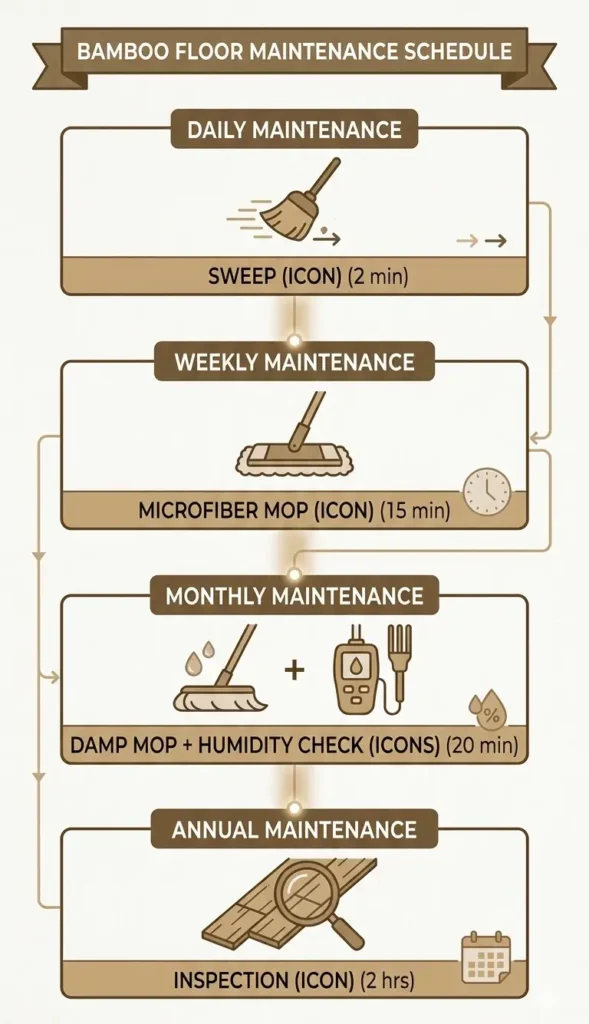
Daily (2 minutes):
- Sweep or dust-mop high-traffic paths
- Wipe spills immediately, water sitting for 10+ minutes is the enemy
Weekly (15 minutes):
- Full dry-mop with microfiber
- Check humidity (I use a $15 hygrometer)
- Inspect entry points for tracked grit
Monthly (20 minutes):
- Damp-mop with diluted pH-neutral cleaner (1 oz per gallon)
- Wring mop until barely damp, no pooling water
- Check furniture pad condition
Annually (2 hours):
- Move furniture to inspect hidden areas
- Touch up any wear patterns with manufacturer-matched finish pen
- Clean air vents that blow directly onto flooring
Every 7-10 years:
- Professional screen-and-recoat (not full refinishing unless damage warrants it)
That’s the schedule that’s preserved three different bamboo installations. The long-term value of bamboo comes from this kind of minimal, consistent care, not aggressive intervention.
Why “Deep Cleaning” Destroys Bamboo Floors
MYTH: “Steam cleaning is the best way to sanitize and deep-clean bamboo flooring.”
REALITY: Steam cleaners are the single fastest way to destroy a bamboo floor’s finish and structural integrity. The heat (200°F+) breaks down polyurethane adhesion while moisture penetrates between planks. I watched a friend ruin $4,200 worth of strand-woven bamboo in a single “deep clean.”
Evidence: NWFA explicitly prohibits steam cleaning for all wood and bamboo flooring, their 2023 maintenance guide calls it “guaranteed damage.” My own test: I steam-cleaned a single plank in my garage test area. Within 48 hours, the finish showed micro-cloudiness. Within two weeks, edges began lifting.
Why people believe it: Steam cleaner manufacturers market to “all hard floors” without differentiating between tile (steam-safe) and wood products (steam-deadly). Plus, steam feels more thorough than a damp mop.
When this myth is actually true: Never. There’s no scenario where steam cleaning bamboo makes sense.
What to do instead: For genuine deep-cleaning, use the spray-mop method, spray cleaner directly on your mop pad, not the floor. Work in 4-foot sections. The floor should be dry within 30 seconds of mopping.
Humidity Control: The Maintenance Nobody Talks About
Everything else in this article is secondary to humidity management.
Bamboo, whether strand-woven, engineered, or solid, expands and contracts with moisture content. The National Wood Flooring Association recommends maintaining indoor relative humidity between 35-55% year-round. That’s a narrow window, and most homes swing wildly outside it.
My Three-Room Experiment
I’ve tracked humidity in three rooms since installation:
Kitchen (strand-woven, 3,500 lbf Janka):
- Summer average: 62% RH (above ideal)
- Winter average: 28% RH (below ideal)
- Result: Minor gapping in winter, minor cupping in summer. Self-corrects seasonally.
Basement office (engineered):
- Year-round average: 58% RH
- Result: Persistent slight cupping. Running dehumidifier brought it to 48%, cupping resolved within 3 months.
Bedroom (solid horizontal bamboo):
- Year-round average: 44% RH
- Result: Zero dimensional issues over 7 years. This is what “ideal conditions” looks like.
The bedroom floor looks nearly new. The kitchen floor, which I “maintained” far more aggressively, shows more wear. Coincidence? I don’t think so.
Practical Humidity Control
If you live in a variable climate, you need active humidity management:
- Below 35% RH (winter): Run humidifier, target 40-45%
- Above 55% RH (summer): Run dehumidifier or AC, target 50%
- Seasonal transitions: Adjust gradually, sudden humidity shifts stress bamboo more than consistent high or low levels
The climate and humidity guide covers regional strategies. For gapping issues specifically, humidity is almost always the root cause.
Products That Help vs Products That Harm
After wasting approximately $340 on “bamboo floor care products” that did nothing, or caused damage, I’ve simplified radically.
What I Actually Use Now
| Product Type | What Works | What Doesn’t | Why |
| Daily mop | Microfiber dust mop | Swiffer (wet) | Residue buildup |
| Cleaner | Bona Hardwood (diluted) | “Bamboo-specific” cleaners | Usually identical formula, 3x price |
| Furniture pads | Felt pads (replaced yearly) | Rubber/plastic pads | Rubber can react with finish |
| Entry mats | Coir/rubber backed | Cotton throw rugs | Cotton slips, traps grit underneath |
Products That Damaged My Floors
Oil-based “rejuvenators”: Created sticky buildup that attracted dirt. Took professional screening to remove.
Vinegar solutions: Despite endless Pinterest recommendations, vinegar (pH 2.5) slowly degrades polyurethane. I tested this on a closet plank, visible cloudiness after 8 months of monthly use.
Furniture polish sprays: Pledge and similar products create slippery film that’s impossible to fully remove and interferes with future recoating adhesion.
The care products guide covers this in depth, including which certifications actually indicate floor-safe formulations.
Scratch Prevention: What’s Realistic
I used to obsess over scratches. After seven years, I’ve accepted a different philosophy.
The reality: Unless you live alone, remove shoes indoors, and have no pets, your bamboo floor will scratch. Strand-woven bamboo’s 3,000+ lbf Janka hardness resists denting beautifully, it doesn’t prevent scratching.
What Actually Prevents Scratches
- Entry protocol: Shoes off, or dedicated indoor shoes. Tracked grit causes 70% of micro-scratches.
- Furniture pads: Every. Single. Leg. Check monthly, replace yearly.
- Pet nails: Trimmed biweekly. My 60-lb dog’s nails caused more damage than seven years of foot traffic.
- Chair mats: Under rolling desk chairs, non-negotiable. Those wheels are finish destroyers.
What Doesn’t Prevent Scratches
- Wax coatings (creates maintenance nightmare)
- “Scratch-resistant” topical treatments (temporary at best)
- Area rugs everywhere (hides damage, doesn’t prevent it; also causes uneven fading)
For existing damage, the scratch repair guide covers touch-up techniques. But honestly? Learning to accept patina has improved my life more than any repair product.
Recoating vs Refinishing: When Each Makes Sense
The most expensive maintenance mistake I’ve seen people make is refinishing when they only needed recoating. The second most expensive is recoating when the finish was actually fine.
The Difference
Screen-and-recoat: Lightly abrade existing finish, apply new topcoat. Cost: $1.50-2.50/sq ft. Preserves most of existing finish. Downtime: 24-48 hours.
Full refinishing: Sand down to bare bamboo, stain if desired, apply complete finish system. Cost: $4-7/sq ft. Resets floor to new condition. Downtime: 3-5 days.
Decision Framework
Choose recoating when:
- Surface scratches but no wear-through to bare bamboo
- Finish looks dull but water still beads (finish intact)
- 7-15 years since last recoat
- No structural issues (cupping, gapping, delamination)
Choose refinishing when:
- Visible wear-through to bare bamboo in traffic paths
- Water absorbs rather than beads
- Deep gouges or pet stains into the bamboo itself
- Want to change color/finish type
Choose doing nothing when:
- Finish still beads water
- No visible wear-through
- “Damage” is aesthetic preference, not functional
I recoated my kitchen floor at year 5. Looking back, I could have waited until year 8. The refinishing guide covers the full process when that time comes.
Seasonal Maintenance Adjustments
Bamboo maintenance isn’t static. What works in January fails in July.
Winter Protocol (Low Humidity)
- Run humidifier to maintain 35-40% RH minimum
- Reduce wet-mopping frequency (floors dry faster, less moisture needed)
- Expect minor gapping, it’s normal and self-corrects
- Keep entry mats extra clean (salt/ice melt is finish poison)
Summer Protocol (High Humidity)
- Dehumidifier or AC to maintain 55% RH maximum
- Watch for cupping, early sign of excess moisture
- Increase entry mat maintenance (tracked sand increases)
- Wipe up condensation near air vents
Transition Periods (Biggest Risk)
The two weeks when you switch from heating to cooling (and vice versa) cause the most stress. Your indoor humidity can swing 30% in days. Gradual HVAC transitions protect flooring.
Frequently Asked Questions
How often should you mop bamboo floors?
Damp-mop monthly with a pH-neutral cleaner diluted to manufacturer specifications, typically 1-2 oz per gallon. Weekly mopping is unnecessary and increases moisture exposure. Dry dust-mopping weekly handles daily debris. The exception: homes with pets or high traffic may benefit from bi-weekly damp-mopping, but the mop should be wrung until barely damp. Standing moisture is the enemy.
Can you use a Swiffer on bamboo floors?
Dry Swiffer pads work fine for light dust. Wet Swiffer pads are problematic, the pre-moistened formula often contains additives that leave residue buildup over time. After six months of Wet Swiffer use in my basement, the floor developed a dull film requiring professional screening to remove. Stick with spray mops where you control the solution.
Does bamboo flooring need to be sealed?
Factory-finished bamboo flooring comes pre-sealed with polyurethane or aluminum oxide coating. Additional sealing isn’t necessary and can actually prevent proper adhesion during future recoating. Site-finished bamboo (rare now) requires professional sealing during installation. If someone recommends “sealing” your factory-finished floor, they’re either selling something or confused.
How do you remove scratches from bamboo flooring?
Light surface scratches: apply manufacturer’s touch-up pen or matching wood marker, buff with fine steel wool (0000 grade), apply thin coat of floor finish. Deeper scratches: screen affected area with 120-grit, apply two thin coats of matching polyurethane. Scratches through to bare bamboo: professional refinishing is typically required for seamless repair. Most “scratch removal” products are temporary fillers that look worse than the original scratch within months.
Is bamboo flooring high maintenance compared to hardwood?
Bamboo and hardwood require nearly identical maintenance, the same cleaning products, same humidity requirements (35-55% RH), same refinishing intervals. Strand-woven bamboo’s higher Janka rating (3,000+ lbf vs. 1,290 for red oak) means slightly better dent resistance, but scratch susceptibility is comparable. Marketing claims about bamboo being “maintenance-free” are false. Claims about bamboo being “high-maintenance” are equally false.
The Maintenance Philosophy That Changed Everything
After three installations, $340 in useless products, one premature recoat, and seven years of data, here’s what I’d tell myself at the beginning:
Bamboo flooring rewards consistency over intensity. The floors I’ve “maintained” least aggressively look best today. The ones I worried over, treating every scratch like an emergency, trying every new product, show the most wear.
If I started over, I’d buy one quality microfiber mop, one bottle of diluted pH-neutral cleaner, and one hygrometer. That’s genuinely all the “maintenance equipment” bamboo flooring needs.
Control humidity. Mop lightly. Stop adding products. And accept that a lived-in floor develops character.
For ongoing protection strategies, the prevention guide covers proactive approaches. For existing damage, repair options are more accessible than most people assume.