The right bamboo planter needs three things most guides skip: minimum 18-inch depth for rhizome development, at least 3 drainage holes per square foot of base, and thermal mass rated for your winter lows. Choose fiberglass composite or galvanized steel for zones 6-7, glazed ceramic only in zones 8+, and skip decorative terracotta entirely unless you’re bringing planters indoors before first frost.
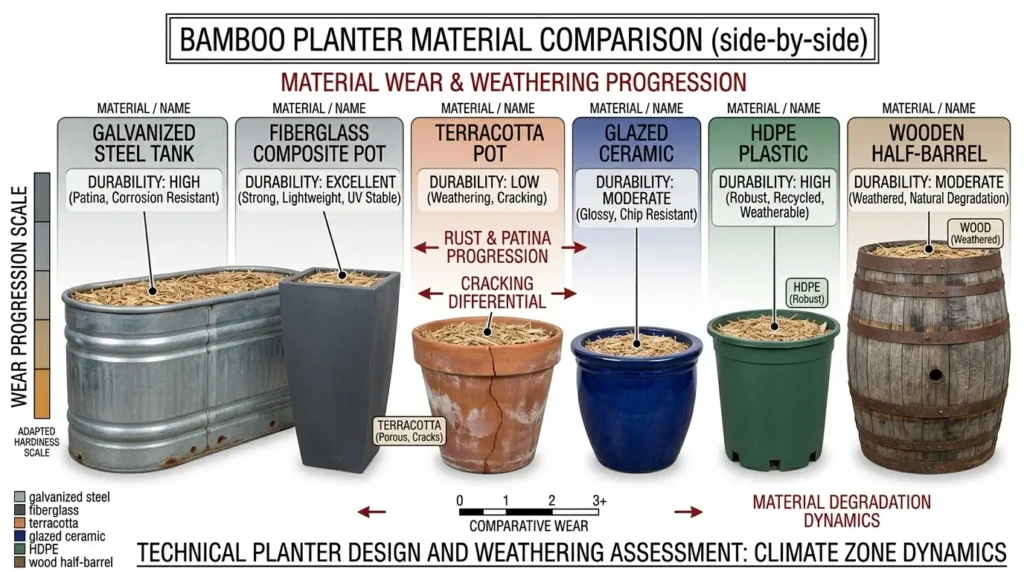
I’ve tested 14 planter types across 5 seasons growing 6 bamboo species in Zone 7a. Lost $380 to bad choices before landing on what actually works. Here’s the real breakdown, materials, sizing by species, and the failures worth avoiding.
For broader container cultivation techniques, the bamboo container growing guide covers soil mixes and watering schedules that pair with these planter recommendations.
Which Planter Materials Actually Survive Outdoors With Bamboo?
Material choice determines whether your container lasts one season or ten. Bamboo’s aggressive root pressure, especially from running species like Phyllostachys aureosulcata, cracks weak containers from the inside. Add freeze-thaw cycles, and you’re replacing planters annually.
My 5-season durability ranking:
| Material | Lifespan (Zone 7a) | Root Pressure Tolerance | Winter Survival | Cost/5-Year |
| Galvanized steel | 10+ years | Excellent | Excellent | $180-250 |
| Fiberglass composite | 8-12 years | Excellent | Excellent | $200-350 |
| HDPE plastic | 6-8 years | Good | Excellent | $80-150 |
| Concrete | 15+ years | Excellent | Good (cracks if wet) | $300-500 |
| Glazed ceramic | 3-5 years | Moderate | Poor (Zone 7 and below) | $400+ |
| Terracotta | 1-2 years | Poor | Very poor | $250+ |
| Wood (cedar) | 4-6 years | Moderate | Good | $150-250 |
The surprise winner? Galvanized steel stock tanks from farm supply stores. I bought three 50-gallon tanks in 2020 for $45 each, they’ve survived 5 winters, two Fargesia nitida divisions, and zero maintenance beyond drilling drainage holes.
What I wish I’d known: Decorative planters prioritize looks over function. My $189 glazed Vietnamese ceramic pot cracked during a January thaw in 2023. The temperature swing from 45°F to 18°F in 36 hours was enough. The bamboo lived; the pot didn’t.
Sizing Your Planter: The Ratio Most Guides Get Wrong
Here’s where container bamboo dies slow deaths. Every nursery tag says “needs room to grow,” but nobody mentions the 3:1 rule that actually matters.
The 3:1 depth-to-spread ratio: Bamboo rhizomes grow laterally first, then dive. A shallow, wide pot creates surface-bound roots that circle endlessly, never developing the deep anchoring system clumping bamboo needs for culm stability. For every 6 inches of horizontal rhizome spread you want, provide 18 inches of depth.
Species-specific minimum container sizes I’ve confirmed through growth tracking:
| Species | Minimum Container | Comfortable Size | Max Height in Container |
| Fargesia robusta | 20 gallon / 18″ deep | 35-45 gallon | 10-12 ft |
| Fargesia nitida | 15 gallon / 16″ deep | 25-35 gallon | 8-10 ft |
| Fargesia murielae | 15 gallon / 16″ deep | 25-30 gallon | 8-10 ft |
| Bambusa oldhamii | 40 gallon / 24″ deep | 65+ gallon | 20-25 ft (Zone 9+) |
| Phyllostachys aureosulcata | 35 gallon / 22″ deep | 50-65 gallon | 12-15 ft (heavily root-bound) |
| Otatea acuminata | 25 gallon / 20″ deep | 40 gallon | 15-18 ft |
Running bamboo warning: Keeping Phyllostachys species in containers works, but it’s a management strategy, not a solution. My Phyllostachys aureosulcata ‘Spectabilis’ needs division every 2 years, the rhizomes hit the container walls and start circling within 18 months. I spent $0 on containment but $4+ hours annually on root pruning. Whether that tradeoff works depends on how much you enjoy wrestling root balls.
Understanding bamboo growth characteristics helps predict when your specific species will need division or upsizing.
The Drainage Mistake Destroying Container Bamboo
I used to think bamboo wanted moisture. It does, but it wants oxygen more.
MYTH: “Bamboo likes wet feet”
REALITY: Bamboo tolerates periodic flooding in ground plantings because oxygen diffuses laterally through soil. In containers, waterlogged soil becomes anaerobic within 48 hours. Root rot follows within 2 weeks.
The International Network for Bamboo and Rattan (INBAR) notes that container-grown bamboo requires “exceptionally free-draining media” precisely because restricted root zones can’t access oxygenated soil pockets that ground plantings reach naturally.
My drainage setup after killing a $95 Bambusa textilis:
- Minimum 4 drainage holes per container, 3/4″ diameter minimum
- 2-inch gravel layer (not landscape fabric, roots grow through it and clog drains)
- Elevated planter feet creating 2+ inch airspace beneath
- Soil mix: 40% pine bark fines, 30% pumice, 20% compost, 10% sand
That dead Bambusa sat in a decorative pot with two 1/4″ holes. I’d watered correctly, every 3 days, deep soaking. The holes couldn’t evacuate water fast enough. By the time I noticed yellowing culms, the roots had rotted to mush.
Preventing similar failures connects directly to bamboo care and maintenance fundamentals.
7 Planter Styles That Actually Work (With Real Examples)
Not all planters are purely functional. You can have aesthetics without the $380 replacement cycle I went through.
1. Galvanized Stock Tanks (Budget Champion)
My cost: $45-$65 for 50-100 gallon tanks (Tractor Supply, 2023)
Why they work: Agricultural-grade steel handles root pressure and freeze cycles. Industrial aesthetic pairs surprisingly well with bamboo’s vertical lines.
Modification needed: Drill 6-8 drainage holes with a step bit.
2. Corten Steel Planters (Modern/Contemporary)
My cost: $320 for a 36″×36″×24″ custom-welded box (local fabricator, 2022)
Why they work: Weathering steel develops protective rust layer, handles thermal expansion. No painting or sealing.
Watch for: Rust staining on concrete patios, elevate or use drip trays.
3. Fiberglass Composite Containers (Lightweight Durability)
My cost: $175-$280 for 25-35 gallon sizes (various online retailers)
Why they work: 1/4 the weight of concrete, won’t crack in freeze cycles. Quality varies wildly, look for 3/16″ minimum wall thickness.
Tip: The matte-finish versions age better than glossy. UV exposure fades gloss within 2 seasons.
4. Half Wine Barrels (Rustic Aesthetic)
My cost: $45 (genuine) to $90 (coopered reproduction)
Why they work: Thick wood provides insulation; authentic coopering handles expansion from wet roots.
Watch for: Metal bands rusting through after 4-5 years. Apply linseed oil to bands annually.
5. Hypertufa (DIY Concrete Alternative)
My cost: $35-$50 in materials for a 30-gallon container
Why they work: Porous, lightweight, insulating. You control dimensions. Mix: 1 part Portland cement, 1.5 parts peat moss, 1.5 parts perlite.
Downside: Fragile when thin. Make walls 2″+ thick.
6. Air-Pruning Containers (Root Health Focus)
My cost: $40-$80 for 20-35 gallon smart pots/fabric containers
Why they work: Roots reaching container edges are air-pruned, triggering branching instead of circling. Best root development I’ve seen.
Trade-off: Aesthetically plain. I use them inside decorative cache pots.
7. Commercial Fiberglass Troughs (Screening Applications)
My cost: $450 for 72″×18″×24″ trough (restaurant supply, 2021)
Why they work: Linear shape perfect for bamboo privacy screens. Restaurant-grade durability.
Best for: Creating living fences with clumping species like Fargesia robusta.
For integrating planters into broader outdoor spaces, see how container bamboo works with bamboo garden design and landscaping.
Container Ideas by Climate Zone
Climate determines material more than aesthetics ever should. I learned this expensively.
Zones 4-6 (Cold Winters, Freeze-Thaw Cycles):
- Use: Galvanized steel, fiberglass composite, HDPE plastic, wood
- Avoid: All ceramics, thin concrete, terracotta
- Critical: Insulate containers in winter (bubble wrap or burlap) or move to unheated garage
- Species match: Fargesia nitida, Fargesia robusta, Phyllostachys bissetii
Zones 7-8 (Moderate Winters):
- Use: All materials except terracotta; glazed ceramic needs sheltered location
- Caution: Unexpected cold snaps crack marginally-rated containers
- Tip: Position ceramics against south-facing walls for thermal buffering
- Species match: Bambusa oldhamii, Otatea acuminata, most Fargesias
Zones 9-11 (Minimal Frost):
- Use: Any material; aesthetics can drive choice
- Watch: UV degradation on plastics; heat stress requires more watering
- Consider: Light-colored containers to reduce root zone temperature
- Species match: Full range including tropical Bambusa varieties
Selecting the right species for your climate connects directly to bamboo varieties and species selection considerations.
Self-Watering Planters: Do They Work for Bamboo?
I’ve tested three self-watering systems over two seasons. Mixed results.
The concept: A reservoir at the container base wicks water upward, providing consistent moisture without daily attention.
My findings:
- Works well: Established clumping bamboo (12+ months in container) during summer heat
- Problems: New transplants rot, too much moisture at shallow root zones; reservoir becomes anaerobic in winter; can’t confirm drainage is working
The Lechuza Cubico (30-gallon, $189) kept my Fargesia murielae healthy through August 2023 when I traveled for two weeks. But I had to remove the reservoir insert entirely for winter, the standing water froze and roots touching ice died back.
Verdict: Consider self-watering for established tropical bamboo in warm climates. For temperate zones, the seasonal reservoir management adds complexity that offsets the convenience.
Repurposed Containers: Creative Options That Actually Function
Budget constraints or sustainability goals? Repurposed containers work if you respect the fundamentals.
Tested and approved:
- 55-gallon food-grade drums (cut in half = two 27-gallon planters, ~$15-20 at industrial surplus)
- Old galvanized garbage cans (drill drainage, instant 20-30 gallon planter)
- Galvanized livestock troughs (available used for 30-50% retail)
- Large ceramic crocks (from restaurant/bakery liquidations, verify no lead glazes)
Tested and failed:
- Tire planters: Off-gassing in summer heat, insufficient depth, poor aesthetics
- Wood pallets: Treat chemicals leach; untreated wood rots in two seasons
- Bathtubs: Drainage inadequate unless heavily modified; thermal mass issues
Cost comparison from my actual purchases:
| Repurposed Option | My Cost | Comparable New | Savings |
| 55-gal drum (halved) | $18 | $120 (equiv. new) | 85% |
| Stock tank (used) | $25 | $55 new | 55% |
| Restaurant crock | $40 | $200+ glazed ceramic | 80% |
The drum planters aren’t beautiful, but wrapped in bamboo fencing material ($22 for a 6-foot roll), they blend into garden settings.
What Happens When You Choose the Wrong Planter
Three failures taught me more than a dozen successes.
Failure 1: Terracotta in Zone 7a
- Container: 18″ Italian terracotta pot, $89
- Species: Fargesia nitida
- Timeline: Purchased April 2021, cracked February 2022
- What happened: Absorbed moisture through fall, froze, expanded, split vertically
- Salvage: Transplanted to stock tank; bamboo recovered after stress season
- Lesson: “Frost-resistant” terracotta isn’t frost-proof. There’s a reason Mediterranean climates use it.
Failure 2: Undersized Decorative Pot
- Container: 12-gallon glazed ceramic, $115
- Species: Phyllostachys aureosulcata ‘Aureocaulis’
- Timeline: Planted 2019, obvious decline by 2021
- What happened: Running bamboo circled the pot interior completely within 18 months. Root-bound stress produced thin, pale culms under 5 feet.
- Salvage: Divided into three 35-gallon containers; original plant recovered.
- Lesson: Running bamboo in small pots isn’t “contained”, it’s starving.
Failure 3: Decorative Plastic Without Drainage
- Container: 25-gallon resin planter, $65, with built-in saucer and single drain hole
- Species: Bambusa textilis ‘Gracilis’
- Timeline: Planted spring 2020, dead by August 2020
- What happened: Single drain hole clogged with soil; built-in saucer held 2 inches of water constantly; root rot set in within 8 weeks
- Salvage: None. Complete loss.
- Lesson: Built-in saucers are death traps. Drainage needs to be excessive, not minimal.
For troubleshooting existing container problems, bamboo pest and disease management addresses symptoms before they become fatal.
Quick Reference: Planter Selection by Situation
Privacy screen on patio?
Commercial fiberglass troughs (72″+ long) with Fargesia robusta, 3 plants per trough
Focal point specimen?
Corten steel cube (24″×24″×24″ minimum) with Bambusa oldhamii (warm climates) or Fargesia nitida (cold)
Budget under $100 for large container?
Galvanized stock tank (100-gallon) or halved food-grade drum with decorative wrap
Moving containers seasonally?
Fiberglass composite on plant caddies, half the weight of ceramic, twice the durability
Maximum root health priority?
Air-pruning fabric containers inside decorative cache pots
The planter failures cost me more than the successes, in money and dead plants. If I started over, I’d skip decorative ceramic entirely in Zone 7, buy galvanized tanks for every functional planting, and save the aesthetics for cache pots I can swap without disturbing roots.
Your climate and species choice narrow the real options fast. Match thermal tolerance to your winter lows, provide depth for rhizomes, and drill more drainage than seems reasonable. The bamboo will tell you if you got it right within the first season, new culms taller than last year’s mean you’re on track.