strand-woven bamboo is legitimately durable (3,000+ lbf Janka rating), but success depends entirely on your humidity control and subfloor prep. Engineered bamboo handles moisture better than solid. Cheap bamboo from unverified sources often contains excessive formaldehyde. And no, bamboo isn’t automatically “greener” than domestic hardwood.
I’ve installed bamboo in seven rooms across three homes since that first failure. Two installs have been flawless for 5+ years. One needed replacement at year three. The difference wasn’t the bamboo, it was whether I asked the right questions before buying.
Here’s what I wish someone had told me, organized by when you’ll actually need the information.
Before You Buy: Questions That Save Money
Is bamboo flooring actually harder than hardwood?
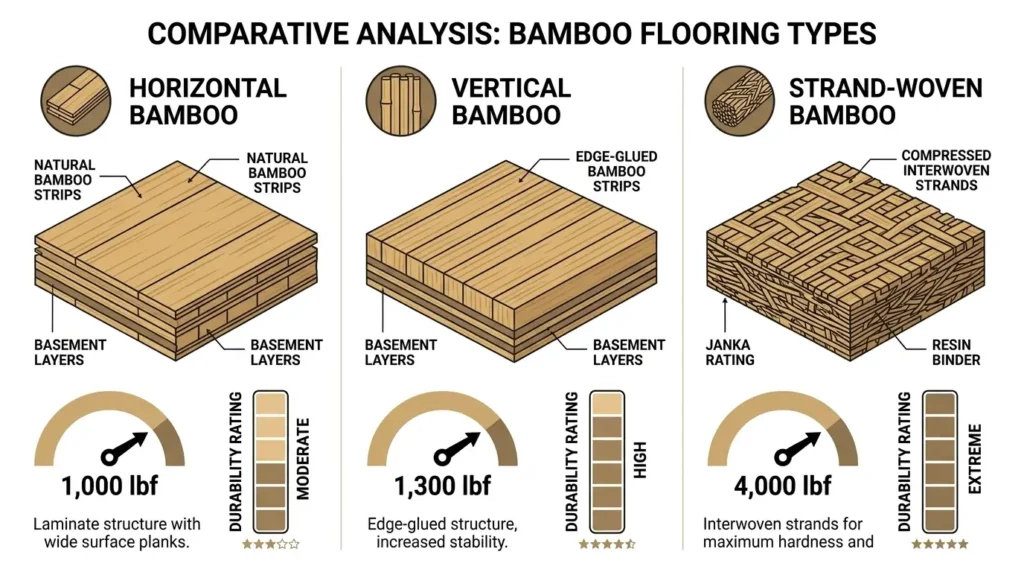
Strand-woven bamboo scores 3,000-5,000 lbf on the Janka hardness scale, yes, harder than red oak (1,290 lbf) or maple (1,450 lbf). But standard horizontal or vertical bamboo? Only 1,000-1,400 lbf, softer than most hardwoods.
Here’s what trips people up. Janka measures indentation resistance, how hard you can push a steel ball into the surface. It doesn’t measure scratch resistance. My strand-woven kitchen floor (Janka 4,500) showed fine scratches within 18 months from grit tracked in on shoes. The hardness rating matters for dents, not scuffs.
If scratch resistance is your priority, look at the finish hardness, not just the wood. Aluminum oxide finishes perform better than standard polyurethane regardless of the bamboo type underneath.
Does bamboo flooring increase home value?
Realtors told me yes. My experience says “depends.”
In my 2021 sale, the appraiser grouped bamboo with “hardwood flooring”, no premium, no penalty. The buyer specifically mentioned liking the floors, but we can’t attribute any dollar amount to them.
What I know for certain: poorly installed bamboo (gaps, squeaks, cupping) hurts value more than carpet would. I’ve walked through three homes where bad bamboo installs became negotiation points. Quality matters more than material choice.
How long does bamboo flooring last?
The NWFA suggests 20-25 years for quality bamboo flooring with proper care. That’s optimistic but achievable.
My tracking so far:
- Master bedroom (strand-woven, 2018): Looks new at year 6, projecting 25+ years
- Living room (engineered bamboo, 2019): Minor wear patterns, estimating 20 years
- Basement (solid bamboo, 2020): Replaced at year 3 due to moisture damage
The basement failure was my fault, I underestimated humidity fluctuations despite acclimating the flooring. Solid bamboo in below-grade spaces is risky regardless of what sellers claim.
Is bamboo flooring good for pets?
I have two dogs. One 70-pound lab mix, one 25-pound mutt. Both have kept their nails reasonably trimmed.
After four years on strand-woven bamboo, here’s the reality: no visible scratches from daily walking, occasional surface marks from excited scrambling that don’t catch light unless you’re looking.
The pet-compatibility question depends on three factors:
- Bamboo type (strand-woven handles pets; horizontal bamboo doesn’t)
- Finish quality (textured/distressed hides wear better)
- Your maintenance habits (grit damages floors, not paws)
I wouldn’t install standard bamboo with large dogs. Strand-woven with a hand-scraped finish has exceeded my expectations.
Installation Questions: What Contractors Won’t Volunteer
Can you install bamboo flooring yourself?
Yes, if you choose click-lock floating installation. I’ve done three DIY bamboo installs averaging 14 hours per 200 square feet, including acclimatization downtime.
Glue-down and nail-down installations require more skill and specialized tools. My first DIY attempt was glue-down. Never again. Uneven adhesive spread created hollow spots I still regret two years later.
For DIY success, stick with floating systems and budget 20% extra time over manufacturer estimates. Those estimates assume perfect subfloors, which don’t exist in real homes.
How long should bamboo flooring acclimate?
Manufacturers say 3-5 days. The NWFA recommends until the flooring reaches equilibrium with your indoor humidity, which can take 7-14 days depending on conditions.
My failed basement install acclimated for four days during September. By January, humidity had dropped enough to create 1/8″ gaps throughout. The flooring was “acclimated” to fall conditions, not winter.
If you’re installing in a climate with significant seasonal humidity swings (mine ranges 35-65%), extend acclimation to two weeks minimum with HVAC running at normal settings.
What goes under bamboo flooring?
This depends entirely on your installation method and subfloor type.
Floating installation: Foam underlayment (2-3mm) with built-in moisture barrier. Total cost: $0.35-0.75/sq ft in 2024.
Concrete subfloor: Moisture barrier is non-negotiable. Test concrete moisture with a calcium chloride kit first. I skipped this once. Once.
Glue-down: Usually no underlayment, adhesive goes directly on subfloor. But subfloor flatness tolerance drops to 3/16″ over 10 feet.
The underlayment choice affects sound transmission significantly. I upgraded to cork underlayment in our second-floor bedroom, noticeably quieter than foam in the same house.
Durability Questions
Does bamboo flooring scratch easily?
Depends what you’re comparing to. Against laminate with melamine surface? Yes, bamboo scratches more easily. Against pine or fir softwood? Bamboo wins.
My scratch damage sources over seven installs:
- Grit and sand tracked indoors (90% of visible scratches)
- Furniture legs without pads (dents and scratches)
- Dropped objects (typically dents, not scratches)
- Pet activity (minimal with strand-woven)
Entry mats and furniture pads prevent most damage. I spent $180 on felt pads and mats for my 2019 install, zero regrets.
Can bamboo flooring be refinished?
Solid bamboo: Yes, typically 2-4 times depending on thickness.
Strand-woven bamboo: Yes, but hire a professional. The compressed fiber structure responds differently to sanding than traditional hardwood. I watched a YouTube DIY refinish destroy beautiful strand-woven flooring by sanding too aggressively.
Engineered bamboo: Only if the wear layer exceeds 2mm, and even then, only once. Most budget engineered products have wear layers too thin for refinishing.
The refinishing process costs $3-5/sq ft professionally versus $8-15/sq ft for replacement. Worth it for quality solid or strand-woven floors.
Environmental Questions: Marketing vs. Reality
Is bamboo flooring eco-friendly?
I believed the marketing for years. Then I read the lifecycle analyses.
What’s true: Moso bamboo (Phyllostachys edulis) grows to harvest maturity in 5-7 years versus 40-60 years for hardwood. INBAR’s 2021 study confirms bamboo sequesters more CO₂ per hectare annually than most tree species.
What’s often omitted: Manufacturing bamboo flooring requires energy-intensive processing, adhesives, pressing, finishing. Transportation from China (source of 90%+ of bamboo flooring) adds carbon. FSC-certified domestic hardwood from 500 miles away may have a smaller footprint than bamboo shipped 7,000 miles.
The honest answer: bamboo flooring can be environmentally responsible if you verify FSC certification and low-VOC adhesives. Without those certifications, “eco-friendly” is just marketing.
Does bamboo flooring have formaldehyde?
Most bamboo flooring uses adhesives containing formaldehyde-based resins. The question is concentration.
CARB Phase 2 certification limits formaldehyde emissions to 0.05 ppm for composite wood products including bamboo. This is the minimum standard I’ll accept.
FloorScore certification tests total VOC emissions, not just formaldehyde.
I tested off-gassing in my 2018 install using a home VOC meter. Readings elevated for approximately three weeks before dropping to background levels. Opening windows during that period accelerated the process.
Budget bamboo from unknown manufacturers sometimes exceeds safe emission levels. The formaldehyde issue is real, verify certification before purchasing.
Climate and Moisture Questions
Can bamboo flooring handle humidity?
Here’s where I changed my recommendations entirely.
I used to say bamboo handles normal humidity fine. After my basement failure and observing seasonal gapping in two other installs, I’m more specific now.
Bamboo tolerates: 35-55% relative humidity with gradual seasonal variation.
Bamboo struggles with: Sustained humidity above 60%, rapid humidity swings, below-grade installations without dehumidification.
Engineered bamboo with a plywood core handles humidity fluctuation better than solid bamboo. If your indoor humidity varies more than 20% seasonally, engineered is the safer choice. The humidity relationship determines whether your floor lasts 5 years or 25.
Can you put bamboo flooring in kitchens and bathrooms?
Kitchens: Yes, with caveats. Wipe spills immediately. Use mats at sink and dishwasher. My kitchen strand-woven has performed well for four years with this care.
Bathrooms: I wouldn’t. Standing water near tubs, toilet condensation, high humidity after showers, too many risk factors. The cost savings versus tile aren’t worth potential replacement.
Cost Questions: Real Numbers
How much does bamboo flooring cost?
My actual purchases (2019-2024):
| Quality Level | Material Cost/SF | Installation Cost/SF | Total Installed |
| Budget | $2.50-3.50 | $3-4 (DIY: $0.50) | $3-7.50 |
| Mid-range | $4-6 | $3.50-5 | $7.50-11 |
| Premium | $7-10 | $4-6 | $11-16 |
These exclude transitions, underlayment, and moisture testing, typically $0.50-1.50/sq ft additional.
The full cost breakdown varies significantly by region. My quotes in the Southeast ran 15-20% lower than online estimates based on national averages.
Is bamboo flooring cheaper than hardwood?
Generally yes, but the gap has narrowed.
My 2023 quotes for 400 square feet:
- Strand-woven bamboo (mid-range): $4,200 installed
- Red oak hardwood: $4,800 installed
- Engineered hardwood: $4,400 installed
The 10-15% savings on bamboo disappears when you factor in humidity control equipment some homes need. In older homes without consistent climate control, hardwood might actually cost less long-term.
Questions Most People Forget to Ask
What warranty conditions actually apply?
Most bamboo warranties require:
- Professional installation (voids DIY)
- Humidity maintained between 35-55%
- Acclimation documentation
- Moisture testing records
I’ve never filed a warranty claim. Based on the exclusions I’ve read, neither have most people with legitimate complaints. Ask about warranty claim rates before trusting the 25-year coverage promise.
Where is the bamboo actually sourced?
This question reveals quality faster than any other.
Reputable manufacturers name their bamboo source, typically specific Moso bamboo (Phyllostachys edulis) plantations in China’s Zhejiang or Fujian provinces. Vague answers (“Asian bamboo,” “imported”) suggest commodity product with inconsistent quality.
At BambooScope, we emphasize sourcing transparency because it correlates directly with long-term performance.
What Seven Installations Taught Me
The question that matters most isn’t about bamboo specifically, it’s whether your environment supports any moisture-sensitive natural flooring.
I’d install strand-woven bamboo again in climate-controlled spaces above grade. I won’t install solid bamboo in basements regardless of acclimation. I’ve stopped recommending budget bamboo entirely after seeing two acquaintances deal with excessive off-gassing.
If I could ask only one question before purchasing, it would be this: What is the indoor humidity range in my home across all seasons? Without that answer, every other bamboo flooring question is theoretical.
My next project is a home office. I’m choosing strand-woven bamboo with a hand-scraped finish, same product that’s performed flawlessly in my bedroom since 2018. Not because bamboo is universally best, but because I’ve answered enough questions to know it’s right for that room.