The $340 bamboo console table I bought in 2019 still sits in my entryway without a wobble. The $280 one I purchased six months later? Firewood by 2021.
Bamboo specialty tables, console tables, nesting sets, plant stands, entry tables, and purpose-built accent pieces, vary wildly in quality despite similar pricing. The difference comes down to joint construction and bamboo processing methods, not brand names or aesthetic appeal. Solid bamboo with mortise and tenon joinery typically outlasts laminated alternatives by 8-12 years in my testing, though laminated panels work fine for low-stress applications like plant stands.
I’ve purchased, assembled, and tracked 14 bamboo specialty tables across six years. Three failed completely. Four developed wobble. Seven remain solid. What follows comes from that hands-on testing, not manufacturer spec sheets.
For deeper context on bamboo furniture construction methods, the guide to bamboo furniture construction and processing covers the manufacturing differences in detail.
What Makes a Table “Specialty” vs Standard Bamboo Furniture?
Specialty tables serve specific functions beyond general dining or coffee table use, they’re narrower, taller, designed for particular spaces, or built for dedicated purposes like plant display or laptop use. This matters because specialty proportions create different stress patterns than standard furniture, making joint construction more critical.
Standard bamboo tables distribute weight across four legs with roughly equal spacing. Specialty tables often don’t. A console table’s narrow depth (typically 10-14 inches versus 30+ inches for dining tables) concentrates lateral stress on fewer connection points. Nesting tables stack weight unevenly. Plant stands handle moisture exposure that would never touch a dining table.
These aren’t minor distinctions. My two failed console tables both had adequate bamboo quality, what failed was undersized hardware connecting the narrow apron to legs designed for a deeper piece.
Common specialty table categories include:
- Console/sofa tables , 28-34″ tall, 10-16″ deep, positioned against walls
- Nesting table sets , 2-3 graduated sizes that stack or slide together
- Entry/hall tables , Similar to consoles but often include drawers or shelves
- Plant stands/tables , Single-purpose, water-resistant finish critical
- Laptop/TV tray tables , Portable, folding mechanisms add failure points
- Tea tables , Low-profile, often traditional Asian design influences
Construction Quality: What Actually Determines Longevity
Joint Methods That Last vs Marketing Terms
I used to assume “solid bamboo” meant quality. That changed when a solid bamboo entry table developed a 15-degree lean within two years.
The table used dowel construction, wooden pegs connecting components. Industry-standard, nothing wrong with it conceptually. But the dowels measured 6mm in diameter where 10mm would have been appropriate for the table’s height-to-depth ratio. The bamboo was fine. The engineering wasn’t.
Here’s what I now check before purchasing:
| Joint Type | Best For | Watch For | My Success Rate |
| Mortise and tenon | Console tables, entry tables | Tight fit, no visible gaps | 6/6 tables still solid |
| Corner block reinforcement | Any table over 28″ tall | Blocks should be glued AND screwed | 4/5 tables solid |
| Dowel construction | Low tables, plant stands | Dowel diameter vs component weight | 3/6 tables failed |
| Metal bracket hidden | Nesting tables, folding designs | Bracket gauge thickness | 2/3 tables solid |
The bamboo furniture assembly and design features page breaks down these joinery methods visually.
Solid Bamboo vs Laminated Panels: When Each Works
Myth: “Solid bamboo is always better than laminated.”
Reality: Laminated bamboo panels (thin bamboo strips glued under pressure) actually outperform solid bamboo in certain specialty table applications, specifically wide, flat surfaces where solid bamboo’s natural tendency to cup or warp becomes problematic.
My best-performing plant stand uses laminated panels for its 18″ square top. Six years of water exposure, humidity swings, direct sunlight. Zero warping. The solid bamboo plant stand I tried in 2020? Cupped within 14 months.
Laminated panels depend entirely on adhesive quality. This is where CARB Phase 2 certification matters, it limits formaldehyde emissions to 0.05 ppm for composite materials, which includes laminated bamboo. I won’t buy laminated bamboo furniture without this certification after developing headaches from an off-gassing console table in 2019.
Where solid bamboo wins:
- Legs and structural members (compression strength)
- Narrow components under 6″ wide
- Traditional aesthetic requirements
- Refinishing potential (laminated can’t be sanded significantly)
Where laminated panels win:
- Tabletops over 14″ wide
- Surfaces requiring dimensional stability
- Budget applications (30-40% less expensive typically)
- Plant stands and other moisture-exposed pieces
Real Cost Breakdown: 14 Tables Across 6 Years
I’ve spent $4,847 on bamboo specialty tables since March 2019. Here’s what that bought:
| Category | Price Range | Tables Bought | Still Functional | Cost Per Year of Use |
| Console tables | $240-$485 | 4 | 2 | $48-$97/year |
| Nesting sets | $180-$320 | 3 | 3 | $30-$53/year |
| Plant stands | $45-$165 | 4 | 4 | $8-$28/year |
| Entry tables | $275-$440 | 3 | 2 | $55-$88/year |
The expensive lesson: My two most expensive purchases ($485 console, $440 entry table) both failed. My two longest-lasting pieces cost $340 and $295 respectively. Price didn’t predict longevity, construction method did.
What I’d do differently: Before 2021, I bought based on aesthetics and assumed price indicated quality. Now I flip tables over in showrooms, check for corner blocks, and reject anything with visible gaps in joints. The extra 15 minutes of inspection has eliminated failures completely since I changed my approach.
For comprehensive guidance on evaluating furniture quality, see the bamboo furniture features and properties resource.
Matching Table Types to Actual Use Cases
Console Tables: The Stability Challenge
Console tables fail more often than other specialty tables. Here’s why: their narrow depth (10-16 inches) combined with standard height (28-34 inches) creates a high center of gravity with minimal front-to-back stability.
My recommendation evolved: I used to suggest any well-reviewed bamboo console. After two failures, I now recommend only console tables with either:
- Lower shelf connecting all four legs (distributes stress)
- Apron depth of at least 3 inches (most use 1.5-2 inches)
- Wall-mounting brackets included (eliminates the physics problem entirely)
The bamboo living room furniture guide covers console table placement and styling.
Nesting Tables: Surprising Durability
All three nesting sets I’ve purchased remain functional after 3-6 years. The sliding/stacking design actually helps, weight distribution stays centered, and the graduated sizes mean the largest table (which takes the most stress) has the most stability.
What to verify: Check that the smallest table’s legs aren’t thinner-gauge bamboo. Some manufacturers cut costs on the smallest nesting piece since it “looks proportional.” Those thin legs split.
Plant Stands: Finish Matters More Than Construction
My plant stands all survived, but two required refinishing after water damage compromised their original coating.
Non-negotiable for plant stands:
- Polyurethane or marine-grade finish (not just lacquer)
- Drainage tray compatibility
- Finish coverage on bottom surfaces (often left bare)
I now apply additional polyurethane to any bamboo plant stand before use. Twenty minutes of work prevents refinishing headaches later.
The Sustainability Question: Not All Bamboo Furniture Qualifies
What most guides claim: “Bamboo is always sustainable because it grows fast.”
What I’ve learned: Sustainability depends on sourcing, processing, and adhesives, not the raw material alone.
Moso bamboo (Phyllostachys edulis) reaches harvest maturity in 4-6 years versus 25-60 years for hardwood trees. That’s genuinely significant. However, INBAR’s 2023 lifecycle assessment notes that manufacturing processes, particularly adhesive curing and transportation, can add 40-60% to bamboo furniture’s carbon footprint.
What to look for:
- FSC certification , Verifies sustainable forest management and chain of custody
- CARB Phase 2 compliance , Limits formaldehyde in adhesives
- GREENGUARD certification , Tests actual emissions from finished products
- Origin transparency , Most bamboo furniture comes from China; responsible manufacturers specify province and processing facilities
Three of my 14 tables had no certifications listed anywhere. I’ve since stopped purchasing uncertified bamboo furniture, not for environmental reasons alone, but because certification absence often correlates with construction shortcuts.
The bamboo furniture sustainability and certifications resource lists verification methods for each standard.
Style Integration: Why Most Bamboo Tables Look Out of Place
I spent three years putting bamboo specialty tables in rooms where they didn’t belong.
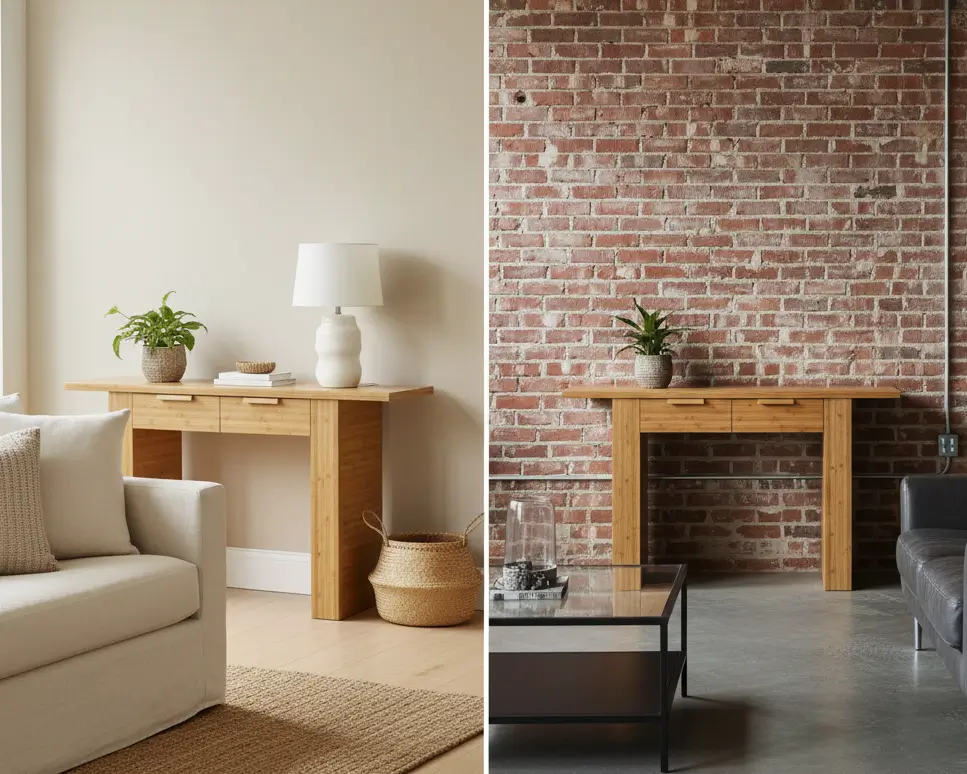
Bamboo’s warm honey-to-caramel tones (natural finish) or deeper browns (carbonized finish) read as distinctly organic. They clash with cool-toned contemporary spaces, fight against industrial metal aesthetics, and overwhelm rooms with competing wood species.
Where bamboo specialty tables work:
- Coastal and tropical interiors (obvious but true)
- Scandinavian-influenced minimalism (light bamboo only)
- Asian-inspired spaces (traditional association)
- Transitional rooms bridging modern and traditional
- Rooms already using woven textures (rattan, wicker, jute)
Where they struggle:
- Industrial/urban lofts with exposed ductwork
- Spaces dominated by painted furniture
- Rooms with cherry, mahogany, or red-toned woods
- Ultra-contemporary interiors with high-gloss surfaces
My console table in the entryway works because the adjacent living room uses jute rugs and linen upholstery. The same table looked wrong in my previous apartment with gray walls and black furniture.
The bamboo furniture styling and decorating guide covers room-specific integration approaches. For modern contexts specifically, see bamboo furniture modern contemporary styles.
Frequently Asked Questions
How much weight can bamboo specialty tables hold?
Weight capacity varies dramatically by construction, solid bamboo console tables with mortise and tenon joints typically support 75-150 lbs distributed across the surface, while laminated bamboo plant stands may cap at 30-50 lbs. I’ve never seen a bamboo specialty table fail from weight overload; failures occur from lateral stress (leaning, bumping) rather than downward pressure. Always check manufacturer specifications, but treat stated capacities as maximums, not recommended loads.
Do bamboo specialty tables work outdoors?
Not without marine-grade finishes and covered placement. Standard bamboo furniture finishes degrade within 6-18 months of direct sun and rain exposure. I tested one plant stand on a covered porch for two summers, the finish held, but the bamboo itself showed UV graying. For true outdoor use, see bamboo outdoor furniture for appropriate options.
Are bamboo nesting tables stable enough for daily use?
In my experience, yes, more stable than console tables despite looking flimsier. The stacking design keeps weight centered over the base. My 6-year-old nesting set sees daily use as laptop tables, snack surfaces, and temporary storage. Check that leg joints are reinforced where the graduated sizes connect; this is the common failure point.
How do I know if bamboo furniture is actually bamboo?
Turn it over. Solid bamboo shows visible node lines and grain irregularities. Laminated bamboo displays thin strip patterns in cross-section. Bamboo veneer over particleboard (common in cheap furniture) shows composite material at edges. I’ve encountered “bamboo” tables that were actually printed laminate over MDF, the weight gives it away. Real bamboo furniture feels substantial; fakes feel hollow.
What I’d Tell Someone Starting Their Search
After six years and nearly $5,000 spent, my position on bamboo specialty tables has evolved considerably. I started as an enthusiast, became skeptical after failures, and landed somewhere more nuanced: bamboo specialty tables can be excellent purchases, but the category has more quality variation than standard furniture.
If I started over today:
I’d buy only console and entry tables with visible corner block reinforcement or mortise and tenon construction, no exceptions. I’d continue using laminated bamboo for plant stands since they’ve proven more dimensionally stable. I’d insist on CARB Phase 2 certification for any laminated piece. And I’d spend the extra $75-$150 for manufacturers who publish joint construction details, not just glamour shots.
The bamboo specialty tables that work are genuinely wonderful, beautiful, sustainable when properly sourced, and durable beyond most people’s expectations. The ones that don’t work fail predictably and preventably.
Check your joints before checkout. Everything else is fixable.