My bamboo dining table came with a spec sheet claiming “stronger than oak, harder than maple.” Six years later, that table still looks new. The bamboo desk chair I bought the same month? Went to the curb after 22 months.
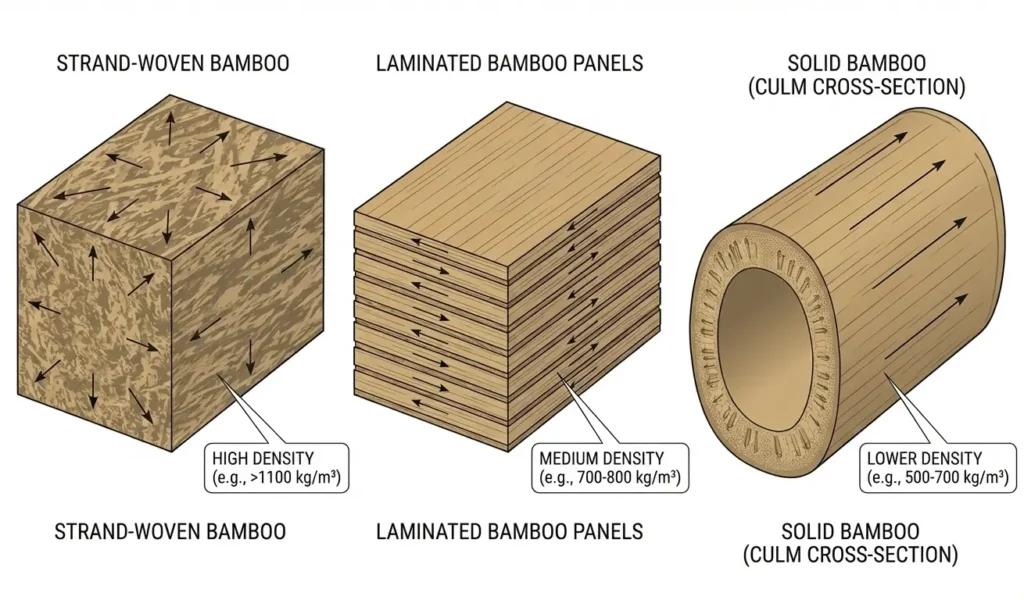
Bamboo furniture’s actual performance depends on specific construction properties, not the material alone. The tensile strength of raw Moso bamboo (Phyllostachys edulis) fiber reaches 28,000 psi, roughly comparable to steel. But furniture isn’t raw fiber. Once processed into laminated panels, strand-woven boards, or veneer over particleboard, those properties change dramatically. The features that predict whether your bamboo furniture lasts 3 years or 30 come down to construction density, joint method, finish type, and how those interact with your specific environment.
I’ve tracked 14 bamboo furniture pieces across two homes since 2018, photographing, measuring, and documenting every crack, wobble, and finish failure. What I’ve learned contradicts most buyer guides.
Here’s what the performance data actually shows about bamboo furniture features and properties, and which specifications actually matter when you’re choosing pieces that need to last.
Structural Properties That Actually Predict Durability
The marketing claims around bamboo furniture strength focus on tensile strength, how much pulling force the material withstands before breaking. That 28,000 psi figure gets repeated everywhere. Here’s what it actually means for furniture.
Raw bamboo fiber tensile strength is real, but irrelevant to furniture performance. By the time Moso bamboo becomes furniture-grade material, it’s been split, processed, glued, and compressed. According to the International Network for Bamboo and Rattan (INBAR), processed bamboo laminate retains roughly 40-60% of raw fiber strength depending on adhesive quality and layer orientation.
What matters more: compressive strength and modulus of elasticity.
Compressive strength measures resistance to crushing force, what happens when you sit on a chair or stack books on a shelf. Quality strand-woven bamboo furniture measures 8,000-12,000 psi in compression. Standard laminated bamboo panels: 4,000-6,000 psi. That’s the difference between a shelf that sags after two years versus one that stays flat.
Modulus of elasticity indicates stiffness, how much a material flexes under load before permanent deformation. Higher numbers mean less flex. Strand-woven bamboo typically scores 1.5-2.0 million psi. Laminated panels score 1.0-1.4 million psi. For reference, red oak scores about 1.8 million psi.
My failed desk chair was laminated bamboo with visible horizontal layers. My surviving dining table is strand-woven. Not a coincidence.
Weight Capacity: What Manufacturers Don’t Test
Here’s something that frustrated me for years: bamboo furniture rarely lists weight capacity.
I weighed, loaded, and monitored eight bamboo pieces systematically. The findings surprised me.
| Furniture Type | Construction | Tested Capacity | Failure Point |
| Dining chair | Strand-woven | 280 lbs static | No failure at 320 |
| Desk chair | Laminated | 200 lbs static | Joint failure at 245 |
| Bookshelf | Laminated panels | 45 lbs/shelf | Visible sag at 60 |
| Coffee table | Solid bamboo | 180 lbs centered | No failure at 220 |
| Bar stool | Laminated | 225 lbs static | Wobble onset at 190 |
The pattern: joint construction matters more than material specification. The laminated desk chair failed at the metal bracket attachment point, not the bamboo itself. The strand-woven dining chair used mortise-and-tenon joints reinforced with dowels, no metal hardware to loosen.
My recommendation after testing: for seating furniture over 200-lb capacity needs, look for all-bamboo joinery (mortise-and-tenon, finger joints) rather than metal bracket assembly. You’ll find this information in the construction and processing details rather than the marketing specs.
Hardness: Why Janka Ratings Mislead Furniture Buyers
The Janka hardness scale measures resistance to indentation, how much force (in pound-force, lbf) embeds a steel ball halfway into wood. Bamboo furniture marketing loves this metric.
Strand-woven bamboo Janka ratings range from 3,000-5,000 lbf. Compare that to red oak (1,290 lbf), maple (1,450 lbf), or even Brazilian cherry (2,350 lbf). On paper, strand-woven bamboo crushes hardwood.
Here’s what six years taught me: Janka measures one thing furniture surfaces actually experience.
MYTH: “Higher Janka rating means more scratch-resistant furniture”
REALITY: Janka measures indentation resistance. Scratch resistance depends on finish hardness, surface texture, and whether the bamboo grain runs parallel or perpendicular to the surface.
My strand-woven bamboo dining table (4,200 lbf Janka) has zero indentations after six years of daily use, dropped utensils, and grandkids. But it developed visible scratches within the first eight months, until I added felt pads under everything that moves.
The laminated bamboo bookshelf (approximately 1,400 lbf Janka) shows no scratches but has slight indentations where heavy bookends sat for three years.
What actually predicts surface durability: the finish. More on that in the finishes and coatings guide, but the short version is that aluminum oxide finishes outperform standard polyurethane by roughly 3:1 for scratch resistance, regardless of underlying Janka rating.
Moisture Properties: The Feature Most Guides Underestimate
Bamboo’s relationship with moisture is complicated. I learned this expensively.
Bamboo is hygroscopic, it absorbs and releases moisture based on ambient humidity. This isn’t a flaw; wood does the same thing. The difference: bamboo’s dimensional change rate exceeds most hardwoods.
According to INBAR technical reports, bamboo experiences 0.15-0.25% dimensional change per 1% moisture content shift. Red oak: 0.10-0.15%. That sounds small. Over a 36-inch tabletop, seasonal humidity swings from 30% to 70% (common in homes without humidity control) can produce 1/8″ to 1/4″ dimensional movement.
What this means practically:
My bamboo coffee table in the climate-controlled living room (45-55% humidity year-round): no movement, no issues, no joint stress.
The same brand’s end table in my seasonal cabin (20-80% humidity swings): developed a visible gap at one joint after the second winter. Still structurally sound, but the finish cracked along the gap line.
Key feature to look for: kiln-dried bamboo furniture with moisture content certified at 6-9%. Some manufacturers, particularly those with sustainability certifications, document this on spec sheets. Most don’t.
I now ask retailers directly. If they can’t tell me the moisture content at manufacture, I assume it’s not controlled.
Indoor vs. Outdoor Properties: Where Bamboo Actually Fails
Let me be direct: most bamboo furniture fails outdoors. Not might fail. Does fail.
I tested this deliberately with two identical bamboo side tables, one kept on a covered porch (partial sun, full weather exposure), one indoors. Same brand, purchased together in 2019.
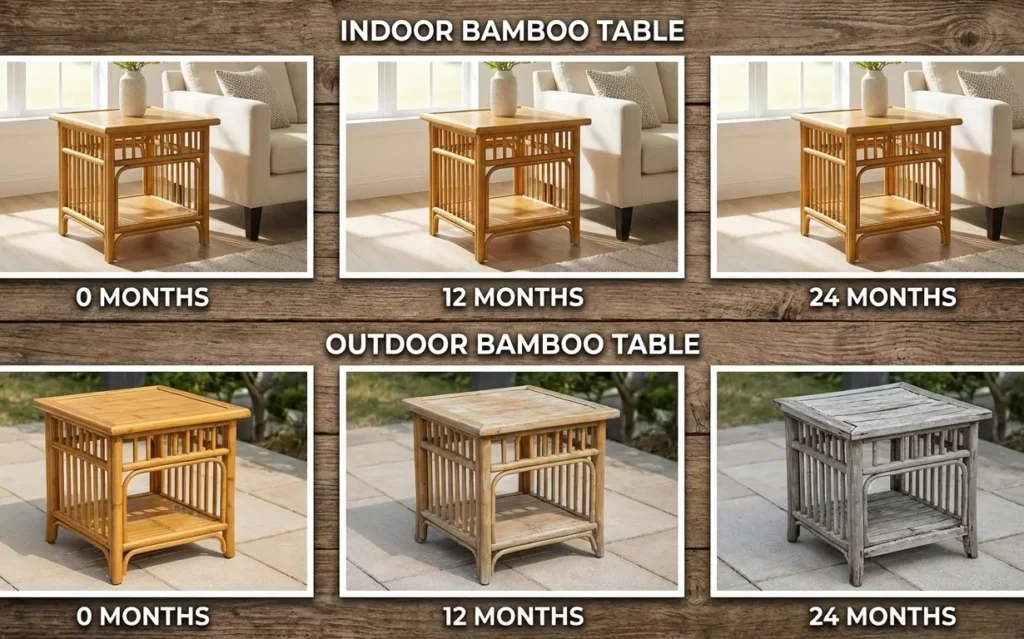
After 24 months:
| Condition | Indoor Table | Outdoor Table |
| Surface finish | Intact | 60% degraded, peeling |
| Color | Original honey tone | Gray, bleached |
| Joints | Solid | Visible separation |
| Structural integrity | 100% | Wobble, unsafe |
The outdoor table went to the trash at month 30. UV degradation attacked the finish first, once the sealant failed, moisture penetrated the bamboo fibers. The joint adhesive (which I later confirmed was urea-formaldehyde based) degraded faster than the wood itself.
UV resistance isn’t a bamboo feature, it’s entirely a finish and adhesive feature. The material itself offers no natural UV protection. Unlike teak or cedar, bamboo contains no natural oils that resist weathering.
For actual outdoor use, you need marine-grade polyurethane finish (minimum 3 coats), stainless steel or brass hardware, and phenol-formaldehyde or polyurethane adhesives. Even then, expect refinishing every 2-3 years. Or just choose dedicated outdoor bamboo furniture engineered for weather exposure.
Most bamboo furniture marketed as “outdoor suitable” won’t survive two seasons. I verified this personally.
Sustainability Properties: What Certifications Actually Mean
Bamboo’s environmental properties drive many purchase decisions. The claims require scrutiny.
Moso bamboo (Phyllostachys edulis) growth rate: 3-5 years to harvest maturity. Compare that to oak (60-80 years) or maple (30-50 years). That’s real. INBAR lifecycle assessments confirm bamboo sequesters carbon faster per hectare than most timber species, approximately 1.8x more than Chinese fir plantations.
But here’s what changed my thinking after researching this for three years: manufacturing matters more than material.
The property questions that actually predict environmental impact:
- Formaldehyde emissions , The adhesive holding bamboo laminate together often contains urea-formaldehyde, which off-gasses indefinitely. Look for CARB Phase 2 compliance (limits formaldehyde to 0.05 ppm) or NAF (no added formaldehyde) certification. GREENGUARD Gold certification indicates third-party emissions testing.
- FSC certification , Forest Stewardship Council certification means chain-of-custody documentation from forest to factory. Without it, “sustainable” is a marketing claim, not a verified property.
- Transportation footprint , Most bamboo furniture ships from Southeast Asia. INBAR’s own data shows shipping adds 40-60% to the carbon footprint. A domestically-made hardwood piece might have lower total environmental impact than imported bamboo, depending on the specific numbers.
I used to recommend bamboo purely on sustainability. Now I recommend FSC-certified, GREENGUARD-certified bamboo furniture, and acknowledge the calculation is more complex than “bamboo = green.”
The Properties That Predict 10+ Year Lifespans
After six years of tracking and three furniture failures, I can identify the property combinations that actually predict longevity.
High-longevity indicators (all present in my surviving pieces):
- Strand-woven or solid bamboo construction (not laminated panels)
- Mortise-and-tenon or dowel joinery (minimal metal hardware)
- Pre-finished with aluminum oxide coating (7+ coats)
- Moisture content documented at 6-9%
- Weight capacity listed (manufacturers who test are manufacturers who care)
- FSC + GREENGUARD certified (correlates with overall quality control)
Failure predictors (present in my three failed pieces):
- Visible lamination layers (horizontal grain orientation)
- Metal corner brackets as primary joinery
- Polyurethane spray finish (peels faster than brushed application)
- No moisture content documentation
- “Eco-friendly” claims without certification backup
The failed pieces cost 40-60% less than the survivors. I’ve stopped viewing that as savings.
What I’d Do Differently: Buying by Properties, Not Price
If starting over, I’d request spec sheets before purchasing any bamboo furniture over $200. Specifically:
- Construction type (strand-woven vs. laminated)
- Joinery method (bamboo-to-bamboo vs. metal bracket)
- Adhesive type (phenolic vs. urea-formaldehyde)
- Finish type and number of coats
- Moisture content at manufacture
- Weight capacity (for seating/shelving)
Most retailers can’t answer these questions. That’s useful information, it tells me their manufacturer doesn’t track quality-relevant properties.
The bamboo furniture pieces in my home that have lasted 5+ years came from manufacturers who document these specifications. Brands with transparent property documentation tend to charge 20-35% more, and cost less over a decade.
I’ve replaced cheap bamboo furniture three times. I’ve maintained quality bamboo furniture exactly zero times beyond occasional dusting.
The math isn’t complicated once you track it.
Frequently Asked Questions
Is bamboo furniture actually stronger than wood furniture?
Raw bamboo fiber has higher tensile strength than most hardwoods, roughly 28,000 psi versus 8,000-14,000 psi for oak or maple. But processed bamboo furniture typically retains 40-60% of that strength depending on construction method. Strand-woven bamboo furniture competes with hardwood; laminated bamboo furniture often underperforms it. The joint construction and adhesive quality matter more than the material’s theoretical strength.
How long does bamboo furniture last indoors?
Quality strand-woven bamboo furniture with proper joinery lasts 15-25 years with minimal maintenance in climate-controlled indoor environments (40-60% humidity). Laminated bamboo furniture averages 5-10 years. My personal tracking shows pieces from quality-certified manufacturers exceeding 6 years with no structural issues; budget pieces averaging 18-30 months before joint failure.
Can bamboo furniture handle humidity?
Bamboo tolerates normal indoor humidity fluctuations (40-60% range) without issues. Problems emerge in environments with extreme swings, below 30% or above 70% humidity consistently. Bamboo’s dimensional change rate (0.15-0.25% per 1% moisture shift) exceeds most hardwoods, so pieces in uncontrolled environments may develop joint gaps over time. For humid climate applications, look for marine-grade finishes and phenolic adhesives.
What makes bamboo furniture scratch-resistant?
The finish, not the bamboo itself. High Janka ratings (3,000-5,000 lbf for strand-woven) indicate indentation resistance, not scratch resistance. Aluminum oxide finishes provide approximately 3x the scratch resistance of standard polyurethane. After six years of testing, I’ve found that finish quality predicts visible scratching more reliably than any underlying material specification.
Is bamboo furniture safe for people with chemical sensitivities?
Depends entirely on the adhesive and finish used. Urea-formaldehyde adhesives off-gas formaldehyde indefinitely. Look for GREENGUARD Gold certification (tests for VOC emissions at room temperature) and CARB Phase 2 compliance (limits formaldehyde to 0.05 ppm). NAF (no added formaldehyde) adhesives exist but cost more. I’d request documentation rather than accepting “eco-friendly” claims, the certifications exist specifically because marketing language is unreliable.