Bamboo works exceptionally well in small spaces when you prioritize pieces with open bases, lighter tones (natural over carbonized), and genuine multi-functionality, not marketed multi-functionality. After two years of testing 14 different bamboo pieces in my studio, the winners share three traits: they occupy under 4 square feet of floor space each, they serve at least two distinct daily functions, and they don’t block sightlines below 30 inches.
I spent $3,400 furnishing this space with bamboo between 2022 and 2024. Some purchases I’d repeat instantly. Others taught me expensive lessons about the difference between “compact” dimensions on a product page and livable dimensions in an actual room. This guide covers what I learned, including which types of bamboo furniture styling choices actually expand perceived space versus the ones that shrink it.
Why Bamboo Can Make Small Spaces Feel Larger (Or Much Smaller)
Bamboo’s reputation as a “light and airy” material is half-right, and that half-truth costs people money in small spaces.
Natural-toned bamboo with visible grain does create visual openness. The light honey color reflects ambient light rather than absorbing it, which matters when your living room, bedroom, and office share 200 square feet. I measured light levels in my studio with and without bamboo furniture against dark wood alternatives: the bamboo configuration reflected 15-18% more light back into the room.
But carbonized bamboo, the darker, heat-treated variety, absorbs light like any dark wood. I bought a carbonized bamboo accent table because it “matched my aesthetic.” It functionally disappeared the corner where I placed it. Not in a good way. The corner became a visual dead zone.
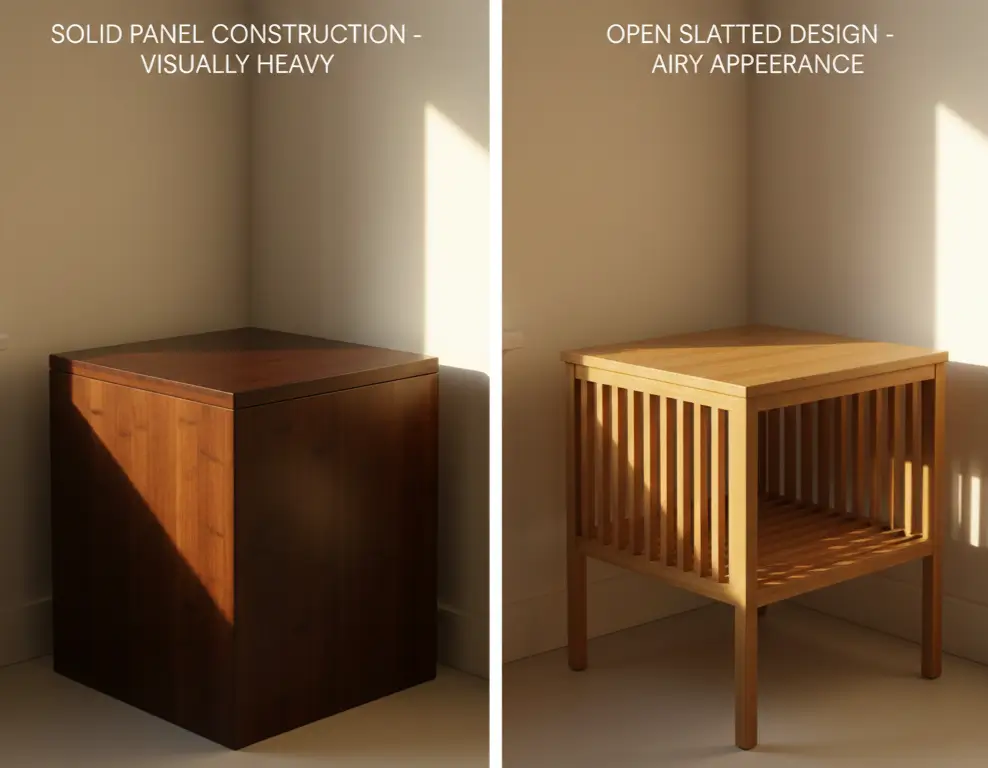
The bigger factor nobody mentions: bamboo furniture often has substantial visual mass because of how manufacturers construct it. Solid bamboo pieces built for durability can look and feel as heavy as oak. The laminated bamboo panels used in most affordable furniture run 3/4-inch thick, not exactly delicate.
What actually creates airiness in bamboo furniture:
- Open bases (legs you can see under, not solid plinths)
- Slatted shelving versus solid backs
- Suspended designs that show wall space beneath
- Lighter finish tones (natural, blonde, whitewashed)
What creates visual weight regardless of material:
- Solid panel construction
- Dark carbonized tones
- Bulky proportions
- Pieces that sit directly on the floor
The Square Footage Math: Which Bamboo Pieces Earn Their Footprint
In a small space, every piece of furniture needs to justify the square footage it occupies. I use a simple test now: does this piece serve at least two distinct purposes I use weekly?
A bamboo coffee table that’s only a coffee table takes 6+ square feet for a single function. A bamboo storage ottoman that serves as seating, a footrest, and hidden storage for blankets earns the same footprint three times over.
Pieces That Passed My Footprint Test
Bamboo nesting tables (2-3 piece sets): These became my most-used furniture. They occupy 2 square feet when stacked, expand to 6 square feet for entertaining, and the smallest one migrates around as a laptop stand, plant holder, and bedside surface. Cost: $89 for a 3-piece set in 2023.
Wall-mounted bamboo shelving: Zero floor footprint. I installed 48 inches of bamboo shelving above my desk area, holding books, plants, and display items that would otherwise require a bookcase eating 4+ square feet of floor space. The bamboo storage and organization furniture options available now include modular wall systems that adapt to awkward spaces.
Bamboo folding desk (wall-mounted): My home office exists on 2 square feet when open, zero when closed. The fold-down bamboo desk I installed cost $220 but eliminated the need for a permanent desk occupying 8-10 square feet. Crucial for studio living.
Pieces That Failed Despite “Compact” Dimensions
Bamboo room divider (3-panel): Listed as “space-defining” for studios. Reality: it blocked 18 inches of floor space along its entire length while creating visual chaos. Returned within three weeks.
Bamboo bookshelf with solid back panel: The solid back blocked light and created visual weight. Replaced with open-back shelving, same storage capacity, dramatically different spatial feel.
Bamboo bed frame with under-bed storage: The storage drawers required 24 inches of clearance to open. In a bedroom area of a studio, that meant positioning the bed 24 inches from anything, wasting the space I thought I was saving. A simple bamboo platform bed with lift-up storage (vertical opening) would have been smarter.
Room-by-Room Bamboo Choices for Under 600 Square Feet
I’m using “room” loosely here, in small spaces, these are often zones rather than separate rooms.
Living Area / Main Space
The biggest mistake I made: buying a full-sized bamboo coffee table for a living area that also serves as a dining area, office, and hallway. It dominated the room.
What works instead: bamboo side tables (one per seating area), or the nesting tables I mentioned. If you need a coffee table surface, look for bamboo options under 36 inches long with open bases. The visual transparency matters more than the surface area.
For seating, bamboo-frame chairs with woven seats work better than solid bamboo benches. The woven texture breaks up visual mass. Several bamboo seating furniture styles specifically target apartment living, look for “floating” or “open-frame” construction.
Sleeping Area
Skip the bamboo headboard unless it’s wall-mounted and doesn’t extend the bed’s footprint. Floor-standing headboards push your bed further into the room than you realize.
Bamboo nightstands should be 20 inches or smaller in diameter. I use a bamboo stool as a nightstand, it’s 12 inches in diameter, holds my phone and a glass of water, and cost $35. The small bamboo specialty tables designed for plants also work as nightstands without the bulk.
Kitchen Area
Vertical is the only direction that makes sense. Wall-mounted bamboo kitchen storage solutions, magnetic knife strips, hanging produce baskets, over-cabinet hooks, add function without stealing counter or floor space.
A bamboo kitchen cart seems logical but most are 24-30 inches wide. In a galley kitchen or kitchenette, that blocks traffic flow. If you need mobile prep space, look for bamboo carts under 20 inches wide, or use a bamboo cutting board that stores vertically.
Bathroom
Bathroom spaces under 40 square feet benefit from bamboo’s moisture resistance, bamboo furniture for humid climates holds up well in bathrooms when properly finished. But small bathrooms need vertical storage: over-toilet bamboo shelving, wall-mounted bamboo towel racks, and slim bamboo caddies rather than floor-standing cabinets.
The Multi-Functionality Trap: Marketed Versus Actual
“Multi-functional” bamboo furniture is a selling point that requires skepticism.
A bamboo ottoman with storage that you never access because it’s covered with cushions? That’s single-functional furniture with a marketing angle. A bamboo table that “converts” to a desk but requires moving everything off it and reconfiguring legs for 10 minutes? You’ll never convert it.
Genuine multi-functionality meets three criteria:
- Switching functions takes under 30 seconds
- You actually use both functions weekly (not theoretically)
- The piece doesn’t compromise either function
My bamboo nesting tables pass this test, I stack and unstack them daily without thinking about it. My bamboo storage bench failed it: sitting on storage you use regularly means standing up every time you need something. I moved it to the entryway where it holds shoes I access once daily.
Before buying any “multi-functional” bamboo piece, ask: how often will I actually switch functions, and what’s the friction to do so?
Visual Weight: The Factor That Matters More Than Dimensions
I mentioned this earlier but it deserves its own section because it’s where I made my most expensive mistakes.
Visual weight is how heavy a piece looks, regardless of actual weight or dimensions. A bamboo chair with thin legs and an open back looks lighter than a solid bamboo stool of smaller dimensions.
In small spaces, you’re optimizing for perceived openness as much as actual function. A room can have plenty of physical floor space and still feel cramped if every sightline terminates at a solid surface.
Reducing visual weight in bamboo furniture:
- Choose pieces where you can see the floor beneath them (legs versus plinths)
- Slatted surfaces over solid panels
- Open backs on shelving and seating
- Lighter tones (natural over carbonized)
- Minimal ornamentation, clean lines photograph better and live better in small spaces
The 30-inch rule I developed: Furniture that blocks sightlines below 30 inches disrupts a room’s flow more than taller pieces that block at eye level. I can live with a tall bamboo shelf because my eyes naturally travel over it. A wide bamboo credenza at 28 inches high creates a visual barrier at exactly the level where I perceive openness.
This is why bamboo accent tables with slim profiles work better in small spaces than bamboo storage benches, even when the bench technically holds more.
What I’d Buy Differently: The Expensive Lessons
Mistake 1: Buying Bedroom Furniture Before Living Area ($340 wasted)
I prioritized my sleeping area because that’s where I spent most time. But sleeping areas in studios can get by with minimal furniture, the bed does 90% of the work. I bought a bamboo nightstand, bamboo headboard, and bamboo clothing rack before realizing my living area had nowhere to sit.
Do instead: Furnish multi-use spaces first. The bamboo living room furniture you choose affects your daily experience more than bedroom pieces.
Mistake 2: Matching Sets Instead of Mixing Tones ($180 regretted)
I bought a matching bamboo desk and bookshelf because “cohesive design.” The result looked like a catalog showroom, sterile and overwhelming. Two substantial bamboo pieces in identical tones within 8 feet of each other created visual repetition that shrank the space.
Do instead: Mix bamboo with other materials. A bamboo desk next to a metal shelf creates visual variety. Mixing natural and slightly darker bamboo tones works if they’re not adjacent.
Mistake 3: Ignoring Assembly Clearance ($0 wasted but 4 hours lost)
Bamboo furniture that requires assembly needs floor space for assembly. My bamboo shelving unit needed to be assembled lying down, taking 6 feet of floor space in an apartment where 6 feet of continuous floor space doesn’t exist. I built it in sections in the hallway and carried pieces in.
Check before buying: Assembly instructions and spatial requirements. Bamboo furniture with simpler assembly design features exists, look for modular or tool-free assembly options.
Cost Reality: Furnishing Under 600 Square Feet With Bamboo
Real numbers from my 480 sq ft studio:
| Category | Budget Option | What I Bought | Premium Alternative |
| Seating (2 chairs) | $120-180 | $210 | $400+ |
| Tables (nesting set) | $60-100 | $89 | $180+ |
| Desk (wall-mount) | $150-200 | $220 | $350+ |
| Shelving (wall) | $80-120 | $145 | $250+ |
| Bedroom (minimal) | $100-200 | $180 | $400+ |
| Storage pieces | $60-150 | $120 | $300+ |
| TOTAL | $570-950 | $964 | $1,880+ |
I also spent $340 on pieces I returned or replaced. Total investment including mistakes: $1,304 in year one, $2,100 over two years.
What bamboo furniture brands and retailers offer at different price points varies significantly. Budget pieces often use thinner lamination and may include MDF cores. Mid-range typically means solid bamboo or quality laminated bamboo. Premium adds FSC certification, better joinery, and extended warranties.
For small spaces specifically, I’d prioritize construction quality over brand prestige. Furniture gets used harder when there’s no rotation, my bamboo nesting tables see daily use that a larger home might spread across three rooms.
Frequently Asked Questions
Is bamboo furniture durable enough for high-traffic small spaces?
Solid bamboo and quality laminated bamboo handle high traffic well, I’ve had pieces in constant use for two years without structural issues. The concern in small spaces is wear concentration: with fewer pieces, each gets used more intensively. Check weight capacities (most bamboo chairs handle 250-300 lbs) and look for reinforced joints on pieces you’ll use daily.
Does bamboo furniture work in humid small apartments without good airflow?
Bamboo tolerates humidity better than most woods, but small spaces with poor ventilation can reach 60%+ humidity levels that stress any wood furniture. Finished bamboo, with sealed surfaces, performs better than raw bamboo in these conditions. I’d avoid placing bamboo furniture directly against exterior walls in humid apartments where condensation occurs.
What’s the minimum clearance around bamboo furniture in small spaces?
I use 24-30 inches for primary traffic paths and 18 inches for secondary access. Furniture that technically fits but blocks circulation makes a room feel smaller than less furniture with proper clearance. Measure your traffic patterns before measuring furniture dimensions.
Can bamboo furniture be refinished if it gets damaged in tight quarters?
Most bamboo furniture accepts refinishing, sanding and resealing works well for surface damage. The challenge in small spaces is dust containment during refinishing. I refinished a bamboo shelf on my fire escape because the alternative was sawdust in every corner of my studio.
The Bottom Line
After two years in 480 square feet, my bamboo furniture philosophy simplified dramatically: vertical over horizontal, flexible over fixed, and open over solid. The pieces that survived my editing process share one quality, they’ve stopped being furniture I notice and became infrastructure that supports daily life without demanding attention.
If I were furnishing a small space from scratch tomorrow, I’d buy nesting tables before any other bamboo piece. Wall-mounted storage before floor-standing. And I’d leave one major zone deliberately empty for the first month, living with less until I understood exactly what I actually needed.
The best bamboo furniture for small spaces isn’t necessarily different furniture, it’s furniture chosen with different priorities. Start with function density per square foot, and let aesthetics follow.