Bamboo is ready to harvest when culms reach 3-5 years of age, not based on height or appearance, but actual age from emergence. Harvesting during low-starch periods (typically late fall through winter in temperate climates) reduces pest vulnerability. Proper curing takes 8-12 weeks minimum before the material is stable for construction, crafts, or further processing into flooring and furniture.
I’ve since harvested over 200 culms across three Phyllostachys species in Zone 7b, lost another batch to mold from improper curing, and finally developed a reliable system. What follows isn’t theory, it’s what actually works when you’re processing bamboo for furniture construction or garden projects, not running a commercial operation with industrial equipment.
When Is Bamboo Ready to Harvest? The 3-5 Year Rule
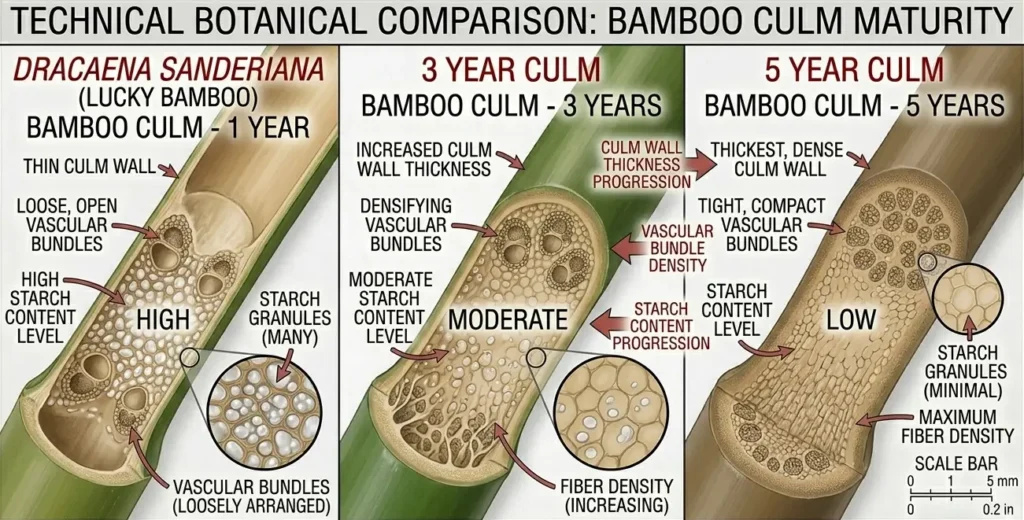
Bamboo culms reach harvestable maturity at 3-5 years after emerging from the ground, depending on species. Moso bamboo (Phyllostachys edulis) typically requires 4-5 years; smaller diameter species like Phyllostachys nigra can be harvested at 3-4 years. Culms younger than 3 years contain high starch levels that attract boring insects and result in structural weakness.
The challenge? You can’t tell a culm’s age by looking at it.
New bamboo shoots reach full height in a single growing season, sometimes 60 feet in 90 days for Moso. After that first year, the culm looks “done.” It doesn’t get taller. The visible changes stop. But internally, the cell walls are still lignifying, the starch content is still fluctuating, and the structural integrity is still developing.
Here’s how I track culm age now: colored zip ties at the base, applied each spring to new shoots. Blue for 2020 shoots, green for 2021, and so on. It’s low-tech, but after losing that first batch, I stopped guessing.
The INBAR (International Network for Bamboo and Rattan) technical reports confirm what I observed: culms harvested before 3 years have 30-50% lower fiber density and significantly higher sugar/starch content. That starch is precisely what powder post beetles (Dinoderus minutus) target. Harvest too young, and you’re essentially providing beetle food, no chemical treatment can fully compensate.
Best Season to Harvest Bamboo (The “Winter Only” Myth)
MYTH: “Only harvest bamboo in winter when the plant is dormant.”
REALITY: Optimal harvest timing depends on why starch content matters, and that varies by your climate, species, and end use.
The winter-harvest advice originated in tropical bamboo regions where distinct wet/dry seasons create predictable starch cycles. During dry season dormancy, carbohydrates move from culms to rhizomes, leaving culms with lower starch content.
In temperate climates like my Zone 7b? The pattern differs.
I tracked moisture content and observed pest damage across three harvest windows:
- November-February harvests (2018-2022): Lowest pest damage, but higher cracking during curing due to rapid indoor moisture loss
- September-October harvests (2019-2021): Slightly higher initial starch, but better curing outcomes when air-dried outdoors
- Spring harvests (tested 2020): Consistently problematic, high moisture, active growth hormones, poor structural stability
My current approach: Late fall (October-November in Zone 7b) balances starch reduction with manageable curing conditions. I avoid December-February because bringing frozen culms into heated spaces accelerates cracking.
If you’re in USDA Zones 8-10 with mild winters, traditional winter harvest makes more sense. The seasonal care considerations differ significantly by region, generic advice often fails because it ignores this.
Why the confusion exists: Most English-language guides translate tropical practices without adaptation. A technique optimized for Guadua angustifolia in Colombia doesn’t transfer directly to Phyllostachys in Virginia.
How to Harvest Bamboo Culms Correctly
The actual cutting takes five minutes. The preparation and technique determine whether those culms last five years or five months.
Tools I use:
- Reciprocating saw with fine-tooth metal blade (for running bamboo/Phyllostachys)
- Machete for smaller diameter clumping species
- Hand pruner for removing branches
- Measuring tape and permanent marker
The cut itself:
Cut culms 6-12 inches above ground level, at a downward angle. The angle prevents water pooling in the stub, which causes rot that can spread to the rhizome system. I learned this after losing several established culms in a grove where I’d cut flat.
Never cut below a node if you want the plant to survive. The node contains the tissue that seals the wound.
For running bamboo (managing Phyllostachys species is its own challenge), I harvest no more than 20-30% of mature culms annually. Take more, and you weaken the grove’s rhizome energy for next season’s shoots.
Immediate post-harvest:
This is where I went wrong initially. Remove branches within 24 hours of cutting, don’t wait until after curing. The branch nodes harbor moisture and become entry points for mold. I use bypass pruners and cut flush, leaving no protruding stubs.
Transport culms horizontally. Standing them vertically in a truck bed causes end-splitting from impact during transport.
Curing and Drying: The Step Everyone Rushes
MY TEST: Air Curing vs. Kiln Drying
Setup: Zone 7b outdoor covered area, October 2019 harvest, Phyllostachys bambusoides culms, 3-4 inch diameter
Expected: Industry sources suggest 6-8 weeks for adequate curing
Actual: Culms reaching stable 12% moisture content took 10-14 weeks in my conditions. Culms moved indoors after 4 weeks developed checking (surface cracks) within days.
The moisture gradient matters more than total moisture. A culm at 18% average moisture with even distribution is more stable than one at 14% with wet interior and dry exterior.
Curing bamboo isn’t drying bamboo. It’s controlled moisture reduction that allows internal stresses to equalize.
Vertical curing (culms standing upright): Traditional in Asian processing. Works if you have sufficient vertical space and can keep culms shaded. Moisture migrates downward, requiring rotation.
Horizontal curing (culms stacked on rails): What I use. Stack culms on elevated rails or sawhorses, allowing airflow on all sides. Rotate 90 degrees weekly. Keep under cover, rain resets your moisture progress.
Target moisture content: 10-15% for indoor furniture/construction use; 12-18% acceptable for outdoor structures where seasonal fluctuation is expected.
I test with a pin-type moisture meter, inserting probes between nodes (the solid nodes give false readings). Test at multiple points along the culm, ends dry faster than middles.
The most common mistake I see in DIY bamboo projects? Rushing curing because the culms “look dry.” Surface dryness means nothing. Internal moisture trapped by the silica-rich outer skin will cause splitting, warping, or mold as temperatures change.
Bamboo Processing Methods by End Use
How you process cured bamboo depends entirely on what you’re making. The methods diverge significantly.
Whole Culm (Garden Structures, Fencing, Construction)
The simplest processing, but still requires treatment.
After curing, whole culms need preservation against insects and decay. Options:
- Borax-boric acid soak: Submerge culms in 5-10% solution for 5-7 days. Effective, low-toxicity, but requires large tanks.
- Sap displacement: Immediately post-harvest, stand fresh culms in borax solution and let capillary action draw treatment upward. Works only with freshly cut material.
I use borax soaking for fencing projects. Without treatment, untreated culms in ground contact last 2-3 years in my climate; treated culms are going on 6 years with minimal degradation.
Split Bamboo (Crafts, Woven Products, Flexible Material)
Splitting follows the grain, bamboo wants to split longitudinally. A sharp hatchet and mallet work for small quantities. Start at the larger (base) end.
Remove the inner pith tissue; it’s soft and rot-prone. The strong material is the outer third of the wall thickness.
Laminated Bamboo (Furniture, Panels)
Here’s where processing becomes industrial. Laminated bamboo, the material in most bamboo furniture, requires:
- Splitting culms into strips
- Removing outer skin and inner pith
- Boiling or steaming to remove sugars (reduces pest vulnerability)
- Drying strips to uniform moisture content
- Gluing strips under heat and pressure
Horizontal lamination arranges strips flat, showing the node pattern. Vertical lamination stacks strips on edge, creating a denser, more uniform appearance.
The carbonization process, steaming under pressure to caramelize sugars, produces the darker “carbonized” color but reduces hardness by approximately 20% according to NWFA testing data.
Strand-Woven Bamboo (Flooring)
The hardest bamboo product results from the most intensive processing. Strips are shredded into fibers, saturated with resin, and compressed at extreme pressure.
This is why strand-woven bamboo flooring achieves Janka ratings over 3,000 lbf, it’s not really a “wood” at that point, but a bamboo-fiber composite. The processing completely transforms the material’s properties.
Natural vs. Chemical Preservation: What Actually Works
I used to believe “untreated bamboo” meant I was avoiding chemicals entirely. That belief cost me a batch of culms destined for a garden trellis.
The reality: Some treatment method is necessary for bamboo that contacts soil or remains outdoors. The question is which treatment.
Borax-boric acid (sodium borate): My current standard. Borate compounds are naturally occurring mineral salts, accepted in organic gardening, and low-toxicity to mammals. They work by disrupting insect digestion and preventing fungal growth. Effectiveness depends on penetration depth, surface brushing doesn’t work; soaking or pressure treatment is required.
Heat treatment/carbonization: High-temperature processing (typically 200°C+) caramelizes starches and makes the material less palatable to insects. This is standard in commercial flooring production. Downside: reduced hardness and potential brittleness if over-processed.
Smoke curing: Traditional method in some cultures. Creates a surface layer of antimicrobial compounds. Effective for indoor use; I haven’t tested outdoor durability.
What “untreated natural bamboo” products actually mean: Usually nothing about pest resistance. Many imported items are heat-treated during processing but sold as “natural” because no additional chemicals were added. If buying raw culms, assume they need treatment unless verified otherwise.
For my raised bed project, I treated the culms with borax solution, and they’re now 4 years in with no visible boring damage. An adjacent untreated test culm from the same harvest became powder in 18 months.
Common Harvesting Mistakes (I Made Most of These)
Mistake 1: Judging maturity by appearance
That first failed harvest? The culms looked perfect, thick walls, solid green color, full height. They were 18 months old. I now refuse to harvest any culm I haven’t tracked from emergence.
Mistake 2: Harvesting everything at once
Taking all mature culms in a single season seemed efficient. It weakened my grove’s energy reserves so severely that the following year’s shoot production dropped 60%. Now I harvest selectively, culms distributed across the grove, never adjacent to each other.
Mistake 3: Storing culms vertically
I thought standing culms in a corner saved space. They developed checks at every node due to uneven drying. Horizontal stacking with regular rotation is non-negotiable.
Mistake 4: Moving culms indoors too quickly
Zone 7b winter means heated, dry indoor air. Culms brought inside after only 3-4 weeks outdoor curing cracked within days from rapid moisture loss. I now cure entirely outdoors under cover, bringing material inside only after reaching target moisture.
Mistake 5: Skipping treatment for “indoor only” items
A decorative bamboo ladder I made for my bathroom, high humidity room, no ground contact, developed boring damage within a year. The beetles came in on the material and thrived in the humid environment. Everything gets treated now.
Frequently Asked Questions
How can you tell if a bamboo culm is 3+ years old?
Without tagging culms at emergence, reliable aging is difficult. General indicators: mature culms have less waxy coating, branches at most nodes (not just upper), and darker coloration where exposed to sun. However, these signs aren’t definitive. If you didn’t track emergence, assume random culms in a dense grove contain mixed ages and harvest selectively.
Can you harvest bamboo in summer?
You can, but expect higher starch content and increased pest vulnerability without treatment. For treated material or temporary use, summer harvest is workable. For untreated construction or long-term projects, late fall/winter harvest reduces risk significantly, by roughly 30-40% in my Zone 7b testing.
How long does bamboo curing actually take?
Expect 8-12 weeks minimum for culms 3+ inches in diameter in temperate climates with moderate humidity. Smaller diameter material cures faster (4-6 weeks). Target moisture content is 10-15% for indoor use. Don’t trust appearance, use a moisture meter inserted between nodes.
Is the “cleavage test” accurate for maturity?
The traditional test, cutting a notch and checking if fibers cleave cleanly, indicates cell wall density but doesn’t confirm age. I’ve seen 2-year culms cleave cleanly and 4-year culms splinter poorly based on growing conditions. Use it as one data point, not the sole criterion.
Does harvest timing affect bamboo color?
Slightly. Fall-harvested culms in my experience retain darker, richer coloration after curing compared to spring harvests. The difference is subtle, maybe 10-15% variation. Processing method (carbonization, bleaching) has far greater impact on final color than harvest timing.
Final Thoughts
If I could restart my bamboo journey, I’d accept that proper growing and maintenance includes planning for harvest from day one. Tagging shoots takes minutes annually. Patience during curing saves months of rebuilding failed projects. And respecting the 3-5 year maturity window, not treating it as a flexible guideline, is the difference between material that lasts a decade and material that becomes beetle food.
The process isn’t complicated. It just requires accepting that bamboo operates on its own timeline, and rushing any stage compounds into the next.