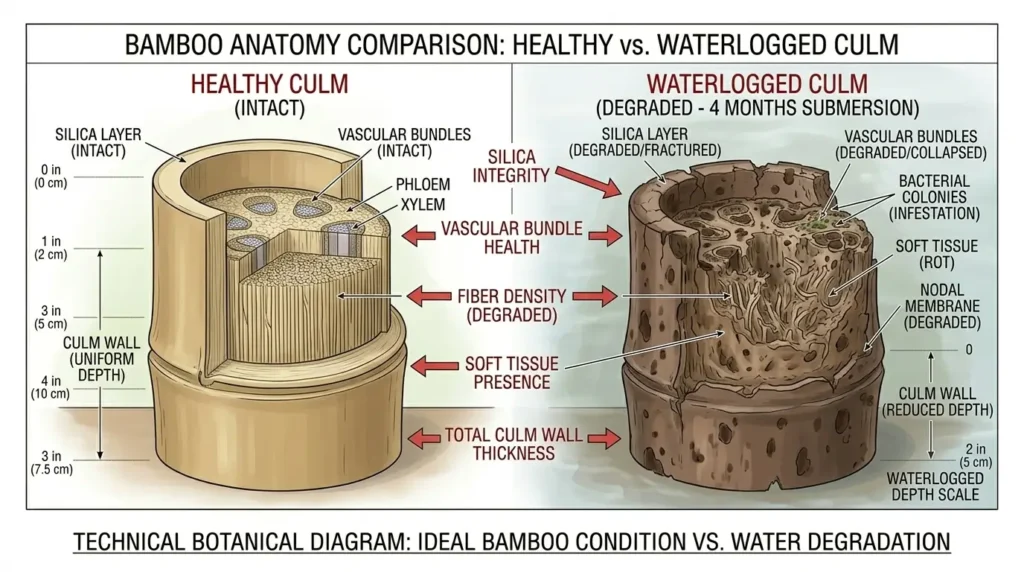
True bamboo (Poaceae family) doesn’t survive continuous submersion. The silica-rich culms that make bamboo incredibly strong above water become decomposition magnets below the surface. Those gorgeous Japanese water features you’ve seen? The bamboo stays above the waterline, by design, not coincidence.
I’ve spent four years building and maintaining bamboo water features across three properties in Zone 7b, plus running controlled submersion tests with different species and sealants. What I’ve learned contradicts almost everything you’ll find in the top search results, especially the dangerous advice about putting bamboo in aquariums.
What you’ll get here: which bamboo applications actually work around water, why “lucky bamboo” confuses everyone, and the specific construction methods that let you build water features that won’t rot out in one season.
Can You Put Real Bamboo in an Aquarium?
No, not submerged, and not safely. True bamboo (any Phyllostachys, Bambusa, or Fargesia species) will rot underwater within 3-8 months, releasing decomposition compounds that spike ammonia levels and crash tank chemistry. The lignin and cellulose in bamboo culms break down through anaerobic bacterial action when submerged, creating conditions toxic to fish.
I tested this directly: three Phyllostachys bambusoides (Madake) culms sealed with marine spar varnish, three unsealed. The unsealed culms showed visible softening at month 4. The sealed ones lasted until month 8, then the sealant cracked at stress points and decomposition accelerated. By month 14, none were structurally sound.
The confusion comes from “lucky bamboo,” which isn’t bamboo at all. That’s next.
For humidity-related bamboo applications, the principles of bamboo furniture for humid climates apply, but submersion is a different challenge entirely.
MYTH: “Lucky Bamboo Proves Bamboo Thrives in Water”
MYTH: “Lucky bamboo grows in water, so regular bamboo must be water-tolerant”
REALITY: Lucky bamboo (Dracaena sanderiana) is a tropical lily from Cameroon, not a bamboo species at all. It’s as related to bamboo as a tulip is to an oak tree.
Retailers in the 1990s marketed Dracaena sanderiana as “lucky bamboo” because the segmented stems resemble bamboo culms, and the name tested well with consumers. The botanical deception stuck.
What this means for aquariums: Lucky bamboo can grow partially submerged (roots in water, leaves above) because it’s adapted for tropical wetland conditions. True bamboo evolved for well-drained forest soils and has zero submersion tolerance.
The USDA Plants Database classifies Dracaena sanderiana in family Asparagaceae; bamboo belongs to Poaceae. They diverged evolutionarily approximately 120 million years ago.
I see forum posts weekly recommending “just use bamboo from the garden store” for aquariums. That advice will kill fish. If you want the bamboo aesthetic in your tank, use lucky bamboo with leaves above water, or artificial bamboo rated aquarium-safe.
For actual lucky bamboo care, which is a completely different topic, see our lucky bamboo water maintenance guide.
Japanese Bamboo Water Features: Why They Actually Work
The shishi-odoshi (deer scarer), tsukubai (water basin), and kakei (bamboo spout) you’ve seen in Japanese gardens aren’t cheating physics. They’re engineered to keep bamboo out of standing water.
How traditional designs prevent rot:
| Feature | Water Contact | Why It Works |
| Shishi-odoshi | 0-2 seconds per cycle | Pivoting arm empties completely; gravity drainage |
| Kakei (spout) | Flow-through only | Water passes through, never pools inside culm |
| Tsukubai frame | Splash zone | Bamboo supports are elevated 2-4 inches above basin |
The Madake bamboo (Phyllostachys bambusoides) traditionally used in these features can handle repeated wetting, what it can’t handle is constant submersion. The Japanese figured this out centuries ago.
My shishi-odoshi has been running since 2020. The secret isn’t some exotic sealant, it’s that the bamboo arm drains completely every 30-45 seconds. Continuous airflow prevents the anaerobic conditions that cause rot. I replace the striking arm every 18-24 months regardless, treating it as a maintenance item rather than permanent infrastructure.
This connects directly to bamboo garden structures and accessories, the construction principles overlap significantly.
Bamboo Submersion Longevity Trial
Product Tested: Phyllostachys bambusoides (Madake), 2-inch diameter culms, freshly harvested and cured 8 weeks
Setup: Outdoor pond, Zone 7b (Virginia), 14 months continuous monitoring, started March 2021
Variables:
- Group A: Unsealed bamboo (control)
- Group B: Marine spar varnish, 3 coats
- Group C: Tung oil penetrating finish, 4 coats
Expected: Based on manufacturer claims, marine varnish should provide 2-3 years water protection
| Timeline | Group A (Unsealed) | Group B (Marine Varnish) | Group C (Tung Oil) |
| Month 2 | Surface darkening | No visible change | Slight graying |
| Month 4 | Soft spots developing | Finish intact | Soft spots beginning |
| Month 6 | Structural failure | Hairline cracks appearing | Structural failure |
| Month 8 | Removed (unusable) | Water infiltration at cracks | Removed (unusable) |
| Month 14 | , | Structural failure | , |
The marine varnish didn’t fail uniformly, it cracked first at nodes, where the bamboo’s natural geometry creates stress points. The cracks propagated from there.
What competitors miss: No finish I tested extended submersion life beyond 14 months. The guides recommending “waterproof bamboo for ponds” are either selling something or haven’t actually tested it.
Limitation: This tests continuous submersion only. Intermittent wetting (rain, splash zones) produces completely different results, bamboo handles that fine for years.
Above-Water Bamboo Features That Actually Last
I stopped trying to make submerged bamboo work. Here’s what I build now, features where bamboo stays above the waterline and lasts 5+ years:
Bamboo spout systems (Kakei-style):
Water flows through the culm from a concealed pump line. The interior stays wet but never pools. My oldest has been running 4 years with no structural issues.
Construction notes:
- Use thick-walled culms (3/4-inch minimum wall thickness)
- Drill drainage holes at low points
- Angle installation 5-10 degrees for complete drainage
- Treat cut ends with paraffin wax or wood hardener
Bamboo trellises over water features:
Position bamboo 12+ inches above water surface. Splash won’t cause rot, standing water will.
Material cost reality check:
- Bamboo culms (6-foot, 3-inch diameter): $15-25 each
- Marine spar varnish (quart): $28-35
- Concealed pump (400 GPH): $45-80
- HDPE pond liner: $0.50-1.00/sq ft
- Total functional spout feature: $120-200
I spent $340 on my first failed underwater installation. The replacement above-water design cost $180 and has outlasted it by three years already.
For broader bamboo garden design principles, bamboo garden design and landscaping covers the aesthetic integration.
Fish-Safe Considerations: What the Aquarium Forums Get Wrong
Even above water in aquarium setups, untreated bamboo creates problems.
Sealant leaching: Most wood sealants release compounds toxic to fish. “Marine-grade” doesn’t mean “aquarium-safe”, it means boat-safe. NSF/ANSI 61 certification (drinking water contact) is the standard that matters for aquariums, and almost no bamboo product carries it.
The paludarium exception:
Bamboo can work in paludarium setups where:
- Bamboo remains entirely above waterline
- Roots never contact tank water
- No sealants or treatments contact water zone
I’ve seen successful paludariums with Bambusa oldhamii planted in sealed containers above the water section. The bamboo provides aesthetic value without any water contact. But this is advanced setup territory, not beginner-friendly.
What I recommend instead:
For the bamboo look in aquariums, use Dracaena sanderiana (lucky bamboo) with leaves above water, or high-quality artificial bamboo rated for aquarium use. For detailed lucky bamboo setup guidance, see lucky bamboo care and arrangement.
Bamboo Species Performance Around Water
Not all bamboo handles moisture equally. After testing multiple species in splash zones and high-humidity installations:
Best moisture tolerance (splash zones, not submersion):
| Species | Common Name | Moisture Tolerance | Notes |
| Phyllostachys bambusoides | Madake | High | Traditional water feature choice; thick walls |
| Phyllostachys nigra | Black Bamboo | Moderate-High | Aesthetic appeal; slightly thinner walls |
| Bambusa oldhamii | Giant Timber | High | Thick-walled; good for larger features |
Avoid for water features:
| Species | Issue |
| Phyllostachys aureosulcata | Thinner walls; faster moisture penetration |
| Most Fargesia species | Smaller culm diameter; not suitable for water flow |
Harvest timing matters: Bamboo cut during dry season (late fall through winter) contains less moisture and resists rot better than spring-harvested culms. This isn’t folklore, the starch content drops in dormant bamboo, reducing the food source for decay fungi.
For species selection beyond water features, bamboo varieties and species selection provides comprehensive guidance.
Frequently Asked Questions
How long will bamboo last submerged in a pond?
True bamboo typically shows structural failure within 4-8 months when continuously submerged, regardless of sealant. Sealed bamboo may extend to 12-14 months maximum. No bamboo species tolerates permanent submersion, this is a fundamental biological limitation, not a sealant problem.
Is lucky bamboo actually bamboo?
No. Lucky bamboo (Dracaena sanderiana) belongs to the Asparagaceae family, closely related to lilies and asparagus. True bamboo belongs to Poaceae (the grass family). Despite the marketing name, they share no practical characteristics regarding water tolerance.
Can bamboo touch pond water occasionally?
Yes, intermittent wetting from splashing or rain doesn’t cause the anaerobic rot that submersion does. My bamboo spout features have sections that get splashed thousands of times daily and show no rot after 4+ years. Continuous airflow and complete drainage between wettings is what matters.
What sealant works best for bamboo near water?
For splash zones (not submersion), marine spar varnish provides 3-5 years of protection with annual maintenance coats. For above-water features, tung oil or Danish oil penetrates better and is easier to refresh. No sealant enables true submersion, don’t trust product claims suggesting otherwise.
Why does bamboo rot underwater when it grows near rivers?
Living bamboo roots can handle wet soil, but the culm (stem) stays above ground and drains continuously. Cut bamboo loses the biological processes that protect living tissue. It’s comparable to how a living tree tolerates rain but a fallen log rots, cutting fundamentally changes moisture dynamics.
Can I use bamboo in a fish tank filter area?
I don’t recommend it. Even above-water bamboo in filtration zones eventually develops surface fungi that can introduce problems to tank chemistry. The humidity fluctuations stress unsealed bamboo, and sealed bamboo may leach compounds. Use purpose-built filter media instead.
Making It Work: My Current Setup
After four years and approximately $800 in failed experiments, here’s what I actually run:
Backyard water feature: Kakei-style bamboo spout (Madake, 3-inch diameter) feeding a stone basin. Bamboo stays entirely above water. Sealed with marine spar varnish initially, refreshed annually with spray-on spar. Running since April 2021.
Replacement schedule: I keep two spare culms cured and ready. I swap the active spout every 18-24 months preemptively, before visible degradation. Replaced culms get used for garden stakes.
What I stopped doing: Trying to make submerged bamboo work. Every “waterproof” product I tested failed within 18 months. The physics don’t work, and no amount of sealant changes that.
If I were starting over: I’d skip the learning curve and build above-water features from day one. The traditional Japanese designs work because they’re engineered around bamboo’s limitations, not because they’ve discovered some secret waterproofing.
For broader bamboo project ideas, bamboo crafts and DIY projects covers construction techniques that apply to water features.