My first bamboo flooring contractor came highly recommended, 15 years experience, great reviews, installed “hundreds” of hardwood floors. Six months later, I was staring at cupped planks throughout my living room. His mistake wasn’t incompetence. He simply didn’t know bamboo behaves differently than the oak and maple he’d spent his career installing.
Finding a qualified bamboo flooring contractor means finding someone with bamboo-specific experience, not just general hardwood credentials. Look for installers with NWFA (National Wood Flooring Association) certification who’ve completed at least 10 bamboo projects, specifically strand-woven or engineered bamboo, not just solid. Ask about their acclimation protocols and moisture testing equipment. Most importantly, ask what makes bamboo installation different from oak. If they can’t answer that clearly, keep looking.
I’ve now hired four different flooring contractors across three bamboo installations. One was excellent. One was adequate. Two were expensive lessons in why bamboo expertise matters. Here’s how to tell the difference before you’re locked into a contract, and when you might be better off installing it yourself.
Why Most Hardwood Contractors Get Bamboo Wrong
Here’s the uncomfortable truth about bamboo flooring installation: most hardwood flooring contractors have limited bamboo experience because bamboo represents roughly 3% of the US flooring market. They’ve installed maybe two or three bamboo floors in their career, if that.
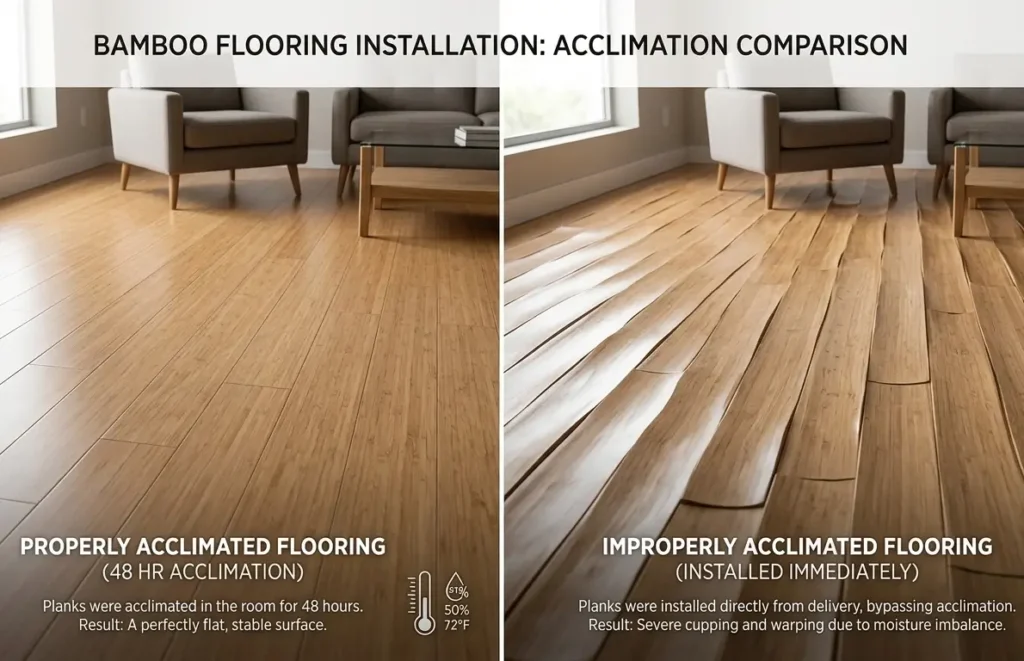
When I hired Contractor #1 back in March 2021, he quoted the job at $3.80 per square foot for installation. Reasonable rate. He showed up with proper tools. He’d been in business for 18 years. What he didn’t do was check the moisture content of my strand-woven bamboo planks against the subfloor differential. He also started installation 48 hours after delivery.
The manufacturer specified 7-14 days of acclimation. My contractor said that was “overkill” based on his hardwood experience.
Within six months, 30% of the planks had cupped. Not enough to trip over, but enough to catch light and make the floor look wavy. Repair estimate: $2,800. Warranty claim denied because installation didn’t follow manufacturer specifications.
What I learned: Bamboo’s cellular structure responds to moisture differently than traditional hardwoods. The compressed fibers in strand-woven bamboo (the most durable type, with Janka ratings of 3,000-5,000 lbf) can absorb and release moisture faster than red oak. Proper acclimation isn’t optional guidance, it’s structural necessity.
My second contractor, hired in 2022, was NWFA-certified and had installed 20+ bamboo floors. She spent the first 30 minutes of our consultation explaining why my previous installation failed. That’s when I knew I’d found someone who actually understood the material.
What to Look for in a Bamboo Flooring Contractor
The essential qualifications for a bamboo flooring contractor are: NWFA certification, documented bamboo-specific installations (minimum 10 projects), proper moisture testing equipment, and clear protocols for acclimation verification.
Here’s the hierarchy I now use when vetting contractors:
Tier 1: Non-Negotiables
- NWFA certification (or equivalent regional certification)
- Owns a pin-type AND pinless moisture meter
- Can explain the difference between strand-woven and horizontal bamboo installation requirements
- Provides written acclimation protocol before starting
Tier 2: Strong Indicators
- Has installed bamboo over radiant heat systems
- Familiar with CARB Phase 2 formaldehyde standards
- References from bamboo-specific projects (not just “hardwood”)
- Carries installation warranty separate from manufacturer warranty
Tier 3: Bonus Qualifications
- Experience with bamboo flooring subfloor preparation on concrete
- Trained by specific bamboo manufacturers (Cali Bamboo, Ambient, etc.)
- Can discuss ASTM F2170 relative humidity testing for concrete subfloors
The NWFA (National Wood Flooring Association) offers bamboo-specific training modules. When I asked my failed contractor if he’d completed any, he said bamboo was “basically hardwood” and didn’t need special training. That should have been my exit cue.
Questions That Reveal Real Bamboo Experience
I’ve developed a five-question vetting protocol based on watching both good and bad contractors work:
Question 1: “What moisture content differential do you target between bamboo planks and subfloor?”
Good answer: “Within 2-4% for strand-woven, I like to verify with both pin and pinless readings.”
Red flag: “Whatever’s standard” or “I go by feel.”
Question 2: “How long do you require for acclimation, and do you verify it?”
Good answer: “Minimum 5-7 days, but I check manufacturer specs and verify moisture content before starting. I’ve waited up to 14 days in high-humidity environments.”
Red flag: “A couple days is usually fine.”
Question 3: “What expansion gap do you leave for strand-woven bamboo?”
Good answer: “3/8 inch minimum, sometimes 1/2 inch depending on room size and HVAC consistency. Bamboo has higher expansion rates than oak.”
Red flag: “Standard 1/4 inch like any hardwood.”
Question 4: “Have you dealt with bamboo flooring callbacks, and what caused them?”
Good answer: Honesty about past issues and what they learned. Every experienced installer has stories.
Red flag: “I’ve never had any problems.” (Either lying or inexperienced.)
Question 5: “What’s the biggest mistake you see other contractors make with bamboo?”
This is the revealing question. Experienced bamboo installers have opinions about this, usually about acclimation shortcuts, improper adhesive selection, or ignoring manufacturer specifications.
Real Cost Comparison: DIY vs Contractor Installation
| Category | DIY | Contractor (Budget) | Contractor (Premium) |
| Materials (500 sq ft) | $2,750 | $2,750 | $3,500 |
| Installation Labor | $0 | $1,500 | $2,500 |
| Tool Rental/Purchase | $280 | $0 | $0 |
| Subfloor Prep | $150 | $400 | $600 |
| Underlayment | $175 | $200 | $250 |
| Trim/Transitions | $220 | $350 | $450 |
| TOTAL | $3,575 | $5,200 | $7,300 |
My actual spend on my 2023 kitchen installation: $5,840 (mid-tier contractor), $640 over my highest estimate because the subfloor needed more leveling than anticipated.
What cost guides don’t mention: The cheapest contractor quote I received in 2023 was $2.20/sq ft for installation. The NWFA-certified specialist quoted $4.50/sq ft. I initially thought the difference was just profit margin.
After my first installation failure, I understand the difference is expertise, equipment, and liability coverage. The cheaper contractor was essentially treating bamboo like laminate. The specialist spent 45 minutes on moisture mapping before quoting.
The installation cost breakdown varies significantly by region, my Pacific Northwest quotes ran 20-30% higher than national averages.
When to Hire vs When to DIY
MYTH: “Bamboo flooring always requires professional installation.”
REALITY: Click-lock (floating) bamboo installation is genuinely DIY-friendly for intermediate homeowners. Glue-down and nail-down require professional expertise for bamboo specifically.
DIY makes sense when:
- You’re installing click-lock/floating bamboo
- Subfloor is already flat and properly prepared
- Room is under 400 square feet
- You can commit to proper acclimation (not just “a few days”)
- You’re comfortable with moisture testing equipment
Hire a professional when:
- Installing strand-woven or solid bamboo requiring glue-down
- Working over concrete subfloors (moisture testing is critical)
- Room has radiant heat (compatibility requirements are strict)
- Complex room shapes requiring intricate cuts
- Commercial or high-traffic applications
I’ve done two DIY floating bamboo installations successfully after learning from my contractor failures. The third installation, strand-woven glue-down over concrete in my basement, I hired a specialist. The moisture management requirements for basements justified the professional cost.
Red Flags That Should Make You Walk Away
After four contractor experiences and conversations with three NWFA-certified installers while researching this, here are the red flags that should end the conversation:
Immediate disqualifiers:
- Dismisses acclimation as unnecessary
- Doesn’t own moisture testing equipment
- Can’t explain the difference between strand-woven and horizontal/vertical grain bamboo
- Quotes without seeing the actual subfloor
- No written warranty or refuses to warranty beyond manufacturer coverage
Serious concerns:
- Only experience is “a few” bamboo jobs
- Bundles bamboo with laminate installation rates
- Pressures you to skip acclimation period to start sooner
- Unfamiliar with your specific bamboo brand’s installation requirements
My failed contractor in 2021 hit three of these flags. I ignored them because of his general experience and positive reviews. Those reviews were for oak and maple installations. Not one mentioned bamboo.
How to Protect Yourself Contractually
Beyond vetting, your contract should specifically address bamboo-related risks.
Required contract elements:
- Acclimation verification clause: Contractor confirms in writing that moisture content was verified before installation began, with readings documented.
- Manufacturer specification compliance: Contract states installation will follow the specific bamboo manufacturer’s guidelines, not generic hardwood practices.
- Installation warranty (separate from product): Minimum 2-year workmanship warranty covering cupping, gapping, and adhesive failure.
- Moisture documentation: Before/after readings of both subfloor and bamboo planks, kept on file.
- Remediation responsibility: Clear language on who pays if installation fails within warranty period, including material replacement.
I now require all four items before signing. My 2023 contractor provided all of this without being asked. That told me as much as her answers to my vetting questions.
Frequently Asked Questions
Is NWFA certification required to install bamboo flooring?
No, NWFA certification isn’t legally required, anyone can install bamboo flooring. However, NWFA-certified installers have completed standardized training including bamboo-specific modules and passed competency assessments. After my experience with an uncertified contractor, I won’t hire non-certified installers for bamboo. The certification signals baseline knowledge about material-specific requirements.
How much more do bamboo flooring specialists charge than general contractors?
In my 2023-2024 quotes, bamboo-experienced contractors charged 40-60% more per square foot than general hardwood installers, typically $4-5/sq ft versus $2.50-3.50/sq ft for installation labor. The premium reflects specialized equipment, proper insurance coverage, and lower callback rates. My “savings” from hiring the cheaper contractor cost me $2,800 in repairs.
Should I supply my own bamboo flooring or let the contractor source it?
Both work, but understand the warranty implications. When contractors supply materials, they typically warranty the entire job. When you supply materials, contractor warranties only cover workmanship, product defects become your problem to pursue separately. I prefer supplying my own high-quality bamboo and ensuring the contractor’s workmanship warranty is robust.
Can tile or carpet installers do bamboo flooring?
Generally, no. Tile installers work with rigid, non-expanding materials, opposite of bamboo. Carpet installers lack hardwood/bamboo-specific tools and techniques. Even laminate flooring installers may underestimate bamboo’s acclimation and moisture requirements. Stick with contractors whose primary experience is hardwood or bamboo specifically.
Final Thoughts
If I were starting over on my bamboo flooring journey, I’d budget 50% more for installation than generic cost calculators suggest, specifically to afford contractors with actual bamboo experience. The material savings I chased with my first install evaporated when I paid for repairs.
My position now: for floating/click-lock installations in simple rooms, confident DIYers can succeed with proper preparation. For glue-down, concrete subfloors, or complex installations, pay for the specialist. The NWFA certification alone doesn’t guarantee expertise, but the vetting questions in this guide will reveal who actually understands bamboo versus who assumes it’s just another hardwood.
For broader context on the installation process itself, our installation guide covers what to expect before, during, and after.