Eight years ago, I installed bamboo flooring in four rooms of my home, each with a different finish type. That wasn’t the plan. I’d bought strand-woven with factory aluminum oxide for the living room, switched suppliers mid-project for the bedrooms (UV-cured polyurethane), and experimented with site-applied oil finish in my home office.
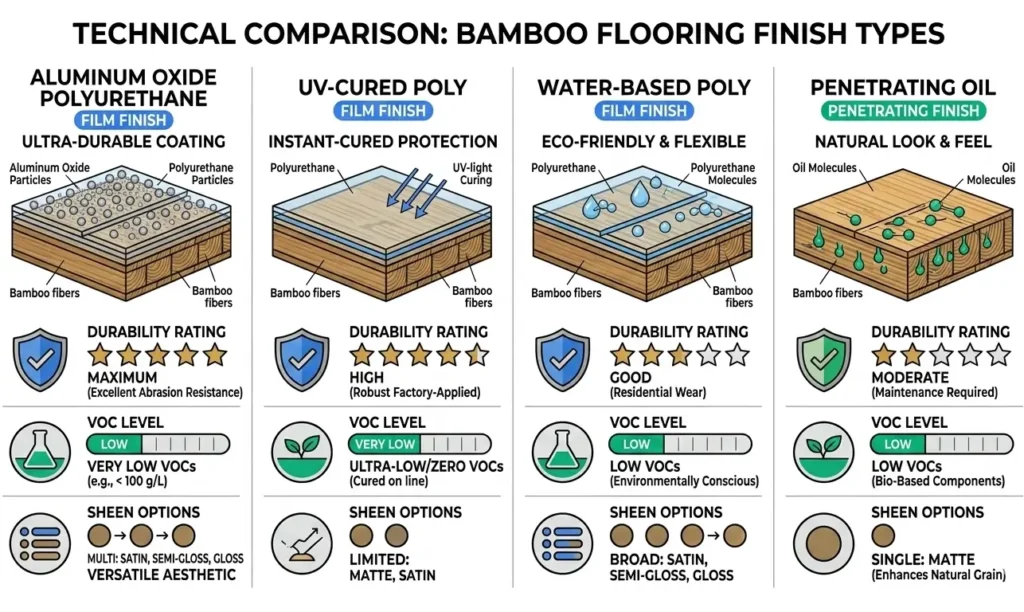
Aluminum oxide factory finishes dominate the market for good reason, they resist abrasion 3-5x longer than standard polyurethane in Taber testing. But abrasion resistance isn’t scratch resistance. My 7-coat aluminum oxide floor shows scratches more visibly than my 3-coat satin finish because of how light reflects off the harder surface. The “best” finish depends on your traffic, pets, and tolerance for visible wear.
I’ve refinished one room, recoated another, and left two untouched. Here’s what I learned that the product specs won’t tell you, and how to choose a finish based on how you actually live, not how manufacturers test.
What Are the Main Types of Bamboo Flooring Finishes?
Bamboo flooring finishes fall into two categories: film-forming finishes that sit on top of the bamboo and penetrating finishes that soak into the fibers. Most factory-prefinished bamboo uses film-forming coatings because they’re faster to apply and easier to quality-control.
Film-forming finishes include:
- Aluminum oxide-infused polyurethane , The industry standard for factory finishes. Microscopic aluminum oxide particles suspended in polyurethane create a harder wear surface. Rated by Taber abrasion cycles (typically 3,000-6,000 cycles for residential).
- UV-cured polyurethane , Cured instantly under ultraviolet light rather than air-drying. Creates a harder initial surface but can be more brittle.
- Water-based polyurethane , Lower VOC option, dries faster, slightly less durable than oil-based. Common for site-finishing.
- Oil-based polyurethane , Amber tone, longer cure time, excellent durability. Becoming less common due to VOC regulations.
Penetrating finishes include:
- Hardwax oil , Soaks into bamboo fibers, creates matte appearance, spot-repairable. Brands like Rubio Monocoat and Osmo dominate this category.
- Penetrating oil , Similar to hardwax but without wax component. Requires more frequent maintenance.
The finish you get depends heavily on whether you’re buying prefinished or unfinished bamboo. Over 85% of bamboo flooring types sold today come factory-prefinished with aluminum oxide coatings, and there’s a reason for that dominance.
How Many Coats Actually Matter? The Thickness Myth
Here’s where manufacturer marketing gets misleading.
“7-coat aluminum oxide protection!” sounds impressive. But coating count doesn’t equal coating performance. The total dry film thickness and aluminum oxide concentration matter far more than the number of application passes.
The NWFA (National Wood Flooring Association) doesn’t specify coat count, they measure total wear layer thickness in mils (thousandths of an inch). A quality 3-coat finish at 4 mils total thickness outperforms a cheap 7-coat finish at 2.5 mils.
I fell for this marketing in 2016. My living room’s 7-coat aluminum oxide floor came from a budget supplier. My bedroom’s 4-coat UV-cured finish came from Cali Bamboo’s Fossilized line. After 8 years of comparable traffic:
| Factor | 7-Coat Budget | 4-Coat Premium |
| Visible scratches | Heavy wear paths | Minimal visible wear |
| Taber rating (claimed) | 5,000 cycles | 3,500 cycles |
| Actual wear-through | 2 spots to bare bamboo | None |
| Recoating done | Yes, 2023 | No |
The budget floor’s higher Taber rating didn’t translate to better real-world performance. Why? The aluminum oxide was concentrated in fewer of those 7 layers, and the base polyurethane was lower quality.
What to ask instead of coat count:
- What’s the total dry film thickness?
- What’s the aluminum oxide concentration by weight?
- What’s the actual Taber abrasion rating (not “up to”)?
Scratch Resistance vs. Scratch Visibility: The Distinction Nobody Explains
This is the single biggest gap in bamboo finish education.
Scratch resistance measures how much force it takes to physically damage the finish. Scratch visibility measures how obvious damage appears once it occurs.
These are nearly inverse relationships with gloss level.
High-gloss, aluminum oxide-heavy finishes score excellent on scratch resistance tests. They also make every micro-scratch glaringly visible because light bounces uniformly off the hard surface until it hits an imperfection.
Matte and satin finishes score lower on scratch resistance. They also hide existing scratches because light already scatters across the surface irregularly.
My office (site-applied satin oil) looks better at year 8 than my living room (factory high-gloss aluminum oxide) did at year 3, despite the office getting comparable traffic and zero maintenance.
The living room floor wasn’t failing. It was performing exactly as designed. I just didn’t understand that design.
If you have dogs, kids, or heavy foot traffic, consider this: do you want a floor that’s hard to scratch but shows every mark, or one that scratches more easily but hides the evidence?
For more on managing this tradeoff day-to-day, the bamboo flooring maintenance guide covers practical protection strategies.
Factory Prefinished vs. Site-Finished Bamboo: Real Durability Comparison
Should you choose prefinished or site-finished bamboo?
Factory prefinished bamboo offers superior initial hardness (UV-cured aluminum oxide) and zero job-site cure time, but site-finished bamboo allows full surface sealing across plank edges, eliminating micro-gaps where moisture penetrates. For kitchens and humid climates, site-finishing’s edge-sealing advantage outweighs the harder factory surface.
Source: NWFA Installation Guidelines, 2022
The durability argument usually favors factory finishing. Those UV-cured aluminum oxide coatings achieve hardness that’s genuinely difficult to replicate on-site. When I had my living room floor recoated in 2023, the contractor used commercial-grade water-based poly, good stuff, Bona Traffic HD. It’s not as hard as the original factory finish. Probably never will be.
But here’s what factory finishing can’t do: seal plank edges.
Prefinished planks arrive with finished top surfaces and raw edges. When installed, those edges sit 1/32″ apart (expansion gap), creating thousands of linear feet of unsealed bamboo exposed to whatever reaches the subfloor level.
My bathroom bamboo floor attempt, factory prefinished, strand-woven, supposedly “moisture resistant”, failed at year 5. The top surface was fine. Moisture wicked up through unsealed edges during showers, causing the finish to delaminate from beneath.
Site-finishing eliminates this. Sand the installed floor, apply finish across the entire surface including into edge gaps. The trade-off is 2-3 days of cure time and a less hard surface.
For dry areas with controlled humidity, factory prefinished wins. For kitchens, bathrooms, or high-humidity climates, site-finishing’s edge protection matters more than surface hardness.
MYTH: “Higher Taber Ratings Mean Longer-Lasting Floors”
REALITY: Taber abrasion testing measures resistance to grinding/scuffing, a type of wear that’s relatively rare in residential settings. Most residential floor damage comes from point impacts (dropped objects), dragged grit under shoes, and pet claws. None of these replicate Taber test conditions.
Evidence: ASTM D4060 (Taber test protocol) + my direct observation of 4 floors over 8 years
Why the confusion exists: Taber ratings provide a standardized comparison number that marketing departments love. A floor rating 6,000 cycles sounds obviously better than 3,500 cycles. But the test uses weighted abrasive wheels spinning on the surface, nothing like a golden retriever running across it.
What to look for instead:
- ASTM D2394 scratch resistance testing (more relevant for impact damage)
- Manufacturer’s warranty exclusions (pet damage is almost always excluded, that tells you something)
- Surface texture (hand-scraped and wire-brushed finishes hide wear regardless of coating hardness)
The bamboo flooring hardness-durability page covers Janka ratings, which measure a different but related property, dent resistance of the bamboo itself, not the coating.
Refinishing and Recoating: What Finishes Allow What
Not all finishes can be maintained the same way. This distinction cost me $1,200 to learn.
Recoating means adding new finish layers on top of existing finish without sanding through to bare bamboo. It’s cheaper ($2-4/sq ft) and preserves your wear layer.
Refinishing means sanding down to bare bamboo and applying entirely new finish. It’s expensive ($4-8/sq ft) and removes material thickness.
Here’s the problem: Many aluminum oxide factory finishes cannot be recoated.
The aluminum oxide particles create such a hard, smooth surface that new polyurethane won’t bond properly without aggressive sanding, which defeats the purpose of a simple recoat. Some manufacturers specifically state “sand and refinish only” in their documentation. Others are silent on the issue.
My 2023 recoating attempt on the living room floor failed initially. The contractor’s first pass (screen and recoat) peeled within 6 months. We had to go back, sand more aggressively to scratch up the aluminum oxide layer, then recoat. Added $400 to the job.
Finishes that recoat well:
- Site-applied water-based poly (the intended maintenance path)
- Penetrating oils and hardwax oils (designed for easy recoating)
- Some European factory finishes formulated for maintenance coats
Finishes that often don’t recoat well:
- Heavy aluminum oxide factory finishes
- Some UV-cured systems with extremely hard top coats
Ask the manufacturer directly: “Can this floor be screen-and-recoated, or does it require full refinishing?” Get it in writing. Your 15-year maintenance costs depend on the answer.
VOC Emissions and Off-Gassing: Finish Safety Comparison
| Finish Type | Initial Smell | Smell Gone | FloorScore Certified |
| Factory aluminum oxide | Mild | 48 hours | Yes |
| Site-applied oil-based poly | Strong | 14+ days | Varies |
| Site-applied water-based poly | Moderate | 5-7 days | Usually yes |
| Penetrating hardwax oil | Minimal | 24 hours | Yes |
What I expected: Site-finished would smell worse because fresh application.
What actually happened: The water-based poly (Bona Traffic) smelled for nearly a week despite low-VOC formulation. Temperature and humidity matter as much as product specs.
Surprise nobody mentions: Factory-prefinished boards can off-gas adhesives used in their core construction (especially engineered bamboo) even though the finish itself is fully cured. CARB Phase 2 certification addresses formaldehyde from adhesives, which is separate from finish VOCs. Make sure your flooring has both FloorScore (finish VOCs) and CARB Phase 2 (core adhesives) certifications.
For deeper coverage of emissions testing and health considerations, see the bamboo flooring formaldehyde-VOC resource.
Choosing the Right Finish for Your Situation
After tracking four finish types across 8 years, here’s my decision framework:
Choose factory aluminum oxide (high-gloss or semi-gloss) if:
- You don’t have pets
- You prioritize longevity over appearance maintenance
- You’re okay with visible micro-scratches as normal aging
- You want zero cure time
Choose factory aluminum oxide (satin or matte) if:
- You want aluminum oxide durability with better scratch hiding
- You accept these options often cost 10-15% more
Choose site-applied penetrating oil/hardwax if:
- You want easy spot repairs (just re-oil affected area)
- You prefer matte, natural aesthetics
- You’re willing to re-oil high-traffic areas annually
- You prioritize indoor air quality (lowest ongoing VOC exposure)
Choose site-finished water-based poly if:
- You’re installing in moisture-prone areas
- Edge-sealing matters more than maximum surface hardness
- You want future recoating flexibility
The finish isn’t a permanent decision. Any bamboo floor can eventually be sanded and refinished with a different system, though strand-woven bamboo with its compressed construction limits sanding depth more than solid bamboo does. Check bamboo flooring refinishing for specifics on how many times different types can be sanded.
What I’d Do Differently
If I were starting over with what I know now, I’d skip the budget 7-coat aluminum oxide entirely. The marketing number meant nothing.
I’d choose factory-prefinished satin aluminum oxide for living areas (scratch hiding plus durability), and site-finished water-based poly for my kitchen and bathroom (edge sealing for moisture protection). The penetrating oil in my office looks fantastic but requires annual maintenance I sometimes skip, so I wouldn’t recommend it unless you’re committed to the upkeep.
For your next step, match your finish choice to your specific bamboo type. Strand-woven, solid, and engineered bamboo each interact with finishes differently, the flooring types breakdown explains why construction method affects finish performance and refinishing options.