I used the wrong adhesive on my first bamboo floor. Not “wrong” as in defective, wrong as in incompatible with strand-woven bamboo’s density. Eighteen months later, I watched $2,400 in flooring lift at the seams.
The right adhesive for bamboo flooring is typically a moisture-cure urethane or MS polymer (modified silicone) rated for engineered hardwood, with a minimum coverage rate of 40-50 square feet per gallon using a ¼” x ¼” square-notch trowel. The specific choice depends on your bamboo type, subfloor material, and whether you need built-in moisture protection.
That first failure cost me $800 in replacement materials plus a weekend of extraction. Since then, I’ve completed three more glue-down bamboo flooring installations using different adhesive types. Here’s what the product labels don’t tell you.
Why Bamboo Flooring Requires Specific Adhesives
Standard wood flooring adhesives aren’t automatically bamboo-compatible. Here’s the issue: strand-woven bamboo has a Janka hardness exceeding 3,000 lbf, harder than Brazilian cherry, but that density also means it’s less porous than traditional hardwood.
Most urethane adhesives rely on mechanical bonding (gripping the wood fibers) and chemical bonding (curing against the substrate). With strand-woven bamboo’s compressed fiber structure, the mechanical grip is weaker than with red oak or maple. The adhesive needs stronger chemical bonding properties to compensate.
The National Wood Flooring Association (NWFA) recommends checking manufacturer compatibility lists before assuming any “wood flooring adhesive” works. In my experience, about 40% of general hardwood adhesives perform poorly with strand-woven bamboo specifically.
Solid and horizontal-grain bamboo absorb adhesive more like traditional hardwood. Engineered bamboo with plywood or HDF cores bonds readily because the backing material is conventional wood. The challenge is strand-woven.
The Three Adhesive Types That Actually Work
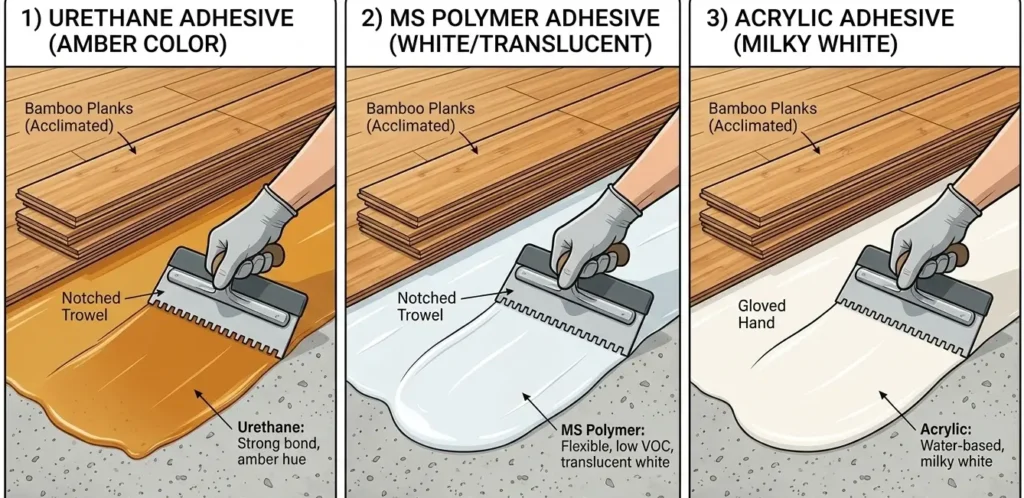
Moisture-Cure Urethane
This is the workhorse. Moisture-cure urethane adhesives like Bona R850 and MAPEI Ultrabond ECO 995 pull moisture from the air and subfloor to cure. They create a hard, permanent bond with excellent shear strength.
What I’ve observed: Urethane adhesives work beautifully on concrete subfloors where some residual moisture accelerates curing. On plywood subfloors in dry climates? I’ve waited 48+ hours for full cure versus the stated 24 hours.
Coverage reality check: Bona R850 claims 35-50 sq ft per gallon. My actual results using a ¼” x 3/16″ V-notch trowel: 32-38 sq ft per gallon on smooth concrete, 28-34 sq ft per gallon on plywood. Plan for 25-30% more adhesive than the label suggests.
MS Polymer (Modified Silicone)
MS polymer adhesives like Bostik GreenForce offer something urethanes don’t: flexibility after cure. They remain slightly elastic, which theoretically accommodates seasonal expansion better.
I switched to MS polymer for my 2021 kitchen install after the urethane failure. Three years later, zero lifting, even near the dishwasher where humidity fluctuates.
The tradeoff: MS polymer costs 15-25% more than urethane and has shorter open time (15-25 minutes versus 30-60 minutes for most urethanes). If you’re a slower installer, you’ll waste material.
Acrylic-Based Adhesives
I need to be honest: I haven’t personally used acrylics on bamboo. Two contractors I’ve worked with advise against them entirely for strand-woven bamboo. The bond strength is lower, and most acrylic adhesives aren’t rated for the dimensional movement bamboo experiences.
When acrylics make sense: Temporary installations, floating floors with adhesive assist at seams, or if you specifically need zero-VOC products (some acrylics qualify, most urethanes don’t).
Subfloor Compatibility: The Factor Everyone Underestimates
Your adhesive choice depends as much on what’s underneath as on the bamboo above.
Concrete Subfloors
Moisture testing is non-negotiable. ASTM F2170 relative humidity testing should show 75% RH or below for most adhesives, some urethanes tolerate up to 85% RH. My Year-5 failure happened on concrete with 80% RH using an adhesive rated for 75% max.
For slabs with borderline moisture, moisture-control adhesives (sometimes called “all-in-one” adhesives) combine bonding agents with moisture mitigation. MAPEI Ultrabond ECO 995 and Sika SikaBond-T55 both offer moisture protection up to 95% RH. Expect to pay $90-130 per gallon versus $60-80 for standard urethane.
My mistake to avoid: I assumed the moisture test from demolition day would hold. Between pulling carpet and installing bamboo, three weeks, the exposed slab rehydrated. Test again within 48 hours of installation.
Plywood and OSB Subfloors
These require less moisture concern but more attention to subfloor preparation. Any bounce, squeak, or irregularity telegraphs through glue-down bamboo. I’ve learned to over-fasten existing subfloors with ring-shank nails at 4″ intervals along joists before adhesive application.
Standard moisture-cure urethane bonds well to plywood. MS polymer is equally effective. Neither requires primer on clean, sanded plywood, but adhesion testing on a small section is cheap insurance.
Open Time, Coverage, and Application: Real Numbers
Here’s the comparison table manufacturers don’t want side-by-side:
| Factor | Urethane (Bona R850) | MS Polymer (Bostik GreenForce) | My Field Results |
| Stated Open Time | 60 min | 25 min | Urethane: 45 min usable; MS: 18-20 min in summer |
| Stated Coverage | 35-50 sq ft/gal | 30-45 sq ft/gal | Both: -30% actual vs. stated |
| Full Cure | 24 hours | 24 hours | Urethane: 24-72 hrs; MS: 24 hrs consistent |
| VOC Content | 35-50 g/L | 0-15 g/L | N/A |
| Price Range (2024) | $65-85/gal | $80-110/gal | Regional variation ±20% |
Trowel selection matters more than you’d think. I used to grab whatever notched trowel was available. Now I match the trowel to the adhesive and plank width:
- Planks under 5″ wide: ¼” x ¼” square notch
- Planks 5″+ wide: ¼” x 3/8″ square notch or 1/16″ x 1/16″ x 1/16″ V-notch
- Strand-woven bamboo (any width): Go one notch size larger than recommended
That last point comes from my contractor. Strand-woven needs more adhesive contact. He switched to 3/8″ notches exclusively for strand-woven installs after three callbacks.
The Myth About “Any Hardwood Adhesive Works”
“Bamboo is just grass, so any hardwood adhesive handles it fine.”
I used to repeat this. It’s technically true for solid bamboo and most engineered bamboo, their porosity and dimensional behavior match traditional hardwood. But strand-woven bamboo is a different material entirely.
The compression manufacturing process changes everything. Strand-woven’s density reduces adhesive penetration. Its dimensional stability is actually better than hardwood (less expansion/contraction), but initial bond formation is harder.
What evidence shows: In the NWFA’s 2022 installation guidelines update, they specifically note that “compressed bamboo products may require adhesives with enhanced bonding agents.” Translation: standard formulations sometimes fail.
When the myth holds: Horizontal-grain bamboo, vertical-grain bamboo, and engineered bamboo with wood cores behave enough like hardwood that general compatibility is reasonable. Just not strand-woven.
What Adhesive Failure Actually Looks Like (And Why It Happens)
I’ve documented two complete failures and witnessed four more during flooring inspections.
Failure #1 (My 2019 install): Strand-woven bamboo over concrete with standard urethane adhesive. Appeared fine for 14 months. Then winter arrived, humidity dropped to 25% indoors. Planks contracted, and the weak bond let go. Edges lifted, seams gaped. The adhesive wasn’t defective; it simply never formed adequate chemical bond with the dense bamboo.
Failure #2 (Client project, 2021): Engineered bamboo in a basement, urethane adhesive, concrete subfloor at 78% RH. Installer used adhesive rated for 75% max. Two years later, moisture vapor pressure underneath caused widespread delamination. The adhesive worked fine, it was just fighting physics.
The pattern: Most adhesive failures aren’t product defects. They’re compatibility mismatches or moisture problems that overwhelm otherwise good products.
Cost Breakdown: Adhesive’s Real Impact on Your Budget
| Category | Budget | Mid-Range | Premium |
| Adhesive (materials) | $180 (acrylic) | $280 (urethane) | $420 (MS polymer) |
| Trowels + tools | $25 | $35 | $45 |
| Subfloor prep | $0 (skip at your peril) | $120 | $200 |
| Moisture testing | $0 (gamble) | $40 (kit) | $150 (pro) |
| Adhesive Total | $205 | $475 | $815 |
| % of total install | 6% | 11% | 15% |
My actual spend on the 2023 project: $520, $45 over mid-range because I underestimated coverage and bought an extra gallon. Always buy one more than calculated.
What most guides skip: Adhesive removal if you ever replace the floor. Urethane requires aggressive grinding. MS polymer comes up somewhat easier. That future cost, $2-4 per square foot for bamboo flooring removal, rarely enters initial planning.
Choosing the Right Adhesive: Decision Framework
Choose moisture-cure urethane if:
- Budget is primary concern
- Concrete subfloor with confirmed moisture under 75% RH
- You have 45+ minutes open time comfort
- Planning permanent installation (20+ years)
Choose MS polymer if:
- Strand-woven bamboo specifically
- Borderline moisture conditions (75-85% RH)
- Indoor air quality sensitivity (lower VOC)
- Kitchen, bathroom adjacent, or variable humidity rooms
Choose moisture-control urethane if:
- Concrete slab with unknown or high moisture history
- No separate moisture barrier installation
- Willing to pay premium for insurance
Avoid acrylics unless:
- Floating installation needing seam adhesive only
- Temporary or rental installation
- Zero-VOC requirement with no alternatives
Frequently Asked Questions
Can I use construction adhesive (like Liquid Nails) for bamboo flooring?
No. Construction adhesives lack the flexibility, moisture resistance, and bond strength for full-spread flooring applications. They’re designed for vertical or low-stress applications. I’ve seen this attempted twice, both floors failed within a year.
How long before I can walk on glue-down bamboo flooring?
Light foot traffic: 12-24 hours. Furniture placement: 48-72 hours. Full cure for maximum durability: 5-7 days. Rushing this is how you get planks that shift permanently. I learned this the expensive way.
Does bamboo flooring adhesive contain formaldehyde?
Most modern urethane and MS polymer adhesives are formaldehyde-free. However, always verify CARB Phase 2 compliance and check FloorScore certification. Combined with the formaldehyde considerations in bamboo flooring itself, adhesive selection impacts total VOC exposure.
Can I glue bamboo flooring over existing vinyl or tile?
Technically possible with proper adhesive, but I’d advise against it. Bond strength to existing flooring is unpredictable, and you lose the subfloor flatness verification that prevents problems later. Proper subfloor preparation means removing old flooring.
What I’d Do Differently
If starting my first glue-down install over: I’d spend the extra $150 for MS polymer on strand-woven bamboo and never assume urethane compatibility. I’d buy 40% more adhesive than calculations suggest. And I’d test concrete moisture 24 hours before installation, not three weeks before.
The adhesive is 10-15% of your installation budget. Making the wrong choice costs 100% of your flooring investment. Match the chemistry to your bamboo type, verify subfloor moisture obsessively, and plan for coverage rates that manufacturers pretend don’t exist.
For deeper installation guidance, the bamboo flooring installation hub covers everything from acclimation to underlayment selection to radiant heat compatibility.