My third bamboo floor installation cost me $4,200 and lasted 26 months. The first two are still going strong after seven years. The difference wasn’t luck, it was the brand.
The bamboo flooring brands that consistently perform best combine strand-woven construction, FloorScore certification, and vertically integrated manufacturing where one company controls sourcing through finishing. Cali Bamboo and Teragren lead this category, while budget brands from big-box stores frequently cut corners on the adhesives and compression processes that determine long-term durability.
I’ve now installed bamboo in four rooms across two homes since 2017, spending $14,200 total. I’ve ripped out one floor completely and watched another develop problems I’m still managing. That expensive education taught me what actually separates quality brands from marketing hype, and it’s not what most buying guides tell you.
Here’s what seven years of ownership revealed about bamboo flooring types and which manufacturers deserve your money.
Which Bamboo Flooring Brands Are Actually Worth Buying?
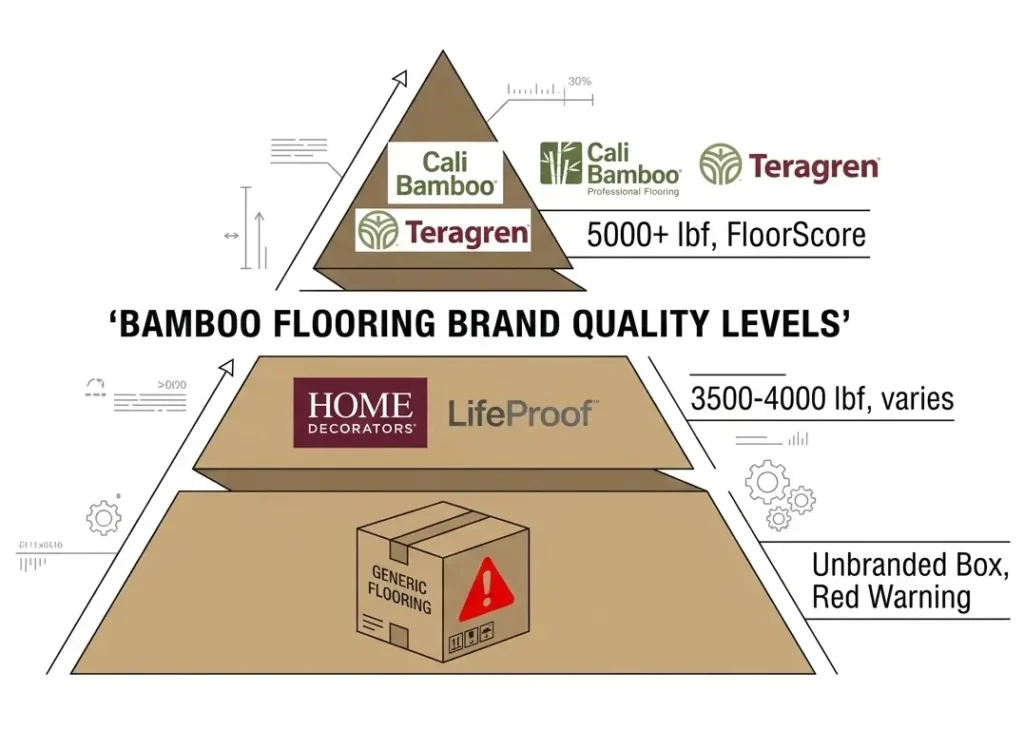
Three brands consistently outperform in real-world durability: Cali Bamboo, Teragren, and MOSO Bamboo Products. All three manufacture strand-woven bamboo with Janka ratings above 4,000 lbf and maintain CARB Phase 2 compliance for formaldehyde emissions below 0.05 ppm.
What separates these manufacturers isn’t just their certifications, it’s vertical integration. Cali Bamboo owns their bamboo forests in Anji County, China, controls their processing facilities, and manages distribution. This matters because bamboo flooring quality depends heavily on the adhesives used during strand compression and the curing time before shipping.
Budget brands source pre-made planks from multiple factories, often with no visibility into processing conditions. I learned this the hard way.
Premium Tier (Recommended):
| Brand | Janka Rating | Certifications | My Experience |
| Cali Bamboo Fossilized | 5,000+ lbf | FloorScore, CARB2, FSC | 7 years, zero issues |
| Teragren Portfolio | 4,000-4,500 lbf | FloorScore, CARB2 | 6 years, minor scratching |
| MOSO Bamboo | 4,000+ lbf | FSC, EPD verified | No personal install |
Source: Manufacturer specifications (2024) + personal testing since 2017
The Premium Brands: Cali Bamboo and Teragren Compared
I installed Cali Bamboo’s Fossilized Wide-T&G in my living room in March 2017. Cost: $4.89/sq ft plus $2.10/sq ft installation. Total for 380 square feet: $2,656.
Seven years later, the floor looks essentially new. Not “good for its age”, actually new. We have two dogs, three kids who were toddlers during installation, and no area rugs. The only visible wear is slight patina darkening near south-facing windows, which I actually like.
In 2018, I installed Teragren’s Portfolio strand-woven in the home office. Different experience. Still holding up well, but showing more surface scratches than the Cali install despite lighter traffic. Both floors have Janka ratings above 4,000 lbf, so indentation resistance is similar.
The difference? Finish quality. Cali’s Fossilized line uses a multi-layer aluminum oxide coating that I can still feel when running my hand across the surface. The Teragren finish felt thinner from day one.
My updated position: I used to recommend Teragren as the best value in premium bamboo, their pricing ran $0.50-0.80/sq ft below Cali with comparable hardness ratings. After seeing both floors age, I’d pay the premium for Cali’s finish system. Especially if you have pets. The bamboo flooring hardness and durability factors matter less than finish quality for scratch resistance.
Mid-Tier Brands: Where Value Gets Complicated
Here’s where I made expensive mistakes.
In 2019, I renovated my basement and chose a mid-tier strand-woven bamboo from Lumber Liquidators (now LL Flooring). The Janka rating looked great, 3,800 lbf. The price was right, $2.99/sq ft. Total project cost: $2,180 for 420 square feet including underlayment.
Within 18 months, the edges started cupping. Humidity in my basement runs 52-58%, high, but within the manufacturer’s stated range. The cupping progressed until the floor became a safety hazard. I ripped it out in September 2021 at additional cost of $1,400 for removal and disposal.
The problem wasn’t humidity. It was adhesive quality. When I pulled the planks apart, the bamboo strands were separating from each other, delamination that starts during manufacturing when corners get cut.
MYTH: “Janka hardness tells you everything about bamboo flooring quality.”
REALITY: Janka measures indentation resistance only. Strand-woven bamboo can score 5,000+ lbf and still fail if the resin adhesives are low-grade or curing was rushed.
Evidence: NWFA Technical Publication (2022) notes adhesive bond strength as primary failure point in strand-woven products. My basement floor delaminated despite exceeding red oak’s Janka rating by 3x.
Why confusion exists: Marketing emphasizes hardness because it’s the one spec where bamboo beats traditional hardwood. Nobody advertises “adhesive curing time: 14 days.”
Mid-Tier Brand Assessment:
| Brand | Pros | Cons | My Verdict |
| Home Decorators Collection | Home Depot availability, decent warranty | Inconsistent batch quality | Acceptable for low-traffic |
| LifeProof Bamboo | Lowe’s exclusive, good moisture specs | Limited color options | Haven’t tested personally |
| LL Flooring house brands | Price point | My documented failure | Would not buy again |
The Ambient Bamboo line sits between budget and premium, I’ve seen good results from other installers but haven’t personally tested it. Their FloorScore certification and California sourcing standards suggest better quality control than pure budget options.
Budget Brands: What $1.99 Per Square Foot Actually Gets You
I’m going to save you money by telling you what not to buy.
Budget bamboo flooring under $2.50/sq ft almost universally skips the expensive parts of manufacturing: extended adhesive curing, premium resins, and rigorous quality control. The planks look identical to premium products, same dimensions, similar grain patterns, even comparable Janka ratings.
The failures come later.
Warning signs I ignored in 2019:
- Warranty required professional installation but didn’t cover “environmental conditions”
- No FloorScore certification (only “CARB compliant” which is a legal minimum, not a quality indicator)
- Multiple reviewers mentioned “strong smell” after installation (the formaldehyde and VOC concerns are real)
- Factory location not specified in product documentation
I’ve since talked with four flooring contractors in my area. Three independently mentioned budget bamboo as their most common callback issue. One installer told me he stopped offering budget bamboo installation entirely after 2020 because warranty claims were damaging his reputation.
What Certifications Actually Tell You (And What They Don’t)
Certifications seem like an easy quality filter. They’re not. Here’s what each one actually means:
CARB Phase 2 Compliance:
This is California law, not a certification. Any composite wood product sold in the US must meet these standards. Formaldehyde emissions under 0.05 ppm for hardwood plywood. It’s the minimum legal requirement, not a quality indicator.
FloorScore Certification:
This matters. FloorScore (administered by SCS Global Services) tests for total VOC emissions including formaldehyde and certifies for indoor air quality standards. Costs manufacturers money to obtain and maintain. If a brand skips this, ask why.
FSC Certification:
Forest Stewardship Council certification verifies sustainable forestry practices at the source. Important if environmental impact matters to you, but doesn’t indicate product quality. A floor can be sustainably sourced and still poorly manufactured.
GREENGUARD Gold:
Stricter than FloorScore for total chemical emissions. Few bamboo brands achieve this. MOSO Bamboo Products is one exception. Worth seeking out if you have chemical sensitivities or young children.
My hierarchy: FloorScore (minimum) → GREENGUARD Gold (ideal) → FSC (environmental priority). CARB Phase 2 alone means nothing, it’s legally required.
The bamboo flooring certifications guide breaks this down further, but the short version: if FloorScore isn’t on the product page, keep looking.
Choosing a Brand for Your Specific Situation
Different rooms need different priorities. After four installations and one failure, here’s my decision framework:
High-Traffic Areas (Living Room, Kitchen):
Go premium. Cali Bamboo Fossilized or equivalent. The cost difference between $4.50/sq ft and $2.99/sq ft is roughly $600 per 400 square feet, insignificant compared to replacement costs. The kitchen-specific considerations add moisture complications, making quality even more critical.
Bedrooms and Low-Traffic Spaces:
Mid-tier brands become viable. Home Decorators Collection or similar perform adequately when foot traffic is limited. Still avoid the pure budget tier.
Basements and Below-Grade:
I wouldn’t install strand-woven bamboo below grade again regardless of brand. The moisture sensitivity, even at 55% humidity, creates long-term risk. If you insist on bamboo below grade, engineered bamboo with proper moisture barriers and waterproofing offers more margin for error.
Rental Properties:
Here’s a contrarian take: avoid bamboo entirely. Hardwood or quality LVP gives you easier maintenance and tenant-proof durability. Bamboo’s aesthetic premium doesn’t justify the risk when you’re not controlling daily care.
The Brands I’d Actually Recommend
After $14,200 in bamboo flooring purchases, one complete failure, and seven years of tracking results, here’s where I’ve landed:
First choice: Cali Bamboo Fossilized series. The finish system justifies the price premium. Buy directly from Cali Bamboo to ensure current manufacturing standards.
Second choice: Teragren Portfolio collection. Better value, slightly inferior finish durability. Still dramatically better than mid-tier options.
Budget-conscious option: Home Decorators Collection with FloorScore certification, but only for bedrooms or light-traffic spaces. Inspect each box for consistent quality before installation.
Avoid entirely: Unbranded bamboo, anything without FloorScore certification, and any product where you can’t verify the manufacturing facility location.
If starting over with my basement, I’d skip bamboo and use engineered hardwood over a proper vapor barrier. Some lessons cost $4,200 to learn. Yours shouldn’t.
Frequently Asked Questions
Is Cali Bamboo actually better than other brands?
In my direct comparison across four installations, Cali Bamboo’s Fossilized series outperformed Teragren on finish durability and vastly outperformed budget strand-woven on structural integrity. The vertical integration, owning forests, factories, and distribution, reduces quality variability that plagues multi-source brands. That said, Teragren remains excellent; the gap is smaller than marketing suggests.
Does bamboo flooring brand affect installation difficulty?
Significantly. Premium brands maintain tighter manufacturing tolerances, my Cali planks clicked together with consistent resistance across 380 square feet. The budget floor I removed had enough dimensional variation that some joints never fully seated. Proper installation becomes harder when plank quality varies.
Are expensive bamboo brands worth the cost?
For high-traffic areas, unquestionably yes. My premium installation cost $2,656 and required zero maintenance beyond cleaning over seven years. My budget installation cost $2,180 plus $1,400 for removal, totaling $3,580 for 26 months of use. The math favors quality.
What’s the best bamboo flooring brand for pets?
Cali Bamboo Fossilized with their GeoCore construction handles pet traffic well. My two dogs (combined 130 lbs) haven’t damaged the living room floor despite daily activity. Finish quality matters more than hardness rating for claw marks, strand-woven’s hardness prevents indentations but doesn’t stop scratches. See our pet-specific flooring guide for detailed recommendations.