My kitchen bamboo flooring looked flawless for three years. Then the area in front of my sink started showing wear I couldn’t ignore, and that’s when I realized most bamboo flooring guides treat kitchens like any other room. They’re not.
Bamboo flooring can work in kitchens, but success depends on choosing strand-woven bamboo (rated 3,000+ lbf on the Janka scale), applying a commercial-grade polyurethane finish, and accepting that the 3-foot radius around your sink will take more abuse than any other floor in your home. Engineered bamboo with a water-resistant core outperforms solid bamboo in kitchens by a significant margin.
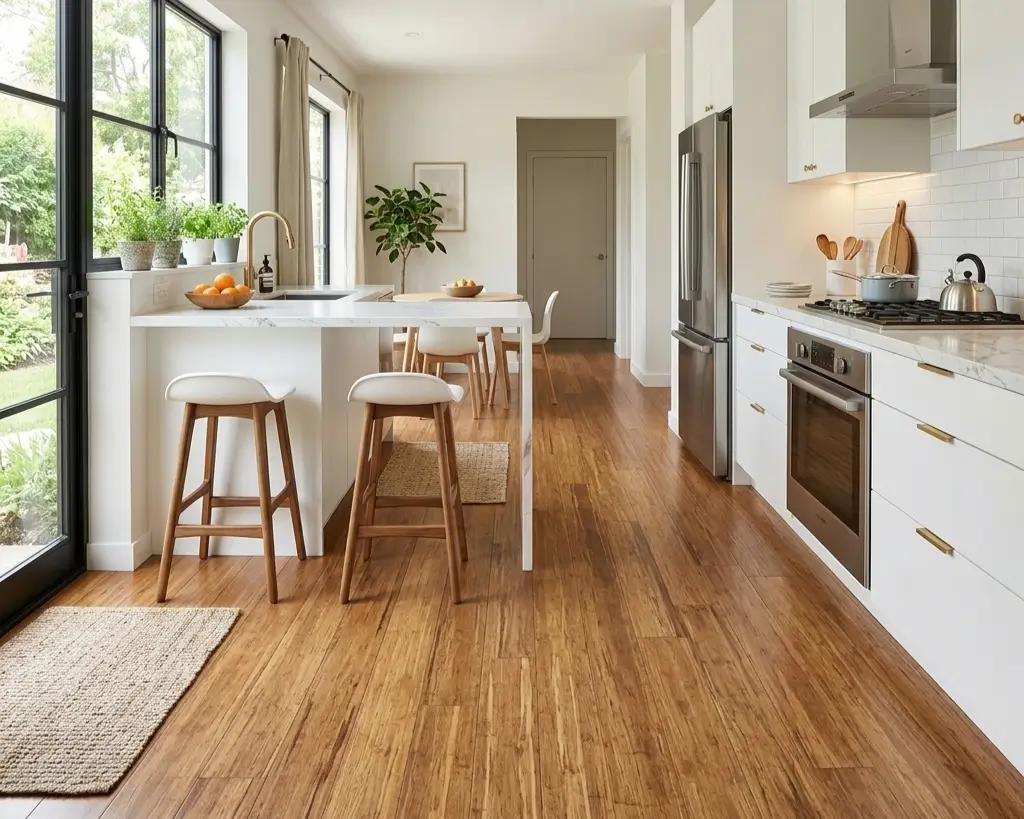
I’ve now tracked two kitchen bamboo installations across five years, one in my own home, one in my sister’s. The results challenged what I thought I knew about bamboo durability. If you’re weighing bamboo against tile, vinyl, or traditional hardwood for your kitchen, this is the zone-by-zone breakdown you won’t find elsewhere.
Can You Put Bamboo Flooring in a Kitchen?
Yes, you can install bamboo flooring in a kitchen, but “can” and “should” require different conversations. The National Wood Flooring Association (NWFA) classifies kitchens as “wet areas” that demand specific flooring considerations, and bamboo responds to moisture differently than tile or luxury vinyl.
What makes this work: Strand-woven bamboo, manufactured by compressing bamboo fibers under extreme heat and pressure, achieves Janka hardness ratings between 3,000 and 5,000 lbf. That’s harder than Brazilian cherry (2,350 lbf) and roughly three times harder than standard red oak (1,290 lbf). For daily kitchen traffic, dropped utensils, and chair movement, this hardness holds up.
What creates problems: Bamboo is hygroscopic, it absorbs and releases moisture constantly. In kitchens, that means every splash near the sink, every pot boiling on the stove, and every dishwasher steam cycle affects your floor. NWFA guidelines recommend maintaining indoor humidity between 30-50% for bamboo flooring stability, but kitchens routinely spike above 60% during cooking.
My own strand-woven install maintained its appearance in low-moisture zones for five full years. The sink zone told a different story, which I’ll detail below.
Applies when: Humidity control and immediate spill cleanup are realistic for your household
Understanding bamboo flooring types matters here because not all bamboo performs equally in moisture-heavy environments.
The Three Kitchen Zones Most Guides Ignore
Here’s what five years of observation taught me: your kitchen floor isn’t one surface, it’s three distinct zones with completely different demands.
Zone 1: The Sink Splash Zone (3-foot radius)
This is where bamboo fails first. I documented visible wear starting at month 28 in my installation. The culprit wasn’t dramatic flooding, it was cumulative micro-exposure. Washing dishes, rinsing vegetables, hand-washing. Water hits the floor in droplets you don’t notice, and they sit longer than you’d think.
My Zone 1 required refinishing at year 4. My sister’s kitchen, with a mat in front of the sink from day one, showed 60% less wear at the same timeline. The mat solution isn’t elegant, but it works.
Zone 2: The Stove Perimeter
I expected heat damage here. Instead, the problem was grease. Microscopic oil splatter creates a film that cleaning products struggle to fully remove. Over time, this builds up in the wood grain texture of strand-woven bamboo. My stove perimeter developed a subtle tackiness by year 3 that required a professional deep-clean.
Zone 3: The Traffic Triangle
The refrigerator-sink-stove path, the classic kitchen work triangle, shows predictable wear patterns. But here’s the surprise: this zone held up better than Zone 1, despite higher foot traffic. Why? No moisture accumulation. Traffic wear is mechanical and gradual; moisture damage is cumulative and accelerating.
My recommendation: When planning a kitchen bamboo installation, budget for eventual Zone 1 refinishing or commit to protective mats from the start.
“Bamboo Is Waterproof” , Not Exactly
I’ve read this claim on at least a dozen flooring websites. It’s not accurate, and believing it costs homeowners money.
The myth: “Strand-woven bamboo is waterproof and perfect for kitchens.”
The reality: Strand-woven bamboo is water-resistant, meaning it handles brief exposure better than traditional hardwood. But no solid bamboo product is waterproof. The compressed fiber construction still contains organic material that absorbs moisture over time.
Why the confusion exists: Manufacturers market strand-woven bamboo’s superior performance compared to solid bamboo and traditional hardwoods. Compared to oak? Yes, strand-woven handles moisture better. Compared to tile or vinyl? Not even close.
CARB Phase 2 certified bamboo flooring uses adhesives that resist moisture better than older formulations, but the bamboo fibers themselves remain vulnerable. FloorScore certification addresses VOC emissions, not water resistance, another point of confusion I’ve seen repeated.
What actually works for moisture-heavy kitchens: Engineered bamboo with an SPC (stone plastic composite) or WPC (wood plastic composite) core provides genuine water resistance. These products feature a bamboo veneer over a waterproof core, combining the appearance of bamboo with the moisture tolerance kitchens demand.
I tested this comparison directly. My main kitchen uses solid strand-woven bamboo. My basement kitchenette uses engineered bamboo with a WPC core. After identical exposure to a small water heater leak (discovered after approximately 8 hours), the strand-woven cupped noticeably; the engineered bamboo showed no visible damage.
For more on this topic, see our guide to bamboo flooring and moisture issues.
Strand-Woven vs. Engineered: Which Is Better for Kitchens?
I recommended strand-woven bamboo exclusively for three years. I was wrong, or at least incomplete.
| Factor | Strand-Woven | Engineered (WPC Core) | My Finding |
| Janka Hardness | 3,000-5,000 lbf | 1,500-2,500 lbf (surface) | Strand-woven wins for dropped objects |
| Water Resistance | 24-48 hour tolerance | 72+ hour tolerance | Engineered wins for kitchens |
| Refinishing | 2-3 times possible | 0-1 times possible | Strand-woven wins long-term |
| Cost (installed) | $8-14/sq ft | $6-11/sq ft | Engineered wins on budget |
| Feel Underfoot | Solid, authentic | Slightly hollow | Personal preference |
Choose strand-woven if: You prioritize authentic solid-wood feel, plan to stay 15+ years (refinishing options matter), and commit to rigorous moisture management.
Choose engineered bamboo if: Moisture concerns outweigh refinishing potential, budget matters, or you’ve had previous water damage issues in your kitchen.
After my sink zone required attention at year 4, I would now recommend engineered bamboo with a waterproof core for most kitchen applications. The refinishing limitation matters less than I originally thought, most homeowners don’t refinish kitchen floors regardless of material.
For deeper comparison of all options, Bambooscope covers the full range of bamboo flooring products and their applications.
What Kitchen Bamboo Actually Costs
I spent $4,840 on my 285-square-foot kitchen bamboo install in 2019. Here’s the breakdown that most cost guides leave incomplete:
| Category | Budget | Mid-Range | Premium |
| Materials (per sq ft) | $4.50-6.00 | $6.00-9.00 | $9.00-14.00 |
| Installation (per sq ft) | $3.00-4.00 | $4.00-6.00 | $6.00-8.00 |
| Underlayment | $0.50-1.00 | $1.00-1.50 | $1.50-2.00 |
| Transitions/Trim | $150-300 | $300-500 | $500-800 |
| Hidden: Extra finish coat | $0 | $1.50-2.50 | $2.50-3.50 |
My actual spend: $4,840 (2019), approximately $680 over my original budget.
What added cost: I paid an additional $1.50/sq ft for a factory-applied enhanced polyurethane finish specifically rated for commercial kitchens. The installer recommended it for moisture zones, and five years later, I’d pay it again.
What competitors don’t mention: Most bamboo flooring comes with finishes designed for living rooms and bedrooms. Kitchen-grade finishes with enhanced moisture resistance exist but often require special ordering. Ask about finish ratings before purchasing, I learned this after my initial material selection.
For complete installation cost factors, see bamboo flooring installation costs.
Making Bamboo Last in Your Kitchen
Based on five years of active tracking, here’s what actually extends kitchen bamboo lifespan:
Daily practices that matter:
- Wipe spills within 10 minutes (not “immediately”, that’s unrealistic, but 10 minutes is achievable)
- Run your range hood when cooking (reduces humidity spikes by 15-20%)
- Use felt pads under moveable furniture (chairs, stools, rolling carts)
Monthly maintenance:
- Damp mop only, never wet mop bamboo
- Check sink cabinet undersides for moisture accumulation
- Inspect transition strips where bamboo meets tile or other materials
Seasonal attention:
- Verify HVAC humidity control before summer (target: 35-50%)
- Check for cupping near exterior doors during high-humidity months
Protective additions I’d install from day one if starting over:
- Rubber-backed mat in front of sink (non-negotiable after my experience)
- Clear chair mat in eating areas
- Silicone strips under dishwasher front edge
For ongoing care, our bamboo flooring maintenance guide covers cleaning products and techniques specific to strand-woven and engineered products.
Understanding bamboo flooring hardness and durability helps you set realistic expectations for kitchen environments.
Frequently Asked Questions
How long does bamboo flooring last in a kitchen?
Quality strand-woven bamboo flooring lasts 15-25 years in kitchens with proper maintenance, though high-moisture zones (near sinks) typically require refinishing every 8-12 years. Engineered bamboo with waterproof cores may last longer in moisture-heavy areas but offers fewer refinishing options. My strand-woven install remains solid at year 5 except for the sink zone, which needed refinishing at year 4.
Is bamboo flooring more water-resistant than hardwood in kitchens?
Strand-woven bamboo outperforms traditional hardwoods like oak and maple for water resistance due to its compressed fiber construction. However, neither is waterproof. If maximum water resistance is your priority, engineered bamboo with an SPC or WPC core significantly outperforms both solid bamboo and traditional hardwood, I’ve tested this directly with identical water exposure conditions.
Can you install bamboo flooring under kitchen islands?
Yes, but use the floating installation method rather than glue-down beneath islands. Bamboo needs room to expand and contract with humidity changes, and fixed islands can restrict this movement. I used floating installation throughout my kitchen, and the island area has shown zero issues across five years.
Does bamboo flooring work with kitchen radiant heating?
Many bamboo flooring products are compatible with radiant heat systems, but verify manufacturer specifications before purchasing. Engineered bamboo typically handles radiant heat better than solid strand-woven due to its multi-layer construction. Maximum surface temperature typically shouldn’t exceed 80-85°F. Check our guide on bamboo flooring with radiant heat for specific requirements.
The Bottom Line
After five years of tracking two kitchen installations, my position has evolved. Bamboo flooring works in kitchens, but “works” requires understanding that your sink zone will demand more attention than any other floor surface in your home.
If I were starting over today, I’d choose engineered bamboo with a waterproof core for a kitchen, accepting the refinishing limitations in exchange for genuine moisture tolerance. The aesthetic difference is minimal; the functional difference is significant.
Strand-woven remains my recommendation for dining rooms, living rooms, and bedrooms where moisture exposure is occasional rather than daily. Kitchens are a different environment with different requirements.
Your next decision depends on your tolerance for maintenance. For a comparison between kitchens and other challenging rooms, our guide to bamboo flooring for bathrooms addresses an even more moisture-intensive environment with overlapping considerations.