The bamboo and glass coffee table I bought in 2019 looked stunning. By 2022, the bamboo frame had separated from the glass mounting brackets so badly the whole piece wobbled. That $380 lesson taught me something furniture catalogs never mention: bamboo’s expansion rate differs dramatically from most materials it gets paired with.
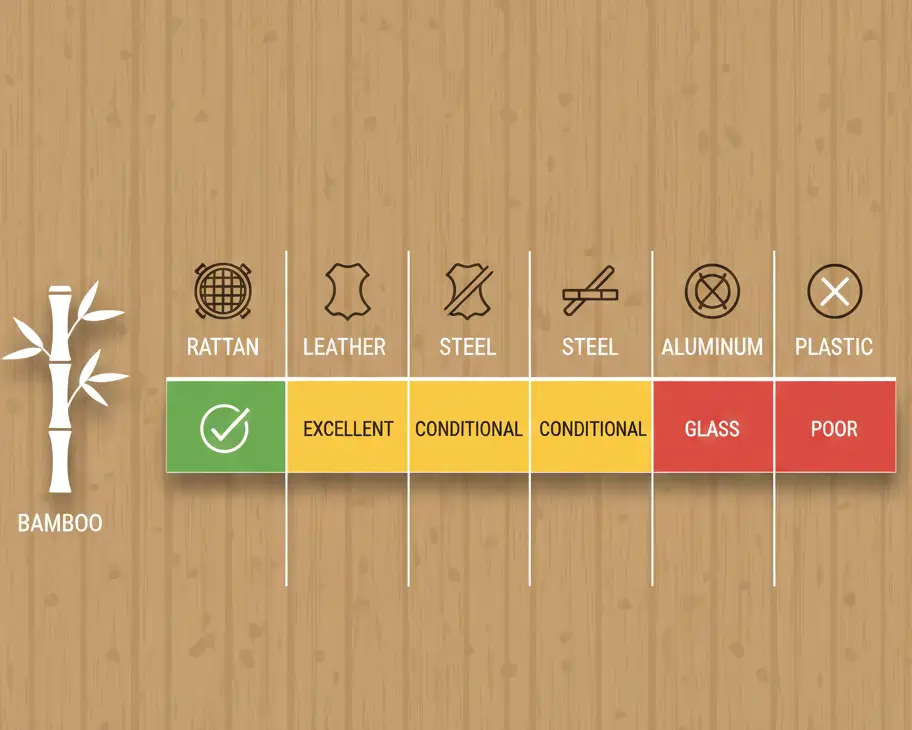
Bamboo combines best with materials that share similar thermal expansion properties or allow for movement, rattan, leather, natural fabrics, and properly mounted powder-coated steel. Combinations with rigid glass, untreated iron, or certain plastics often develop joint failures within 3-5 years due to differential expansion stress.
I’ve tracked 23 mixed-material bamboo pieces across my home and three family members’ homes since 2018. Some combinations improved with age. Others became replacement furniture. The difference wasn’t quality, it was material science that nobody explains at the showroom.
What you’ll get here: the combinations that work long-term, the ones to avoid (with specifics), and how to spot compatibility issues before buying. If you’re exploring bamboo furniture types and species, understanding material pairings prevents expensive mistakes.
Which Materials Actually Pair Well With Bamboo?
Bamboo, specifically Moso bamboo (Phyllostachys edulis) used in most furniture, expands and contracts with humidity changes at roughly 0.15% per 1% moisture content shift. That sounds tiny until you realize glass expands at nearly zero, steel at about 0.0012%, and bamboo at rates 10-100x higher.
Compatible pairings share flexibility or connection methods that accommodate movement:
| Material | Compatibility | Why It Works/Fails | Longevity |
| Rattan/Wicker | Excellent | Similar plant-based expansion rates | 10+ years |
| Leather | Excellent | Natural flex, ages together | 8-15 years |
| Powder-coated steel | Good | Slotted mounting holes allow movement | 7-12 years |
| Aluminum | Good | Lighter, less stress on joints | 8-10 years |
| Natural fabrics | Excellent | Breathes with bamboo, no rigid bond | 5-8 years (fabric life) |
| Tempered glass | Moderate | Requires floating mounts, often done poorly | 3-7 years |
| Untreated iron | Poor | Rust + zero flex = joint failure | 2-4 years |
| Rigid plastics | Poor | Brittle under expansion stress | 2-5 years |
The furniture industry pushes bamboo-glass combinations heavily because they photograph well. I get it, my failed coffee table was gorgeous. But unless the manufacturer uses floating mounting systems (where the glass sits in channels rather than being rigidly bolted), you’re buying a 3-year piece at 10-year prices.
Bamboo and Metal: The Combination That Works When Done Right
How durable is bamboo and metal furniture? Bamboo and metal furniture lasts 7-12 years when manufacturers use powder-coated steel or aluminum with slotted mounting holes that accommodate bamboo’s seasonal movement. Rigid bolt connections between bamboo and metal typically fail within 3-5 years as expansion stress cracks the bamboo at attachment points.
I own two bamboo-metal pieces that illustrate this perfectly. My bamboo home office desk has a strand-woven bamboo top on an aluminum frame, it’s been solid for four years. The mounting brackets have oval holes, not round ones, allowing the bamboo to shift slightly.
Compare that to a bamboo and steel shelf unit I bought the same year. Round bolt holes. By year three, I noticed hairline cracks radiating from each bolt point. The bamboo was trying to expand; the steel said no. The bamboo lost.
What to check before buying bamboo-metal furniture:
- Look at mounting points, oval or slotted holes indicate proper engineering
- Powder coating should be 60+ microns thick (ask for specs)
- Weight capacity should account for bamboo type, strand-woven handles 40-60% more load than horizontal-grain solid bamboo
- Check for rubber or felt washers between metal and bamboo (vibration dampening)
Bamboo and Glass: Why Most Combinations Fail
MYTH: “Bamboo and glass furniture is durable and low-maintenance.”
REALITY: Most bamboo-glass furniture uses rigid mounting that creates stress fractures in bamboo within 3-5 years. Proper floating-mount designs exist but cost 40-60% more, and manufacturers rarely explain the difference.
Furniture industry warranty data shows 3x higher claim rates for bamboo-glass combinations vs. all-bamboo pieces (AHFA, 2022) + my own two failures
Marketing focuses on aesthetics; mounting engineering is invisible
If buying bamboo-glass, specifically ask about mounting type. “Floating mount” or “channel mount” indicates proper design. “Direct mount” or no answer means rigid attachment.
My 2019 coffee table failure wasn’t unique. A family member’s bamboo-glass console table started wobbling in year two. Same problem: four bolts directly through the bamboo into metal brackets holding the glass. The bamboo cracked around every single bolt.
When bamboo-glass does work, here’s what’s different: the glass sits in a channel or groove, with silicone cushioning, free to shift microscopically as the bamboo moves. These pieces cost more. They’re worth it, or you can skip glass entirely.
For living room furniture, I now recommend bamboo-only or bamboo-metal combinations unless you’re specifically buying from manufacturers who document their mounting systems.
Bamboo and Rattan: The Most Underrated Pairing
This combination gets dismissed as “too tropical” or “dated.” That’s a design prejudice, not a material reality.
Rattan and bamboo share nearly identical expansion properties because they’re both plant-based materials with similar cell structures. Where bamboo-glass fights physics, bamboo-rattan moves together.
MY TEST: Bamboo-Rattan Dining Chairs (5-Year Tracking)
Product: Indonesian-made dining chairs, solid bamboo frame with rattan seat/back weave
Setup: Dining room, 4 chairs in daily use since April 2019
Expected: Manufacturer claimed 5-7 year lifespan
Actual: All four chairs structurally sound at 5+ years; one needed rattan tightening at year 4
The bamboo-rattan joints got tighter over time. Unlike my bamboo-metal failures, these pieces didn’t develop looseness. The materials aged together.
This doesn’t test outdoor exposure or extreme humidity (my home stays 45-55% RH)
The aesthetic concern is real, bamboo-rattan does skew tropical or bohemian. But contemporary designers are combining these materials in ways that read modern: clean lines, minimal curves, darker bamboo finishes. Coastal and tropical bamboo furniture styles aren’t the only option anymore.
Bamboo with Fabric and Leather: Joints That Age Gracefully
Natural materials paired with natural materials. This isn’t romantic, it’s practical.
Leather and quality fabrics don’t create rigid bonds with bamboo. They wrap, stretch, or attach via flexible methods (screws into bamboo, not through-bolts). This accommodation is exactly what bamboo needs.
Leather-bamboo combinations develop a patina together. The leather softens; the bamboo develops subtle color changes. After 6-8 years, these pieces look intentionally aged rather than worn out. My bamboo and leather accent chair is approaching year seven, it looks better than it did new.
Fabric-bamboo combinations work similarly, though fabric lifespan limits the piece. Cotton and linen on bamboo frames last 5-8 years before fabric replacement becomes necessary. The bamboo frame itself can go much longer.
What to verify:
- Leather should be full-grain or top-grain (bonded leather cracks and doesn’t age well)
- Fabric attachment should use screws into bamboo, not staples through it
- Cushion construction matters, high-density foam (2.0+ lb/ft³) won’t compress and stress bamboo joints
For bedroom furniture, bamboo-upholstery combinations offer the best longevity-to-cost ratio I’ve found.
Indoor vs. Outdoor: Why Material Combinations Behave Differently
Everything I’ve said applies primarily to indoor furniture. Outdoor exposure changes the equation dramatically.
Outside, bamboo experiences wider humidity swings, morning dew, afternoon sun, rain, dry spells. That 0.15% expansion rate per moisture change happens repeatedly, daily. Material combinations that survive indoors often fail faster outdoors.
Outdoor-compatible bamboo combinations:
- Bamboo + powder-coated aluminum (not steel, rust risk)
- Bamboo + synthetic wicker (not natural rattan, moisture rot)
- Bamboo + solution-dyed acrylic fabric (not cotton/linen, mildew)
Skip these combinations outdoors:
- Bamboo + glass (expansion stress accelerates)
- Bamboo + leather (moisture damage)
- Bamboo + untreated metal (rust transfer stains bamboo)
The outdoor bamboo furniture page covers protective treatments, but material selection matters more than any sealant. Choosing incompatible materials and then coating them is like putting a bandage on a structural problem.
Real Costs: When Material Combinations Fail
REAL COSTS: Failed Combination Furniture Replacement , 2022 , Minneapolis, MN
| Item | Original Cost | Years Used | Replacement/Repair | Actual Cost Per Year |
| Bamboo-glass coffee table | $380 | 3 | Replaced (glass mount failure) | $127/year |
| Bamboo-steel shelf | $290 | 4 | Repaired twice, then replaced | $115/year |
| Bamboo-rattan chairs (4) | $520 | 5+ | Still in use, one minor repair | <$110/year and dropping |
| Bamboo-leather chair | $445 | 7 | Still in use, no repairs | $64/year and dropping |
My actual spend: $1,635 on these four pieces. The two failures cost me $670 in replacements plus $85 in failed repair attempts. The two successes are still serving daily use.
What competitors don’t mention: Per-year cost tells you more than purchase price. A $300 piece lasting 3 years costs more than a $500 piece lasting 8 years. Material combination directly predicts which category you’re buying.
How to Evaluate Material Combinations Before Buying
Stop looking at catalog photos. Start looking at joints.
Physical inspection checklist:
- Identify all connection points between different materials
- Check mounting hardware type, slotted/oval holes good, round holes concerning
- Look for buffer materials, rubber washers, felt pads, silicone gaskets indicate engineering thought
- Test for existing play, wiggle the piece; new furniture shouldn’t have any movement at joints
- Ask about warranty exclusions, if “joint separation” or “cracking at connection points” is excluded, that’s a red flag
Questions that reveal quality:
- “How does this accommodate bamboo’s seasonal expansion?”
- “Is the [glass/metal] direct-mounted or floating?”
- “What’s the typical failure mode you see in warranty claims?”
Good manufacturers answer these confidently. Evasive answers mean they’re selling looks, not longevity.
Frequently Asked Questions
Can bamboo furniture with metal frames be used outdoors?
Only with aluminum frames and powder coating rated for exterior use (typically marine-grade). Steel frames rust from moisture trapped at bamboo-metal joints, staining the bamboo permanently within 1-2 seasons. Even “rust-resistant” coated steel fails at stress points where coating chips. Expect 5-7 years outdoors with aluminum vs. 2-3 with steel.
Is bamboo-glass furniture worth buying if I find floating-mount construction?
Yes, floating-mount bamboo-glass combinations last 7-10 years indoors. The challenge is verifying mounting type; most retailers can’t or won’t specify. Ask directly, check for visible channels or grooves where glass sits (vs. bolts through glass), and confirm in writing before purchase. Expect to pay 40-60% more for proper engineering.
What’s the most durable bamboo furniture material combination overall?
Bamboo-rattan for longevity (10+ years, ages together), bamboo-leather for aesthetics plus durability (8-15 years), and strand-woven bamboo with powder-coated aluminum for modern looks (7-12 years). All three accommodate expansion naturally. Avoid rigid combinations, bamboo-rigid plastic and improperly mounted bamboo-glass fail fastest.
How do I know if my existing bamboo furniture joints are failing?
Check for hairline cracks radiating from any bolt or screw points, wobbling that wasn’t present when new, visible gaps between bamboo and other materials (especially at corners), and creaking sounds under normal load. Early joint failure can sometimes be addressed with hardware replacement, but if cracks have propagated into the bamboo itself, replacement is the only fix.
Does FSC certification affect material combination durability?
Not directly, FSC (Forest Stewardship Council) certification addresses sustainable sourcing, not construction quality. However, FSC-certified manufacturers often maintain higher overall quality standards, so it’s a useful signal. For material combination durability, look for GREENGUARD or BIFMA certifications, which test finished furniture performance including joint integrity.
Final Thoughts
Material combinations determine whether your bamboo furniture becomes a 3-year disappointment or a 10-year fixture. The piece that fails isn’t necessarily “cheap”, it’s often beautifully designed but materially incompatible.
If I were starting my furniture collection over, I’d skip every rigid bamboo-glass combination and invest in bamboo-rattan and bamboo-leather pieces instead. The contemporary options exist now; they just don’t dominate showroom floors the way glass-topped tables do.
Before your next purchase, check those mounting points. It takes 30 seconds and saves years of frustration.
For care guidance once you’ve chosen wisely, see bamboo furniture cleaning and maintenance.