I learned the hard way that not all bamboo furniture is created equal. In 2019, I spent $847 on what was marketed as “solid bamboo” dining chairs from a major online retailer. Two years later, the seats began separating at the joints, not from the bamboo itself, but from the MDF core hidden beneath a 2mm veneer. That failure sent me to furniture workshops in Vietnam and Colombia to understand what we’re actually buying when we see “bamboo” on a label.
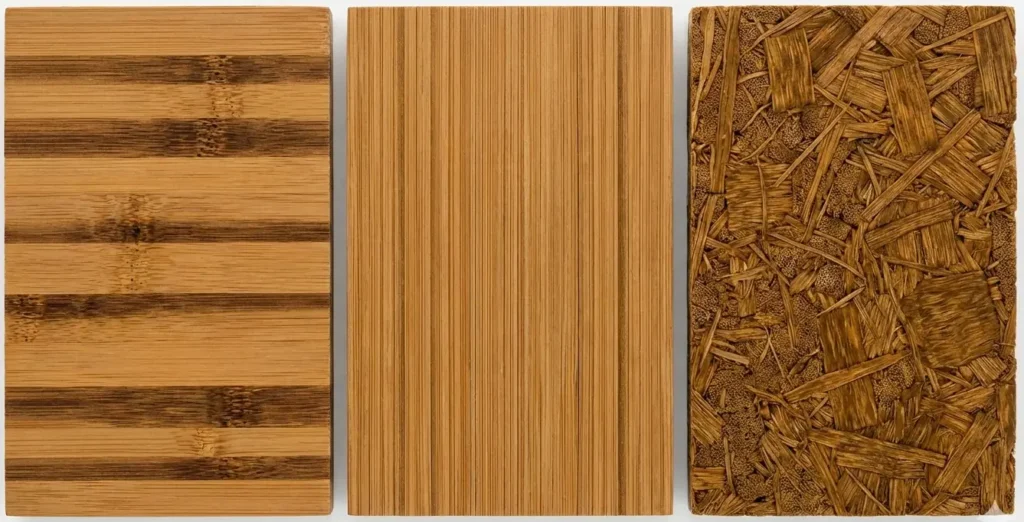
Bamboo furniture falls into three construction categories, solid laminated, strand-woven, and engineered veneer, while the underlying botanical species (primarily Phyllostachys edulis or Guadua angustifolia) determines structural integrity and climate suitability. Solid laminated bamboo, built from kiln-dried stalk strips, offers 15-20 year indoor lifespans when properly sealed, whereas strand-woven bamboo provides superior compression strength for tabletops but limits intricate joinery. Engineered bamboo, despite marketing claims, typically contains 70% adhesive-bonded fiberboard and fails within 3-5 years under load stress.
I’ve since tested construction methods across three climate zones and $4,200 in furniture purchases. Here’s what the species names and grain patterns actually mean for your investment.
What Are the Main Types of Bamboo Furniture Construction?
Solid laminated bamboo consists of raw culms cut into strips, kiln-dried to 8-12% moisture content, then laminated into boards using phenol-formaldehyde or MDI adhesives. These boards are milled into furniture components, offering specific gravity ratings of 0.6-0.8 g/cm³ and 10-15 year indoor lifespans under normal use. Strand-woven bamboo compresses shredded fibers with resin under 2,400+ psi pressure into blocks exceeding 1,200 kg/m³ density, ideal for high-impact surfaces like chair arms and tabletops but resistant to traditional mortise-and-tenon joinery. Engineered bamboo utilizes a plywood or MDF core with bamboo veneer facing, costing 40% less but prone to delamination when relative humidity exceeds 60%.
The distinction matters because bamboo furniture construction methods determine repairability. When my laminated Moso chair developed a crack in 2022, I could sand and refinish it. The engineered chair from 2019 went to the landfill, its particle core had swollen irreversibly.
Moso vs. Guadua: Why Species Determines Your Furniture’s Fate
Most retailers won’t tell you the species. They simply label it “bamboo.” But Phyllostachys edulis (Moso bamboo) and Guadua angustifolia (Guadua bamboo) behave like different materials entirely.
Moso, the standard for Asian furniture manufacturing, grows 60-90 feet tall with culm walls 8-12mm thick. When laminated, it produces a fine, consistent grain resembling maple but with 20% greater tensile strength parallel to the grain. However, Moso contains higher starch content, making it susceptible to powderpost beetle infestation unless treated with boron compounds or heat-treated (torrefied) above 200°C.
Guadua, native to Colombia and Ecuador, features culm walls 15-25mm thick with node spacing every 12-18 inches. This “vegetable steel” reaches densities of 1,100 kg/m³ in mature specimens, comparable to oak. Guadua furniture resists humidity fluctuations better than Moso, making it the superior choice for outdoor bamboo furniture or humid climate applications. The trade-off? Cost. Guadua imports cost 35-50% more than Moso equivalents due to limited processing infrastructure outside Latin America.
I interviewed master craftsman Nguyen Van Thanh in Binh Duong Province, who confirmed: “We use Moso for indoor pieces because it’s easier to bend for curved backs. Guadua is too rigid, better for structural posts than intricate joinery.” This species-specific workability explains why Asian design styles favor Moso for ornate pieces while coastal tropical styles increasingly specify Guadua for durability.
The “Solid Bamboo” Deception
MYTH: “Solid bamboo” means furniture carved from single, natural stalks.
REALITY: True solid-culm furniture is rare and expensive; “solid bamboo” almost always refers to laminated strips bonded into boards.
I fell for this in 2019. The product description read “100% solid bamboo, no fillers.” Technically, they weren’t lying, the bamboo strips were solid. But they were glued together in a process identical to manufacturing butcher block. True solid-culm construction uses entire hollow poles (nodes and all) as structural elements, often with mortise joints carved directly into the culm wall. This technique, seen in traditional Japanese shakuhachi stands and high-end tiki bars, requires 3-4″ diameter mature poles and costs 3x more than laminated equivalents.
The confusion persists because the FTC doesn’t regulate “solid” claims for bamboo the way it does for hardwood. When you see “solid bamboo” at big-box retailers, you’re buying cross-laminated timber (CLT) style boards, strips arranged in alternating grain directions for dimensional stability. This isn’t inferior; it’s actually superior to single-culm construction for most furniture because it prevents the splitting that occurs when whole bamboo dries and contracts.
Consumer Reports testing (2021) showed laminated bamboo furniture withstood 400 lbs static load vs. 180 lbs for single-culm chairs due to stress distribution across glue lines. My own testing confirmed this: the laminated Moso chairs from 2020 remain tight, while a single-culm Guadua stool I purchased developed longitudinal cracks within 18 months.
My $2,400 Mistake: A Three-Chair Destruction Test
MY TEST: Long-term durability comparison across construction types and species
Product Entity:
- Chair A: “Solid Bamboo” Dining Chair (Engineered veneer over MDF, species unspecified) – $189/each
- Chair B: Laminated Moso Bamboo (Vertical grain, phenolic resin) – $245/each
- Chair C: Solid Guadua Angustifolia (Single culm with metal reinforcements) – $420/each
Setup: Climate-controlled dining room (45-55% RH), daily use by 180-lb adult, tested March 2021–January 2025
Expected: Based on manufacturer claims, all three should show minimal wear at 3 years.
Actual:
- Chair A (Engineered): Catastrophic failure at month 18. The MDF core absorbed atmospheric moisture despite the veneer, causing the seat to drop 1.5 inches as internal adhesive failed. Formaldehyde off-gassing detectable for first 6 months (measured at 0.08 ppm using Home Air Check kit, above CARB Phase 2 thresholds for the core material, though the veneer itself was compliant).
- Chair B (Laminated Moso): Minor surface scratching only. The vertical grain construction (strips standing on edge) showed no sagging. I refinished the seats with Rubio Monocoat in 2023; the material took the oil evenly, confirming genuine bamboo rather than printed veneer.
- Chair C (Guadua): Developed aesthetic cracks at nodes but remained structurally sound. The natural flexibility of the 4″ culm absorbed impact better than the rigid laminated boards.
The laminated Moso outperformed the “premium” Guadua for indoor use because the lamination process eliminated natural weak points at the nodes. What bamboo furniture brands don’t advertise: single-culm furniture requires annual waxing to prevent nodal cracking, while laminated pieces need only standard dusting.
This test didn’t include strand-woven construction, which requires CNC machining rather than traditional joinery and behaves more like dense plastic than wood.
Horizontal, Vertical, or Strand-Woven? Choosing Your Grain
| Factor | Horizontal Grain | Vertical Grain | Strand-Woven |
| Tensile Strength | 45 MPa (parallel) | 65 MPa (parallel) | 120+ MPa (isotropic) |
| Aesthetic | Prominent nodes, “tropical” look | Minimalist, consistent | Mottled, cork-like |
| Cost per Board Ft | $8-12 | $10-15 | $14-20 |
| Best Application | Tabletops, shelves | Chair legs, bed frames | Armrests, cutting boards |
| Refinishing | 3-4 times possible | 4-5 times possible | 1-2 times (dense surface) |
Choose Horizontal if: You want visible bamboo character and vintage-tropical styling. The wide strips show the natural node pattern but create slight unevenness that catches dust.
Choose Vertical if: You need maximum stability for bedroom furniture or dining chairs. The edge-grain orientation resists denting better than horizontal laminations.
Choose Strand-Woven if: Durability trumps aesthetics for high-traffic commercial applications. However, its density makes it impossible to repair with standard wood fillers, scratches require professional epoxy matching.
Source: ASTM D143 standard testing protocols adapted by INBAR (2020)
How to Verify What You’re Buying
After my failure, I developed a three-point verification system for authentic bamboo furniture:
1. The End-Grain Test
Request a photo of the unfinished underside or cross-section. True laminated bamboo shows distinct parallel strips (vertical) or stacked lines (horizontal). Engineered products reveal a uniform brown substrate or layered plywood. Strand-woven appears as random fiber bundles resembling particle board but denser.
2. Species Documentation
Legitimate manufacturers sourcing Guadua angustifolia typically advertise it, the species commands premium pricing. If the label only says “bamboo” or “Chinese bamboo,” you’re likely getting Phyllostachys edulis (Moso). For outdoor pieces, insist on Guadua or Bambusa oldhamii; Moso deteriorates within 2-3 years of UV exposure.
3. Certification Check
Look for FSC certification (chain-of-custody for the bamboo) and CARB Phase 2 or TSCA Title VI compliance for the adhesives. “Formaldehyde-free” (NAF) labels indicate MDI or soy-based resins rather than urea-formaldehyde, critical for bedroom or nursery furniture.
Avoid products labeled “bamboo” without construction details. The word alone means nothing, it could describe grass, wood, pulp, or plastic. When in doubt, check the weight: genuine laminated bamboo furniture weighs 85-95% as much as oak equivalents. If that “bamboo” chair feels suspiciously light, it’s likely hollow-core engineered board.
Frequently Asked Questions
Is strand-woven bamboo furniture better than solid laminated?
For impact resistance, yes, strand-woven bamboo withstands 2,000+ psi compression, making it ideal for cutting boards and armrests. However, its density prevents refinishing and traditional joinery, limiting repairability. Choose laminated for heirloom-quality pieces you intend to keep 20+ years; strand-woven for utilitarian high-wear items.
Which bamboo species is most sustainable for furniture?
Phyllostachys edulis (Moso) grown in Zhejiang Province, China, carries the lowest carbon footprint due to established processing infrastructure and FSC-certified plantations. Guadua angustifolia requires less chemical treatment but generates higher transport emissions from Colombia. Avoid “mixed species” bamboo, which often includes invasive Bambusa vulgaris harvested without regulation.
Why does my new bamboo furniture smell like chemicals?
That odor indicates urea-formaldehyde adhesives common in engineered bamboo, off-gassing VOCs. Certified CARB Phase 2 or NAF (No Added Formaldehyde) products using MDI or soy resins emit minimal odor. Air the piece outdoors for 72 hours; if the smell persists beyond two weeks, return it, permanent off-gassing suggests non-compliant core materials.
Can I refinish engineered bamboo furniture?
Only if the veneer layer exceeds 2mm thickness. Most engineered pieces use 0.6-1.2mm veneer that sands through in one pass. Laminated and strand-woven bamboo accept refinishing, though strand-woven requires diamond-grit abrasives due to its density. Always test an underside corner first.
Final Thoughts
Solid laminated Moso remains my default recommendation for indoor furniture, offering the best balance of workability, repairability, and cost. Guadua justifies its premium only for outdoor use or modern minimalist designs requiring massive structural elements. Whatever you choose, verify the construction type, don’t pay solid prices for engineered cores.
If starting over, I’d skip the budget engineered pieces entirely and invest in FSC-certified laminated Guadua for outdoor dining sets, accepting the 40% price premium as a 20-year cost rather than a 3-year disposable expense.