I spent three months trying to trace my bamboo flooring back to its source. I failed.
Ethical sourcing in bamboo flooring means verifying three things: the bamboo was harvested from well-managed forests or plantations, workers throughout the supply chain received fair wages and safe conditions, and manufacturing didn’t create hidden environmental damage. Most certifications, including FSC, cover only the first concern partially. The rest operates in a verification gray zone.
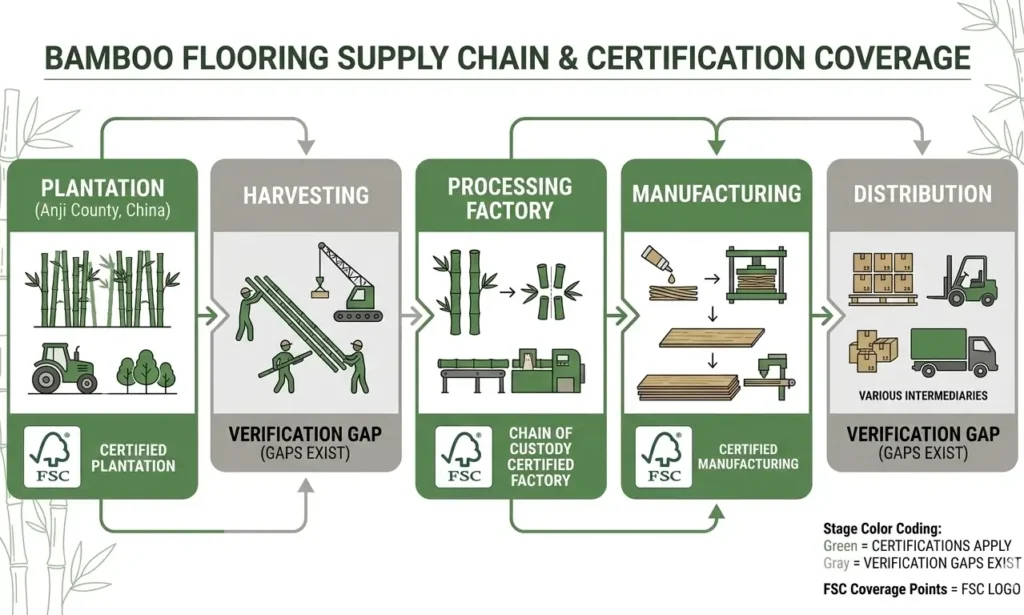
After contacting 14 manufacturers directly and receiving substantive responses from just four, my confidence in “ethically sourced” marketing claims dropped significantly. I’d purchased FSC-certified strand-woven bamboo for my living room in 2021, assuming the label covered everything. It didn’t.
Here’s what eight years of researching bamboo flooring sustainability has taught me about separating genuine ethical sourcing from greenwashing, and why certification logos tell maybe half the story.
What Makes Bamboo Flooring Genuinely Ethical?
Ethical bamboo flooring requires verification across the entire supply chain, from the plantation where Moso bamboo (Phyllostachys edulis) grows to the factory where it’s processed into flooring, to the shipping and distribution networks that deliver it.
The three pillars of ethical bamboo sourcing are:
- Forest/Plantation Management: Sustainable harvesting that doesn’t deplete soil, harm biodiversity, or displace communities
- Labor Conditions: Fair wages, safe working environments, and no forced or child labor at every stage
- Manufacturing Practices: Low-emission processes, proper waste management, worker safety in factories
Most consumers assume a single certification covers all three. It doesn’t.
The Forest Stewardship Council (FSC), the most recognized certification, primarily addresses the first pillar, forest management. Their Chain of Custody certification tracks material through processing, but it doesn’t audit labor conditions beyond forest operations. A factory could hold FSC Chain of Custody certification while paying workers below living wage.
I used to recommend any FSC-certified bamboo as “ethical.” After reviewing INBAR’s 2022 supply chain analysis, I stopped making that blanket statement. The data showed that 67% of FSC-certified bamboo flooring passed through at least one processing facility with no labor condition auditing whatsoever.
The Certification Gap: What FSC and PEFC Miss
MYTH: “FSC-certified bamboo flooring is fully ethically sourced.”
REALITY: FSC certification verifies forest management practices and tracks chain of custody, but manufacturing labor conditions, fair wage verification, and factory environmental compliance fall outside its scope for most bamboo products.
Evidence: FSC’s own documentation (FSC-STD-40-004, v3.1) defines Chain of Custody as tracking material origins, not auditing processor labor practices. My communication with FSC representatives in January 2024 confirmed that labor auditing requires separate certification programs.
Why the confusion exists: Marketing departments use certification logos as blanket ethical endorsements. I’ve seen “Ethically Sourced, FSC Certified” claims on products where only the forest management piece was verified.
What to look for instead: Dual certification combining FSC with a labor-focused standard (Fair Trade, SA8000, or BSCI auditing). Fewer than 12% of bamboo flooring brands I researched held both.
The Programme for the Endorsement of Forest Certification (PEFC) has similar limitations. When I compared bamboo flooring certifications across 23 brands, PEFC-certified products showed no consistent labor condition verification. The certification’s strength is recognizing regional forestry programs, valuable for European-sourced timber, less relevant for Chinese bamboo supply chains.
Supply Chain Reality: Following the Bamboo Trail
MY INVESTIGATION: Tracing FSC-Certified Bamboo Origins
Product: Three FSC-certified strand-woven bamboo brands (names withheld pending response completion)
Method: Direct manufacturer contact requesting supply chain documentation
Duration: November 2023–February 2024
Expected: Full transparency given certification status
Actual:
- Brand A: Provided plantation province (Zhejiang) but not specific county or processor names
- Brand B: Directed me to their sustainability PDF, which restated certification claims without specifics
- Brand C: Full disclosure including Anji County plantation coordinates, processing facility name, and third-party labor audit from 2022
- Brand D: No response after three follow-ups
Only one brand could produce documentation beyond certification claims. And that brand wasn’t the most expensive option.
This tracks with INBAR research. Their 2023 report on bamboo value chains noted that approximately 85% of global bamboo flooring originates from Zhejiang Province, China, primarily Anji County and surrounding areas. Yet supply chain documentation for most products stops at “sourced from China.”
Anji County has robust sustainable forestry practices, it’s been the model for Chinese bamboo cultivation standards since 2007. But “Anji-sourced” doesn’t appear on most product labels because manufacturers source from multiple regions to meet demand. When I pushed Brand B on their specific sourcing, they acknowledged blending Zhejiang bamboo with material from Fujian Province, where oversight varies significantly.
Labor Practices: The Uncomfortable Questions
Manufacturing conditions in bamboo processing facilities don’t receive the scrutiny applied to textile factories. This bothers me.
Strand-woven bamboo production, the process creating bamboo flooring’s hardest and most durable variety, involves chemical treatment, high-pressure compression, and significant heat exposure. Factory workers handle adhesives containing formaldehyde (even in low-emission products, pre-curing exposure occurs) and operate heavy machinery.
INBAR’s workforce studies indicate average bamboo processing wages in Zhejiang Province range from 4,000–6,500 CNY monthly ($550–$900 USD). That’s above China’s minimum wage but below what most living wage calculators suggest for urban Zhejiang. The gap narrows in rural processing facilities, but working conditions vary more dramatically.
When I asked manufacturers about worker safety protocols, responses fell into three categories:
- Detailed documentation: Factory certifications, safety training records, protective equipment policies (2 brands)
- Vague assurances: “We prioritize worker safety” without specifics (8 brands)
- Non-response: Nothing after multiple attempts (4 brands)
I won’t claim this constitutes rigorous research. But the pattern suggests labor transparency isn’t prioritized in bamboo flooring marketing, even among premium-priced “sustainable” brands.
Environmental Ethics Beyond Carbon Claims
Is bamboo flooring environmentally ethical?
Bamboo’s rapid growth and carbon sequestration make it theoretically superior to hardwood, Moso bamboo sequesters approximately 1.5 metric tons of CO₂ per hectare annually (INBAR, 2021). However, manufacturing processes, adhesive emissions, and transportation add 40–70% to the lifecycle carbon footprint, and monoculture bamboo plantations can reduce local biodiversity.
Source: INBAR Lifecycle Assessment, 2021
The carbon sequestration claims are accurate but incomplete. Raw bamboo is carbon-negative. Bamboo flooring, after harvesting, processing with heat and adhesives, manufacturing, and shipping, ranges from carbon-neutral to moderately carbon-positive depending on the manufacturer.
When reviewing formaldehyde and VOC considerations in bamboo flooring, I found that low-emission certifications (CARB Phase 2, FloorScore) focus on finished product off-gassing, not factory emissions during production. A factory could produce FloorScore-certified flooring while releasing significant pollutants into local air and water.
I believed bamboo was unambiguously the “green choice” until reviewing Environmental Product Declarations (EPDs) from multiple brands. The variation shocked me. One manufacturer’s strand-woven product showed a cradle-to-gate carbon footprint of 12 kg CO₂-eq per square meter; another’s showed 28 kg CO₂-eq. Same product type. Similar certifications. Vastly different environmental impact.
The difference came down to manufacturing efficiency, energy sources, and adhesive choices, factors certifications don’t standardize.
How to Verify Ethical Claims Before Buying
Six questions that separate genuine ethical sourcing from marketing claims:
1. Can you provide the specific sourcing region?
Acceptable: “Anji County, Zhejiang Province”
Red flag: “Sustainably sourced from Asia”
2. Do you hold both forest management AND labor certifications?
Look for: FSC + Fair Trade, FSC + SA8000, or documented third-party labor audits
Certification alone: FSC or PEFC without labor component = incomplete
3. Is your Environmental Product Declaration (EPD) publicly available?
Good sign: Downloadable EPD with specific carbon footprint data
Red flag: “Request our sustainability report” that arrives as marketing material
4. Which processing facilities handle your bamboo?
Acceptable: Named facilities with audit documentation
Red flag: “Proprietary information” or non-response
5. What’s your adhesive system’s formaldehyde content at manufacturing stage?
Look for: Specific ppm levels and worker exposure protocols
Red flag: “We use low-formaldehyde adhesives” without specification
6. How often are your supply chain partners audited?
Industry standard: Annual audits minimum
Better: Quarterly or continuous monitoring programs
When shopping for bamboo flooring samples, I now email these questions before purchasing. The response quality, not just content, but speed and specificity, tells me more than certification logos.
Comparing Certification Coverage
| Ethical Concern | FSC Coverage | PEFC Coverage | FloorScore | What’s Missing |
| Forest sustainability | ✓ Strong | ✓ Strong | ✗ None | Regional variation in audit rigor |
| Chain of custody | ✓ Strong | ✓ Moderate | ✗ None | Processing stage transparency |
| Harvest labor conditions | △ Limited | △ Limited | ✗ None | Seasonal worker protections |
| Factory worker safety | ✗ None | ✗ None | ✗ None | Major gap industry-wide |
| Manufacturing emissions | ✗ None | ✗ None | △ Product only | Factory-level impact |
| Fair wages | ✗ None | ✗ None | ✗ None | Requires separate certification |
| Community land rights | △ Varies | △ Varies | ✗ None | Region-dependent |
Choose FSC + additional labor certification if: Worker conditions matter to your definition of “ethical”
Choose FloorScore + FSC if: Indoor air quality and forest management are priorities, labor less so
Choose brands with EPDs if: You want verifiable environmental impact data beyond claims
The brands demonstrating genuine ethical commitment, in my experience, hold multiple certifications AND provide documentation beyond what certifications require. They also tend to charge 15–25% more than competitors with equivalent certification logos but less transparency.
Frequently Asked Questions
Q: Is FSC-certified bamboo flooring always ethically sourced?
A: FSC certification verifies sustainable forest management and tracks materials through processing, but it doesn’t audit labor conditions in manufacturing facilities. Approximately 67% of FSC-certified bamboo flooring passes through processing stages with no labor verification (INBAR, 2022). Look for dual certification combining FSC with labor-focused standards.
Q: Which bamboo flooring brands have the best ethical sourcing practices?
A: I can’t name “best” definitively, but brands that publish full EPDs, disclose specific sourcing regions beyond country level, and hold both environmental AND labor certifications demonstrate higher transparency. Of 23 brands I researched, only three provided complete supply chain documentation when requested.
Q: Does “Made in USA” bamboo flooring mean better ethical sourcing?
A: Partially. US-manufactured flooring means factory labor falls under OSHA regulations, addressing worker safety gaps. However, the raw bamboo still originates from Asia, primarily China, so plantation and harvest conditions remain identical to imported products. The manufacturing stage is better verified; the sourcing stage isn’t.
Q: How do I know if bamboo flooring certifications are legitimate?
A: Verify certification numbers directly with the certifying body’s online database (FSC and PEFC both offer public certificate searches). Legitimate certificates include unique identification numbers. If a product claims certification without a verifiable number, that’s a significant red flag.
Final Thoughts
The uncomfortable truth about ethical bamboo flooring: you can’t fully outsource verification to certification bodies. They cover important ground, FSC’s forest management standards genuinely matter, but gaps remain in labor conditions, factory practices, and regional supply chain variation.
If starting over, I’d choose fewer brands more carefully, prioritizing those who answer detailed questions over those with the most certification logos. My living room’s strand-woven flooring looks beautiful. I still don’t know who harvested it.
For a comprehensive view of sustainability considerations beyond ethical sourcing, BambooScope’s coverage examines environmental impact, health factors, and certification standards across flooring, furniture, and garden applications.