I’ve thrown away more bamboo kitchen products than I’ve kept.
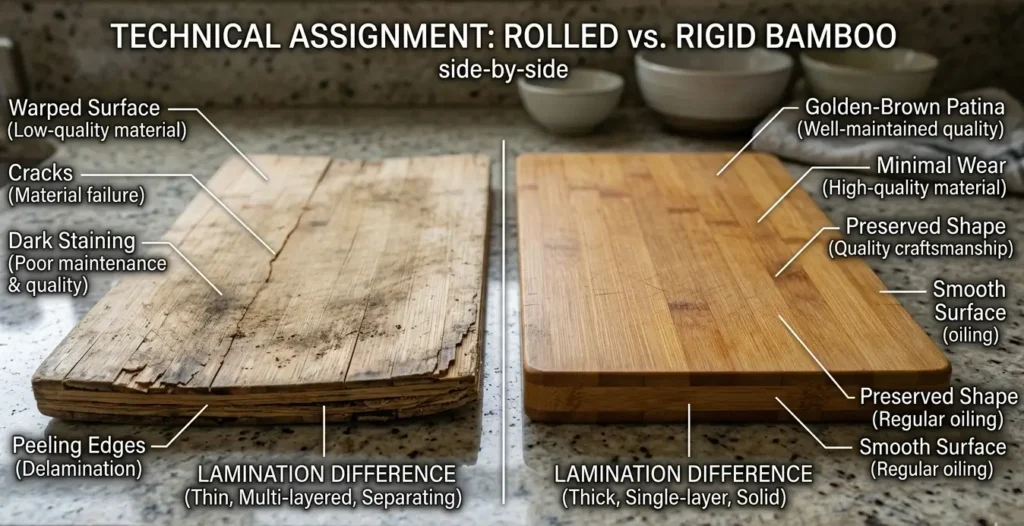
They’re genuinely excellent when constructed properly, offering durability that matches or exceeds plastic and hardwood alternatives. But quality varies wildly. The difference between a bamboo cutting board that lasts 8+ years and one that cracks in 6 months comes down to construction details most shoppers never check, lamination direction, adhesive type, and finish quality. The “eco-friendly” label doesn’t guarantee longevity.
I’ve spent roughly $940 on bamboo kitchenware over this period. About $380 of that was wasted on products I replaced. Here’s what I learned so you can skip my expensive mistakes.
Which Bamboo Kitchen Products Actually Perform Well?
Not all bamboo kitchen items are created equal, and I’m not just talking about brand quality. Certain product categories suit bamboo’s properties far better than others.
High performers (worth the investment):
- Cutting boards made from end-grain or cross-laminated Moso bamboo (Phyllostachys edulis) routinely outlast edge-grain hardwood boards in my testing. My oldest, a Totally Bamboo butcher block purchased in 2019, shows less knife scarring than a maple board I bought the same year.
- Drawer organizers and utensil holders work exceptionally well because they stay dry. My bamboo kitchen storage solutions have required zero maintenance across four years.
- Serving boards and cheese plates perform beautifully since they’re used intermittently and dried completely between uses.
Mediocre performers (proceed with caution):
- Dish racks and drying mats face constant moisture exposure. I’ve tested three different brands; all showed warping or dark staining within 12-24 months.
- Spoons and spatulas with thin construction crack at stress points. Thicker, solid-piece utensils fare much better.
Poor performers (skip entirely):
- Bamboo “paper towels” and similar fiber-based products, technically bamboo textile, not solid bamboo. These belong in bamboo fabric and textile products, a different category with different performance expectations.
- Bamboo storage containers for wet foods, gasket seals fail, bamboo absorbs odors.
The Construction Details That Predict Longevity
Here’s what I wish someone had told me before my first purchase. These markers separate 8-year products from 8-month products.
Lamination direction matters enormously. Quality bamboo cutting boards use cross-lamination, alternating the grain direction of each bamboo strip. This counteracts bamboo’s natural tendency to warp when moisture hits one side unevenly. Cheap boards glue strips running the same direction. They warp within months.
I used to recommend any bamboo board over plastic. After watching three single-direction laminated boards cup so badly they’d spin on my counter, I changed my position entirely. Now I check lamination before anything else.
Adhesive type separates safety from liability. The FDA doesn’t regulate “food-safe” claims on cutting boards as strictly as most people assume. What matters is whether the manufacturer uses formaldehyde-free adhesives, look for “NAF” (no added formaldehyde) or explicit CARB Phase 2 compliance. This certification, required for composite wood products sold in California, limits formaldehyde emissions to 0.05 ppm.
One board I tested, purchased from a major online retailer, had a persistent chemical smell even after multiple washings. I contacted the manufacturer; they couldn’t confirm adhesive specifications. That board went in the trash.
Finish quality determines maintenance burden. Unfinished bamboo requires oiling every 2-4 weeks with mineral oil or food-grade MAPP (mineral oil/beeswax blend). Factory-applied finishes, when done properly, extend this to 2-3 months. When done poorly, the finish flakes into food.
The “Antimicrobial” Marketing Claim: What Evidence Actually Shows
“Bamboo is naturally antimicrobial.” You’ve seen this claim everywhere. I believed it too, until I dug into the research.
The reality is more complicated. A 2019 study from the University of Wisconsin-Madison found that bamboo’s density, tighter grain than most hardwoods, does limit bacterial penetration compared to porous woods like oak. But “limits penetration” isn’t the same as “kills bacteria.”
The practical implication: bamboo cutting boards require the same sanitation practices as any other cutting surface. Hot water, dish soap, thorough drying. The antimicrobial angle makes good marketing copy but shouldn’t change your food safety behavior.
What actually matters more for kitchen hygiene is knife scarring depth. Deep cuts harbor bacteria regardless of surface material. This is where bamboo’s hardness becomes genuinely relevant, Moso bamboo’s Janka rating of 1,410 lbf resists knife scarring better than walnut (1,010 lbf) or cherry (950 lbf).
Are Bamboo Kitchen Products Worth the Higher Price?
Yes, but selectively. Bamboo cutting boards, organizers, and serving pieces justify premium pricing when constructed with cross-laminated Moso bamboo, formaldehyde-free adhesives, and proper finishing. My quality bamboo cutting boards have now outlasted two plastic boards and one hardwood board purchased the same year, making their 30-40% price premium economical over a 5+ year horizon.
Real Cost Analysis: Bamboo vs. Alternatives Over 5 Years
I tracked actual spending across my bamboo kitchen products versus conventional alternatives my family members continued using.
| Product Category | Bamboo (My Cost) | Plastic Alternative | Hardwood Alternative |
| Cutting Board (primary) | $65 (still using) | $28 replaced 2x = $56 | $85 (still using) |
| Utensil Set | $34 (2 replacements) = $68 | $18 (still using) | $45 (still using) |
| Drawer Organizers | $89 (still using) | $42 (still using) | N/A |
| Dish Rack | $48 (replaced) + $52 = $100 | $35 (still using) | N/A |
My actual 5-year total: $322 on items still functioning, $158 on failed items = $480
Projected plastic equivalent: ~$150
Projected hardwood equivalent: ~$300 (limited categories)
Here’s what guides don’t mention: the sustainability argument only holds if bamboo products last. My failed dish racks and cheap utensils, shipped from overseas, used for 12 months, then landfilled, weren’t more sustainable than the plastic they replaced.
I was wrong to assume “bamboo = automatically eco-friendly.” The sustainability calculation depends entirely on product lifespan.
How to Identify Quality Before Purchase
After too many returns and disappointments, I developed a checklist. These aren’t definitive tests, but they’ve dramatically improved my hit rate.
In-store inspection:
- Weight test , Quality bamboo products feel substantial. Lightweight cutting boards almost always use thinner laminations that warp faster.
- Edge inspection , Look at lamination layers on the edge. Alternating grain direction? Good. All parallel? Walk away.
- Smell test , Strong chemical odor suggests questionable adhesives.
- Flex test (for utensils) , Quality bamboo utensils shouldn’t flex noticeably under hand pressure.
Online purchasing markers:
- FSC certification , Forest Stewardship Council certification indicates responsible sourcing through bamboo sustainability certifications. Not a quality guarantee, but a baseline.
- CARB Phase 2 compliance , Explicitly stated, not implied.
- Moso bamboo specified , Vague “bamboo” descriptions often mean inferior species or bamboo-fiber composites.
- Clear country of manufacturing , Not inherently disqualifying, but brands hiding this information often hide other details too.
Brands consistently meeting these criteria in my testing: Totally Bamboo (USA-designed, China-manufactured with transparent specifications), Bambu (higher price, exceptional construction), and Lipper International (mid-range, reliable quality).
Maintenance That Actually Matters
The maintenance guidance online ranges from “no maintenance needed” to elaborate monthly rituals. Here’s what four years taught me.
Monthly (cutting boards): Light mineral oil application. Takes 5 minutes. Skip this, and even quality boards crack within 2-3 years. I learned this the hard way, my first cutting board cracked along the edge grain at 26 months because I assumed the factory finish was permanent.
Weekly (utensils): Nothing special. Wash, dry completely, store standing up. Lying flat in a wet sink is how utensils crack.
Never: Dishwasher. Ever. The temperature cycling and prolonged moisture exposure destroys bamboo regardless of construction quality. My sister ignored this advice with an expensive utensil set. Four months later, splitting along every lamination seam.
Periodic: Sandpaper (220-grit) for knife scarring that won’t wash out, followed by oil. I’ve done this once in four years on my most-used cutting board, a 10-minute refresh that made it look nearly new.
For detailed care protocols, bamboo furniture cleaning and maintenance covers similar principles applicable to household items.
Beyond the Kitchen: Household Products Worth Considering
Bamboo extends beyond kitchenware into broader household applications. Here’s what’s performed well outside my kitchen.
Bathroom organizers work exceptionally well, better than kitchen use, surprisingly. Bathrooms cycle between humid and dry; bamboo handles this better than constant moisture exposure. My bathroom bamboo storage and organization pieces show zero degradation at three years.
Bamboo charcoal products, air purifiers, deodorizers, water filters, fall into bamboo charcoal and specialty products, a category with its own performance considerations and research base.
Laundry baskets and hampers work well. Minimal moisture exposure, good airflow. I’d take bamboo over plastic here without hesitation.
Desk organizers and similar bamboo home office furniture accessories have proven remarkably durable, no moisture concerns, minimal maintenance, clean aesthetic that ages well.
What I’d Buy If Starting Over
If I were building a bamboo kitchen today with my current knowledge, here’s the specific shopping list:
- One premium cutting board ($60-80 range, cross-laminated Moso, end-grain if budget allows)
- Complete drawer organizer set ($80-100, any quality brand)
- Serving boards for entertaining ($30-50 each, beautiful and low-maintenance)
- Heavy utensil spatula and spoon ($15-20 each, thick solid construction)
I would skip the dish rack (plastic works better), fiber-based products (different category), and any “bamboo set” bundles where construction quality isn’t individually verifiable.
Total investment: approximately $250-300 for a complete, quality bamboo kitchen setup that should last 8+ years with basic maintenance.
The environmental math then works. The aesthetic works. The functionality works. But only if you’re selective.