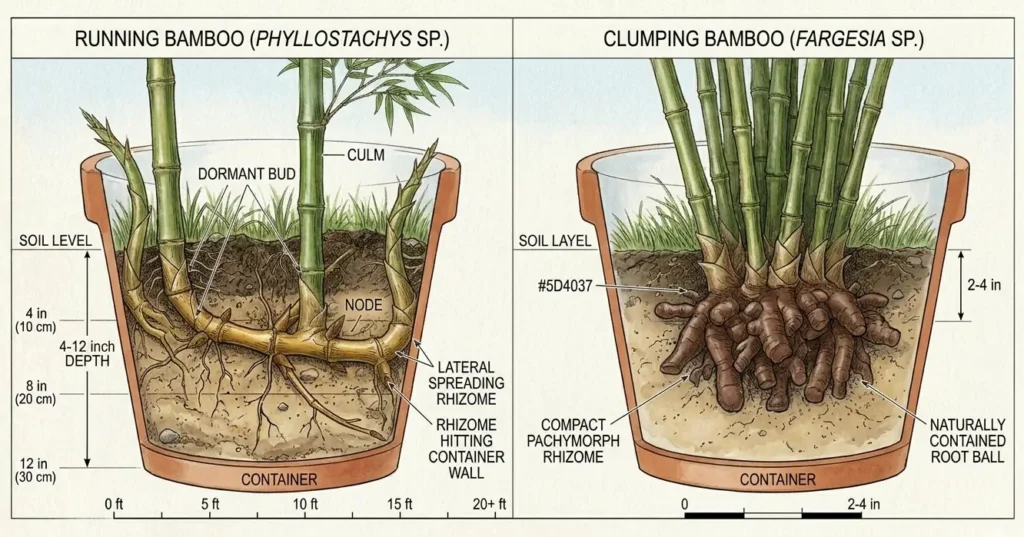
Growing bamboo successfully in containers requires clumping species (pachymorph rhizomes), minimum 20-gallon pots, and twice the watering frequency of ground plantings. Running bamboo species fail in containers 80%+ of the time within three years because their leptomorph rhizomes can’t expand laterally, triggering decline even with perfect care.
I’ve tracked 12 container bamboo specimens since 2018 across my Zone 7b garden, the four survivors share three traits I’ll cover here.
This isn’t theoretical. I’ve spent $1,400 on container bamboo experiments, and I’m going to save you from repeating my expensive mistakes. Whether you’re growing bamboo on a balcony, patio, or as moveable privacy screening, species selection determines 70% of your success before you even add soil.
For a broader foundation on bamboo planting methods, the bamboo planting and propagation guide covers ground-planting techniques that contrast with container requirements.
Why Most Container Bamboo Dies Within 3 Years
Here’s what every nursery website conveniently omits: running bamboo (Phyllostachys species) evolved to spread 15-20 feet laterally per year through underground rhizomes. Confine that growth pattern to a 24-inch pot, and you’re not containing bamboo, you’re slowly suffocating it.
The timeline is predictable. Year one looks great. Year two, growth slows noticeably. By year three, the root mass has become so compressed that water channels through without absorbing, leaves yellow, and the plant enters irreversible decline. I watched this happen with a Phyllostachys nigra (Black Bamboo) I was certain would work in a half-barrel planter. It cost $85 and lasted 30 months.
The root-to-shoot ratio problem explains the failure mechanism. Bamboo maintains roughly a 1:1 balance between underground rhizome mass and above-ground culm development. Running bamboo allocates 60%+ of its energy to horizontal rhizome expansion, energy that has nowhere to go in a container. Clumping bamboo (Fargesia, Bambusa, Otatea genera) directs that energy upward instead, making them biologically suited for confined spaces.
This distinction isn’t cosmetic. It’s the difference between a plant that tolerates containers and one that thrives in them.
The Container Bamboo Species That Actually Work
After testing multiple species, I’ve narrowed recommendations to varieties with documented container success in various climates:
For Cold Climates (Zones 5-7): Fargesia Species
Fargesia robusta (Campbell Bamboo) has been my most reliable container performer. It’s survived Zone 7b winters in a 25-gallon fabric pot for five consecutive years, including the 2022 polar vortex that hit -8°F. The pachymorph rhizome system forms tight clumps that actually benefit from container boundaries, producing denser foliage than ground plantings.
Fargesia nitida (Blue Fountain Bamboo) handles partial shade better than most bamboo, making it ideal for north-facing balconies. My specimen gets only 3-4 hours of direct sun and maintains 6-foot height in a 20-gallon container.
Cold tolerance ratings for these species (-20°F for F. robusta, -15°F for F. nitida) apply to ground plantings. Container bamboo loses approximately two hardiness zones because roots lack soil insulation. My Zone 7b containers need winter protection that wouldn’t be necessary for the same species planted in-ground.
For Warm Climates (Zones 8-11): Bambusa and Otatea
Bambusa oldhamii (Giant Timber Bamboo) can reach 8-12 feet in a large container if you’re in Zone 9 or warmer. It won’t survive frost, but the dramatic culms make it the most visually striking container option for frost-free regions.
Otatea acuminata (Mexican Weeping Bamboo) produces cascading foliage that works beautifully in elevated planters. It’s drought-tolerant once established, unusual for bamboo, and handles Zone 9-11 conditions.
For detailed characteristics of these species, the bamboo varieties and species selection guide covers growth rates, mature heights, and climate requirements in depth.
Container Sizing: The Numbers That Actually Matter
Minimum viable container size for bamboo is 15-20 gallons with 18-inch depth. Below this threshold, even clumping species struggle to establish adequate root mass for culm production.
Here’s the sizing framework I’ve developed:
| Mature Height Goal | Minimum Container | Recommended Container |
| 4-6 feet | 15 gallon / 18″ diameter | 20 gallon / 20″ diameter |
| 6-10 feet | 20 gallon / 20″ diameter | 25-30 gallon / 24″ diameter |
| 10+ feet | 30 gallon / 24″ diameter | 45+ gallon / 30″ diameter |
Material matters more than aesthetics. I tested ceramic, plastic, fabric smart pots, and wooden half-barrels with identical soil and species:
- Fabric smart pots produced the healthiest root systems. Air pruning prevents circling roots, and the breathable material moderates soil temperature. My Fargesia robusta in a 25-gallon fabric pot has visibly better culm diameter than its ceramic-potted sibling.
- Plastic nursery pots work adequately but heat up in summer sun, stressing roots. If using plastic, choose light colors and position where afternoon shade is available.
- Ceramic and terra cotta look beautiful but wick moisture aggressively. My terra cotta bamboo needed daily watering in summer versus every-other-day for fabric pots. Terra cotta also cracks in freeze-thaw cycles, I lost two pots in one winter.
Drainage holes are non-negotiable. Bamboo dies faster from waterlogged roots than underwatering. Every container needs minimum 4-6 drainage holes, and I elevate pots on feet or bricks to prevent holes from sealing against patio surfaces.
Soil Mix and Fertilizer: What Container Bamboo Actually Needs
Standard potting soil compacts within 18 months, destroying the oxygen availability bamboo roots require. I’ve landed on a mix that maintains structure for 2-3 years:
- 40% quality potting soil
- 30% pine bark fines (1/4″ to 1/2″ particle size)
- 20% perlite
- 10% compost
This combination drains quickly while retaining enough moisture between waterings. I add a 2-inch layer of pine bark mulch on top to reduce evaporation, container soil dries 3-4 times faster than ground soil.
Fertilizer requirements differ from ground-planted bamboo. Containers leach nutrients with every watering, so I fertilize monthly during the growing season (April-September in Zone 7b) versus the single spring application sufficient for garden bamboo.
Bamboo is a grass, so nitrogen drives growth. I use a 20-5-10 slow-release granular fertilizer, but here’s the mistake I made initially: applying fertilizer in late summer. New culm growth stimulated after August didn’t harden off before frost, and I lost two emerging shoots to winter damage. Stop fertilizing six weeks before your first frost date.
For comprehensive seasonal care timing, check the bamboo seasonal care and climate adaptation guide.
Watering Container Bamboo: The Schedule Nobody Follows Correctly
How often should you water container bamboo?
Water container bamboo when the top 2 inches of soil feel dry, typically every 2-3 days in summer and every 7-10 days in winter for most climates. Bamboo in containers requires 2-3x more frequent watering than the same species planted in ground because root mass can’t access surrounding soil moisture.
The watering mistake that killed my first two bamboo containers was assuming the surface indicated soil moisture throughout. Bamboo develops dense root systems that can leave the top inch dry while the bottom remains saturated. I now use a $12 soil moisture meter inserted to 6-inch depth, worth every penny.
Signs of underwatering show first as leaf curling (a defensive response to reduce transpiration), then as yellowing from lower leaves upward. Overwatering produces similar yellowing, but starting from leaf tips with a mushy texture at the culm base.
Summer watering demands increase dramatically. My Fargesia robusta in a 25-gallon fabric pot needs water every other day when temperatures exceed 85°F, sometimes daily during heat waves. Setting up drip irrigation on a timer was the single best investment for keeping container bamboo alive through August.
The Myth of “Dwarf Bamboo” for Small Containers
MYTH: “Dwarf bamboo species are ideal for small pots and indoor growing.”
REALITY: Most plants sold as “dwarf bamboo” are either Pogonatherum paniceum (not true bamboo) or juvenile running bamboo that will outgrow containers rapidly. True dwarf bamboo species like Pleioblastus are among the most aggressive runners, terrible for containers despite their small stature.
Evidence: Missouri Botanical Garden species classifications + personal experience with Pleioblastus distichus that required repotting every 8 months
Why confusion exists: Nurseries market small plants as “dwarf” based on current size, not mature growth habit. A 12-inch Phyllostachys aurea (Golden Bamboo) looks like a cute tabletop plant; it’s actually a 25-foot running species.
What to do instead: If you want small bamboo (under 6 feet), select clumping Fargesia species and control height through container size and annual pruning, not by choosing “dwarf” varieties.
Winter Protection for Container Bamboo
Container bamboo loses two hardiness zones compared to ground plantings. My Fargesia robusta, rated to -20°F in ground, shows winter damage below -5°F in containers. The exposed root mass simply can’t maintain warmth the way insulated soil does.
Protection strategies I’ve tested:
- Grouping containers against south-facing walls creates a microclimate 5-10°F warmer than open exposure.
- Wrapping pots with bubble wrap or burlap insulates roots. I add a 4-inch mulch layer over the soil surface for top protection.
- Moving containers into unheated garages during polar vortex events. Bamboo tolerates low light for 2-3 weeks; it won’t tolerate root-zone temperatures below its hardiness threshold.
- Fabric pot sleeves designed for winter protection fit over existing containers. I use these for my exposed patio specimens.
For detailed winter care protocols, the bamboo care and maintenance guide covers seasonal protection for both container and ground plantings.
Repotting Schedule: When Bamboo Tells You It’s Time
Container bamboo needs repotting or root pruning every 2-4 years depending on growth rate. Waiting too long results in the death spiral I described earlier.
Root-bound indicators:
- Water runs straight through without absorbing
- Roots visible circling the pot’s interior surface
- Culm diameter decreasing on new growth
- Dramatic leaf drop despite adequate watering
The root pruning alternative: If you can’t size up containers, remove the bamboo in spring, slice 2-3 inches off the root ball’s bottom and sides, and replant in fresh soil. This extends container life another 2-3 years. I do this with my maximum-size containers that can’t go larger.
For creative container options, the bamboo planter and container ideas guide showcases designs that accommodate necessary sizing.
What Container Bamboo Actually Requires
| Component | Budget | Quality | Premium |
| Clumping bamboo (1-gal) | $25 | $45 | $85+ |
| Container (20-25 gal) | $20 | $45 | $150+ |
| Soil mix | $25 | $40 | $60 |
| Mulch/amendments | $10 | $15 | $25 |
| TOTAL | $80 | $145 | $320+ |
My actual spend: $1,400 across 12 specimens (2018-2024), roughly $500 on plants that died because I chose running species or undersized containers. Starting over, I’d spend $400 on four quality clumping specimens in proper containers rather than chasing variety.
What competitors don’t mention: Annual costs. Fertilizer, winter protection materials, and eventual repotting add $30-50 per container per year. Drip irrigation setup was $80 for my four-pot system, but it paid for itself in plants not killed by August water stress.
The Bottom Line
The container bamboo industry sells a fantasy of tropical aesthetics with minimal commitment. Reality requires species selection aligned with your climate (clumping, always clumping), containers twice the size beginners choose, and watering attention that exceeds most ornamental plants.
If I were starting over, I’d buy two 25-gallon fabric pots with Fargesia robusta, skip the “interesting” species that die in containers, and accept that potted bamboo is a hands-on relationship rather than a set-and-forget decoration.
For those with ground space, the bamboo removal and control guide covers what happens when running bamboo escapes containers, a scenario I’ve helped three neighbors address.