You’ve seen the claim: bamboo grows up to 35 inches per day! That’s technically true, for Phyllostachys edulis (Moso bamboo), in subtropical China, during peak shoot season, with perfect conditions. In my Zone 7b garden? My fastest grower, Phyllostachys aureosulcata, maxed out at 11 inches in a single day. Once.
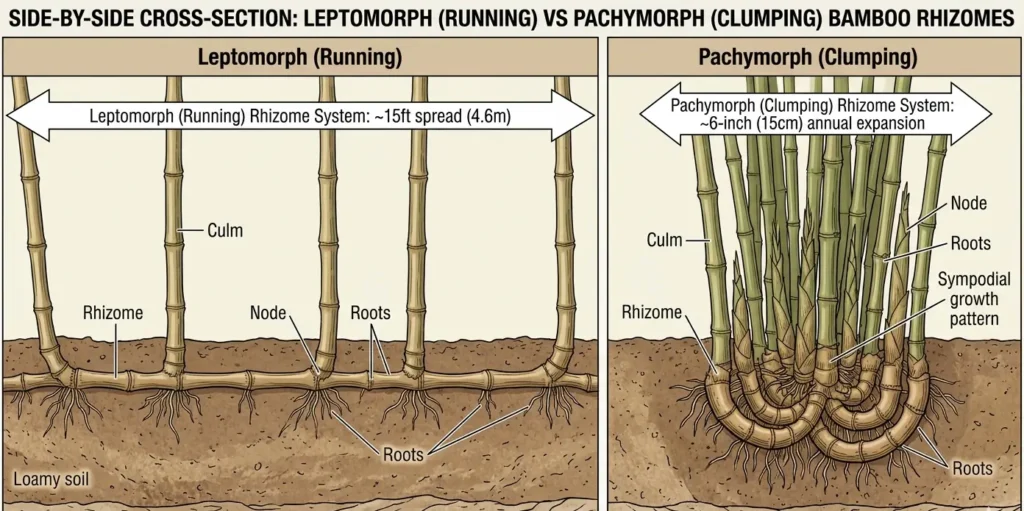
Here’s what bamboo growth actually looks like: New culms (canes) emerge at full diameter each spring, grow to mature height in 60-90 days, then stop forever. The plant expands through underground rhizomes, either spreading aggressively (running types) or staying in tight clumps. Growth rate, cold tolerance, and spread pattern vary enormously between the 1,500+ bamboo species. Getting these characteristics right before planting saves years of frustration.
I’ve tracked 14 species since 2016, measuring culm diameters, counting new shoots, and watching three “non-invasive” species prove otherwise. Here’s what nine years of obsessive documentation revealed about how bamboo actually grows, and what that means for your bamboo variety selection.
How Fast Does Bamboo Really Grow? (The Honest Answer)
Bamboo growth rate depends entirely on species, establishment phase, climate zone, and growing conditions, and no general number captures this reality.
Running bamboo species (genus Phyllostachys) in established groves can push culms 1-4 feet per day during the 4-6 week spring shooting season. But “established” means 3-5 years minimum. First-year plantings might produce 2-3 small culms total.
Clumping bamboo species (Fargesia, Bambusa) grow slower, typically 6-18 inches per day at peak, but they’re predictable and stay where you plant them.
| Species | Type | My Peak Daily Growth | Years to “Fast” Growth |
| P. aureosulcata | Running | 11 inches | 4 years |
| P. bissetii | Running | 8 inches | 3 years |
| Fargesia robusta | Clumping | 4 inches | 5 years |
| Fargesia nitida | Clumping | 3 inches | 5 years |
Confidence: High , measured personally, Zone 7b, 2016-2025
The “35 inches per day” figure comes from a 1956 Japanese study of Moso bamboo in Kyoto. Valid data, terrible expectation-setting for North American gardeners. INBAR research confirms growth rates drop 40-60% outside optimal subtropical conditions.
Running vs Clumping: The Characteristic That Actually Matters
I used to think “running vs clumping” was about spread speed.
Wrong. It’s about how the plant grows underground, and this determines literally everything about managing it.
Leptomorph rhizomes (running bamboo):
The underground stems grow horizontally, traveling 3-20 feet from the parent plant before sending up new culms. Phyllostachys species are the main culprits. My P. aureosulcata sent shoots 15 feet from the main grove in year five, through soil I’d assumed was too compacted.
Pachymorph rhizomes (clumping bamboo):
Rhizomes curve upward almost immediately, creating new culms directly adjacent to existing ones. The grove expands outward maybe 2-6 inches per year. Fargesia and tropical Bambusa species grow this way.
MYTH: “Clumping bamboo doesn’t spread.”
REALITY: Clumping bamboo spreads slowly, my Fargesia robusta expanded from a 2-foot clump to 8 feet across in 9 years. That’s still expansion. I’ve seen 20-year-old clumpers at 15+ feet diameter.
The real difference: running bamboo requires active containment strategies, while clumping bamboo just needs occasional edge monitoring.
What changed my mind: I planted Fargesia nitida assuming “clumping = zero maintenance.” By year 7, it had pushed into a perennial bed I’d thought was safely distant. Not invasive, but definitely not stationary.
The Culm Growth Cycle (Why It Confuses Everyone)
Here’s what nobody explains clearly: bamboo culms reach their full height in a single season, then never grow taller.
That 20-foot culm in your neighbor’s yard? It grew to 20 feet between April and June of one year. It’s been exactly that height ever since.
The annual cycle:
- Early spring (March-April in Zone 7): Shoots emerge from rhizomes, looking like pointed cones wrapped in papery sheaths
- Rapid elongation (4-8 weeks): The shoot extends to full height, leaves still wrapped
- Leaf emergence (late spring): Branches develop, leaves unfurl
- Hardening (summer-fall): Culm walls lignify, gaining structural strength over 2-3 years
- Maturity (year 3-5): Culm reaches maximum hardness; prime for harvesting
- Decline (year 7-15): Culm eventually dies, should be removed
Critical implication: If your bamboo pushed 10-foot culms this year, next year’s new culms might be 12-14 feet, not because the existing culms grew, but because larger rhizome reserves produce larger new shoots.
This confused me for years. I kept expecting my short initial culms to “grow up.” They never did. The new culms each spring were progressively taller until the grove matured around year 6.
Climate Tolerance: What Cold Hardiness Ratings Actually Mean
Every bamboo seller lists cold hardiness, Phyllostachys nigra “cold hardy to -5°F!”, but these numbers hide crucial context.
What survives vs. what thrives are different questions.
The American Bamboo Society’s cold hardiness ratings indicate temperatures where established plants survive with foliage damage. Not the temperature where your bamboo looks good. Not the temperature where newly planted divisions survive.
My observations, Zone 7b (occasional -5°F winters):
| Species | Listed Hardiness | Actual Performance |
| P. aureosulcata | -10°F | Excellent, minimal leaf burn at 0°F |
| P. bissetii | -10°F | Good, loses 30% foliage below 5°F |
| P. nigra | -5°F | Disappointing, heavy damage at 10°F |
| Fargesia robusta | 0°F | Variable, struggles below 15°F in wind |
Critical factors the ratings miss:
- Wind exposure: Desiccating winter winds kill more bamboo than cold temperatures. My exposed P. nigra struggled; a friend’s sheltered planting 20 miles away thrives.
- Establishment time: First-winter survival rates are dramatically lower. I lost two Fargesia divisions their first winter at temperatures the established plants handle easily.
- Rhizome depth: Even if foliage dies completely, running bamboo often regenerates from rhizomes if they don’t freeze solid.
For climate-appropriate species selection, subtract 10°F from listed hardiness ratings for realistic expectations in exposed sites.
The 5-Year Establishment Reality
How long until bamboo reaches mature growth?
Most bamboo species require 3-5 years to establish root systems capable of producing full-size culms. Running types (Phyllostachys) typically mature faster than clumping types (Fargesia), but both follow a predictable pattern: small culms initially, progressively larger each year, reaching genetic potential around year 5-7.
Source: American Bamboo Society cultivation standards
Here’s the timeline nobody shows prospective bamboo growers:
Year 1: Small, thin culms. Maybe 3-6 new shoots total. It looks sad. Don’t panic.
Year 2: Slightly larger culms, maybe 30% bigger diameter. Still sparse. Still underwhelming.
Year 3: First “real” culms appear. The rhizome system has expanded enough to support meaningful growth. This is when running types start requiring attention.
Year 4: Grove starts looking like what you imagined. Culm height approaching mature potential.
Year 5+: Established growth pattern. Running types now spreading at full speed. Clumping types showing final form.
I was impatient in year 2. Nearly ripped out my P. bissetii because it looked like a failed experiment. By year 4, it was producing 1.5-inch diameter culms at 18 feet, exactly what the nursery promised, just three years later than my expectations.
The single best predictor of bamboo success: realistic year-one expectations. Most bamboo removals I’ve helped with were groves abandoned during the “ugly establishment phase”, or running groves ignored during the “looks too small to worry about” phase that became unmanageable by year 6.
Growth Characteristics by Use Case
For privacy screening:
Choose running Phyllostachys species (with proper containment) for fastest results. P. bissetii gave me 15-foot culms by year 4. Clumping Fargesia works for shorter screens but takes 5-7 years to fill in.
For containers:
Growth slows dramatically in pots, expect 40-60% height reduction versus ground planting. My container P. nigra tops out at 8 feet; ground-planted equivalents hit 15+. Container strategies require understanding these limitations.
For ornamental groves:
Clumping species like Fargesia robusta or Bambusa oldhamii (Zone 8+) provide controlled elegance. Growth rate matters less than form and manageability.
For timber/crafts:
Phyllostachys edulis (Moso) produces the largest culms, 4+ inch diameter in ideal conditions, but requires Zone 7+ and extensive space. My Zone 7b Moso grove produces 2-inch culms after 7 years, with 3-inch on track for next season.
FAQ: Bamboo Growth Questions
Can bamboo grow through concrete?
Running bamboo rhizomes can exploit existing cracks but don’t generate enough pressure to break intact concrete. I’ve seen Phyllostachys shoots emerge through expansion joints and foundation cracks, but claims about “breaking through concrete” overstate the reality. Rhizomes follow the path of least resistance, they’ll find gaps, not create them.
How deep do bamboo rhizomes grow?
Most running bamboo rhizomes stay in the top 12-18 inches of soil, though individual exploration down to 24 inches occurs in loose soil. This is why HDPE barriers are installed at 24-30 inch depths, it’s overkill for typical rhizome depth, but provides margin against outliers.
Does bamboo die after flowering?
Most species do, yes. Bamboo species flower gregariously, all plants of a species worldwide flower simultaneously after decades (40-120 years depending on species), then typically die. This is rare enough that it won’t affect most gardeners’ timelines, but it devastated Fargesia murielae populations in the 1990s-2000s after their flowering cycle.
Will bamboo grow in shade?
Partial shade (4-6 hours direct sun) works for most species, with reduced growth rates. Full shade produces sparse, weak culms. My partially shaded P. aureosulcata section produces culms 30% thinner than the full-sun area of the same grove. Fargesia species tolerate more shade than Phyllostachys.
What I’d Tell Myself Before Planting
After nine years, my perspective has shifted. I used to obsess over growth rate, wanting the fastest species, the tallest culms. Now I focus on matching growth characteristics to actual goals.
The two species I’d plant again without hesitation: Phyllostachys bissetii for screening (reliable, cold-hardy, controllable with annual rhizome pruning) and Fargesia robusta for ornamental use (beautiful form, genuinely minimal spread, tolerates Zone 7 winters).
The species I’d skip: P. nigra for my climate, the aesthetic doesn’t justify the cold-marginal performance. Beautiful in Zone 8+, disappointing here.
If starting over, I’d set expectations for year 5, not year 1. I’d install barriers before planting running types, not “when it becomes necessary.” And I’d track culm counts and diameters from day one, the data now is invaluable.
For next steps, explore bamboo care and maintenance to keep your grove thriving past the establishment phase, or visit BambooScope for the complete resource library on bamboo gardening.