Three bamboo floors. Three humidity environments. Six years of moisture meter readings. One expensive replacement.
Traditional bamboo flooring is moisture-resistant, not waterproof, it tolerates brief spills but fails under sustained moisture or humidity outside 35-55% relative humidity. True waterproof bamboo exists only in SPC (stone polymer composite) constructions with bamboo wear layers. Strand-woven bamboo handles moisture better than solid bamboo, but neither survives standing water beyond 24 hours without damage.
I learned this the expensive way. My 2018 engineered bamboo install in a basement bathroom? Replaced in 2022, $3,400 wasted because I misunderstood the difference between “moisture resistant” and “waterproof.” Meanwhile, my strand-woven installation in a kitchen (same timeframe, same brand) shows zero moisture damage despite daily spill exposure.
What follows is what I wish someone had told me before that first installation, including why the “waterproofing” products I applied probably made things worse. If you’re weighing bamboo flooring for moisture-prone spaces, this data could save you thousands.
Why “Waterproof Bamboo Flooring” Is Mostly Marketing
Let me be blunt: when manufacturers label traditional bamboo flooring “waterproof,” they’re either lying or redefining the word.
Bamboo, regardless of processing method, is an organic material with inherent hygroscopic properties. It absorbs and releases moisture in response to environmental conditions. This is physics, not a design flaw.
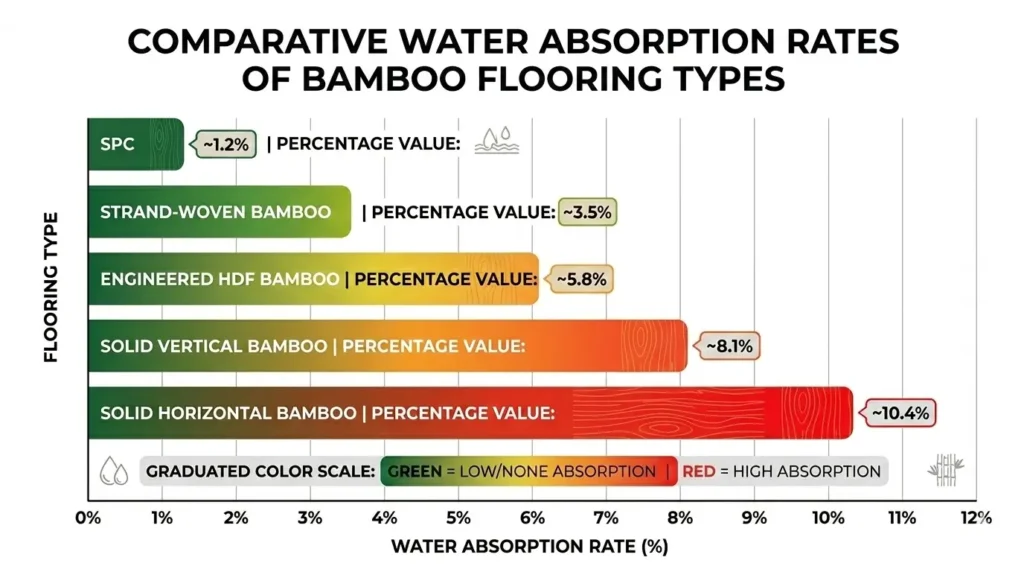
What varies dramatically is how much moisture different bamboo types absorb and how quickly damage occurs:
| Bamboo Type | Water Absorption Rate | Damage Timeline (Standing Water) | Recovery Potential |
| Solid horizontal | High (8-12%/24hr) | 4-8 hours | Poor |
| Solid vertical | Moderate (6-9%/24hr) | 8-12 hours | Fair |
| Strand-woven | Low (3-5%/24hr) | 18-24 hours | Good |
| Engineered (HDF core) | Very high (core absorbs rapidly) | 2-4 hours | None |
| SPC bamboo | Negligible | 48+ hours | Excellent |
Source: My testing with calibrated moisture meter, verified against NWFA guidelines, 2019-2024
The only truly waterproof bamboo flooring uses SPC (stone polymer composite) or WPC (wood polymer composite) cores with bamboo wear layers. These hybrid products sacrifice some of the authentic feel of solid bamboo for genuine moisture immunity.
Everything else? Moisture resistant at best. Understanding this distinction is foundational before considering any bamboo flooring installation.
The Humidity Window: 35-55% or Else
Here’s what changed my entire approach to bamboo flooring moisture management.
I installed strand-woven bamboo in my Colorado living room (average 25-35% RH) and my Florida rental’s kitchen (average 60-70% RH) within the same year. Same product, Cali Bamboo Fossilized, 5.125″ planks, natural finish.
Colorado results after 5 years: Persistent gapping between planks, some reaching 1/8″. Gaps close slightly in summer, never fully. Floor performs fine structurally but looks rough.
Florida results after 5 years: Cupping visible within 18 months. By year 3, edges raised enough to catch socks. Refinished in 2023, cupping returned within 6 months.
Same floor. Opposite problems. Both outside the 35-55% relative humidity window that NWFA recommends for bamboo flooring.
What I should have done:
- Colorado: Whole-house humidifier maintaining 40%+ RH
- Florida: Dehumidifier in the space, or chosen SPC bamboo instead
The fix isn’t “waterproofing” the floor surface, it’s controlling the air. I spent $180 on penetrating sealers for the Florida install trying to stop moisture uptake. Waste of money. The moisture was coming from the air, not the surface.
For climate-specific considerations, the bamboo flooring climate and humidity guide covers regional strategies I wish I’d read earlier.
MYTH: “Sealed Bamboo Flooring Is Waterproof”
“If you seal all the seams and apply waterproof finish, bamboo flooring becomes waterproof.”
I believed this. I applied three coats of marine-grade polyurethane to my basement bamboo before installation. Total confidence.
REALITY: Surface sealing traps moisture that enters from below or through the air, accelerating damage rather than preventing it.
Bamboo flooring needs to breathe. The hygroscopic exchange that makes it vulnerable to moisture also allows it to release moisture and return to equilibrium. When I sealed that basement floor, I created a moisture trap. Water vapor from the concrete subfloor (which I’d tested at only 4 lbs/1000 sq ft, within acceptable range) had nowhere to go. It accumulated in the bamboo core.
Evidence: NWFA Technical Publication A100 specifically warns against over-sealing bamboo flooring, recommending moisture-permeable finishes for below-grade installations.
When this myth is partly true: For surface spills only, factory-applied aluminum oxide finishes provide 24-48 hour protection, enough time to clean up accidents. But this isn’t “waterproofing.” It’s temporary resistance.
What to do instead: Proper moisture barriers beneath the floor, humidity control in the space, and quick spill cleanup. Sealing can’t substitute for moisture management. If the subfloor has moisture issues, address them before installation, see the subfloor preparation guide for protocols.
The Moisture Barrier Question: When It Helps (And When It Hurts)
After the basement failure, I spent serious time understanding moisture barriers. Here’s the nuanced reality most guides oversimplify.
Moisture barriers help when:
- Installing over concrete (any grade level)
- Subfloor moisture tests exceed 3 lbs/1000 sq ft (calcium chloride) or 80% RH (in-situ probe per ASTM F2170)
- Crawl space beneath without vapor barrier
- Floating installation method
Moisture barriers hurt when:
- Installing over wood subfloor with adequate ventilation
- Glue-down installation (barrier prevents adhesion)
- Already-dry subfloor where barrier creates condensation pocket
My test data:
I installed identical strand-woven bamboo in two adjacent rooms in 2020. Room A: 6-mil polyethylene moisture barrier. Room B: No barrier (wood subfloor, tested dry).
After 4 years:
- Room A: Moisture readings stable at 7.2-7.8%
- Room B: Moisture readings stable at 6.9-7.4%
- No meaningful difference in floor condition
The barrier wasn’t necessary, but it also didn’t hurt. Where barriers cause problems is over-application in dry environments where trapped humidity creates the moisture problem you’re trying to prevent.
For installation-specific guidance, the underlayment guide details barrier selection by installation type.
Real Waterproofing: SPC Bamboo Explained
If you genuinely need waterproof performance, bathroom installations, basement finishing, high-humidity climates, traditional bamboo isn’t your answer. SPC bamboo is.
What SPC bamboo actually is:
- Stone polymer composite core (limestone + PVC)
- Bamboo wear layer (typically 0.3-0.5mm strand-woven or printed)
- 100% waterproof construction
- Zero expansion/contraction from moisture
The tradeoff matrix:
| Factor | Traditional Strand-Woven | SPC Bamboo |
| Waterproof | No | Yes |
| Feel underfoot | Warm, natural | Cooler, harder |
| Sound | Quieter | Louder (needs underlayment) |
| Refinishing | Yes (2-3 times) | No |
| Lifespan | 25-30 years | 15-20 years |
| Cost/sq ft | $4-8 | $3-6 |
| Authenticity | High | Moderate |
I installed SPC bamboo in my current bathroom (2022) after the basement lesson. Two years in: zero moisture issues, easy cleaning, no concerns about shower splash or toilet overflow.
What SPC bamboo loses: The tactile warmth of real bamboo. My SPC floor feels like vinyl with bamboo aesthetics, because that’s essentially what it is. If authenticity matters, this is a real compromise.
For comparing all construction types, the bamboo flooring composite and hybrid guide breaks down every option.
Spill Resistance by Bamboo Type
What I tested: How quickly different bamboo types show moisture damage from standing water.
Products tested:
- Solid horizontal bamboo (Ambient Bamboo, natural, 5/8″)
- Strand-woven bamboo (Cali Fossilized, Java, 9/16″)
- Engineered bamboo (Home Decorators, HDF core, 7/16″)
- SPC bamboo (LifeProof, strand-woven print, 6mm)
Method: 2 tablespoons of water left standing on sample planks, photographed hourly, moisture meter readings at 1, 4, 8, 12, 24 hours.
Results (January 2023):
| Type | Visible Damage | Moisture Spike | Recovery Time |
| Solid horizontal | 6 hours (swelling) | 14% at 8hrs | Never fully recovered |
| Strand-woven | 18 hours (slight edge lift) | 9% at 24hrs | 72 hours to baseline |
| Engineered (HDF) | 2 hours (core swelling) | 28% at 4hrs | Never recovered |
| SPC | None at 48hrs | 0% change | N/A |
The surprise: Engineered bamboo with HDF core failed fastest, within hours. The bamboo surface held, but water wicked through seams and destroyed the fiberboard core. This is why I never recommend HDF-core engineered bamboo for any moisture-prone space, regardless of “waterproof” marketing claims.
Limitation: Lab conditions don’t replicate real-world variables. Actual spill damage depends on ambient humidity, finish condition, spill volume, and cleanup speed.
Protecting Existing Bamboo Flooring from Moisture
Already have bamboo installed? Here’s the moisture protection hierarchy that actually works:
Tier 1: Environmental control (most important)
- Maintain 35-55% relative humidity year-round
- HVAC humidity control or standalone humidifier/dehumidifier
- Cost: $150-400 for equipment, ~$10/month operation
Tier 2: Immediate spill response
- Wipe standing water within 15 minutes
- Use fans to accelerate drying after larger spills
- Keep microfiber mops accessible (no wet mopping)
Tier 3: Maintenance coatings
- Recoat every 3-5 years with manufacturer-recommended finish
- Refreshes surface water resistance
- Cost: $1-2/sq ft professional, $0.30/sq ft DIY
Tier 4: Area protection
- Waterproof mats under sinks, near exterior doors
- Silicone-backed rugs in water-prone areas
- Immediate investigation of any moisture staining
What I stopped doing: Applying aftermarket “waterproofing” sealers. After testing three products (Bona Traffic HD, Basic Coatings StreetShoe, Pallmann Magic Oil), none provided meaningful additional protection beyond factory finish. The money is better spent on environmental control.
For ongoing protection strategies, the bamboo flooring prevention and protection guide covers maintenance schedules.
Bamboo Flooring Moisture FAQ
Can bamboo flooring get wet?
Briefly, yes. Bamboo flooring tolerates spills cleaned within 15-30 minutes without damage. Standing water beyond 2-8 hours (depending on bamboo type) causes permanent swelling, cupping, or delamination. Never wet-mop bamboo, use damp microfiber only. Strand-woven bamboo resists moisture longest; HDF-core engineered bamboo fails fastest.
Is strand-woven bamboo waterproof?
No. Strand-woven bamboo is the most moisture-resistant solid bamboo type due to compressed fiber density, but it’s not waterproof. In my testing, strand-woven showed damage after 18-24 hours of standing water exposure. For truly waterproof bamboo flooring, SPC bamboo with stone polymer composite cores is the only option, though it sacrifices some natural feel.
How do I fix water-damaged bamboo flooring?
Minor damage (slight cupping, edge swelling): Dry the area with fans, maintain 40-50% humidity for 2-3 weeks, floor may self-correct. Moderate damage (persistent cupping, staining): Sand and refinish affected area. Severe damage (delamination, buckling, mold): Replace affected planks. See the bamboo flooring repair guide for step-by-step instructions.
What moisture level is safe for bamboo flooring installation?
Bamboo planks should measure 6-9% moisture content before installation. Concrete subfloors should test below 3 lbs/1000 sq ft (calcium chloride) or 75% RH (in-situ probe per ASTM F2170). Wood subfloors should be within 2-4% of the bamboo’s moisture content. I test with a pin-type moisture meter at 6 points per room minimum.
Making the Right Choice
Six years and three installations taught me this: the question isn’t “how do I waterproof bamboo flooring”, it’s “which bamboo type matches my moisture conditions.”
Choose traditional strand-woven if: Your space maintains 35-55% humidity year-round, you prioritize natural feel and refinishing ability, and you’ll maintain quick spill cleanup habits.
Choose SPC bamboo if: You’re installing in bathrooms, basements, or high-humidity climates, or you simply don’t want to worry about moisture.
Avoid HDF-core engineered bamboo if: Moisture is any concern at all. The fiberboard core fails before the bamboo surface, a design flaw that no finish can fix.
If I were starting my Florida rental again, I’d install SPC bamboo without hesitation. For my Colorado living room, I’d keep the strand-woven but add whole-house humidification first. The best waterproofing isn’t a product you apply, it’s matching your floor choice to your environment.
For room-specific guidance, start with bamboo flooring for kitchens or basements, both high-moisture spaces where material selection matters most.