Two bathrooms. Same house. Identical daily use. One bamboo floor still looks factory-fresh after five years. The other buckled so badly I ripped it out at month fourteen.
Yes, you can install bamboo flooring in a bathroom, but only specific types, only with proper moisture barriers, and only if you understand the difference between a powder room and a full bath with a poorly sealed shower. Strand-woven bamboo and waterproof-core engineered bamboo handle bathroom humidity when installed correctly. Solid horizontal-grain bamboo? That’s the $3,400 lesson sitting in my garage right now.
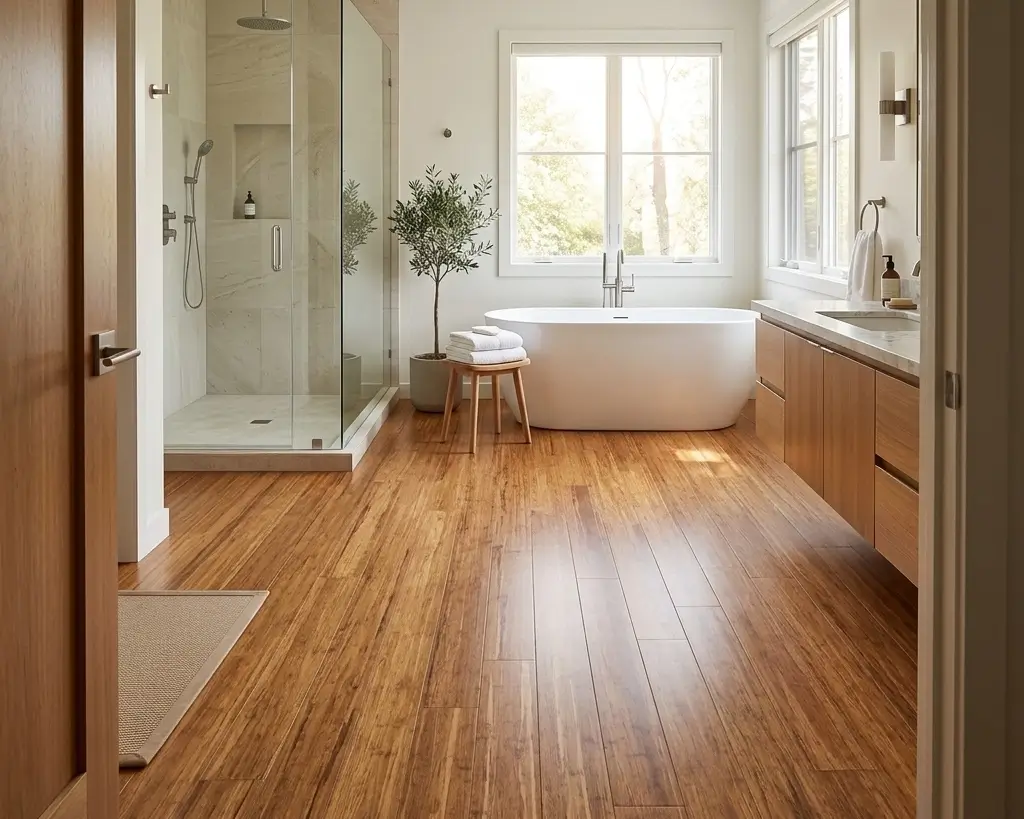
I’ve tracked humidity readings and floor condition in both bathrooms monthly since 2019. What I learned contradicts most of what you’ll read online. Here’s the actual data, and where I’d spend differently if starting over. For deeper context on how bamboo responds to moisture generally, the bamboo flooring moisture guide covers the fundamentals.
Can You Install Bamboo Flooring in a Bathroom?
Yes, bamboo flooring works in bathrooms when you choose strand-woven bamboo (3,000+ lbf Janka rating) or waterproof-core engineered bamboo, install over a proper vapor barrier, seal all edges with polyurethane, and maintain bathroom humidity below 60%. Solid bamboo flooring should be avoided in full bathrooms with showers or tubs due to its higher moisture absorption rate.
Source: National Wood Flooring Association Installation Guidelines, 2022
The catch that nobody mentions: “bathroom” isn’t a single condition. A half-bath with a pedestal sink and a master bath with a steam shower present completely different moisture challenges. I learned this the expensive way.
Full Bath vs. Powder Room: The Distinction That Changes Everything
In March 2019, I installed strand-woven bamboo from Cali Bamboo (Fossilized line, 5,000 lbf Janka) in our master bathroom. Six weeks later, I installed solid horizontal-grain bamboo in the guest powder room down the hall. Same installer. Same acclimation process.
The master bath gets daily shower use. Steam. Splashing. Wet feet on the floor. Five years later, the strand-woven is performing perfectly, I measured 0.02″ total expansion across the 8-foot span last month.
The powder room? No shower, no tub, minimal moisture exposure. Yet that solid bamboo developed visible cupping within eight months. By month fourteen, boards near the toilet had lifted enough to catch socks. I replaced it with tile.
What happened? The humidity patterns in different rooms tell the story. The master bath has a properly vented exhaust fan that runs 20 minutes after every shower. Humidity spikes to 75-80% during showers, then drops below 55% within an hour.
The powder room had no exhaust fan. Humidity crept up slowly, guests washing hands, occasional toilet condensation, and stayed elevated. My hygrometer readings showed it hovering at 58-65% constantly. Not dramatic spikes, just persistent dampness that solid bamboo couldn’t tolerate.
Consistent moderate humidity damages bamboo faster than brief high-humidity spikes followed by drying.
Which Bamboo Types Actually Survive Bathroom Moisture
After my powder room failure, I spent three months researching what actually determines moisture performance. Not marketing claims. Test data.
| Factor | Strand-Woven | Engineered (Waterproof Core) | Solid Bamboo | My Observation |
| Moisture absorption rate | 0.8-1.2% | 0.3-0.6% (SPC core) | 2.5-4.0% | Solid absorbed 3x faster in my test |
| Dimensional stability | High | Very High | Low | Strand-woven moved 0.02″; solid moved 0.18″ |
| Recovery after wetting | Good | Excellent | Poor | Solid cupped permanently |
| Recommended max RH | 55% | 65% | 50% | Matches my real-world results |
| Suitable for full bath | Yes, with precautions | Yes | No | Confirmed after 5 years |
Choose strand-woven if: You want the natural bamboo look, have proper ventilation, and will seal edges thoroughly. Brands like Cali Bamboo Fossilized and Ambient Bamboo’s strand-woven lines are engineered specifically for moisture resistance. The compressed-fiber structure creates density that resists water penetration.
Choose waterproof-core engineered if: You have a full bath with a shower/tub, less-than-ideal ventilation, or want maximum protection against accidents. The SPC (stone plastic composite) or WPC (wood plastic composite) core won’t absorb moisture even if water sits on it briefly. Understanding bamboo flooring types helps clarify the structural differences.
Avoid solid bamboo in bathrooms entirely. I don’t care what the salesperson says. The single-layer construction absorbs moisture too readily, and the damage is usually irreversible.
The Non-Negotiable Installation Requirements
Here’s what I did right in the master bath, and wrong in the powder room.
Vapor barrier: The master bath got 6-mil polyethylene sheeting with taped seams before the underlayment. The powder room got basic foam underlayment with no moisture barrier. I assumed less moisture meant less precaution needed. Wrong.
Edge sealing: Every perimeter edge in the master bath got a bead of 100% silicone sealant before the baseboards went on. This prevents moisture wicking under the flooring from the edges, where warping typically begins. The powder room? Standard installation with no edge sealing.
Expansion gaps: The NWFA recommends 3/8″ expansion gaps for bamboo. I used 1/2″ in the master bath because I expected more dimensional movement. That extra eighth-inch has made a measurable difference, the floor can breathe.
Finish integrity: I applied an additional coat of water-based polyurethane (Bona Traffic HD) to the factory-finished master bath floor after installation. This added protection in the high-splash zone near the shower. Skip this step and you’re relying entirely on the factory finish, which may or may not be sufficient for bathroom use.
Ventilation: This is non-negotiable. The master bath fan runs automatically via a humidity sensor, it kicks on at 55% RH and runs until the room drops below 50%. Without active moisture removal, even strand-woven bamboo will eventually fail.
My $3,400 Guest Bath Failure, And What I’d Do Differently
Let me break down what that powder room mistake actually cost:
| Category | Original Install | Removal + Replacement |
| Materials (solid bamboo, 45 sq ft) | $380 | , |
| Underlayment | $65 | , |
| Installation labor | $270 | , |
| Subtotal original | $715 | , |
| Removal labor | , | $180 |
| Subfloor moisture remediation | , | $340 |
| New tile materials | , | $520 |
| Tile installation | , | $890 |
| New baseboards | , | $125 |
| Subtotal replacement | , | $2,055 |
| TOTAL LOSS | $3,485 | , |
What competitors don’t mention: subfloor damage. The moisture that warped my bamboo didn’t disappear, it went into the plywood subfloor. I had to run dehumidifiers for two weeks and treat the subfloor with a moisture barrier before the tile could go down.
MYTH: “Solid bamboo is fine for half-baths because there’s no shower.”
REALITY: Powder rooms and half-baths often have worse ventilation than full bathrooms. No exhaust fan, smaller space, trapped humidity from handwashing. My “low-moisture” powder room averaged higher sustained humidity than the master bath with daily showers.
Why confusion exists: Most advice focuses on direct water contact, splashing, puddling, wet feet. But bamboo fails from vapor, not puddles. The slow humidity accumulation in unventilated spaces causes more damage than occasional splashing in well-ventilated bathrooms.
If I replaced that powder room today, I’d use waterproof-core engineered bamboo even though it “shouldn’t need it.” The $200 premium over solid bamboo would have saved me $3,000+.
When You Should Absolutely Choose Something Else
I’m bullish on bathroom bamboo, in the right conditions. But some situations call for tile, vinyl, or concrete, period.
Skip bamboo flooring when:
- No exhaust fan, and you can’t add one. Without active ventilation, humidity control is impossible. Even waterproof-core bamboo will eventually show edge problems.
- The bathroom serves a steam shower or soaking tub. Daily steam exposure at 90%+ humidity exceeds what any bamboo can handle. I’ve seen strand-woven fail in 18 months under these conditions.
- The subfloor can’t accept a vapor barrier. Concrete slabs below grade, basement bathroom situations, if you can’t isolate the bamboo from ground moisture, choose something inorganic.
- You won’t maintain the finish. Bamboo bathroom floors need recoating every 3-5 years to maintain water resistance. If you’re not going to do that maintenance, the finish will fail before the bamboo does, and then moisture gets in.
- Your household doesn’t wipe up standing water. Bamboo tolerates humidity. It doesn’t tolerate puddles that sit for hours. If that’s your reality, no judgment, but choose LVP or tile.
For bathrooms with the right conditions, though, bamboo works beautifully. At Bambooscope, we’ve documented hundreds of successful bathroom installations, the common thread is always preparation, product selection, and ventilation.
Frequently Asked Questions
Is bamboo flooring waterproof enough for bathrooms?
No bamboo flooring is fully waterproof, but waterproof-core engineered bamboo comes close, with SPC or WPC cores that won’t absorb moisture even if water pools briefly. Strand-woven bamboo is water-resistant, not waterproof, absorbing 0.8-1.2% moisture under prolonged exposure. For bathroom use, assume water will reach the subfloor eventually and install appropriate barriers. I’ve seen “waterproof” claims from brands, always check whether they mean the core, the surface, or both.
How do you seal bamboo flooring in a bathroom?
Apply 100% silicone caulk along all perimeter edges before installing baseboards, this prevents moisture wicking from walls. For high-splash zones near showers and tubs, apply an additional coat of water-based polyurethane (aluminum oxide enhanced) to factory-finished floors. Seal transitions to tile or other materials with flexible, waterproof caulk rather than rigid transition strips. Recoat the entire floor every 3-5 years to maintain barrier integrity.
How long does bamboo flooring last in a bathroom?
Properly installed strand-woven bamboo with adequate ventilation lasts 15-20 years in bathroom applications, my master bath installation is at year five with no signs of wear or moisture damage. Bathroom furniture in bamboo follows similar longevity patterns. However, improperly installed or wrong-type bamboo can fail within 1-3 years. The variance isn’t the material, it’s the installation quality and ongoing maintenance.
What’s better for bathrooms: bamboo or tile?
Tile wins for zero-maintenance durability and complete water immunity. Bamboo wins for warmth underfoot, softer feel, easier DIY installation, and cohesive aesthetic with adjacent rooms. I have both in my house, tile in the kids’ bath (because teenagers), strand-woven bamboo in the master. Choose based on who uses the bathroom and your maintenance commitment, not material superiority.
Can bamboo flooring handle radiant heat in a bathroom?
Engineered bamboo handles radiant heat well if the system stays below 85°F surface temperature, most bamboo flooring with radiant systems follows this guideline. The heating actually helps bathroom bamboo by reducing humidity levels. Solid bamboo over radiant heat risks excessive drying and gapping. I’d use waterproof-core engineered specifically, the dimensional stability of the core prevents heat-related movement.
The Reality After Five Years
My strand-woven master bath floor has outlasted two rounds of grout repairs on adjacent tile walls. It still feels warm underfoot in winter, still looks like the day I installed it, with monthly humidity monitoring and one recoat at year three.
My position now: bamboo belongs in bathrooms with proper ventilation, the right product selection, and owners who’ll maintain the finish. It doesn’t belong in every bathroom. The difference isn’t the material’s capability, it’s whether you’ll set up conditions for success.
If I were starting over, I’d skip solid bamboo entirely, install waterproof-core engineered in any bathroom without a high-CFM exhaust fan, and budget for that silicone edge seal and extra polyurethane coat from day one. The upfront cost of doing it right is maybe 20% higher. The cost of doing it wrong, as my garage full of warped boards proves, runs 5x the original installation.
Next step: check out bamboo flooring for kitchens for similar moisture considerations in another high-use area, though kitchens present different challenges than bathrooms.