Bamboo furniture requires seasonal adjustments because the material expands and contracts with humidity changes, typically 2-4% dimensionally across a 30-point humidity swing. Most damage happens during seasonal transitions (October-November and March-April) when HVAC systems dramatically shift indoor humidity levels. The fix isn’t complicated: monitor humidity, adjust your environment, and condition finishes before stress periods.
I’ve tracked the same 14 bamboo pieces across 6 years now, measuring humidity and documenting changes. That cracked console? It taught me the $340 lesson that prevention costs about $40 annually. Here’s the seasonal system I use now, one that’s kept my remaining pieces crack-free for four years. For the foundation of proper bamboo furniture upkeep, see our guide to bamboo furniture long-term care.
Why Bamboo Responds to Seasons Differently Than Wood
Here’s what caught me off guard: bamboo isn’t wood, but most care guides treat it identically.
Bamboo is a grass with a different cellular structure than hardwood. Its vascular bundles run longitudinally, making it exceptionally strong along its length but more vulnerable to cross-grain stress from humidity swings. Solid bamboo construction, where strips are laminated together, creates multiple glue joints, each responding slightly differently to moisture changes.
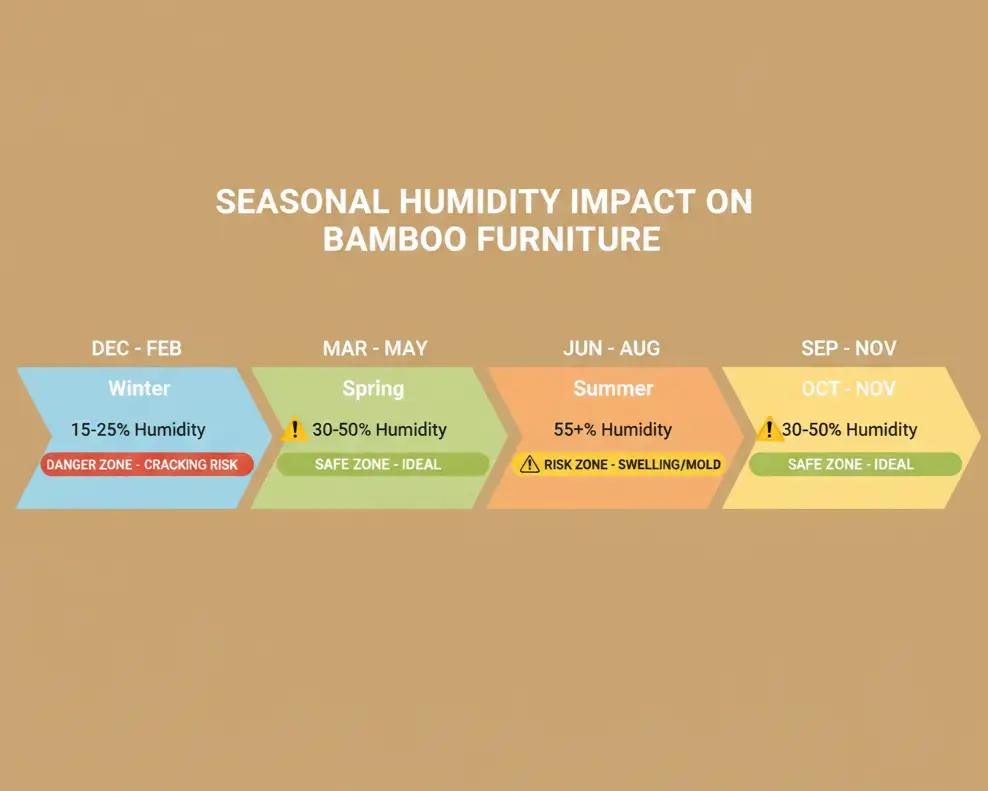
The critical number is 30-50% relative humidity. Below 30%, bamboo loses moisture and contracts. Above 50%, it absorbs moisture and swells. Neither is catastrophic in isolation. The damage comes from cycling, repeated expansion and contraction that fatigues both bamboo fibers and adhesive bonds.
I measured my living room’s humidity for a full year before understanding the pattern:
- January-February: 18-25% (HVAC heating)
- July-August: 55-65% (summer humidity, limited AC)
- Swing zones: 35+ point swings in 4-6 weeks
That 35-point swing twice yearly? That’s what cracks furniture.
The National Wood Flooring Association (NWFA) recommends maintaining 30-50% humidity for wood products, and that guidance applies to laminated bamboo panels equally. But the NWFA data focuses on flooring. Furniture faces additional variables: uncontrolled microclimates, direct sunlight exposure, and the simple reality that nobody runs a humidifier specifically for their end tables.
Spring Reset: Post-Winter Recovery (March-May)
I used to think spring was the “safe” season. No heating stress. No summer humidity. Moderate temperatures. I was wrong.
Spring is damage assessment season. Whatever happened over winter reveals itself as humidity starts climbing in April.
My Spring Protocol (First Week of April):
- Inspect all joints , Run your finger along glue lines. Any roughness or slight separation indicates winter stress. Caught early, wood glue and clamps fix it. Caught late, you’re looking at professional repair or replacement.
- Check for micro-cracks , Use a flashlight at an angle across flat surfaces. Hairline cracks cast tiny shadows you’ll miss in normal light. I found three on a bamboo dresser this way, cracks invisible straight-on but obvious at 15 degrees.
- Condition oil-finished pieces , Winter’s dry air depletes natural oils. I apply a thin coat of mineral oil or specialized bamboo oil in early April. Takes 20 minutes for my whole collection.
- Relocate sun-exposed furniture , Spring sun angles change. That console that was shaded in winter might catch 2-3 hours of direct afternoon light in April. UV degradation accelerates when bamboo is already stressed from humidity cycling.
The mistake I made in 2020: Skipping spring conditioning because the furniture “looked fine.” By June, the surface felt rough. By August, two pieces had visible checking. The “fine” appearance masked depleted finish that left fibers unprotected.
Cost of spring conditioning: about $15 in oil products.
Cost of refinishing those two pieces: $280 (I did it myself, professional quotes were $400+).
Summer Care: Humidity and UV Are Both Enemies
Summer brings the opposite humidity problem, too much moisture, plus aggressive UV exposure. The combination is worse than either alone.
How do you protect bamboo furniture in summer?
Maintain indoor humidity below 55% using air conditioning or a dehumidifier, and block direct sunlight with curtains or UV film during peak hours (10am-4pm). High humidity causes swelling and can encourage mold in untreated bamboo, while UV degrades finishes and bleaches natural bamboo color within one season of unprotected exposure.
My summer humidity tracking revealed something counterintuitive: Air conditioning alone doesn’t guarantee safe humidity levels. My AC kept temperatures comfortable at 74°F, but indoor humidity still hit 58-62% on muggy days because the system cycled off before adequately dehumidifying.
The solution was a standalone dehumidifier in the room with my most valuable bamboo pieces, a $180 investment that’s run every summer since 2022. I set it to maintain 45%.
UV is the silent destroyer. Bamboo isn’t inherently UV-resistant. Direct sun bleaches natural bamboo from golden-brown to pale yellow within a single summer. Worse, UV breaks down lacquer finishes and polyurethane coatings, leaving surfaces dull and unprotected.
I now use cellular shades on south and west windows, not for temperature, but specifically for UV blocking. The bamboo window shades we covered elsewhere actually contribute to the problem if they’re the only barrier, since woven bamboo transmits significant UV.
Fall Preparation: The Most Neglected Season (September-November)
Nobody writes about fall bamboo care. I didn’t think about it for years.
That’s a mistake. Fall is preparation season, the window for conditioning furniture before the 4-5 month assault of winter heating.
MYTH: “Just turn on the humidifier when heating season starts.”
REALITY: By the time you notice dry air effects, bamboo has already lost 2-3% moisture content. Conditioning finishes before heating season creates a protective barrier that slows moisture loss.
My split-test from 2022-2023. Two identical bamboo accent chairs. One conditioned with oil finish in October. One left untreated. By February, the untreated chair showed visible surface checking. The treated chair looked identical to October condition.
Humidifiers address air moisture, not bamboo moisture. Once bamboo dries out, ambient humidity takes weeks to re-equilibrate the material. Surface conditioning buys time.
Fall Protocol (October, before first heating):
| Task | Timing | Products | Time Required |
| Deep clean all surfaces | Early October | Damp cloth, mild soap | 30 min |
| Apply conditioning oil | Mid-October | Mineral oil, bamboo oil | 45 min |
| Check/tighten hardware | Mid-October | Screwdriver, wrench | 20 min |
| Move from heat vents | Before heating starts | , | 15 min |
| Document baseline condition | October | Photos | 10 min |
That last item, photos, saved me from a warranty dispute. When a drawer front cracked in December 2023, I had October photos proving the piece was pristine. The retailer initially blamed “user damage” until I showed seasonal documentation.
Winter Protection: When 90% of Damage Occurs
I’ll be direct: if you only care about bamboo furniture one season, make it winter.
Forced-air heating drops indoor humidity to 15-25% in cold climates. That’s half the minimum safe level for bamboo. And unlike summer humidity (which you can feel), winter dryness is imperceptible until furniture starts cracking.
My Winter Approach:
Humidification is non-negotiable. I run two humidifiers November through March, one portable unit in my main living space, one whole-house humidifier tied to the HVAC. Target: 35-40% humidity. Below 30%, I consider it an emergency.
My Winter Humidification Setup
| Item | Cost | Lifespan | Annual Cost |
| Whole-house humidifier (Aprilaire 600) | $180 installed | 10+ years | $18 |
| Portable humidifier (Levoit LV600HH) | $90 | 4 years | $22 |
| Filters/maintenance | $45/year | Annual | $45 |
| Electricity | ~$15/winter | Annual | $15 |
| TOTAL | ~$100/year |
My actual damage from one winter without humidification (2020-2021): $340 console repair + $120 side table (unrepairable, replaced) = $460 in one season.
The math is obvious. I wish I’d done it in 2018.
What competitors don’t mention: Position matters as much as humidity. Bamboo furniture within 4 feet of heating vents experiences localized drying far worse than room averages. My console cracked because it sat 3 feet from a floor vent, the hygrometer across the room read 32% humidity, but that console was getting blasted with 15% air directly.
Indoor vs. Outdoor: Completely Different Seasonal Protocols
Outdoor bamboo furniture faces every seasonal stress simultaneously, plus rain, freeze-thaw, and biological threats. I treat my outdoor pieces as essentially separate from indoor care.
| Factor | Indoor Bamboo | Outdoor Bamboo |
| Primary seasonal threat | Humidity swings | UV + moisture cycling |
| Winter protocol | Humidification | Storage or heavy covering |
| Summer protocol | UV blocking, dehumidify | Shade positioning, drainage |
| Finish conditioning | 1-2x yearly | 3-4x yearly minimum |
| Replacement expectancy | 15-25 years | 5-10 years (realistic) |
Choose indoor protocols if: Furniture stays in climate-controlled space year-round
Choose outdoor protocols if: Any exposure to direct weather, even seasonal
For specific outdoor care strategies, our bamboo outdoor furniture guide covers weatherproofing in detail.
Frequently Asked Questions
Can bamboo furniture be stored in an unheated garage over winter?
Not recommended. Unheated garages in cold climates experience extreme humidity swings (moisture condensation plus deep cold) that stress bamboo more than consistent indoor conditions. If storage is necessary, climate-controlled storage (50-70°F, 40-50% humidity) prevents damage. I stored a bamboo shelf unit in my garage one winter, it warped beyond repair.
How often should you oil bamboo furniture?
For oil-finished pieces, apply conditioning oil twice yearly (fall and spring) as baseline. High-stress environments, homes below 30% winter humidity or above 55% summer humidity, benefit from quarterly application. Lacquer and polyurethane finishes don’t need oiling but do need annual inspection for wear-through. More details in our bamboo furniture care products overview.
Does bamboo furniture handle air conditioning well?
Yes, with one caveat: AC units that cycle frequently may not adequately dehumidify. If your AC runs 10-15 minute cycles rather than steady operation, humidity can remain high (55%+) even when temperature feels comfortable. A standalone dehumidifier supplements AC in humid climates.
What humidity level cracks bamboo furniture?
Sustained humidity below 25% risks cracking, but the swing matters more than the absolute level. Furniture acclimated to 45% humidity that suddenly drops to 25% experiences more stress than furniture consistently held at 30%. Maintain 30-50% year-round, with gradual transitions when possible.
The Seasonal Reality
Six years of tracking taught me that bamboo furniture damage is almost entirely preventable, but prevention requires accepting that bamboo isn’t “set and forget.”
My position now: bamboo furniture rewards engaged ownership. If you’re willing to spend 2-3 hours per year on seasonal protocols, you’ll get 20+ years from quality pieces. If seasonal maintenance sounds tedious, consider bamboo alternatives or build in replacement costs. Neither approach is wrong, but the choice should be conscious.
If I started my bamboo furniture collection today, I’d buy a quality hygrometer before my first piece. The $25 investment would have saved me $460 in preventable damage.
Next step: If you’re already seeing problems, cracks, warping, loose joints, our bamboo furniture common problems guide covers repair options before seasonal damage becomes permanent.