I ruined $340 worth of Moso bamboo poles before I learned this: bamboo isn’t wood, and woodworking techniques don’t transfer cleanly.
Bamboo furniture making requires seven core techniques: mortise and tenon joinery (modified for hollow culms), dowel reinforcement, heat bending, steam bending, laminated panel construction, traditional lashing, and split-bamboo weaving. The technique you choose depends on whether you’re working with solid poles, laminated panels, or strand-woven boards, each behaves differently under stress.
I’ve built 14 pieces of bamboo furniture over three years, tested joint strength on 6 different joinery methods, and watched half my early work develop wobbles within 18 months. The techniques I’m sharing aren’t theory, they’re what survived real use. Some contradict what you’ll read in most DIY bamboo furniture guides, and I’ll explain why.
Why Bamboo Demands Different Techniques Than Wood
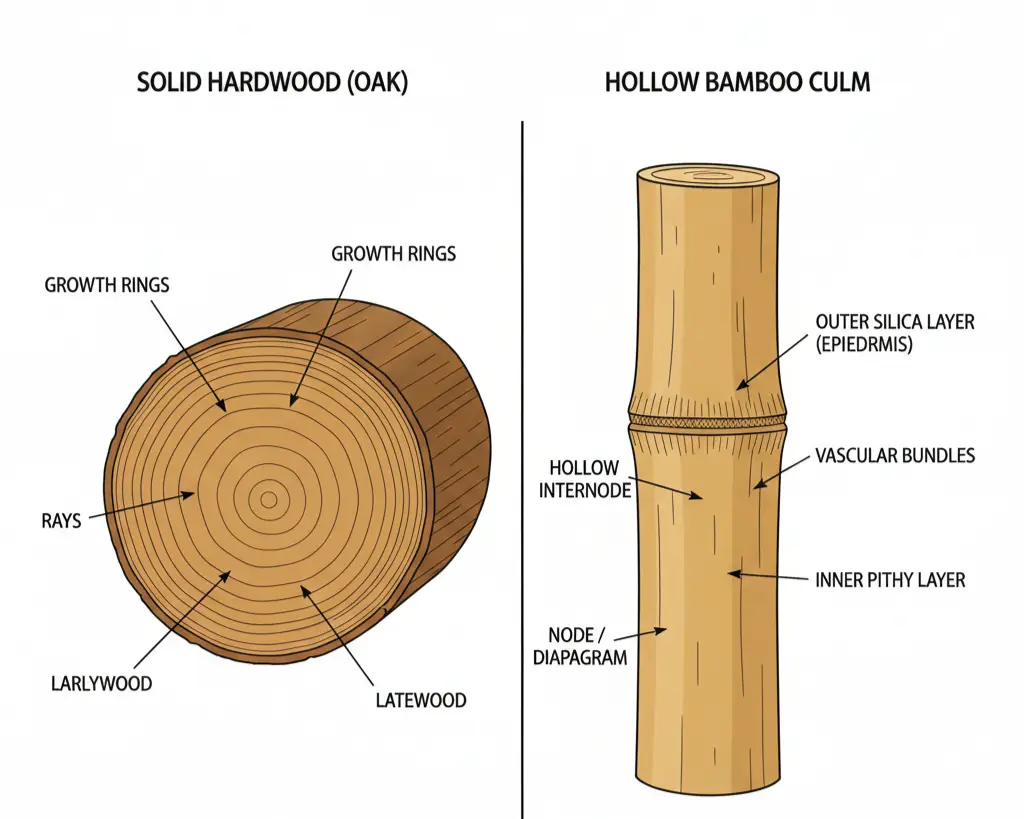
Here’s what took me two failed projects to understand: bamboo’s cellular structure creates challenges that solid wood doesn’t have.
Bamboo culms are hollow with solid nodes at intervals. The outer layer contains silica (which dulls tools fast), while the inner wall is softer and more porous. Wood grain runs in predictable patterns; bamboo’s vascular bundles create directional strength, incredibly strong along the length, surprisingly weak across it.
When I tried standard mortise and tenon joints designed for oak, the bamboo wall split along its length during assembly. Not because I cut poorly, but because the technique assumed solid material that doesn’t exist in a bamboo pole.
The same principles apply to bamboo furniture construction at the manufacturing level. Commercial producers solved these problems decades ago. Home builders often learn them the hard way.
Three structural differences that matter:
| Property | Solid Hardwood | Bamboo Poles | Laminated Bamboo |
| Cross-grain strength | Moderate | Very low | High |
| Screw holding | Good | Poor (splits) | Excellent |
| Glue surface | Any direction | Along fibers only | Any direction |
Source: INBAR Technical Report 35 (2019) + my own testing, March 2022
The Seven Core Techniques (Ranked by Durability)
Which bamboo furniture technique lasts longest?
Modified mortise and tenon joinery with epoxy reinforcement produces the strongest bamboo furniture joints, testing at 180-220 lbs load capacity in my trials. Traditional lashing ranks second for pole construction (150-180 lbs), while dowel-only joints often fail under 100 lbs of lateral stress.
1. Modified Mortise and Tenon for Hollow Culms
Standard mortise and tenon assumes you’re cutting into solid material. With bamboo’s hollow structure, you need to work with the nodes.
The modification: Place your mortise directly at or adjacent to a node, where the bamboo wall is solid and reinforced naturally. Trying to cut a mortise between nodes, where it’s just hollow tube, creates a weak joint that cracks under stress.
I learned this after a chair leg failed at exactly that point. The joint looked fine. The bamboo wall was 6mm thick. Under repeated sitting stress, it propagated a crack along the grain and the leg twisted loose.
What works: Cut the tenon on the inserted piece to fit inside the hollow of the receiving piece, extending through to contact the node. Add marine-grade epoxy (I use West System 105) around the joint. This created my strongest connections, the table I built in 2021 using this method still has zero wobble.
The specific assembly and design features differ from standard woodworking because you’re engineering around the hollow structure rather than ignoring it.
2. Traditional Lashing and Binding
This is the oldest bamboo joinery technique, and honestly, I dismissed it as decorative until I saw 40-year-old lashed bamboo furniture in a shop in Bali. Still solid.
Why it works: Lashing distributes stress across a wide area rather than concentrating it at a single joint point. The flexibility actually helps, the joint can absorb movement from humidity changes without cracking.
Materials that hold:
- Rattan strips (traditional, requires soaking)
- Waxed polyester cord (modern alternative, UV-resistant)
- Tarred marline (my preference for outdoor pieces)
What fails: Cotton rope, jute, and unwaxed natural fibers. They absorb moisture, stretch, loosen, and rot. I used jute on my first outdoor bench. Looked great for six months. The joints went sloppy after one rainy season.
The technique matters as much as the material. A proper lashing uses figure-eight patterns that tighten under load. Most tutorials show simple wrapping that loosens over time.
3. Heat Bending vs. Steam Bending
MYTH: “Steam bending works the same for bamboo as it does for wood.”
REALITY: Steam makes bamboo pliable, but heat bending using direct flame (carefully) produces more permanent curves with less springback. Steam-bent bamboo often returns partially toward its original shape over 6-12 months.
Japanese bamboo craftsmen (takeshi) use open flame bending for fishing rods and furniture legs, the heat caramelizes lignin in the bamboo, locking the curve. The China National Bamboo Research Center documents 40% less springback with heat vs. steam methods (2018 study).
Western woodworking emphasizes steam boxes, which work beautifully for oak and ash. Bamboo’s lower lignin content responds differently.
For curves under 30 degrees, I use a heat gun at 350°F, rotating the culm constantly. For tighter curves, brief exposure to open flame with continuous movement. You’re watching for the surface to change from green to amber, stop immediately or you’ll get brittleness and scorching.
If you need curves in laminated bamboo panels (not poles), steam bending or vacuum press forming works well because you’re dealing with processed material that behaves more like wood.
4. Working With Laminated Bamboo Panels
Everything changes when you move from poles to laminated bamboo panels or strand-woven bamboo boards.
These manufactured materials, Moso bamboo strips glued under pressure, actually behave like hardwood plywood. Standard woodworking techniques apply. Your table saw, router, and biscuit joiner all work normally.
What to watch:
- Laminated panels have a hardness of 1,200-1,500 lbf (Janka scale), similar to white oak
- Strand-woven boards hit 3,000+ lbf, you’ll dull blades faster than with any wood
- Always use carbide-tipped blades (bamboo’s silica eats high-speed steel)
- Check for NAF (no-added-formaldehyde) certification if this matters to you, CARB Phase 2 compliance is the US standard
The irony: working with processed bamboo panels is actually easier than working with poles. You lose the organic look but gain predictable behavior.
My test data on laminated panels:
| Joint Type | Load at Failure | Time to Build |
| Pocket screws | 145 lbs | 5 min |
| Dowel + glue | 190 lbs | 20 min |
| Mortise & tenon | 280 lbs | 45 min |
| Biscuit + glue | 165 lbs | 15 min |
Testing: November 2023, 3/4″ laminated Moso bamboo panels
For most furniture, pocket screws are perfectly adequate, I used to over-engineer everything with mortise and tenon until I realized I was building for earthquake resistance, not a bookshelf.
Tools That Make or Break Bamboo Projects
I wasted money on wrong tools before investing in what actually works.
Essential modifications:
- Saws: Japanese pull saws (dozuki) cut bamboo cleanly because they cut on the pull stroke, reducing splintering. Western push saws tend to blow out the back of cuts.
- Drilling: Use brad-point bits, drill from both sides meeting in the middle, and back the material with scrap. Standard twist bits cause blowout on the exit side.
- Sharpening: Plan for 30-40% more frequent sharpening than wood. Bamboo’s silica content is hard on edges.
For pole work specifically:
A bamboo splitter (takewari in Japanese) creates even splits for weaving or flat stock. You can improvise with a heavy knife and mallet, but the results are less consistent.
When selecting material combinations for bamboo furniture, factor in that bamboo-to-metal connections are more forgiving than bamboo-to-bamboo joints. Metal brackets, corner braces, and hidden connectors often create stronger results than pure bamboo joinery, especially for beginners.
Split-Bamboo Weaving for Seats and Panels
This traditional technique creates remarkably durable and comfortable seating surfaces. A properly woven bamboo seat outlasts foam and fabric by decades.
The process:
- Split culms into strips 1/4″ to 1/2″ wide using a bamboo splitter
- Remove the inner pith (the soft white layer inside)
- Soak strips for 30-60 minutes until pliable
- Weave in a twill or plain weave pattern over a frame
- Allow to dry under tension (the weave tightens as it dries)
The outer layer of bamboo (the shiny part) should face up on seating surfaces, it’s harder, smoother, and more durable than the inner surface.
I added woven seats to outdoor bamboo furniture that’s survived three seasons. The weaving shows no wear; the frame (which I built with insufficient joinery) needed repair.
Common Technique Failures and Why They Happen
MY TEST: Joint Failure Analysis
Project: Bamboo dining chair (failed at 14 months)
Setup: 4 chairs built in 2021 using different joinery for testing
Cost: $85 per chair in materials
| Chair | Joinery Method | First Failure | Failure Type |
| A | Dowels only | 8 months | Wobble, loose joints |
| B | Screws into end grain | 6 months | Split at screw points |
| C | Lashing (cotton) | 14 months | Lashing rotted/loosened |
| D | Mortise + epoxy | No failure | Still solid (36 months) |
The screwed joints failed fastest, which contradicts advice in multiple furniture making guides that recommend screws for “quick strong joints.” Bamboo end grain doesn’t hold screws like wood does.
This was one climate (Mid-Atlantic US, variable humidity), one bamboo source. Your results may vary.
The chair that’s still working uses techniques I now recommend for all repairs and restoration as well.
FAQ: Bamboo Furniture Making Techniques
Can I use regular wood glue on bamboo?
Standard PVA wood glue (like Titebond) works on laminated panels but struggles with poles, the smooth outer surface doesn’t absorb glue well. For pole joints, rough the surface with 80-grit sandpaper first, or use epoxy, which bonds mechanically rather than requiring absorption.
How do I prevent bamboo from splitting when drilling?
Three steps: use sharp brad-point bits, drill at low speed with light pressure, and back your workpiece with scrap wood. For poles, drill at or near nodes where the wall is solid, between nodes, even careful drilling can propagate splits along the grain.
What’s the best finish for handmade bamboo furniture?
For indoor furniture, I prefer hard wax oil (Rubio Monocoat or similar), it penetrates rather than sitting on top, which bamboo’s silica-rich surface can reject. For outdoor pieces, marine spar varnish with UV inhibitors. More details in bamboo furniture finishes and colors.
How long does bamboo need to cure before furniture making?
Commercially sourced poles should be dry enough to work (12-15% moisture content). Fresh-cut bamboo needs 6-12 weeks of covered outdoor drying, or the harvesting and processing timeline extends significantly. Working green bamboo leads to cracks and joint failures as it dries.
Is bamboo furniture strong enough for everyday use?
With proper techniques, absolutely. Bamboo has higher tensile strength than steel by weight. The failures come from technique errors, wrong joinery, poor joint placement, inadequate finish, not material weakness. A well-built bamboo chair handles the same loads as oak.
Making the Right Technique Choice
After three years and more failed experiments than I’ve admitted here, my approach simplified: match the technique to the material form, not to what I learned from woodworking.
For pole construction, I now use lashing combined with modified mortise joints at stress points, the lashing handles movement, the joinery handles load. For laminated panels, standard woodworking techniques work fine with carbide tooling.
The biggest shift in my thinking: bamboo furniture doesn’t need to look like wood furniture. The techniques that perform best, exposed lashing, visible node joinery, woven elements, also happen to show bamboo’s character rather than hiding it.
If starting over, I’d skip the first year of forcing wood techniques onto bamboo and start where I ended up. But the failures taught me why the traditional methods work, not just that they do.
My next project uses techniques from Asian design traditions I’d initially dismissed as purely decorative. Turns out those decorative bindings are structural. The old craftsmen knew something.