Select bamboo by working backward from your goal. Privacy screens in cold climates need Phyllostachys bissetii or Fargesia robusta. Ornamental specimens work best with Phyllostachys nigra or Fargesia nitida.
Timber production requires Phyllostachys edulis (Moso) in Zone 7b or warmer. The running versus clumping distinction matters less than matching species cold tolerance, mature height, and spreading behavior to what you’re actually trying to accomplish.
That framework comes from growing 14 species across two properties over 12 years, including one disastrous Bambusa oldhamii that turned to mush at 28°F despite being sold as “hardy to 20°F.” I’ve watched species outperform their ratings and others fail spectacularly. Here’s the selection system I wish someone had explained before my first $400 mistake.
Running vs. Clumping: The Fundamental Split That Shapes Everything
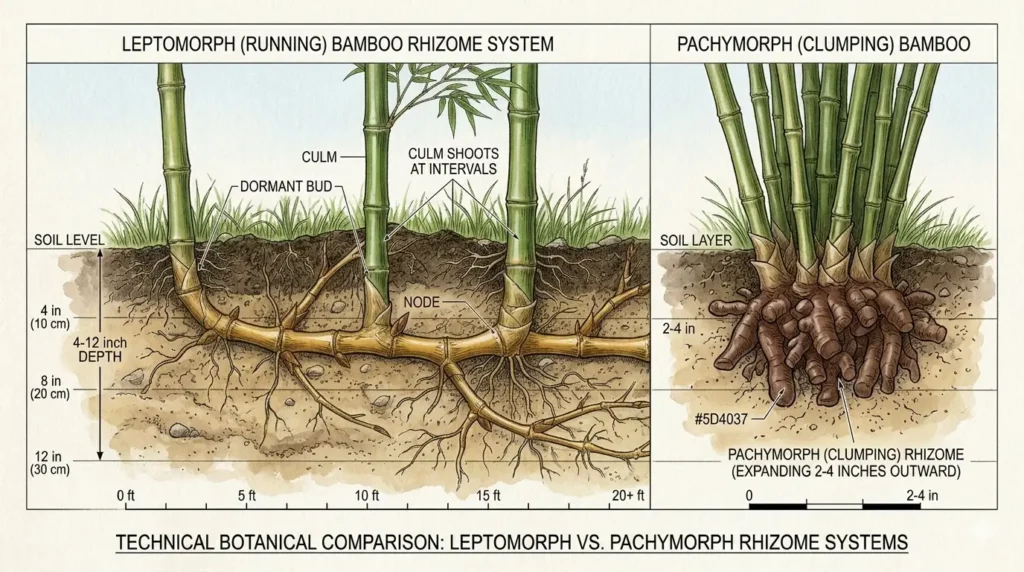
What separates running from clumping bamboo? Running bamboo (leptomorph rhizome system) sends underground stems horizontally up to 20 feet per year, producing new culms far from the parent plant. Clumping bamboo (pachymorph rhizome system) expands outward slowly, typically 2-4 inches annually, keeping growth contained to a gradually expanding footprint.
This isn’t just a containment question. It determines your species options entirely.
Running bamboo genera (Phyllostachys, Pleioblastus, Sasa) include most cold-hardy species and all commercial timber varieties. If you’re in Zone 6 or colder, you’re almost certainly planting running bamboo, the clumping options that survive those temperatures are limited to Fargesia species.
Clumping bamboo genera (Bambusa, Dendrocalamus, Fargesia) dominate tropical and subtropical climates. Fargesia species handle cold, but most Bambusa varieties need Zone 9+ to survive winter.
The American Bamboo Society species source list identifies over 1,400 bamboo species globally, but only about 200 grow reliably in North American climates. Your USDA zone eliminates most options immediately.
What 12 Years Growing 14 Species Actually Taught Me
My bamboo education started in 2012 with a privacy screen project in Zone 7a (Virginia). The plan: create a 40-foot living fence blocking the neighbor’s second-story deck view.
Expected: Based on nursery recommendations, I planted Phyllostachys aureosulcata ‘Spectabilis’ (Yellow Groove Bamboo). Advertised height: 25-35 feet. Advertised cold tolerance: -10°F. Installation cost: $1,800 for 15 plants.
Actual (Year 12): The grove topped out at 22 feet, respectable, but 10 feet shorter than advertised. Cold tolerance proved accurate through winters hitting -8°F. The surprise? Underground spreading was manageable with annual rhizome pruning along the property line, about 3 hours of work each November. No barrier needed.
The expensive lesson came from my Zone 6b Pennsylvania property. I planted Bambusa oldhamii (Giant Timber Bamboo) in 2016, trusting a seller’s “cold hardy to 18°F” claim. The American Bamboo Society lists this species at 22-26°F minimum. Three winters later, after a 15°F night, every culm was dead.
The pattern I’ve observed: Advertised cold tolerance typically represents survival threshold, not thriving threshold. Subtract 5-10°F from catalog ratings to estimate the temperature where bamboo maintains full foliage without winter dieback.
If you’re dealing with species that spread beyond intended boundaries, bamboo removal and control covers containment strategies I’ve actually tested.
Cold Hardiness: Advertised vs. Actual Survival
Most bamboo cold-hardiness ratings come from observations in protected microclimates or single-winter events. Long-term survival across multiple harsh winters tells a different story.
| Species | Catalog Rating | Lowest Survived | Condition After |
| Phyllostachys bissetii | -20°F | -14°F | Full recovery, no dieback |
| Phyllostachys nigra | -5°F | -8°F | 40% culm loss, recovered in 2 seasons |
| Fargesia robusta | -15°F | -12°F | Minor leaf burn, full recovery |
| Phyllostachys aureosulcata | -10°F | -14°F | 15% tip dieback, recovered |
| Bambusa oldhamii | 22°F | 15°F | Complete death |
What this data shows: Phyllostachys bissetii consistently outperforms its rating. It’s my top recommendation for cold-climate privacy screens, the most cold-tolerant running bamboo that still achieves substantial height (20-25 feet mature). Meanwhile, Phyllostachys nigra (Black Bamboo) barely survived that -8°F night, despite being sold as hardy to -5°F.
The USDA Plant Hardiness Zone map updated in 2023, shifting many areas half a zone warmer. This matters for bamboo selection, species previously marginal in your area may now thrive, while you have access to varieties that would have failed a decade ago.
MYTH: “Clumping Bamboo Is Always the Safe Choice”
REALITY: Clumping bamboo trades cold hardiness for containment convenience, and in many climates, that’s the wrong tradeoff.
I hear this constantly from homeowners terrified of bamboo spreading. They default to clumping species, then wonder why their plants died over winter or never reached privacy-screen height.
Here’s the problem: Most clumping bamboo (Bambusa, Dendrocalamus) requires Zone 9+ to survive. The cold-hardy exception, Fargesia species, tops out at 12-15 feet and often struggles in hot, humid summers (they’re native to high-altitude Chinese forests).
When the myth is true: Zone 9-11 with no space for barriers. In these climates, Bambusa textilis ‘Gracilis’ or Bambusa oldhamii provide better height without spreading concerns.
When the myth fails: Zones 5-8. Here, properly contained running bamboo (Phyllostachys species with rhizome barriers) outperforms clumping options in cold tolerance, mature height, and visual density.
Evidence: The American Bamboo Society’s cultivation guide notes that Fargesia species, the only clumping genus for cold climates, frequently suffer “summer collapse” in zones with sustained temperatures above 90°F. I’ve watched Fargesia murielae drop leaves every July in Virginia, while Phyllostachys bissetii twenty feet away stayed lush.
For detailed care across seasons, bamboo seasonal care and climate adaptation covers what each growth type needs.
Best Species by Purpose: The Selection Matrix
Stop browsing bamboo alphabetically. Start with your goal.
Privacy Screens (Zones 5-7)
Top Pick: Phyllostachys bissetii
- Height: 20-25 feet | Spread rate: Moderate-aggressive | Cold: -20°F
- Why it wins: Dense foliage to ground level, fastest to fill gaps
Runner-up: Fargesia robusta (if running bamboo isn’t an option)
- Height: 12-15 feet | Clumping | Cold: -15°F
- Trade-off: Shorter, needs more plants for coverage
Privacy Screens (Zones 8-10)
Top Pick: Bambusa textilis ‘Gracilis’ (Slender Weaver’s Bamboo)
- Height: 25-35 feet | Clumping | Cold: 18°F
- Why it wins: Tight clumping habit, elegant culms, no barrier needed
Ornamental Specimens
Top Pick: Phyllostachys nigra (Black Bamboo)
- Height: 20-30 feet | Spread: Moderate | Cold: -5°F
- Why it wins: Striking black culms develop over 2-3 years. The most visually distinctive temperate bamboo.
Runner-up: Phyllostachys vivax ‘Aureocaulis’
- Height: 40-50 feet | Spread: Aggressive | Cold: -5°F
- Trade-off: Requires serious containment, but produces massive golden culms
Timber/Construction
Top Pick: Phyllostachys edulis (Moso Bamboo)
- Height: 50-75 feet | Culm diameter: 5-7 inches | Cold: 5°F (Zone 7b+)
- Why it wins: The commercial timber species. Mature culms suitable for bamboo construction and building projects.
Container Growing
Top Pick: Fargesia nitida (Fountain Bamboo)
- Height: 8-12 feet | Clumping | Cold: -20°F
- Why it wins: Manageable size, tolerates partial shade, elegant arching form. Details in bamboo container growing.
Runner-up: Pleioblastus viridistriatus (Dwarf Greenstripe)
- Height: 2-4 feet | Running | Cold: -10°F
- Why it wins: Brilliant chartreuse foliage, aggressive in-ground but contained in pots
Species Selection Mistakes I’ve Made (So You Don’t)
Mistake #1: Trusting single-source cold ratings
Bambusa oldhamii, 2016. Seller claimed 18°F tolerance. ABS documentation showed 22-26°F. I believed the seller. Paid $340 for three plants. All dead after one winter.
Lesson: Cross-reference cold ratings with American Bamboo Society species lists and regional growing reports. Add 5-10°F buffer to catalog minimums.
Mistake #2: Ignoring summer heat tolerance
Fargesia murielae, 2018. Perfect cold hardiness for Zone 7a. Nobody mentioned it’s a high-altitude species that sulks when temperatures exceed 85°F for extended periods. Every summer, it looks half-dead by August. Recovers in fall, but the drama isn’t worth it.
Lesson: Mountain bamboos (Fargesia) struggle in hot, humid southeastern summers. Phyllostachys species handle heat better.
Mistake #3: Underestimating running bamboo management
This one’s nuanced. I used to recommend clumping species exclusively to beginners. After watching several Fargesia plantings fail (wrong climate, insufficient height, summer stress) while properly maintained running bamboo thrived, I changed my position.
Running bamboo with annual rhizome pruning, 3-4 hours of work in November, often outperforms the “safe” choice. Bamboo care and maintenance covers the pruning technique.
Matching Species to Your Climate Zone
Zones 5-6 (Cold Continental)
Your options are limited, but viable:
- Phyllostachys bissetii: Most reliable. Dense, 20-25 feet.
- Phyllostachys nuda: Similar cold tolerance, slightly more open growth.
- Fargesia robusta: Clumping option, 12-15 feet max.
Avoid: Any Bambusa species, Phyllostachys edulis (Moso), Phyllostachys nigra in Zone 5.
Zones 7-8 (Transition)
The sweet spot for bamboo diversity:
- Running: Full Phyllostachys range available. P. nigra, P. aureosulcata, P. vivax all thrive.
- Clumping: Fargesia species reliable. Bambusa textilis marginal in 7b, solid in Zone 8.
Zones 9-11 (Subtropical/Tropical)
Clumping bamboo paradise:
- Bambusa oldhamii: Giant timber, 50-70 feet
- Dendrocalamus asper: Massive culms, commercial timber
- Bambusa ventricosa: Buddha Belly, ornamental
Running bamboo still works but often grows too aggressively without dormancy periods to slow spread.
Frequently Asked Questions
What’s the fastest-growing bamboo for privacy screens?
In optimal conditions, Phyllostachys vivax grows culms up to 70 feet tall and spreads 3-5 feet underground annually. However, faster isn’t always better, this species requires aggressive containment. For manageable growth with good density, Phyllostachys bissetii reaches functional privacy height (15-20 feet) within 3-4 years while spreading at roughly half the rate.
Can I grow tropical bamboo in Zone 7?
Not reliably. Bambusa and Dendrocalamus species suffer root death below 25-28°F, regardless of above-ground protection. Container growing with winter greenhouse storage is technically possible, but the logistics rarely justify the effort. Phyllostachys species are better suited and reach comparable heights.
How do I identify bamboo species from existing plants?
Key identification features include culm color (fresh and aged), node shape, branch pattern at nodes, and new shoot sheath characteristics. The American Bamboo Society maintains identification resources, and bamboo growth characteristics covers the anatomical differences between genera.
Is there a bamboo that won’t spread but grows tall?
Bambusa textilis reaches 25-35 feet with true clumping growth, but requires Zone 8 or warmer. In cold climates, you’re choosing between shorter clumping species (Fargesia at 12-15 feet) or contained running species. There’s no cold-hardy clumping bamboo that exceeds 20 feet reliably.
Making Your Selection
Species selection determines 80% of your bamboo success or failure. Get this wrong, and no amount of care compensates.
My system after 12 years: Define your purpose first. Identify your true hardiness zone (not the catalog’s optimistic interpretation). Match spreading tolerance to your containment willingness. Then, and only then, pick from the species that survive all three filters.
If I were starting my first bamboo project today, I’d plant Phyllostachys bissetii in Zones 5-7 for privacy, Phyllostachys nigra for ornamental impact in Zone 7+, and skip clumping species entirely unless I lived Zone 9 or warmer.
For specifics on establishing your selected species, bamboo planting and propagation covers timing, spacing, and first-year care.